NEET UG . NEET Botany . Botany . Plant Growth and Development
Chapter 8: Plant Growth and Development
Ch 8
NEET Botany
NEET UG
Growth
Development and Seed Germination
Development — Development is the sum of growth and differentiation, progressing from a zygote to an organised mature plant.
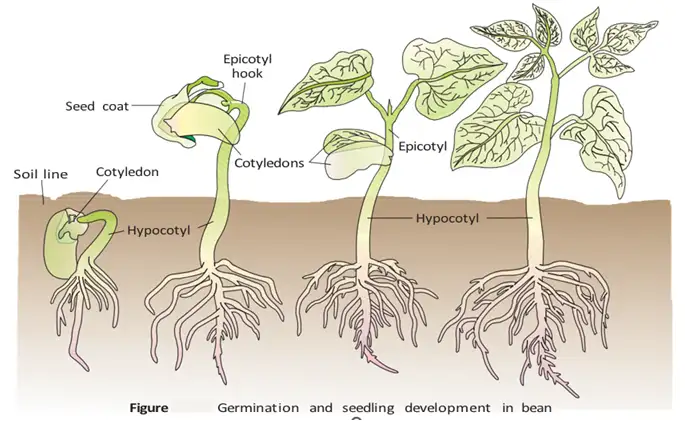
Development and Germination
- Plant development: An ordered succession of events produces roots, leaves, branches, flowers, fruits and seeds; development is controlled by intrinsic and extrinsic factors.
- Germination: In favourable conditions, the embryo becomes active and grows into a seedling.
- Unfavourable conditions: A seed undergoes suspended growth until conditions become suitable.
- Epigeal germination: Cotyledons are pushed above the soil; in hypogeal germination, cotyledons remain below the soil.
Photoblastic seeds — Seeds that germinate only in the presence of light.
Seed viability — The capacity of a seed to germinate and develop into a seedling.
| Factor | Requirements |
|---|---|
| External | Water, oxygen and suitable temperature |
| Internal | Stored food, growth regulators, completion of the rest period and viability |
Plant Growth
Growth — Growth is an irreversible, permanent increase in the size of an organ, its parts or an individual cell.
Features and Types of Plant Growth
- Metabolism and energy: Growth is associated with anabolic and catabolic processes that use energy; expansion of a leaf is an example of growth.
- Indeterminate growth: Plant growth generally continues throughout life.
- Lower plants: Growth is diffuse; any cell can divide and enlarge.
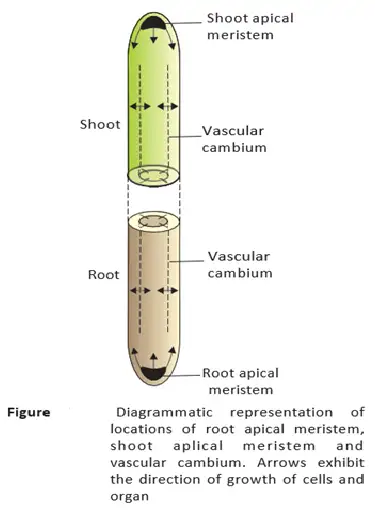
- Higher plants: Specialised regions called meristems produce growth; continual addition of new cells by meristems is the open form of growth.
| Point | Primary growth | Secondary growth |
|---|---|---|
| Effect | Elongation of the plant along its axis | Increase in girth |
| Meristems | Root and shoot apical meristems, and intercalary meristems | Lateral meristems, including vascular cambium and cork cambium |
| Occurrence | Plant elongation | Generally characteristic of gymnosperms and dicot plants |
Measuring Plant Growth
- Parameters: Growth is measurable through changes in fresh weight, dry weight, length, area, volume or number of cells.
- Examples: A maize root apical meristem can produce more than 17,500 new cells per hour; a watermelon cell may increase in size up to 350,000 times.
- Suitable measure: Pollen-tube growth is measured by length; growth of a dorsiventral leaf is measured by surface area.
Phases of Growth
| Phase | Location / main change | Key cell features |
|---|---|---|
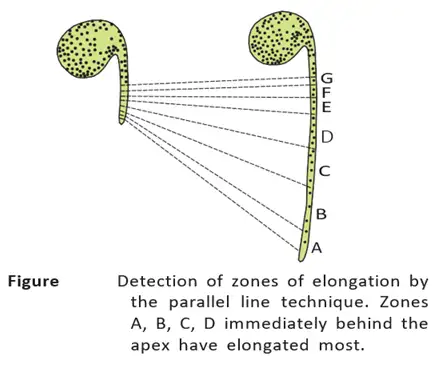
| Meristematic | Root and shoot apices; cells divide continuously | Dense protoplasm, large conspicuous nuclei, thin cellulosic primary walls, abundant plasmodesmata and high respiration rate |
| Elongation | Cells just behind the meristematic zone enlarge | Increased vacuolation, cell enlargement and new cell-wall deposition; enlargement may occur in all directions or mainly linearly |
| Differentiation or maturation | Enlarged cells develop specialised structures and functions | Cells attain maximal size, with wall thickening and protoplasmic modifications |
Growth Rates
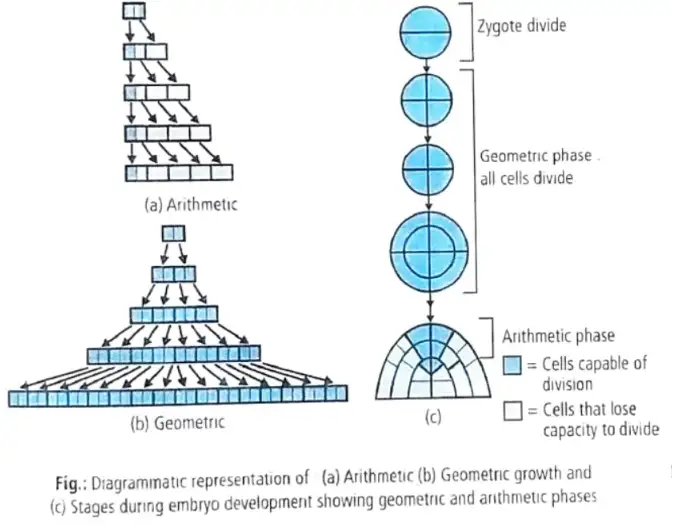
Growth rate — Growth rate is the increase in growth per unit time; it may be arithmetic or geometrical.
| Point | Arithmetic growth | Geometrical growth |
|---|---|---|
| Daughter cells after mitosis | One continues dividing; the other differentiates and matures. | Both retain the ability to divide. |
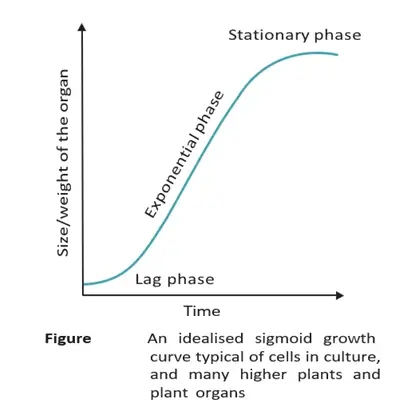
| Pattern | Constant increase; a plot of organ length against time is linear. | Initially slow (lag phase), then rapid exponential (log phase); limited nutrients lead to a stationary phase. |
| Curve / example | A root elongating at a constant rate. | A sigmoid or S-shaped curve is characteristic of plant cells, tissues and organs growing in a natural environment. |
For constant-rate elongation, is length at time , is length at time zero, and is the growth rate per unit time.
is final size, is initial size, is relative growth rate, is growth time, and is the base of natural logarithms. The final size depends on the initial size.
Growth-Rate Comparisons
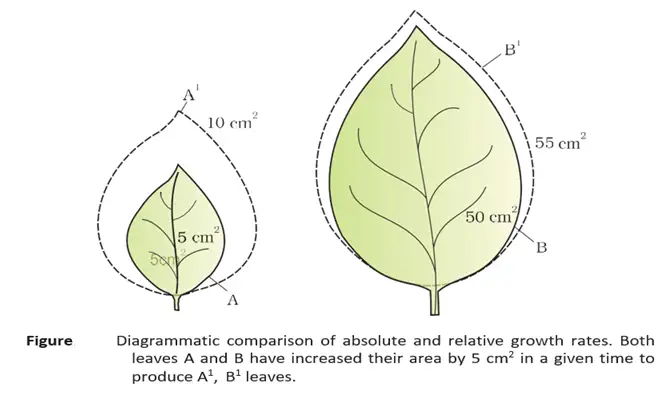
- Relative growth rate: Measures the ability of a plant to produce new plant material; it is also called the efficiency index.
- Absolute growth rate: Total growth per unit time.
- Relative growth rate: Growth per unit time expressed on a common basis, such as per unit of the initial parameter.
| Measure | Meaning |
|---|---|
| Absolute growth rate | Total growth per unit time |
| Relative growth rate | Growth per unit time expressed on a common basis, such as per unit of the initial parameter |
Differentiate primary and secondary growth in plants.
Name the three phases of plant growth and state the key feature of each.
Quick recap
- Development combines growth and differentiation; seed germination activates the embryo under favourable conditions.
- Seed germination requires suitable external conditions and internal readiness; viability is the capacity to germinate and develop.
- Plant growth is generally indeterminate; meristems support open growth, primary elongation and secondary increase in girth.
- Growth is measurable using parameters such as weight, length, area, volume and cell number; leaf expansion is growth.
- The phases are meristematic, elongation and differentiation or maturation.
- Arithmetic growth is linear; geometrical growth has lag, exponential and stationary phases and may form a sigmoid curve.
- Absolute growth rate measures total growth per unit time; relative growth rate expresses growth on a common basis.
Differentiation, Dedifferentiation and Redifferentiation
Differentiation
- Differentiation: Permanent qualitative changes in a cell’s structure, chemistry and physiology produce a specialised cell type.
- Example: Tracheary elements lose their protoplasm and develop strong, elastic, lignocellulosic secondary walls for water transport.
Dedifferentiation
- Dedifferentiation: Differentiated living cells regain the capacity to divide and form new cells.
- Examples: Interfascicular vascular cambium, cork cambium and wound cambium arise through dedifferentiation.
- Callus: In culture, dedifferentiated parenchyma cells form a mass of dividing cells called callus.
Redifferentiation
| Point | Differentiation | Dedifferentiation | Redifferentiation |
|---|---|---|---|
| Main change | Cells become specialised | Living specialised cells regain division capacity | Cells from dedifferentiated meristems become specialised again |
| Example | Tracheary elements | Callus formation from parenchyma | Secondary xylem and secondary phloem |
Commitment and Cell Fate
What are dedifferentiation and redifferentiation? Give examples.
Why can the same group of apical meristem cells form different tissues?
Quick recap
- Differentiation is permanent specialisation associated with gene activation or repression.
- Tracheary elements lose protoplasm and develop lignocellulosic secondary walls.
- Dedifferentiation restores the division capacity of differentiated living cells.
- Parenchyma cells can form a dividing callus in culture.
- Redifferentiation specialises cells derived from dedifferentiated meristems.
- Cell location and signals guide commitment and the formation of different tissues.
Development
Meaning and sequence of development
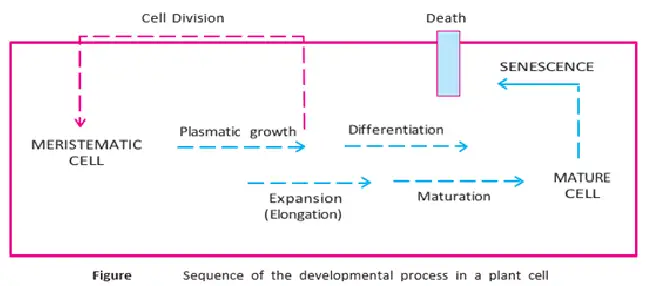
Control of plant development
- Intrinsic control: Genetic factors and plant growth regulators regulate development.
- Extrinsic control: Light, temperature, water, oxygen and nutrition influence plant development.
- Response: Plant development is shaped by the interaction of internal controls and environmental conditions.
Plasticity and heterophylly
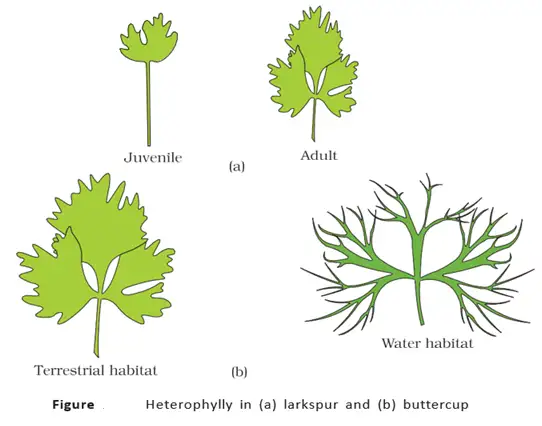
What is plasticity? Give examples of heterophylly.
Quick recap
- Development includes formation, growth, differentiation, maturation, reproduction, senescence and death.
- Plant development proceeds through germination, seedling, juvenile, mature, flowering, seed-formation and senescence stages.
- Development includes changes between phases and changes within cells.
- Genetic factors and growth regulators are intrinsic controls; environmental conditions are extrinsic controls.
- Plasticity allows plants to form different structures according to developmental stage or environment.
- Heterophylly occurs developmentally in cotton, coriander and larkspur, and environmentally in buttercup.
Plant Growth Regulators
Plant growth regulators (PGRs) — Small molecules of diverse chemical composition that regulate plant growth, differentiation and development, even at low concentrations.
Phytohormone — A naturally produced, non-nutrient chemical that can move to another plant region and regulate one or more physiological reactions at low concentrations.
| Group | Hormones |
|---|---|
| Growth promoters | Auxins, gibberellins and cytokinins |
| Growth inhibitors | Abscisic acid (ABA) and ethylene; ethylene also promotes processes such as fruit ripening |

Auxins
Nature, sources and detection
- Nature: Weakly acidic growth hormones with an unsaturated ring structure.
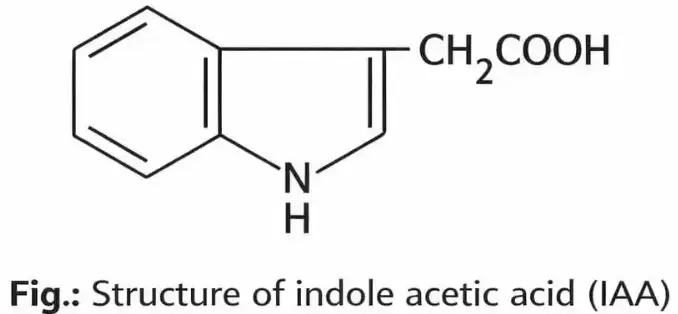
- Natural auxins: Indole-3-acetic acid (IAA) and indole-3-butyric acid (IBA). IAA is also listed as a synthetic auxin.
- Synthetic auxins: NAA, 2,4-D, MCPA and IAA; these have properties similar to natural auxins.
- Location and precursor: IAA occurs in shoot apices, leaf primordia and developing seeds; tryptophan is its precursor.
- Bioassays: Avena curvature test and root-growth inhibition test detect auxin activity.
| Date / scientist | Finding |
|---|---|
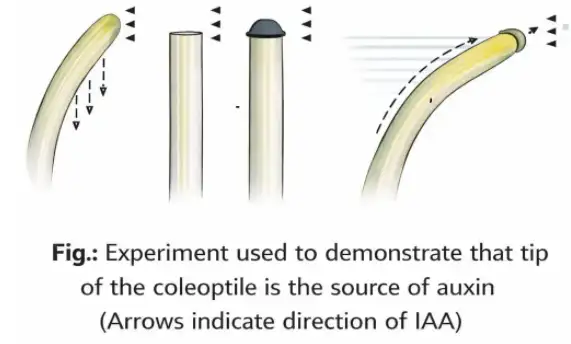
| 1880 — Charles and Francis Darwin | Showed that coleoptile tips of canary grass perceive unilateral light. |
| 1928 — F. W. Went | Collected a growth-promoting substance from oat coleoptile tips in agar; it moved basipetally and caused concentration-dependent bending. |
| 1931 — Kogl and Smith | Isolated auxin-related substances from human urine. |
| 1934 — Kogl and colleagues | Identified heteroauxin as indole-3-acetic acid (IAA), the real plant auxin. |
Physiological functions
- Growth and differentiation: Promote cell elongation in shoots, cambial cell division, and early xylem and phloem differentiation in tissue culture.
- Roots: Initiate rooting in stem cuttings; high auxin concentrations inhibit root growth.
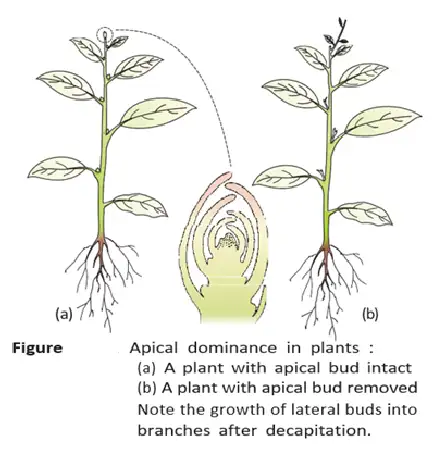
- Apical dominance: Suppress axillary buds, maintaining dominance of the shoot tip. Removing the tip (decapitation) releases lateral buds; used in tea plantations and hedge-making.
- Reproduction and fruit: Promote flowering in pineapple, increase fruit size, advance fruit formation and induce parthenocarpy in some plants, such as tomato.
- Sex expression: Can feminise plants by inducing female flowers on male plants.
- Senescence and abscission: Delay senescence and prevent early shedding; they can promote abscission of older, mature leaves and fruits.
- Weed control: Synthetic auxins such as 2,4-D and 2,4,5-T selectively damage broad-leaved dicot weeds while sparing mature monocots.
- Tropisms and metabolism: Unequal auxin distribution produces phototropism and geotropism; auxins also stimulate respiration and metabolism.
Gibberellins
Nature, sources and detection
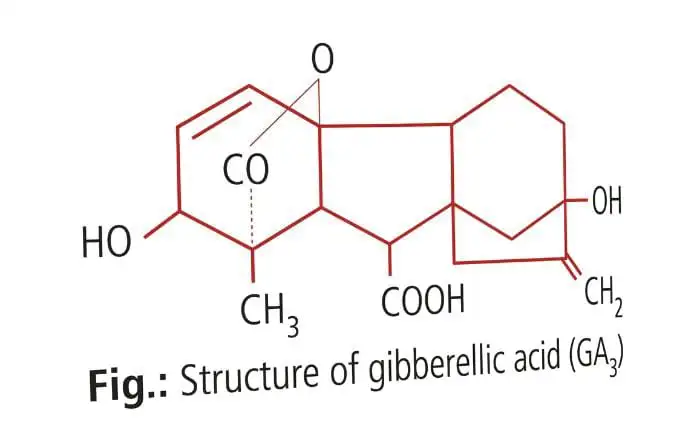
- Nature: Weakly acidic growth hormones with a gibberellin ring structure; over 100 gibberellins are known in fungi and higher plants.
- Discovery: Kurosawa (1926) found the active substance in filtrate of *Gibberella fujikuroi*, which causes bakanae disease in rice. GA₃ was the first purified gibberellin and is the most studied.
- Location and precursor: Produced in apical shoot buds, young leaves, near shoot tips, root tips and developing seeds. Mevalonic acid, derived from acetyl-CoA, is a precursor.
- Transport and bioassays: Move by simple diffusion and conducting channels; barley endosperm and dwarf pea tests are bioassays.
Physiological functions
- Germination: Promote seed germination by inducing α-amylase synthesis and overcoming dormancy; GA₃ can induce germination of photoblastic lettuce seeds in darkness.
- Bolting: Cause rapid internode elongation in rosette plants such as cabbage, producing an elongated stalk.
- Dwarf plants: Overcome genetic dwarfism and increase plant height, e.g., in maize and pea.
- Sex expression and ageing: Promote maleness and delay senescence, allowing fruits to remain on plants longer.
- Fruit development: Act as potent parthenocarpy-inducing agents; increase grape-stalk length and improve fruit shape, such as in apple.
- Agriculture and industry: GA₃ speeds malting in brewing; sugarcane spraying increases stem length and can raise yield by up to 20 tonnes per acre.
- Other use: Spraying juvenile conifers hastens maturity and early seed production.
Cytokinins
Nature, discovery and detection
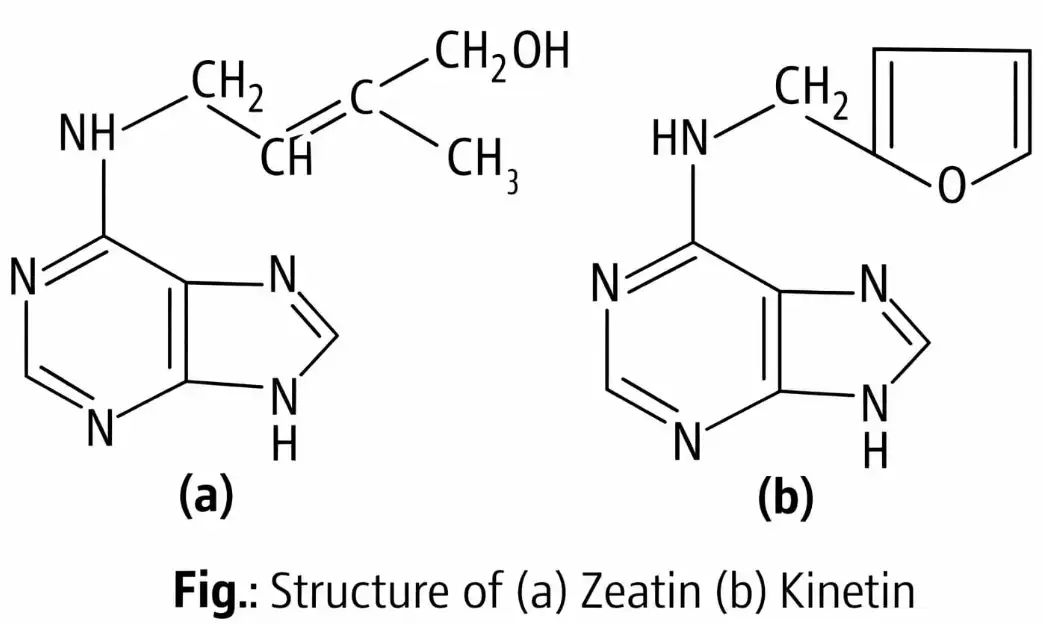
- Nature: Basic hormones derived from aminopurine or phenyl urea; they promote cytokinesis.
- Discovery: Skoog’s group found tobacco-stem callus proliferated when nutrients and auxin were supplemented with materials such as yeast extract, vascular tissue, coconut milk or DNA.
- Kinetin: Miller and colleagues (1955) isolated the first cytokinin from degraded, autoclaved herring-sperm DNA; kinetin is not naturally found in plants.
- Zeatin: The first natural plant cytokinin, obtained from unripe maize grains; also occurs in coconut milk.
- Location and bioassays: Abundant in rapidly dividing regions, including root apices, developing shoot buds and young fruits. Tests include tobacco pith culture, leaf-senescence retardation and excised radish-cotyledon expansion.
Physiological functions
- Cell division and organ formation: Promote cell division, control morphogenesis and support initiation of plant organs.
- Shoot and leaf growth: Increase seedling width; promote new leaves, chloroplast development, lateral shoots and adventitious shoots.
- Apical dominance: Help overcome apical dominance.
- Sex expression: Can induce femaleness in male plants.
- Senescence and abscission: Delay senescence (Richmond–Lang effect) and retard abscission.
- Food mobilisation and storage: Mobilise food; cytokinin treatment keeps marketed vegetables fresh and prolongs the life of cut shoots and flowers.
Ethylene
Nature, discovery and detection
- Nature: The only gaseous phytohormone; stimulates transverse (isodiametric) growth while retarding longitudinal growth. It is synthesised from methionine.
- Discovery: Cousins (1910) confirmed a volatile substance from ripening oranges hastened banana ripening; Gane (1934) identified it as ethylene; Crocker and colleagues (1935) recognised it as a plant hormone.
- Location: Present in small amounts in most plant parts; production is greatest during fruit ripening and in senescing tissues.
- Bioassays: Triple response of etiolated pea seedlings and gas chromatography.
Physiological functions and uses
- Triple response: Causes axis swelling, horizontal seedling growth and apical-hook formation in dicot seedlings.
- Senescence and ripening: Promotes senescence and abscission of leaves and flowers; increases respiration during fruit ripening. This rise is the respiratory climacteric.
- Dormancy and sprouting: Overcomes seed and bud dormancy; promotes peanut-seed germination and potato-tuber sprouting.
- Sex expression and flowering: Small external doses increase female flowers in cucumber. Used to initiate flowering and synchronise fruit set in pineapple and mango.
- Growth in flooded plants: Promotes internode and petiole elongation in deep-water rice, helping shoots remain above water.
- Roots: Promotes root growth and root-hair formation; waterlogging induces ethylene formation in roots and adventitious-root formation.
- Agricultural use: Ethephon is a widely used ethylene source; it is absorbed and transported in aqueous solution.
- Ethephon effects: Hastens ripening of tomatoes and apples and promotes abscission for thinning flowers or fruits, including cotton, cherry and walnut.
Abscisic Acid (ABA)
Nature, discovery and detection
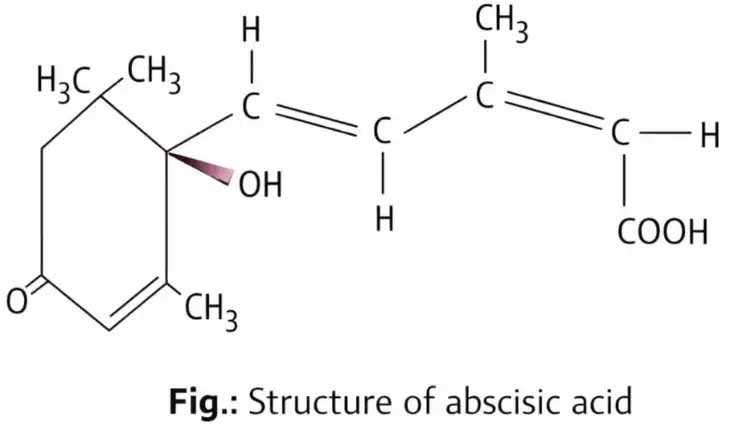
- Nature: Mildly acidic, general growth inhibitor; called the stress hormone because adverse conditions such as drought and waterlogging stimulate its production.
- Discovery: First isolated from cotton bolls by Addicott and colleagues (1963).
- Location and synthesis: Found in many plant parts and abundant in chloroplasts of green cells; synthesised from mevalonic acid or xanthophyll.
- Bioassays: Rice-seedling growth-inhibition test and inhibition of α-amylase synthesis in barley endosperm.
Physiological functions
- Growth and abscission: Inhibits growth and induces abscission; promotes leaf senescence.
- Dormancy: Inhibits seed germination and induces seed and bud dormancy. Dormancy helps seeds withstand desiccation and other unfavourable conditions.
- Flowering: Inhibits flowering in long-day plants but can promote it in some short-day plants.
- Water conservation: Partly closes stomata during drought and acts as an antitranspirant.
- Seed development: Important in seed development, maturation and dormancy.
- Hormone interaction: Counteracts many effects of GA₃.
Interactions between plant hormones
| Process | Hormones and effects |
|---|---|
| Cell growth and division | Auxins, gibberellins and cytokinins act synergistically; ABA antagonises their effect. |
| Sex expression | Auxins, cytokinins and ethylene promote femaleness; gibberellins promote maleness. |
| Senescence | Auxins and cytokinins delay it; ABA and ethylene promote it. |
| Stomatal movement | Cytokinins promote opening; ABA causes closure. |
| Seed and bud dormancy | ABA induces dormancy; gibberellins overcome it. |
| Cambial activity and fruit development | Auxins, gibberellins and cytokinins promote them; ABA inhibits them. |
How does GA₃ promote seed germination?
What is the respiratory climacteric?
State two contrasting effects of ABA and gibberellins.
Quick recap
- PGRs are low-concentration chemical regulators of plant growth, differentiation and development.
- Auxins promote shoot elongation and apical dominance; high concentrations inhibit root growth.
- Gibberellins promote germination, bolting and stem elongation, and overcome genetic dwarfism.
- Cytokinins promote cell division and shoot development while delaying senescence.
- Ethylene is a gaseous hormone that promotes fruit ripening, abscission and the respiratory climacteric.
- ABA is a stress-related growth inhibitor that closes stomata and induces seed and bud dormancy.
- Hormone effects may be synergistic or antagonistic; ABA often counteracts growth-promoting hormones.
NEET Botany — ALL CHAPTERS
1
The Living World
2
Plant Kingdom
3
Morphology of Flowering Plants
4
Anatomy of Flowering Plants
5
The Unit of Life
6
Photosynthesis in Higher Plants
7
Respiration in Plants
8
Plant Growth and Development
9
Sexual Reproduction in Flowering Plants
10
Principles of Inheritance and Variation
11
Molecular Basis of Inheritance
12
Biotechnology :Principles and Processes
13
Biotechnology and its Applications