NEET UG . NEET Botany . Botany . Sexual Reproduction in Flowering Plants
Chapter 9: Sexual Reproduction in Flowering Plants
Ch 9
NEET Botany
NEET UG
Flower- A fascinating Organ of Angiosperms
Sexual Reproduction in Angiosperms
Sexual reproduction — The development of new organisms through the formation and fusion of gametes.
- Occurrence: All flowering plants show sexual reproduction.
- Flower: Flowers are the specialised reproductive organs of angiosperms.
- Adaptations: Diversity in inflorescences, flowers and floral parts helps ensure the formation of fruits and seeds.
Flower Structure and Floriculture
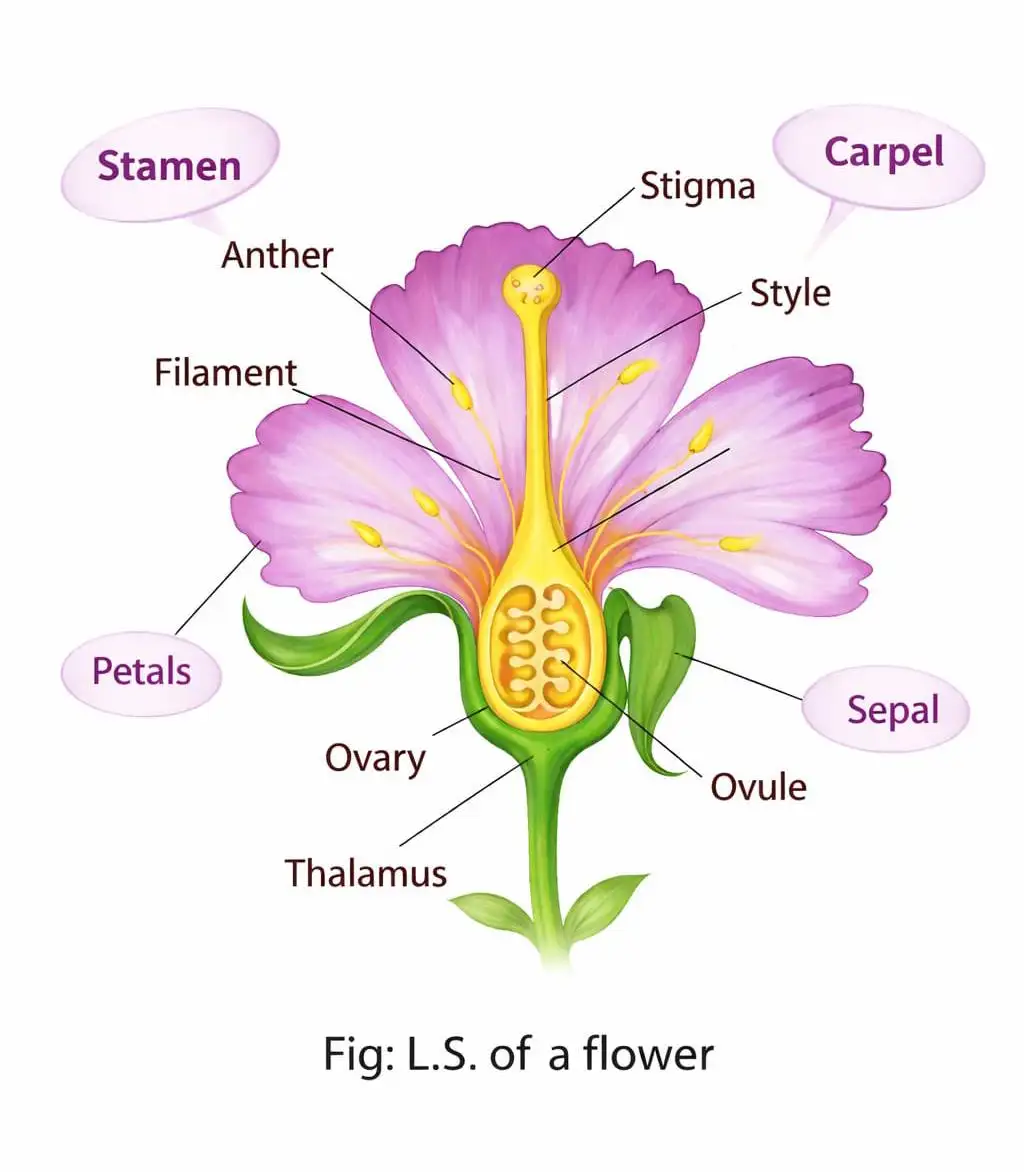
Flower — A modified shoot of determinate growth, with highly condensed internodes and leaves specialised into floral organs.
- Receptacle: The base on which the floral whorls are attached.
- Complete flower: Has four whorls—calyx, corolla, androecium and gynoecium.
- Floriculture: The cultivation of ornamental plants for their flowers.
Quick recap
- All flowering plants show sexual reproduction, involving the formation and fusion of gametes.
- Flowers are the specialised reproductive organs of angiosperms.
- A flower is a modified shoot of determinate growth with highly condensed internodes.
- The receptacle bears the four whorls: calyx, corolla, androecium and gynoecium.
- Floriculture is the cultivation of ornamental plants for their flowers.
Pre-Fertilisation :Structure and Events
Floral Reproductive Structures
Development of the flower
- Floral development: Hormonal and structural changes lead from floral primordia to buds and flowers.
- Reproductive whorls: The androecium is the male part and consists of stamens; the gynoecium is the female part and consists of pistils.
Stamen, Microsporangium and Pollen Grain
Stamen — The male reproductive organ of a flower, made of an anther and a filament.
Anther structure
- Filament: Its proximal end attaches to the thalamus or to a petal.
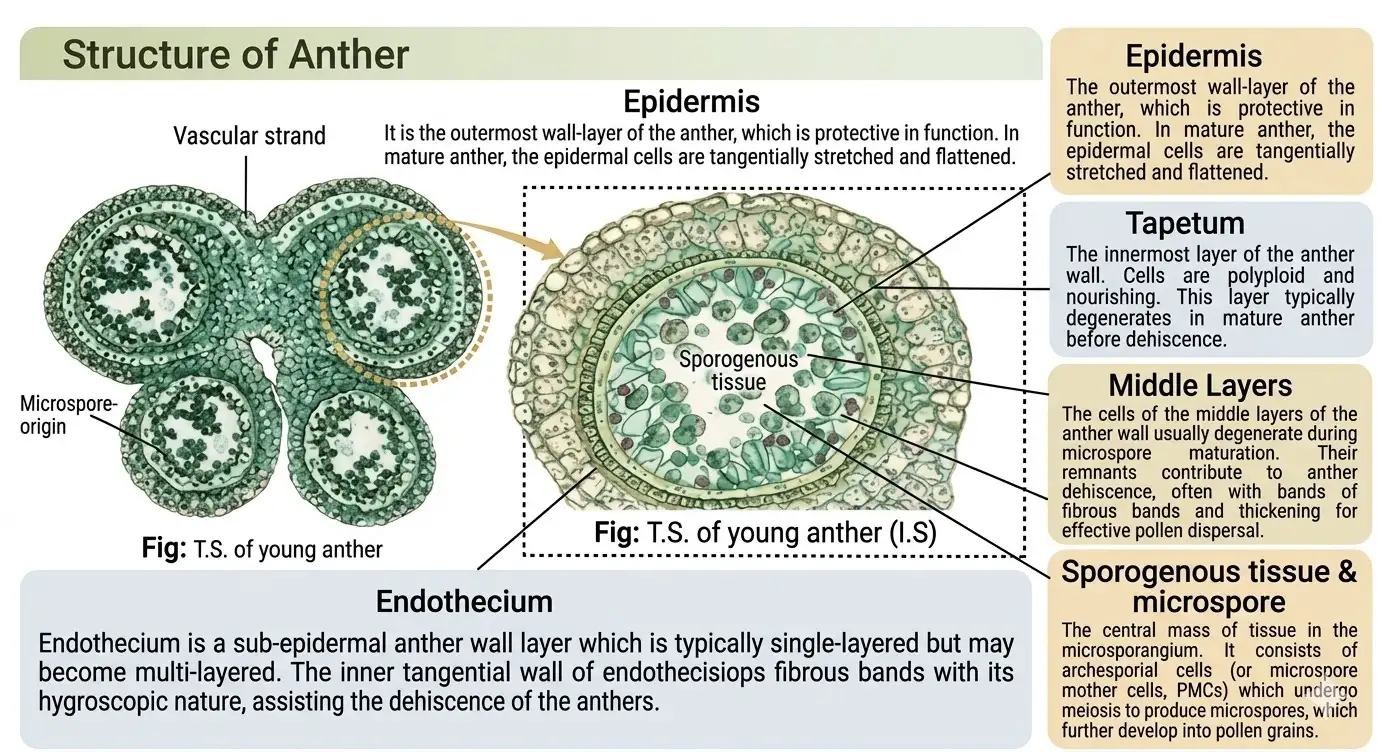
- Typical anther: Bilobed and dithecous, with two thecae in total; a longitudinal groove may separate them.
- Microsporangia: The tetragonal anther has four microsporangia, one at each corner and two in each lobe.
- Pollen sacs: Microsporangia extend along the anther and develop into pollen-filled sacs.
Anther Wall and Tapetum
Microsporangial wall
- Four layers: Epidermis, endothecium, middle layers and tapetum, from outside to inside.
- Outer three layers: Protect the microsporangium and help the anther dehisce to release pollen.
- Tapetum: The innermost layer; it nourishes developing microspores and pollen grains.
| Type | Features | Examples |
|---|---|---|
| Amoeboid (invasive / periplasmodial) | Found in some primitive angiosperms; absorbs food from the middle layers and, after degeneration, nourishes developing microspores. | Typha, Alisma, Tradescantia |
| Glandular (secretory) | Stationary; usually does not degenerate early and secretes nutrients into the pollen-sac cavity; common in flowering plants. | Capsella |
Microsporogenesis
Microsporogenesis — Formation of microspores from a pollen mother cell by meiosis.
Formation of pollen grains
- Sporogenous tissue develops into pollen mother cells.
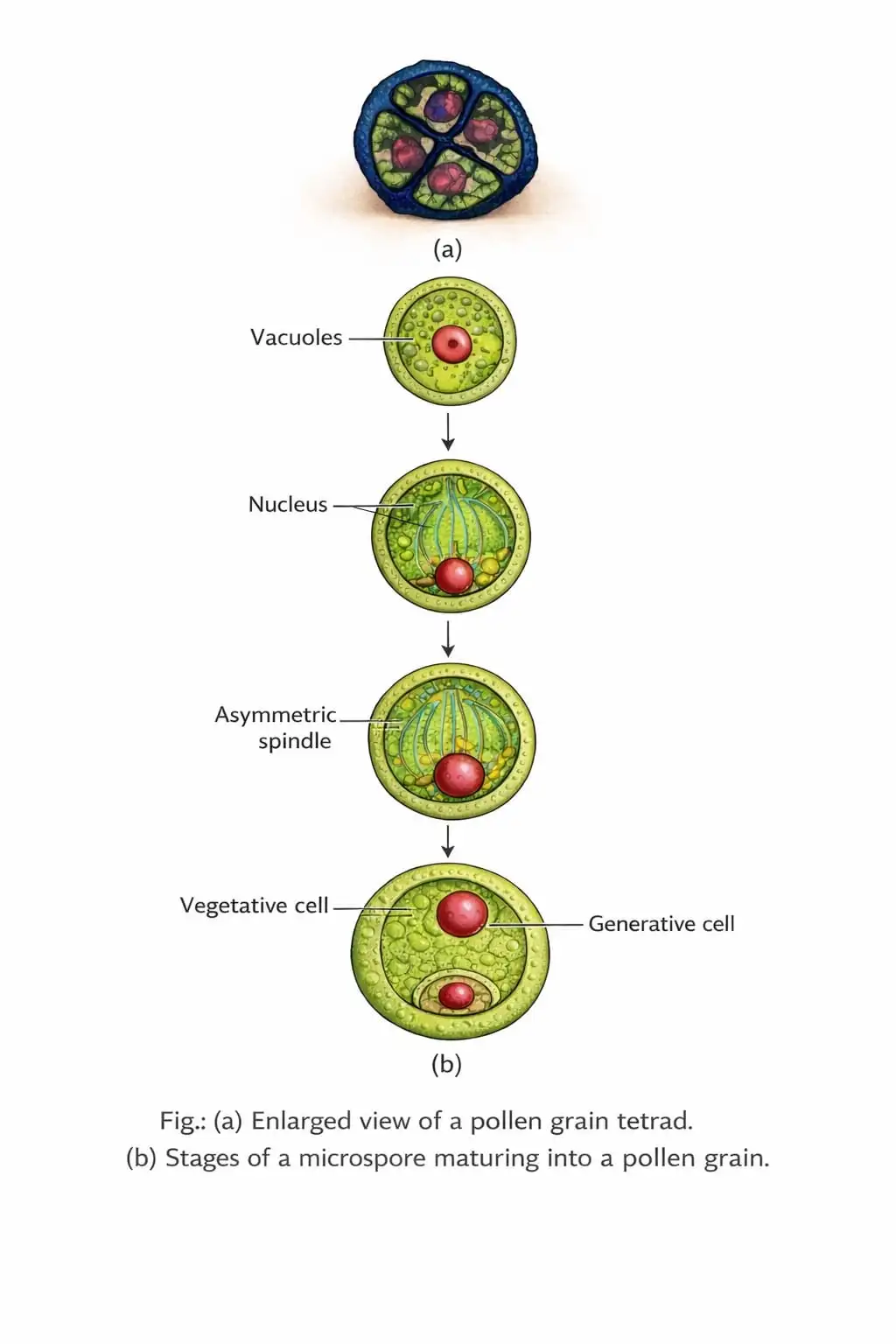
- Each pollen mother cell undergoes meiosis, forming a tetrad of microspores.
- The four microspores separate; as the anther matures and dehydrates, they develop into pollen grains.
Pollen Grain
Structure and development
- Male gametophyte: A pollen grain is its first cell; it is usually spherical and about – in diameter.
- Sporoderm: The pollen wall has a tough outer exine and a thin, elastic inner intine.
- Exine: Made of sporopollenin, it resists chemical and biological breakdown and can persist in fossil deposits.
- Germination sites: Exine-thin regions without sporopollenin are germ pores if circular, and germinal furrows if elongated.
- Intine: It extends through a germ pore during germination to form the pollen tube.
- Two cells: Mitosis produces a large vegetative (tube) cell with food reserves and an irregular nucleus, and a smaller generative cell with dense cytoplasm.
- Male gametes: In over of angiosperms, pollen is shed at the two-celled stage; the generative cell divides in the pollen tube. Other species shed three-celled pollen.
Pollen: importance and viability
- Allergies: Pollen from some species can cause allergies and chronic respiratory problems such as asthma and bronchitis.
- Viability: It varies with species, temperature and humidity; rice and wheat pollen may lose viability within 30 minutes, while Rosaceae and Leguminosae pollen may remain viable for months.
- Pollen banks: Pollen can be stored in liquid nitrogen at for use in crop-breeding programmes.
- Nutrition: Pollen grains are nutrient-rich and are also used in pollen tablets as food supplements.
Pistil and Gynoecium
Parts and forms
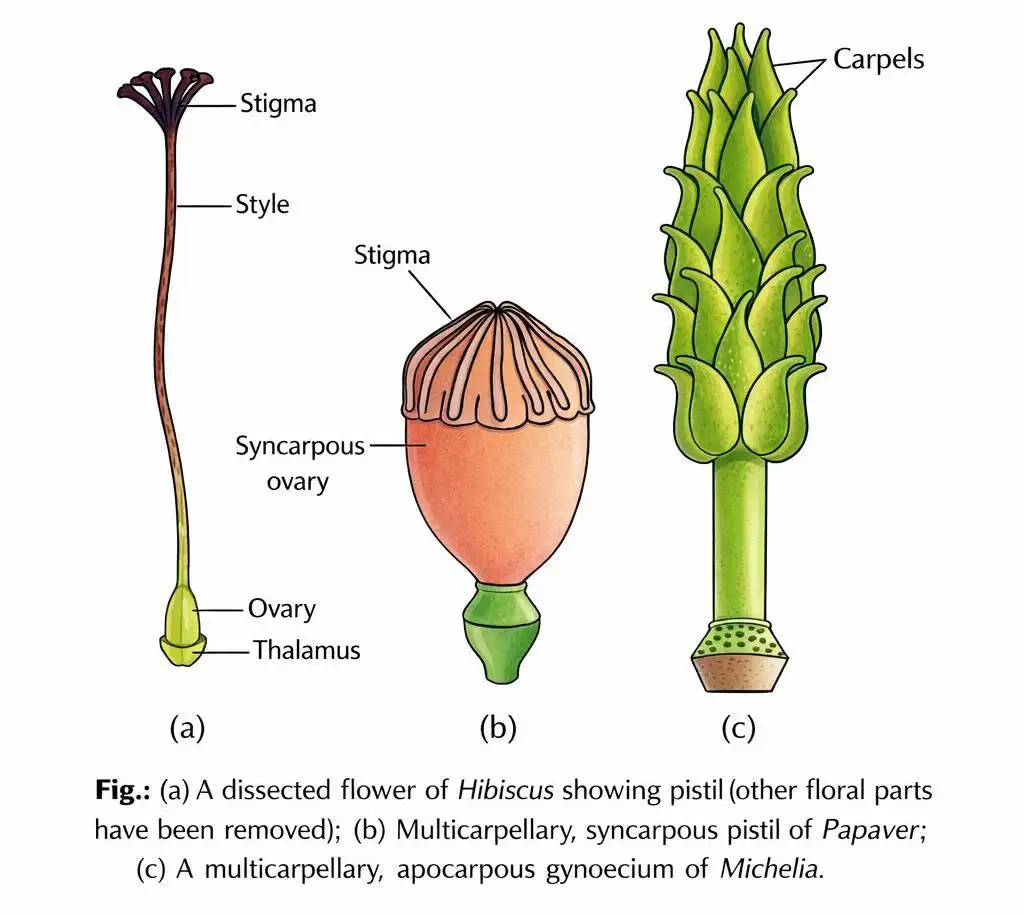
- Gynoecium: May contain one pistil (monocarpellary) or several pistils (multicarpellary).
- Pistils: Several pistils are fused in a syncarpous gynoecium or free in an apocarpous gynoecium.
- Pistil parts: A receptive stigma sits at the tip, joined by a style to the swollen ovary.
- Ovary: Contains one or more locules and a placenta, from which ovules arise.
- Ovule number: One in wheat, paddy and mango; many in papaya, watermelon and orchids.
Megasporangium (Ovule)
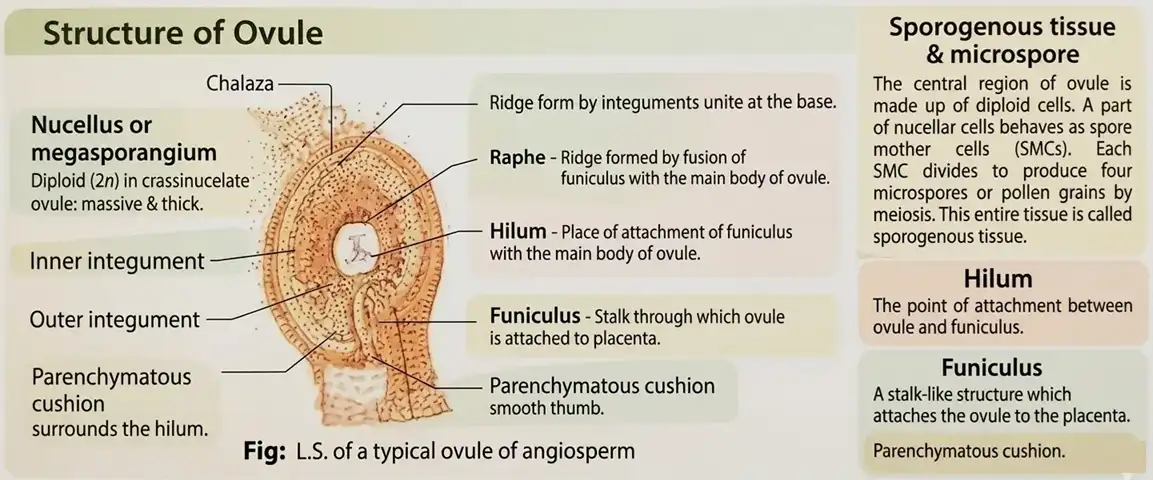
Ovule — An integumented megasporangium in seed plants that develops into a seed after fertilisation.
Ovule structure
- Funicle and hilum: The funicle attaches the ovule to the placenta; the hilum is the junction of the ovule body and funicle.
- Integuments: One or two protective envelopes surround the nucellus, usually leaving a small opening, the micropyle.
- Nucellus and chalaza: The nucellus is tissue containing reserve food; the chalaza is the ovule’s basal region opposite the micropyle.
- Embryo sac: A large oval cell within the ovule; it is the female gametophyte.
| Type | Integuments | Examples / occurrence |
|---|---|---|
| Unitegmic | One | Common in Gamopetalae |
| Bitegmic | Two | Members of Polypetalae and monocots |
| Ategmic | None | Santalum album, Loranthus |
| Tritegmic | Three | Rare; Asphodelus |
Megasporogenesis
Megasporogenesis — Formation of megaspores from a megaspore mother cell (MMC) by meiosis.
Formation of the functional megaspore
- A single large MMC with dense cytoplasm and a prominent nucleus differentiates in the micropylar region of the nucellus.
- The MMC undergoes meiosis to form four haploid megaspores, usually arranged in a linear tetrad.
- The upper three megaspores usually degenerate; the lowermost enlarges and becomes functional.
Female Gametophyte (Embryo Sac)
Development and mature structure
- Monosporic development: The embryo sac develops from one functional megaspore.
- Nuclear divisions: Its nucleus divides mitotically to form two nuclei at opposite poles, then four and eight nuclei; these are free-nuclear divisions, not immediately followed by cell-wall formation.
- Polar nuclei: One nucleus from each pole moves to the centre; the two fuse to form the diploid secondary nucleus.
- Chalazal end: Three nuclei form the antipodal cells.
- Micropylar end: Three nuclei form the egg apparatus: one egg cell (oosphere) between two synergids.
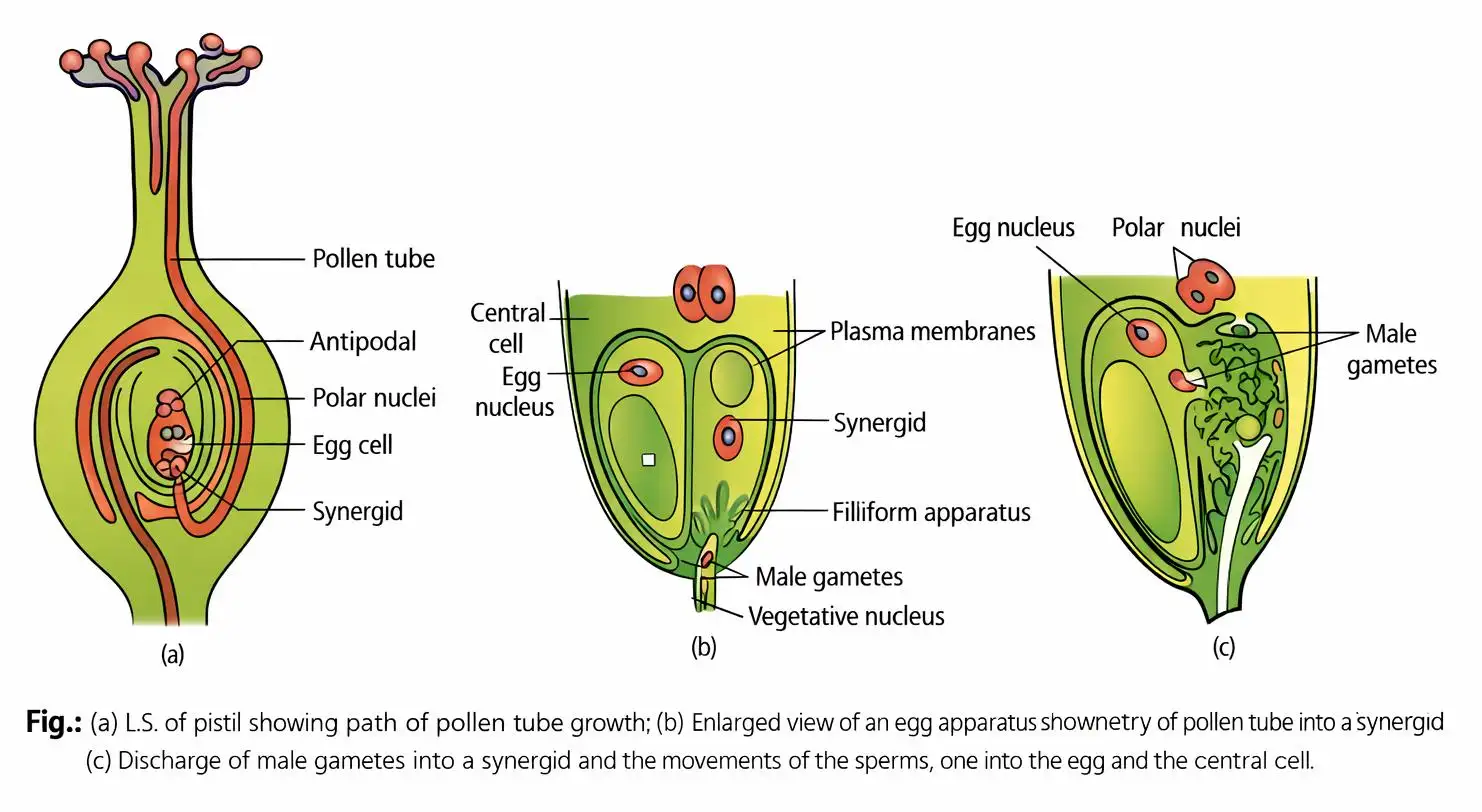
- Filiform apparatus: Special thickenings at the micropylar tips of synergids help guide the pollen tube into a synergid.
- Mature embryo sac: It is eight-nucleate but seven-celled: three antipodals, two synergids, one egg cell and one central cell containing two polar nuclei.
- After fertilisation: The egg forms the zygote; synergids disorganise soon after, and antipodals eventually disorganise and may provide nourishment.
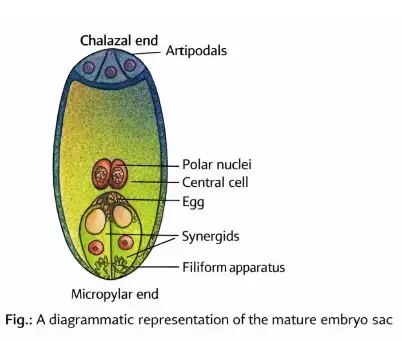
Do not confuse eight-nucleate with eight-celled: the mature embryo sac is eight-nucleate but seven-celled because the central cell contains two polar nuclei.
Pollination
Pollination — Transfer of pollen grains from anther to the receptive stigma of the same flower or another flower of the same species.
| Type | Transfer | Key point |
|---|---|---|
| Autogamy | Anther to stigma of the same flower | Self-pollination in a perfect (bisexual) flower |
| Geitonogamy | Anther of one flower to stigma of another flower on the same plant | Genetically equivalent to self-pollination, but ecologically cross-pollination because pollen moves between flowers |
| Xenogamy (allogamy) | Anther of one plant to stigma of a genetically different plant of the same species | True cross-pollination |
Devices Promoting Self- or Cross-Pollination
| Device | Meaning / effect | Example |
|---|---|---|
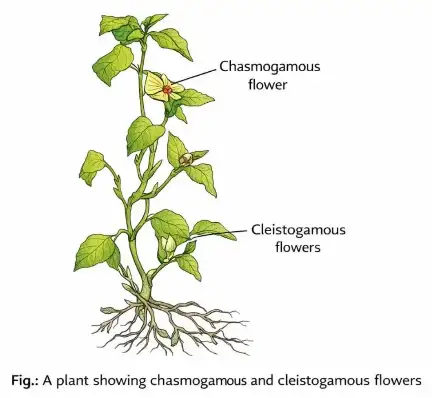
| Cleistogamy | Flowers never open, ensuring self-pollination. | Commelina benghalensis |
| Anther–stigma contact | Parts move into contact at maturity, promoting self-pollination. | Filaments bend toward the stigma in Mirabilis jalapa; the style curves toward ripe anthers in Solanum tuberosum. |
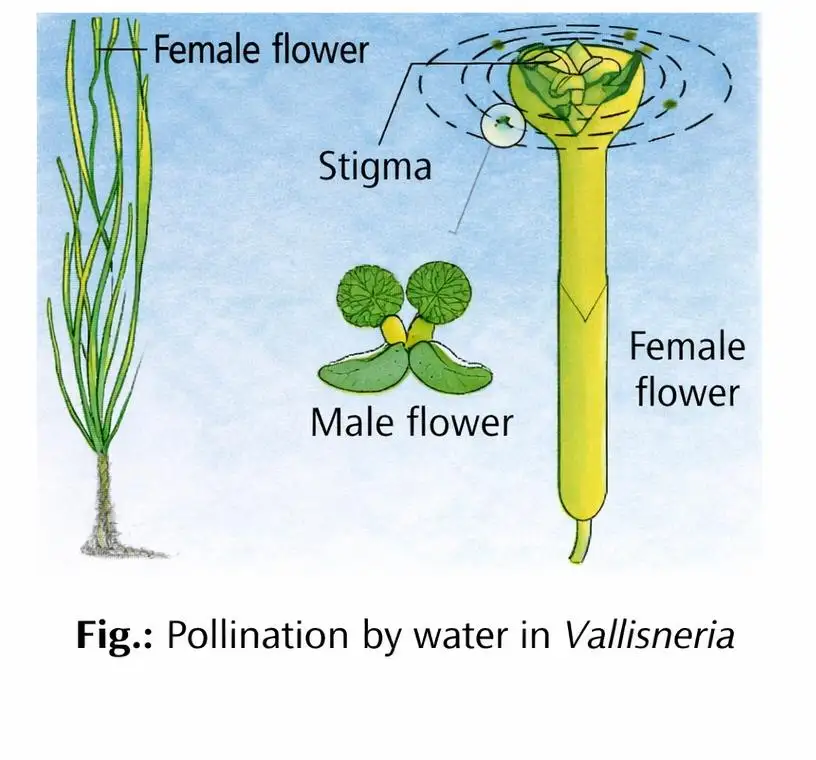
| Dicliny (unisexuality) | Male and female flowers are separate. Monoecious plants bear male and female flowers on the same plant; dioecious plants bear them on separate individuals. | Monoecious: maize. Dioecious: Morus alba, Vallisneria. |
| Self-sterility | A flower’s own pollen cannot fertilise its stigma. | Camellia sinensis, Passiflora |
| Dichogamy | Anthers and carpels mature at different times. | Protandry: anthers mature first, as in Helianthus annuus. Protogyny: carpels mature first, as in Brassica. |
| Heterostyly | Flowers have two (dimorphic) or three (trimorphic) forms, with anthers and stigmas at different levels. | Different floral forms reduce self-pollination. |
| Herkogamy | A physical barrier separates androecium and gynoecium, reducing self-pollination. | In Calotropis, gynoecium and pollinium form a gynostegium; pollination occurs through insects. |
Pollination Agents
| Type | Flower and pollen features | Examples / note |
|---|---|---|
| Anemophily (wind) | Flowers are inconspicuous, scentless and nectarless; anthers and stigmas are often exerted. Pollen is small, dry, light and non-sticky; stigmas are often feathery or branched. Flowers may be crowded in inflorescences, often with one ovule per ovary. | Maize, grasses, mulberry, date palm, Cannabis |
| Hydrophily (water) | Flowers are usually small, inconspicuous, odourless, colourless and nectarless; whorls may be reduced and wax-covered. Pollen is small, light, non-sticky and often wax-coated; the stigma is unwettable but sticky. | Hypohydrophily occurs below water: Ceratophyllum, Najas, Zostera. Epihydrophily occurs at the surface: Vallisneria. |
| Type | Flower and pollen features | Examples |
|---|---|---|
| Entomophily (insects) | Flowers are often bright and fragrant, producing nectar or edible pollen; pollen is heavy, spiny and sticky, often with pollenkitt. | Insect-pollinated flowers |
| Ornithophily (birds) | Flowers are often large, brightly coloured and odourless, with abundant mucilaginous nectar; corollas may be tubular, cup-shaped or urn-shaped. | Nicotiana glauca, Callistemon, Strelitzia reginae (sunbirds) |
| Chiropterophily (bats) | Flowers are dull-coloured, strongly fruity or fermenting in smell, and provide abundant nectar and pollen. | Kigelia, Adansonia, Bauhinia |
| Malacophily (snails) | Pollination by snails. | Arisaema |
| Myrmecophily (ants) | Pollination by ants. | Some Rubiaceae |
Pollen–Pistil Interaction
Recognition and pollen-tube growth
- Compatibility check: Pollination may place incompatible pollen on the stigma; the pistil recognizes pollen and promotes or inhibits its growth.
- Stigma types: A dry stigma has papillae without obvious exudate; a wet stigma has a receptive surface covered with exudate.
- Stigmatic exudate: Contains sugars, phenolic compounds, amino acids and proteins; mucopolysaccharides contribute to its viscosity.
- Pollen tube: It secretes enzymes that digest stigma tissues and grows chemotropically between style cells, guided by a calcium–boron–inositol–sugar gradient.
- Entry into embryo sac: The tube reaches the micropyle and enters the embryo sac through one of the synergids beside the egg.
- Application: Understanding recognition can help breeders manage even incompatible pollinations to produce desired hybrids.
Artificial Hybridisation
Purpose and safeguards
- Purpose: Breeders cross selected plants, sometimes different species or genera, to combine desirable traits.
- Goal: Ensure that only pollen from the chosen male parent reaches the receptive stigma and prevent unwanted pollen contamination.
Emasculation and bagging
- For a bisexual female parent, remove the anthers from an unopened flower bud before they dehisce; this is emasculation.
- Cover the emasculated flower with a suitable bag, usually butter paper, to prevent unwanted pollen from reaching the stigma; this is bagging.
- When the stigma becomes receptive, apply mature pollen from the chosen male parent, then rebag the flower and allow the fruit to develop.
- For a unisexual female parent, emasculation is unnecessary; bag the bud before it opens, pollinate at receptivity and rebag.
Why is a mature angiosperm embryo sac described as seven-celled and eight-nucleate?
Distinguish autogamy, geitonogamy and xenogamy.
When is emasculation needed in artificial hybridisation?
Quick recap
- A typical anther contains four microsporangia; its tapetum nourishes developing pollen.
- Microsporogenesis forms microspores by meiosis; pollen has a sporopollenin-rich exine and a tube-forming intine.
- The ovule contains the megasporangium; one functional megaspore usually forms the seven-celled, eight-nucleate embryo sac.
- Pollination may be autogamy, geitonogamy or xenogamy; floral adaptations and agents influence pollen transfer.
- Monoecious plants bear male and female flowers on the same plant; dioecious plants bear them on separate individuals.
- Pollen–pistil interaction selects compatible pollen and guides pollen-tube growth into the embryo sac.
- Emasculation and bagging help breeders control pollen sources during artificial hybridisation.
Double Fertilisation
Pollen-Tube Formation
- Germination: On a compatible stigma, the pollen grain germinates and the intine grows out through a germ pore to form the pollen tube.
- Male gametes: The generative cell divides mitotically during pollen-tube growth to produce two male gametes.
Pollen-Tube Entry into the Ovule
Common route into the embryo sac
- Regardless of ovule entry route: The pollen tube always enters the embryo sac through its micropylar region.
Syngamy and Triple Fusion
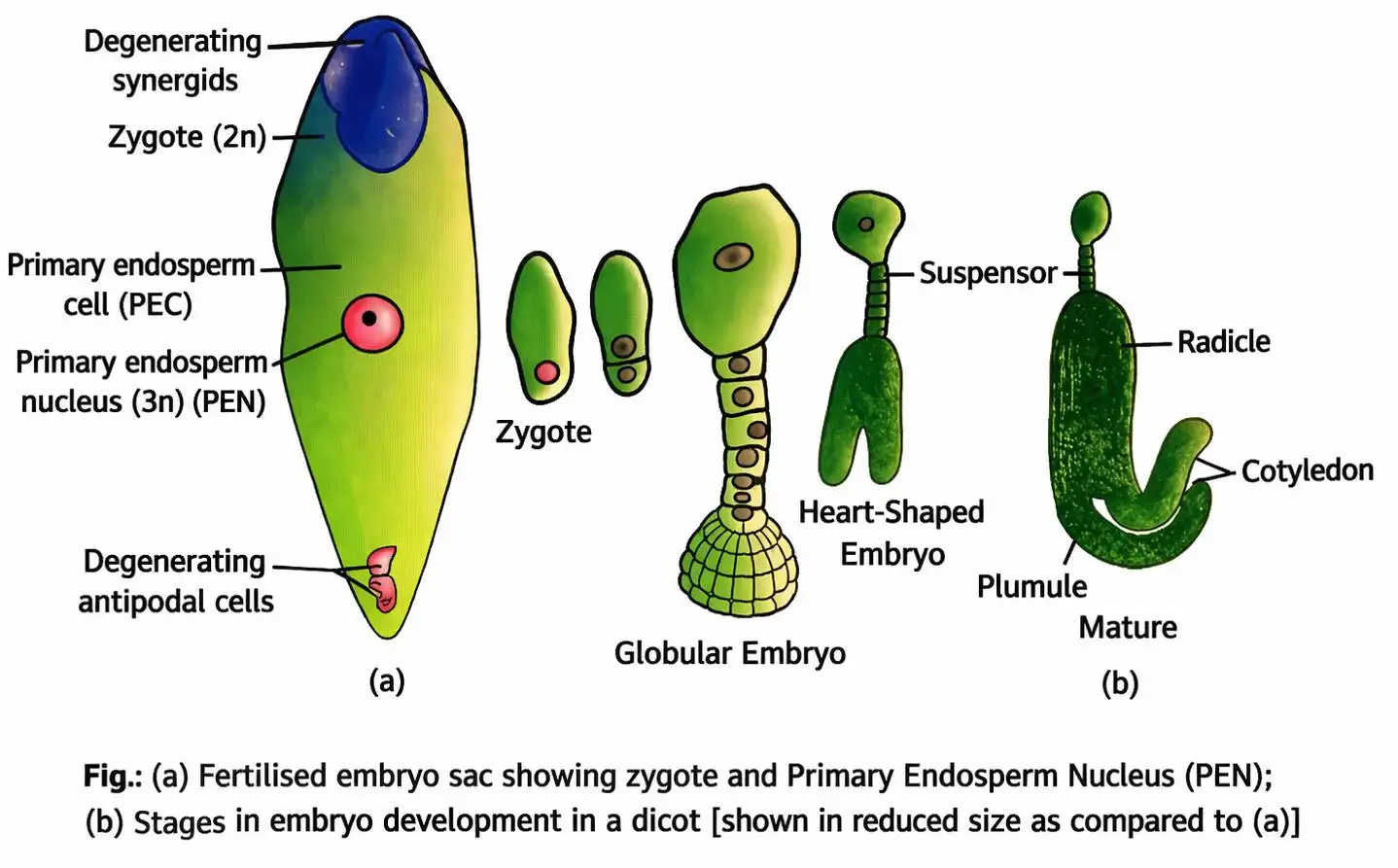
| Process | Fusion | Product and fate |
|---|---|---|
| Syngamy (generative fertilisation) | Male gamete + egg | Zygote → embryo |
| Triple fusion (vegetative fertilisation) | Male gamete + two polar nuclei (or secondary nucleus ) | Primary endosperm nucleus → primary endosperm cell → endosperm |
Double fertilisation — The occurrence of syngamy and triple fusion in the same embryo sac is called double fertilisation; it is characteristic of angiosperms.
Discovery
- First reported: S. G. Nawaschin reported double fertilisation in 1898 in *Fritillaria* and *Lilium*.
What are syngamy and triple fusion, and what does each produce?
Why is fertilisation in angiosperms called double fertilisation?
Quick recap
- Siphonogamy is fertilisation involving pollen-tube formation.
- Pollen tubes enter ovules by porogamy, chalazogamy or mesogamy.
- Whatever the ovule entry route, the tube reaches the embryo sac through the micropylar region.
- Syngamy forms a diploid zygote, which develops into the embryo.
- Triple fusion forms the triploid primary endosperm nucleus, which gives rise to endosperm.
- Syngamy plus triple fusion in one embryo sac is double fertilisation; S. G. Nawaschin reported it in 1898.
Post- Fertilisation :Structures and Events
Post-fertilisation Events
- Post-fertilisation events: After double fertilisation, the zygote develops into an embryo, while the ovule matures into a seed.
- Fruit formation: The ovary develops into a fruit, enclosing the seed or seeds.
Endosperm
| Seed type | Endosperm fate | Examples |
|---|---|---|
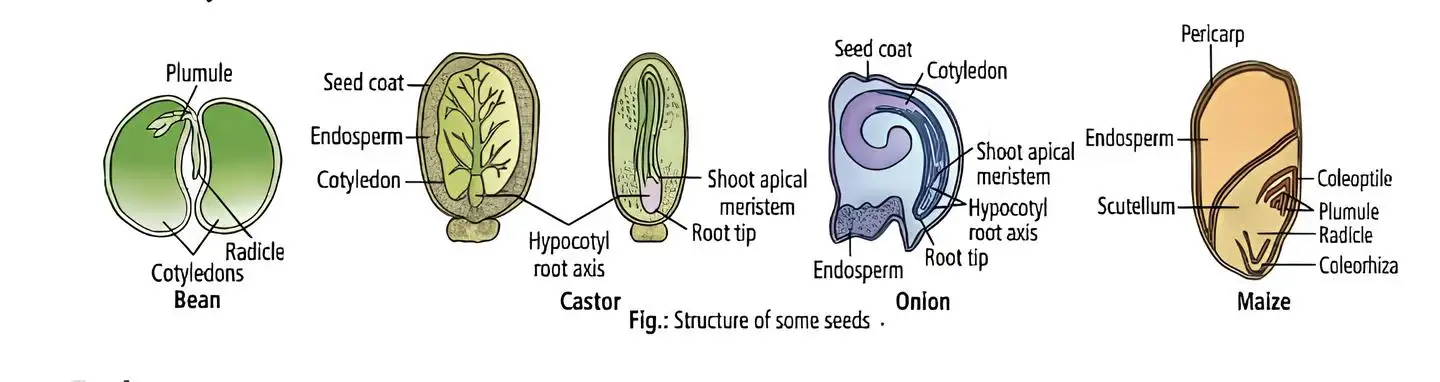
| Non-endospermic (exalbuminous) | Endosperm is consumed by the developing embryo before seed maturity. | Pea, groundnut, beans |
| Endospermic (albuminous) | Endosperm persists in the mature seed and is used during germination. | Castor, coconut |
Examples of Endosperm
- Tender coconut water: Free-nuclear endosperm containing thousands of nuclei.
- White coconut kernel: Cellular endosperm.
Embryo
- Embryo development: The zygote lies at the micropylar end of the embryo sac and usually begins dividing after some endosperm has formed.
- Stages: The zygote forms a proembryo, followed by globular, heart-shaped and mature embryo stages; early development is similar in dicots and monocots.
Dicot Embryo
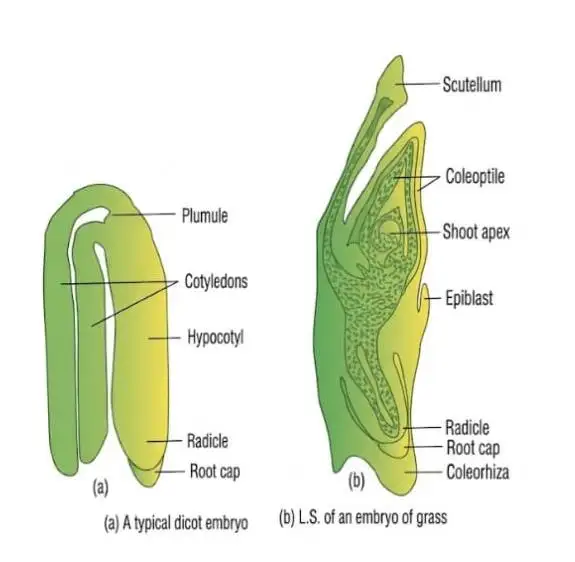
- Structure: A dicot embryo has an embryonal axis and two cotyledons.
- Epicotyl: The part above the cotyledons ends in the plumule, or stem tip.
- Hypocotyl: The part below the cotyledons ends in the radicle, or root tip, which is covered by a root cap.
Monocot Embryo
Seed
Seed Maturation and Germination
- Micropyle: Allows oxygen and water to enter the seed during germination.
- Maturation: Water content falls to about 10–15% of seed mass, slowing the embryo’s metabolic activity.
- Dormancy: The embryo may become inactive; seeds germinate when conditions are favourable.
- Germination conditions: Adequate moisture, oxygen, and suitable temperature.
Seed viability — The ability of a seed to retain its capacity to germinate over time; it may last from a few weeks to several years.
Fruit
| Part | Position / description |
|---|---|
| Epicarp | Outer skin of the fruit |
| Mesocarp | Middle, often fleshy and pulpy part |
| Endocarp | Innermost part surrounding the seeds |
| Fruit type | Develops from |
|---|---|
| Simple | A monocarpellary ovary or a multicarpellary syncarpous ovary |
| Aggregate | A multicarpellary apocarpous (free-carpel) ovary |
| Composite (multiple) | A complete inflorescence |
Parthenocarpy — Fruit formation without fertilisation; the resulting fruits are seedless.
Fruit Study and Seed Release
- Pomology: The study of fruits.
- Indehiscent fruits: Do not release seeds at maturity; seeds are released after the fruit wall disintegrates. Examples: cashew nut and cereals.
- Dehiscent fruits: Release seeds at maturity. Examples: pea and bean.
Differentiate between albuminous and non-albuminous seeds.
Name the parts of the grass embryo and their functions or positions.
What is parthenocarpy? Give one example.
Quick recap
- Post-fertilisation events include endosperm and embryo development, seed formation, and fruit formation.
- Endosperm forms before the embryo, is triploid, and may develop through free-nuclear and cellular stages.
- Dicot embryos have two cotyledons; monocot embryos have one, called the scutellum in grasses.
- A mature seed has seed coat(s), cotyledon(s), and an embryo axis; persistent nucellus is called perisperm.
- Seed viability is the capacity to germinate over time and can be reduced by reserve exhaustion, embryo damage, or enzyme denaturation.
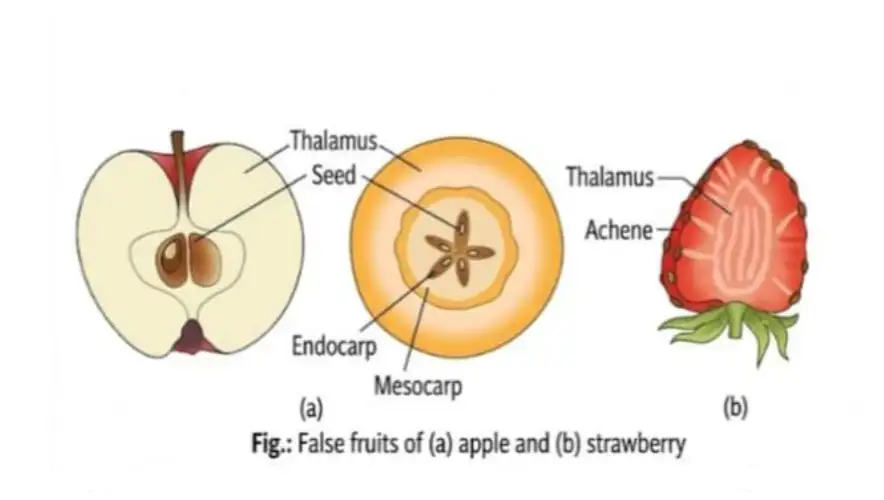
- Fruits may be true or false, and are classified as simple, aggregate, or composite by their origin.
- Parthenocarpy forms fruit without fertilisation; dehiscent fruits release seeds at maturity, unlike indehiscent fruits.
Apomixis and Polyembryony
Apomixis
Apomixis — Formation of new individuals without forming or fusing gametes; it is asexual reproduction that mimics sexual reproduction.
Polyembryony
Polyembryony — Occurrence of more than one embryo in a single seed.
| Type | How extra embryos form | Example / note |
|---|---|---|
| Simple polyembryony | More than one egg is fertilised. | A type of polyembryony. |
| Adventive polyembryony | Extra embryos develop through sporophytic budding. | A type of polyembryony. |
Examples
- Polyembryony occurs in Citrus, onion and groundnut.
What is apomixis?
Distinguish simple and adventive polyembryony.
Quick recap
- Apomixis produces new individuals without gamete formation or fusion.
- Apomixis is asexual reproduction that mimics sexual reproduction.
- Polyembryony means more than one embryo occurs in a seed.
- Simple polyembryony results from fertilisation of multiple eggs.
- Adventive polyembryony forms extra embryos through sporophytic budding.
- Citrus, onion and groundnut are examples of polyembryony.
NEET Botany — ALL CHAPTERS
1
The Living World
2
Plant Kingdom
3
Morphology of Flowering Plants
4
Anatomy of Flowering Plants
5
The Unit of Life
6
Photosynthesis in Higher Plants
7
Respiration in Plants
8
Plant Growth and Development
9
Sexual Reproduction in Flowering Plants
10
Principles of Inheritance and Variation
11
Molecular Basis of Inheritance
12
Biotechnology :Principles and Processes
13
Biotechnology and its Applications