QUESTION PAPER
2023 BOARD EXAM
CBSE Class 10 Science Board Paper 2023 — Set 2
2023
Science
Class 10
CBSE EXAMINATION PAPER-2023
SCIENCE
(Solved)
General Instructions :
Read the following instructions carefully and follow them :
- This question paper contains 45 questions. All questions are compulsory.
- This question paper is divided into 5 sections.
- Section A – questions number 1 to 3 are case based questions
- Section B – questions number 4 to 23 are multiple choice questions
- Section C – questions number 24 to 31 are very short answer
- Section D – questions number 32 to 40 are short answer
- Section E – questions number 41 to 45 are long answer
- There is no overall choice given in the question paper. However, an internal choice has been provided in few questions.
- Use of calculator is NOT allowed.
Section A
The teacher while conducting practicals in the laboratory divided the students into three groups and gave them various solutions to find out their pH and classify them into acidic, basic and neutral solutions.
Group A: Lemon juice, vinegar, colourless aerated drink.
Group B: Tomato juice, coffee, ginger juice.
Group C: Sodium hydroxide, sodium chloride, lime water.
(1) List two ways of determining pH of a solution.
[1 Mark](2) Explain, why the sour substances such as lemon juice are effective in cleaning the tarnished copper vessels.
[2 Marks](3) For the solutions provided, which group is/are likely to have pH value (i) less than 7, and (ii) greater than 7?
[1 Mark](4) "pH has great importance in our daily life." Justify this statement by giving two examples.
All the reproductive methods of living organisms are broadly categorized into two types: 1. Asexual reproduction, and 2. Sexual reproduction.
Asexual reproduction involves the participation of a single parent without the formation of gametes, fertilisation and transfer of genetic material. This method is a common means of rapidly increasing offsprings under favourable conditions.
(1) Write one advantage of sexual mode of reproduction over asexual reproduction.
[1 Mark](2) Name the type of fission that occurs in Leishmania and Plasmodium.
[1 Mark](3) Give reasons why: (i) Colonies of yeast fail to multiply in water but multiply in sugar solution. (ii) Rhizopus individuals do not grow on a dry slice of bread.
(4) Name the filamentous structures a student could identify when he collected water from a pond that appeared dark green. How do these organisms multiply ? Explain.
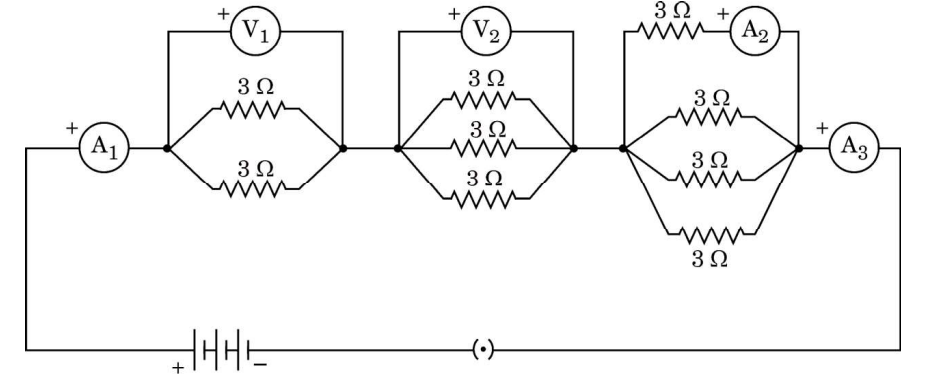
(1) What is the relationship between the readings of A₁ and A₃? Give reasons for your answer.
(2) What is the relationship between the readings of A₂ and A₃?
(3) Determine the reading of the voltmeter V₁.
(4) Find the total resistance of the circuit.
Section B
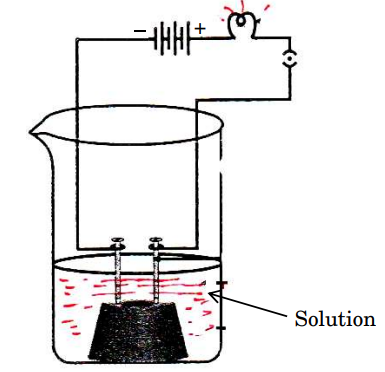
In the given experimental set-up, if the experiment is carried out separately with each of the following solutions, the cases in which the bulb will glow is/are:
(i) Dilute hydrochloric acid
(ii) Dilute sulphuric acid
(iii) Glucose solution
(iv) Alcohol
In order to balance the following chemical equation, the values of the coefficients x and y respectively are:

The total number of electrons shared in the formation of an ethyne molecule is:
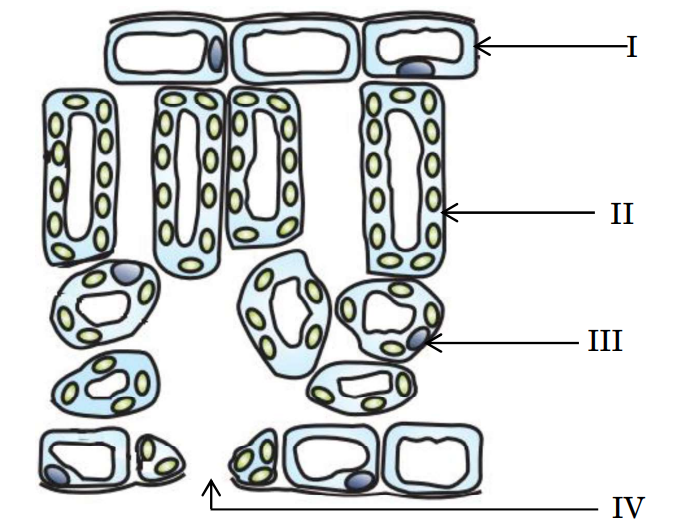
In the following diagram, identify the cells through which massive amounts of gaseous exchange takes place for photosynthesis:
When an 'X' bearing sperm fertilises the egg, the resulting zygote has the following combination of chromosomes:
An object is placed in front of a convex mirror at infinity. According to the New Cartesian Sign Convention, the sign of the focal length and the sign of the image distance in this case are respectively:
For verifying Ohm's law, we design an electric circuit diagram in which we show the arrangement of different circuit components. We find that with respect to the resistor, the:
In a resistive circuit, if the current is increased to two times, the percentage change in the amount of heat dissipated in the circuit would be:
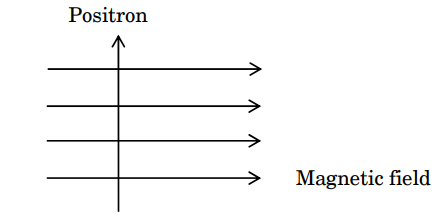
A positron enters a uniform magnetic field at right angles to it as shown. The direction of force experienced by the positron will be:
Assertion (A): Sodium oxide is an amphoteric oxide.
Reason (R): Metal oxides which react with both acids as well as bases are known as amphoteric oxides.
Assertion (A): When a bacterium divides into two, and the resultant two bacteria divide again, the four bacteria produced would be almost similar.
Reason (R): DNA copying involves small inaccuracies in the reproduction process.
Assertion (A): A person suffering from myopia cannot see distant objects clearly.
Reason (R): A converging lens is used for the correction of myopic eye as it can form real as well as virtual images of the objects placed in front of it.
Assertion (A): Magnetic field lines do not intersect each other.
Reason (R): Magnetic field lines are imaginary lines, the tangent to which at any point gives the direction of the field at that point.
Section C
When copper powder is heated in a watch glass, a black substance is formed.
(i) Why is this black substance formed? Name it.
(ii) How can this black substance be reversed to its original form?
(a) Why is it important to prevent oxygenated and deoxygenated blood from mixing in birds and mammals?
(b) Which animals can tolerate some mixing of the oxygenated and deoxygenated blood streams ? On what factor does the body temperature of these animals depend ?
Mendel crossed a pure tall pea plant (TT) with a pure short pea plant (tt) and obtained all tall plants in F generation.
(a) What is the gene combination present in the plants of F₁ generation ?
(b) Give reason why only tall plants are observed in F₁ progeny.
(c) What will be the ratio of the plants obtained in the F₂ generation when F₁ plants are self-pollinated ?
When and where does a rainbow appear in the sky ? Draw a labelled ray diagram to show its formation.
What is scattering of light ? Why does the clear sky appear blue ?
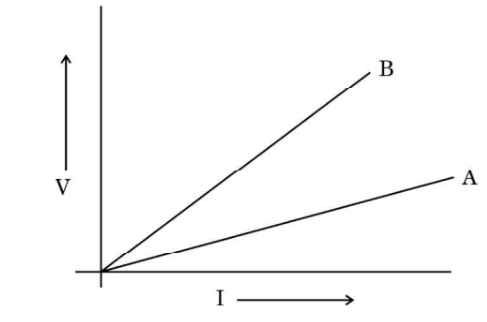
V - I graph for two conducting wires A and B are as shown. If both wires are of the same length and same diameter, which of the two is made of a material of high resistivity? Give reasons to justify your answer.
We do not clean ponds or lakes but an aquarium needs to be cleaned regularly. Why ?
Section D
Silver chloride kept in a china dish turns grey in sunlight.
(a) Write the colour of silver chloride when it was kept in the china dish.
(b) Name the type of chemical reaction taking place and write the chemical equation for the reaction.
(c) State one use of the reaction. Name one more chemical which can be used for the same purpose.
With the help of suitable chemical equations, list the two main differences between roasting and calcination. How is metal reduced from the product obtained after roasting/calcination of the ore ? Write the chemical equation for the reaction involved.
(i) What is the first step in the breakdown of glucose during aerobic and anaerobic respiration ? Where does it take place ?
(ii) ATP is called the energy currency of the cell. Why ?
(iii) What is meant by residual volume of air in a breathing cycle ?
Write in sequence the steps for experimental verification of the fact that sunlight is essential for photosynthesis .
Name the hormone released and the gland which secretes it in human beings during scary situations. How does the body respond to enable it to deal with the situation ?
A student has focussed the image of an object of height 3 cm on a white screen using a concave mirror of focal length 12 cm. If the distance of the object from the mirror is 18 cm, find the values of the following :
(i) Distance of the image from the mirror
(ii) Height of the image
Define power of a lens. The focal length of a lens is 10 cm. Write the nature of the lens and find its power. If an object is placed at a distance of 20 cm from the optical centre of this lens, according to the New Cartesian Sign Convention, what will be the sign of magnification in this case ?
Explain the meaning of overloading of an electrical circuit. List two possible causes due to which overloading may occur in household circuits. Write one preventive measure that should be taken to avoid overloading of domestic circuits.
Explain how some harmful chemicals enter our bodies through the food chain. Why is the concentration of these harmful chemicals found to be maximum in human beings ?
Section E
An acid 'X' and an alcohol 'Y' react with each other in the presence of an acid catalyst to form a sweet smelling substance 'Z'. Identify 'X', 'Y' and 'Z'. Write the chemical equation for the reaction involved and name it. The substance 'Z' on treatment with sodium hydroxide produces back the alcohol 'Y' and sodium ethanoate. Write the chemical equation for the reaction involved and name it, giving justification for the name.
(i) Name the simplest saturated hydrocarbon. Draw its electron dot structure. Which type of bonds exist in this compound ?
(ii) Name any two mixtures of the carbon compound used as a fuel in daily life, of which the above mentioned compound is an important component.
(iii) In which homologous series of carbon compounds can this compound be placed ? Write the general formula of the series.
(iv) Which type of flame is produced on burning it ?
(i) List three points of difference between nervous and hormonal mechanisms for control and coordination in animals.
(ii) How are auxins related with the bending of plant shoot towards unidirectional light ? Explain.
(i) Name the disorder which a person is likely to suffer from due to the following :
(I) Over-secretion of growth hormone
(II) Deficiency of oestrogen in females
(III) Less secretion of thyroxine
Also name the gland that secretes each of the hormones mentioned above.
(ii) How is the timing and amount of hormone released regulated ? Explain with the help of an example.
(a) An object is placed in front of a convex lens of focal length f. If the distance of the object from the lens is 2f, draw a ray diagram to show the formation of the image. Write the value of magnification in this case.
(b) A student has focussed the image of a candle flame on a white screen using a convex lens. The situation is as given below : Length of the flame = 2 cm Focal length of the lens = 12 cm Distance of the flame from the lens = 16 cm If the flame is perpendicular to the principal axis of the lens, calculate the values of the following :
(i) Distance of the image from the lens
(ii) Length of the image formed
Paper Details
CBSE Board Exam 2023
Class
Class 10
Subject
Science
Year
2023
Set
Set 2
Other Years — Science