SOLUTIONS
2024 BOARD EXAM
CBSE Class 10 Science Board Paper 2024 — Set 1 Solutions
2024
Science
Class 10
CBSE EXAMINATION PAPER-2024
SCIENCE
(Solved)
General Instructions :
Read the following instructions carefully and follow them :
- This question paper contains 45 questions. All questions are compulsory.
- This question paper is divided into 5 sections.
- Section A – questions number 1 to 3 are case based questions
- Section B – questions number 4 to 23 are multiple choice questions
- Section C – questions number 24 to 31 are very short answer
- Section D – questions number 32 to 39 are short answer
- Section E – questions number 40 to 45 are long answer
- There is no overall choice given in the question paper. However, an internal choice has been provided in few questions.
- Use of calculator is NOT allowed.
Section A
(1) What is the cathode and anode made of in the refining of copper by this process?
[1 Mark](2) Name the solution used in the above process and write its formula.
[1 Mark](3) How copper get refined when electric current is passed in the electrolytic cell?
(4) You have two beakers 'A' and 'B' containing copper sulfate solution. What would you observe after about 2 hours if you dip a strip of zinc in beaker 'A' and a strip of silver in beaker 'B'? Give reason for your observations in each case.
[2 Marks]Mendel worked out the rules of heredity by working on garden pea using a number of visible contrasting characters. He conducted several experiments by making a cross with one or two pairs of contrasting characters of pea plant. On the basis of his observations he gave some interpretations which helped to study the mechanism of inheritance.
(1) When Mendel crossed pea plants with pure tall and pure short characteristics to produce F₁ progeny, which two observations were made by him in F₁ plants?
(2) Write one difference between dominant and recessive trait.
[1 Mark](3) In a cross with two pairs of contrasting characters Mendel observed 4 types of combinations in F₂ generation. By which method did he obtain F₂ generation? Write the ratio of the parental combinations obtained and what conclusions were drawn from this experiment.
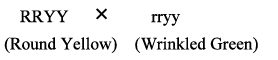 [2 Marks]
(4) Justify the statement: "It is possible that a trait is inherited but may not be expressed."

(1) List two properties of the image formed in case 2.
[1 Mark](2) In which one of the above cases will the mirror form a diminished image of the object? Justify your answer.
[1 Mark](3) What is the nature and size of the image formed by mirror C? Draw a ray diagram to justify your answer.
[2 Marks](4) An object is placed at a distance of 18 cm from the pole of a concave mirror of focal length 12 cm. Find the position of the image formed in this case.
Section B
When 2 mL of sodium hydroxide solution is added to a few pieces of granulated zinc in a test tube and then warmed, the reaction that occurs can be written in the form of a balanced chemical equation as:
The reaction between zinc metal and sodium hydroxide solution on warming produces sodium zincate (Na₂ZnO₂) and hydrogen gas (H₂). The balanced chemical equation that represents this reaction is 2NaOH + Zn → Na₂ZnO₂ + H₂. This is confirmed by the given context, which states that “2NaOH (aq) + Zn (s) → Na₂ZnO₂ (s) + H₂ (g)” and mentions the formation of hydrogen gas.
Select from the following a decomposition reaction in which the source of energy for decomposition is light:
The decomposition of silver bromide (2AgBr) into silver (2Ag) and bromine gas (Br₂) is caused by light energy, as given in the context. This reaction is similar to the decomposition of silver chloride by sunlight, which is used in black and white photography. Other reactions mentioned require heat or electricity, but 2AgBr decomposes specifically due to light energy.
A metal and a non-metal that exists in liquid state at the room temperature are respectively:
Carbon compounds:
(i) are good conductors of electricity.
(ii) are bad conductors of electricity.
(iii) have strong forces of attraction between their molecules.
(iv) have weak forces of attraction between their molecules.
The correct statements are:
Consider the following compounds:
FeSO₄, CuSO₄, CaSO₄, Na₂CO₃
The compound having maximum number of waters of crystallization in its crystalline form in one molecule is:
MnO₂+4HCl→MnCl₂+2H₂O+ Cl₂.
The reaction given above is a redox reaction because in this case:
Consider the following statements:
(i) The sex of a child is determined by what it inherits from the mother.
(ii) The sex of a child is determined by what it inherits from the father.
(iii) The probability of having a male child is more than that of a female child.
(iv) The sex of a child is determined at the time of fertilization when male and female gametes fuse to form a zygote. The correct statements are:
The correct statements are (ii) and (iv). The sex of a child is determined by the chromosome inherited from the father, since the mother always provides an X chromosome while the father can provide either an X or a Y chromosome. The presence of a Y chromosome makes the child male, while XX makes the child female. This determination happens at fertilization when the sperm and egg fuse to form a zygote. Statement (i) is incorrect because the mother's chromosome is always X and does not determine sex. Statement (iii) is incorrect because the probability of having a male or female child is approximately equal.
Chromosomes:
(i) carry hereditary information from parents to the next generation.
(ii) are thread-like structures located inside the nucleus of an animal cell.
(iii) always exist in pairs in human reproductive cells.
(iv) are involved in the process of cell division. The correct statements are:
A stomata closes when:
(i) it needs carbon dioxide for photosynthesis.
(ii) it does not need carbon dioxide for photosynthesis.
(iii) water flows out of the guard cells.
(iv) water flows into the guard cells.
The correct reason(s) in this process is/are:
The correct options are (ii) and (iii). According to the provided context, stomata close when the plant does not need carbon dioxide for photosynthesis to prevent excessive water loss. This closure happens because the guard cells lose water and shrink, causing the stomatal pore to close. Therefore, stomata close when the plant does not need carbon dioxide (ii), and when water flows out of the guard cells causing them to shrink (iii). Water flowing into guard cells (iv) causes them to swell and the stomata to open, and needing carbon dioxide (i) leads to stomatal opening, not closing.
-
(A)
-
(B)
-
(C)

-
(D)
Assertion (A) Hydrogen gas is not evolved when zinc reacts with nitric acid.
Reason (R) Nitric acid oxidises the hydrogen gas produced to water and itself gets reduced.
Both Assertion (A) and Reason (R) are true and Reason (R) is the correct explanation of the Assertion (A). When zinc reacts with nitric acid, hydrogen gas is not evolved because nitric acid is a strong oxidising agent. It oxidises any hydrogen gas that would be formed into water, and itself gets reduced. This is different from reactions with dilute sulfuric or hydrochloric acid, where hydrogen gas is evolved.
Assertion (A): Accumulation of harmful chemicals is maximum in the organisms at the highest trophic level of a food chain.
Reason (R): Harmful chemicals are sprayed on the crops to protect them from diseases and pests
Both Assertion (A) and Reason (R) are true, but Reason (R) is not the correct explanation of the Assertion (A). The assertion is true because harmful chemicals, which are not degradable, get accumulated progressively at each trophic level, leading to maximum accumulation in organisms at the highest trophic level (biological magnification). The reason is also true as harmful chemicals like pesticides are sprayed on crops to protect them from diseases and pests. However, the reason does not directly explain the assertion; it only explains the source of harmful chemicals, not the fact that accumulation is maximum at the highest trophic level.
Assertion (A): The rate of breathing in aquatic organisms is much faster than in terrestrial organisms.
Reason (R): The amount of oxygen dissolved in water is very high as compared to the amount of oxygen in air.
Assertion (A) is true because aquatic organisms generally have a faster breathing rate to meet their oxygen needs. However, Reason (R) is false because the amount of oxygen dissolved in water is actually much lower compared to oxygen in the air. The low availability of oxygen in water forces aquatic organisms to breathe faster to intake sufficient oxygen. Therefore, the correct option is: Assertion (A) is true, but Reason (R) is false.
Assertion (A): The rainbow is a natural spectrum of sunlight in the sky.
Reason (R): Rainbow is formed in the sky when the sun is overhead and water droplets are also present in air.
correct option: Assertion (A) is true, but Reason (R) is false.
Section C
Explanation: When calcium oxide (CaO) reacts with water (H2O), they combine to form a single product, calcium hydroxide Ca(OH)2, also known as slaked lime. This type of reaction where two or more reactants combine to form one product is called a combination reaction.
Chemical Equation: CaO (s) + H2O (l) → Ca(OH)2 (aq) + Heat
This reaction releases heat, which shows it is exothermic. It is also called the slaking of lime.
State one role of each of the following in human digestive system:
(i) Hydrochloric acid
(ii) Vill
(iii) Anal Sphincter
(iv) Lipase.
(ii) Villi are tiny finger-like projections in the small intestine that increase the surface area for absorption of nutrients.
(iii) Anal sphincter controls the opening and closing of the anus and helps in the controlled elimination of feces.
(iv) Lipase is an enzyme that breaks down fats into glycerol and fatty acids in the digestive system.
How is the movement of leaves of a sensitive plant different from the downward movement of the roots?
There is a hormone which regulates carbohydrate, protein and fat metabolism in our body. Name the hormone and the gland which secretes it. Why is it important for us to have iodised salt in our diet?
Show how you would connect three resistors each of resistance 6 Ω, so that the combination has a resistance of 9 Ω. Also justify your answer.
To get a combination resistance of 9 ohms using three 6 ohm resistors, connect two resistors in series and then connect the third resistor in parallel to this series combination.
Step 1: Connect two resistors in series. Their combined resistance Rₛₑᵣᵢₑₛ = 6 Ω + 6 Ω = 12 Ω.
Step 2: Connect this series combination in parallel with the third resistor (6 Ω).
Step 3: Equivalent resistance R_eq = 1 / (1 / 12 + 1 / 6) = 1 / (1 / 12 + 2 / 12) = 1 / (3 / 12) = 4 Ω, but since we want 9 Ω, reverse the process.
Actually, connect two resistors in parallel and then connect the third in series.
Step 1: Two resistors in parallel, Rₚₐᵣₐₗₗₑₗ = 1 / (1 / 6 + 1 / 6) = 3 Ω.
Step 2: Connect the third resistor (6 Ω) in series: R_eq = 3 Ω + 6 Ω = 9 Ω.
Therefore, connect two resistors in parallel and then connect the third resistor in series with this parallel combination to get an equivalent resistance of 9 ohms.
This works because the total resistance decreases in parallel and increases in series, allowing us to get the required resistance.
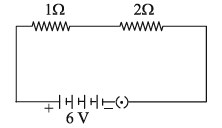
In the given circuit calculate the power consumed in watts in the resistor of 2 Ω:
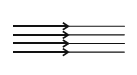
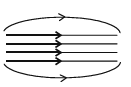
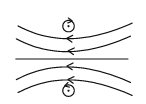
(i) Two magnetic field lines do not intersect each other. Why?
(ii) How is a uniform magnetic field in a given region represented? Draw a diagram in support of your answer.
(i) Two magnetic field lines do not intersect each other because if they did, it would mean that at the point of intersection, the magnetic field has two different directions, which is not possible. The tangent to the field line at any point shows the direction of the magnetic field, so field lines must not cross.
(ii) A uniform magnetic field is represented by straight, parallel, and equally spaced magnetic field lines. This shows that the magnetic field has the same strength and direction at every point in that region. For example, between two opposite poles of two identical magnets placed close to each other, the magnetic field lines are parallel and evenly spaced.
Section D
Write one chemical equation each for the chemical reaction in which the following have taken place:
(i) Change in colour
(ii) Change in temperature
(iii) Formation of precipitate.
Mention colour change/temperature change (rise/fall)/compound precipitated along with equation.
Example: Copper sulphate solution is blue. When iron is added, the solution turns greenish due to formation of iron sulphate.
Equation: CuSO4 (blue) + Fe → FeSO4 (green) + Cu
(b) Change in temperature:
Example: When quicklime (CaO) is mixed with water, heat is released (temperature rise).
Equation: CaO + H2O → Ca(OH)2 + heat
(c) Formation of precipitate:
Example: When silver nitrate reacts with sodium chloride, a white precipitate of silver chloride is formed.
Equation: AgNO3 + NaCl → AgCl (white precipitate) + NaNO3
(i) The pH of a sample of tomato juice is 4.6. How is this juice likely to be in taste? Give reason to justify your answer.
(ii) How do we differentiate between a strong acid and a weak base in terms of ion-formation in aqueous solutions ?
(iii) The acid rain can make the survival of aquatic animals difficult. How?
(ii) A strong acid ionizes completely in aqueous solution, producing a large number of H+ ions. For example, hydrochloric acid (HCl) dissociates fully to give H+ and Cl- ions. A weak base, on the other hand, does not ionize completely in water and produces fewer OH- ions. For example, ammonia (NH3) ionizes partially, forming fewer hydroxide ions. Thus, ion formation helps differentiate between strong acids and weak bases.
(iii) Acid rain contains dissolved acidic components like sulfuric and nitric acids which lower the pH of water bodies. This acidic environment harms aquatic animals by disrupting their physiological balance, damaging gills, causing skin irritation, and affecting reproduction. Low pH can also dissolve toxic metals from the soil which further pollute the water and make survival difficult for aquatic life.
(i) Why is respiratory pigment needed in multicellular organisms with large body size?
(ii) Give reasons for the following:
(a) Rings of cartilage are present in the throat,
(b) Lungs always contain a residual volume of air,
(c) The diaphragm flattens and ribs are lifted up when we breathe,
(d) Walls of alveoli contain an extensive network of blood vessels.
(i) Need for respiratory pigment in multicellular organisms with large body size:
In large multicellular organisms, simple diffusion is not sufficient to supply oxygen to all cells because the body size is large and cells are far from the external environment. Respiratory pigments like haemoglobin bind oxygen from the lungs and transport it through the blood to the tissues that need oxygen. This ensures efficient oxygen delivery and maintains the body’s metabolic needs.
(ii) Reasons for the following:
(a) Rings of cartilage are present in the throat: These cartilage rings keep the trachea or windpipe open and prevent its collapse when we breathe, ensuring continuous airflow.
(b) Lungs always contain a residual volume of air: This residual air prevents the lungs from collapsing and ensures that gas exchange can continue even between breaths.
(c) The diaphragm flattens and ribs are lifted up when we breathe: This increases the chest cavity volume, causing air to be sucked into the lungs for inhalation.
(d) Walls of alveoli contain an extensive network of blood vessels: This rich blood supply helps in the efficient exchange of gases—oxygen moves from alveoli into blood, and carbon dioxide moves from blood into alveoli for exhalation.
Study the diagram given below and answer the questions that follow:
(i) Name the defect of vision represented in the diagram. Give reason for your answer.
(ii) List two causes of this defect.
(iii) With the help of a diagram, show how this defect of vision is corrected.
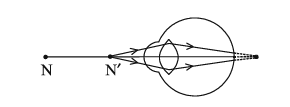
(ii) Causes: Two causes of myopia are: (1) Excessive curvature of the eye lens, (2) Elongation of the eyeball.
(iii) Correction: Myopia can be corrected by using a concave lens of suitable power. The concave lens diverges the light rays before they enter the eye, which moves the focal point backward so that the image is formed exactly on the retina, resulting in clear distant vision.
Below is a simple diagram illustrating the correction of myopia:
Concave lens → |>>>>(Eye) → Image on retina.
This correction helps the eye focus distant objects properly.
Plants → Deer → Lion.
In the given food chain, what will be the impact of removing all the organisms of the second trophic level on the first and third trophic levels? Will the impact be the same for the organisms of the third trophic level in the above food chain if they were present in a food web? Justify.
A gas 'X' which is a deadly poison is found at the higher levels of the atmosphere and performs an essential function.
Name the gas and write the function performed by this gas in the atmosphere. Which chemical is linked to the decrease in the level of this gas? What measures have been taken by an international organization to check the depletion of the layer containing this gas?
The gas 'X' referred to in the question is ozone (O₃). Although ozone is a deadly poison at ground level, it plays a crucial role in the higher levels of the atmosphere, specifically in the ozone layer. It absorbs and shields the Earth's surface from harmful ultraviolet (UV) radiation from the Sun, which can cause serious health problems such as skin cancer and damage to living organisms.
The depletion of the ozone layer is mainly caused by chemicals called chlorofluorocarbons (CFCs). These chemicals release chlorine atoms when they break down in the stratosphere, which then destroy ozone molecules, leading to thinning of the ozone layer.
To address this serious environmental problem, the international community adopted the Montreal Protocol, an agreement to phase out the production and use of ozone-depleting substances like CFCs. Due to these measures, the ozone layer's depletion has slowed down, and there are signs of recovery, although continuous efforts are needed to protect it fully.
Name and state the rule to determine the direction of a:
(i) magnetic field produced around a current carrying straight conductor.
(ii) force experienced by a current carrying straight conductor placed in a magnetic field which is perpendicular to it.
(i) The rule to determine the direction of the magnetic field around a current-carrying straight conductor is called the Right-Hand Rule. According to this rule, if you point the thumb of your right hand in the direction of the current, then the way your fingers curl around the conductor shows the direction of the magnetic field. This magnetic field forms concentric circles around the wire.
(ii) The rule to find the direction of the force on a current-carrying conductor placed in a magnetic field perpendicular to it is called Fleming's Left-Hand Rule. According to this rule, stretch your thumb, first finger, and second finger of the left hand so that they are mutually perpendicular. The first finger points in the direction of the magnetic field (from North to South), the second finger points in the direction of the current, and the thumb will then point in the direction of the force (motion) experienced by the conductor.
Section E
(i) Define a homologous series of carbon compounds.
(ii) Why is the melting and boiling points of C₄H₈ higher than that of C₃H₆ or C₂H₄?
(iii) Why do we NOT see any gradation in chemical properties of a homologous series compound?
(iv) Write the name and structures of (i) aldehyde and (ii) ketone with molecular form C₃H₆O.
(ii) The melting and boiling points of C4H8 are higher than C3H6 and C2H4 because it has a larger molecular size and greater surface area leading to stronger intermolecular forces (like van der Waals forces), which require more energy to overcome.
(iii) We do not see gradation in chemical properties in a homologous series because the chemical properties depend mainly on the functional group which remains the same in all members of the series, so the reaction behaviour is similar.
(iv) (a) Aldehyde with formula C3H6O is Propanal. Structure: CH3-CH2-CHO.
(b) Ketone with formula C3H6O is Acetone (Propanone). Structure: CH3-CO-CH3.
(i) Write the name and structure of an organic compound 'X' having two carbon atoms in its molecule and its name is suffixed with '-ol'. 5
(ii) What happens when 'X' is heated with excess concentrated sulphuric acid at 443 K? Write chemical equation for the reaction stating the conditions for the reaction. Also state the role played by concentrated sulphuric acid in the reaction.
(iii) Name and draw the electron dot structure of hydrocarbon produced in the above reaction.
(ii) When ethanol (X) is heated with excess concentrated sulphuric acid at 443 K, it undergoes a dehydration reaction where a molecule of water is removed resulting in the formation of ethene (an alkene). The reaction is:
CH3-CH2-OH --(hot conc. H2SO4, 443 K)--> CH2=CH2 + H2O
Concentrated sulphuric acid acts as a dehydrating agent and catalyst in this reaction. It removes water from ethanol to form ethene and also speeds up the reaction without being consumed.
(iii) The hydrocarbon formed is Ethene (C2H4). Its electron dot structure represents the covalent bonds between the two carbon atoms with a double bond and the bonded hydrogen atoms. The structure can be shown as:
C : C
| |
H H H H
Each line corresponds to a pair of shared electrons (a covalent bond) between atoms. Ethene has a double bond between the two carbon atoms indicating the presence of 4 shared electrons between them.
(i) Name three techniques/devices used by human females to avoid 5pregnancy. Mention the side effects caused by each.
(ii) What will happen if in a human female (a) fertilisation takes place, (b) an egg is not fertilised?
1. Barrier method (e.g., condom or diaphragm): This method prevents sperm from reaching the egg.
Side effects: Some people may have allergies or irritation due to latex.
2. Oral contraceptive pills: These pills change the hormonal balance of the body so that eggs are not released from the ovaries.
Side effects: Nausea, weight gain, mood changes, or blood clots in rare cases.
3. Intrauterine device (IUD): A small device inserted in the uterus to prevent fertilization or implantation.
Side effects: May cause abdominal pain, heavy bleeding, or infection in some women.
(ii) (a) If fertilisation takes place in a human female, the fertilised egg (zygote) moves to the uterus and gets implanted in the uterine lining. This leads to pregnancy, and the embryo starts developing.
(b) If an egg is not fertilised, it will not get implanted in the uterus. The egg along with the thickened lining of the uterus breaks down and is shed from the body during menstruation.
(i) Draw a diagram showing spore formation in Rhizopus and label the (a) reproductive and (b) non reproductive parts. Why does Rhizopus not multiply on a dry slice of bread?
(ii) Name and explain the process by which reproduction takes place in Hydra.
(ii) In Hydra, reproduction takes place by a process called budding. A small bud develops on the body of the parent Hydra due to repeated cell division at one spot. This bud grows into a miniature Hydra and when fully developed, it detaches from the parent and becomes an independent organism. Budding allows Hydra to reproduce asexually and produce offspring genetically identical to the parent.
(i) Define electric power. Express it in terms of potential difference (V) and resistance (R).
(ii )An electric oven is designed to work on the mains voltage of 220 V. This oven consumes 11 units of electrical energy in 5 hours. Calculate:
(a) power rating of the oven
(b) current drawn by the oven
(c) resistance of the oven when it is red hot
It is expressed as the product of potential difference (V) and current (I) in the circuit, i.e., P = V * I.
Using Ohm's law, I = V / R, so power can also be expressed as P = V * (V / R) = V2 / R.
(ii) Given data: Voltage, V = 220 V
Energy consumed = 11 units = 11 kWh
Time, t = 5 hours
(a) Power rating of the oven:
Energy consumed = Power * time
Power = Energy / time = 11 kWh / 5 h = 2.2 kW = 2200 W
(b) Current drawn by the oven:
Using P = V * I, I = P / V = 2200 W / 220 V = 10 A
(c) Resistance of the oven when red hot:
Using Ohm's law, V = I * R, so R = V / I = 220 V / 10 A = 22 ohms.
(i) Write the relation between resistance R and electrical 5 resistivity ρ of the material of a conductor in the shape of cylinder of length l and area of cross-section A. Hence derive the SI unit of electrical resistivity.
(ii) The resistance of a metal wire of length 3 m is 60 Ω. If the area of cross-section of the wire is 4×10⁻⁷𝑚², calculate the electrical resistivity of the wire.
(iii) State how would electrical resistivity be affected if the wire (of part 'ii') is stretched so that its length is doubled. Justify your answer.
The SI unit of resistance R is ohm (Ω), length l is measured in meters (m), and area A in square meters (m2). Therefore, the SI unit of resistivity ρ is Ω * m, derived as ρ = R * (A / l) = (Ω) * (m2 / m) = Ω * m.
(ii) Given: Length l = 3 m, Resistance R = 60 Ω, Area of cross-section A = 4 * 10-7 m2.
Using the formula for resistivity: ρ = R * (A / l) = 60 * (4 * 10-7 / 3) = 60 * (1.3333 * 10-7) = 8 * 10-6 Ω m.
Therefore, the electrical resistivity of the wire is 8 × 10⁻⁶ ohm meter.
(iii) Electrical resistivity ρ depends only on the material and temperature. When the wire is stretched to double its length, its dimensions change but the material remains the same. Therefore, the resistivity ρ remains unchanged.
Justification: Resistivity is an intrinsic property of the material and does not depend on the shape or size of the conductor. Even if the length doubles and area changes, resistivity remains constant as long as the temperature stays the same.
Paper Details
CBSE Board Exam 2024
Class
Class 10
Subject
Science
Year
2024
Set
Set 1
Other Years — Science