QUESTION PAPER
2025 BOARD EXAM
CBSE Class 10 Science Board Paper 2025 — Set 5
2025
Science
Class 10
CBSE EXAMINATION PAPER-2025
SCIENCE
(Solved)
General Instructions :
Read the following instructions carefully and follow them :
- This question paper contains 46 questions. All questions are compulsory.
- This question paper is divided into 5 sections.
- Section A – questions number 1 to 3 are case based questions
- Section B – questions number 4 to 23 are multiple choice questions
- Section C – questions number 24 to 32 are very short answer
- Section D – questions number 33 to 40 are short answer
- Section E – questions number 41 to 46 are long answer
- There is no overall choice given in the question paper. However, an internal choice has been provided in few questions.
- Use of calculator is NOT allowed.
Section A
(1) An element A has atomic number 16, how will it attain its nearest noble gas configuration?
[1 Mark](2) Write the number of (i) single and (ii) double covalent bonds in a molecule of butene (C4H8).
[1 Mark](3) Explain the formation of a molecule of ammonia (NH₃), using electron dot structure. (Atomic number of nitrogen is 7)
(4) Why does carbon share its valence electrons with other atoms of carbon or with atoms of other elements ?
In human beings, there are 23 pairs of chromosomes. Out of these 23 pairs of chromosomes (i.e. 46 chromosomes), 22 pairs of chromosomes are called autosomes and one pair of chromosomes. i.e. two chromosomes are called sex chromosomes. The sex chromosomes are of two types — ‘X’ chromosomes and ‘Y chromosomes. The sex of a child (i.e. progeny), is decided at the time of fertilisation. In other words, at the time of zygote formation the sex chromosomes inherited from the parents of a child decide whether the new born will be a boy or a girl.
(1) What are chromosomes?
[1 Mark](2) Why is the pair of sex chromosomes in human males called mismatched pair?
[1 Mark](3) Show with the help of a flow chart that the statistical probability of getting a boy or a girl is 50 : 50.
[2 Marks](4) Mention two examples of animals where sex is not determined genetically like human beings. Describe in brief the method of sex determination in these animals.
In order to obtain magnetic field lines around a bar magnet, a student performed an experiment using a magnetic compass and a bar magnet. The magnet was placed on a sheet of white paper fixed on a drawing board. Using magnetic needle he obtained on the paper a pattern of magnetic field lines (as shown below) around the bar magnet.
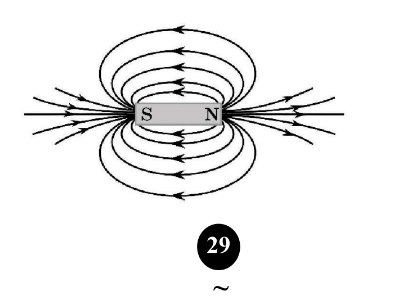
(1) By convention, the field lines emerge from the north pole and merge at the south pole. Why? Give reason.
[1 Mark](2) State the relationship between strength of the magnetic field and the degree of closeness of the field lines.
(3) (i) No two field lines can ever intersect each other. Give reason. (ii) The magnetic field in a given region is uniform. Draw a diagram to represent it.
(4) Draw the pattern of the magnetic field lines through and around a current carrying solenoid. What does the pattern of field lines inside the solenoid represent ?
Section B
The main observations while performing the experiment of burning magnesium ribbon in air are:
(i) Magnesium ribbon burns with a dazzling white flame.
(ii) A white powder is formed.
(iii) Magnesium ribbon vapourises.
(iv) Aqueous solution of the white powder turns blue litmus to red.
A common feature observed in the crystals of washing soda, copper sulphate, gypsum and ferrous sulphate is that all:
The values of a, b, c, and d in the following balanced chemical equation are respectively:
a Pb(NO₃)₂ ⟶(heat) b PbO + c NO₂ + d O₂
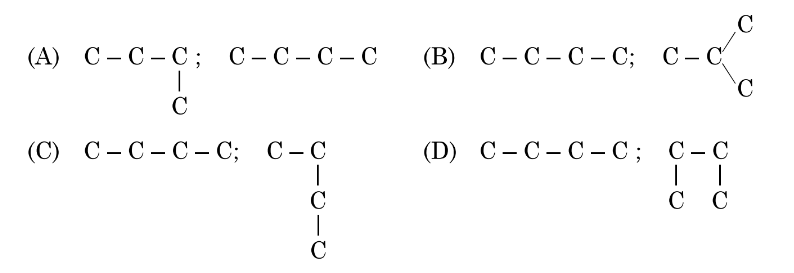
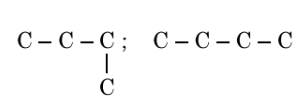
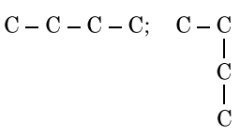
If we make a carbon skeleton with four carbon atoms, the two different possible skeletons will be:
-
(A)
-
(B)
-
(C)
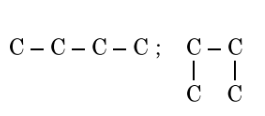
-
(D)
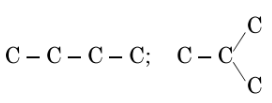
Listed below are the steps of nutrition in Amoeba. Select the correct sequence of these steps :
(i) Diffusion of simple nutrients into cytoplasm
(ii) Food vacuole formation
(iii) Formation of finger like temporary extensions of cell surface
(iv) Complex substances broken to simpler ones
(v) Undigested material thrown out of the cell surface
Which among the following is not a neural action controlled by the part of the human brain labelled ‘X’ in the figure above?
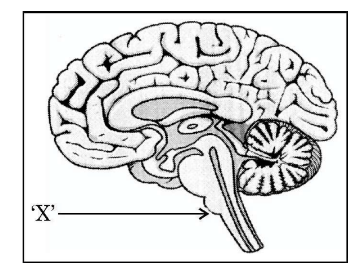
The examples of natural and manmade (artificial) ecosystems are respectively:
Human activities that are affecting the environment are:
Assertion (A): Silver chloride turns grey in sunlight.
Reason (R): Decomposition of silver chloride into silver and chlorine takes place by sunlight.
Assertion (A): The embryo gets nutrition from the mother’s blood with the help of a tissue called placenta.
Reason (R): Placenta is a disc embedded in the uterine wall.
Assertion (A): The pattern of the magnetic field of a solenoid carrying current is similar to that of a bar magnet.
Reason (R): The pattern of the magnetic field around a current carrying conductor is independent of the shape conductor.
Assertion (A): All organisms can make organic compounds like sugar and starch from inorganic substances using radiant energy of the sun.
Reason (R): The Organisms producing food by photosynthesis are called producers.
Section C
A crystalline substance of green colour ‘X’ emits gases of characteristic odour when heated over a flame. It first loses water and changes colour. On further heating, it decomposes and produces a solid compound Y.
(a) Identify ‘X’ and ‘Y.
(b) State the change in colour observed when ‘X’ is heated.
Give reasons:
(a) The male reproductive organ responsible for formation of germ cells is located outside the abdominal cavity.
(b) The roles of the glands, present along the path of the vas-deferens, are very significant.
How is lymph formed ? State its important function.
(a) Identify ‘X’ in the figure of human nephron shown below. What role does it play in the process of urine formation ?
(b) Why some substances are selectively reabsorbed from the initial filtrate of urine, as it flows along the tabular part of nephron ?
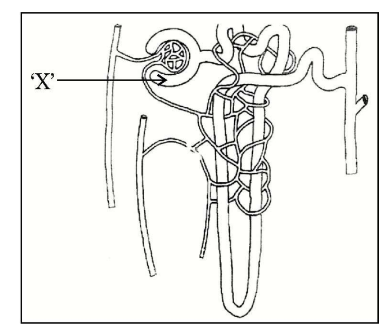
The values of absolute refractive indices of kerosene and water are 1.44 and 1.33 respectively. Compare the two media on the basis of their
(a) optical density
(b) mass density
(c) relative speed of propagation of light.
What do you infer on the basis of above comparisons?
(a) Why are the organisms of first trophic level important in any food chain ?
(b) Justify the following statement :
‘The flow of energy in an ecosystem is unidirectional.’
Establish the relationship between the commercial unit of electric energy and the SI unit of electric energy.
Section D
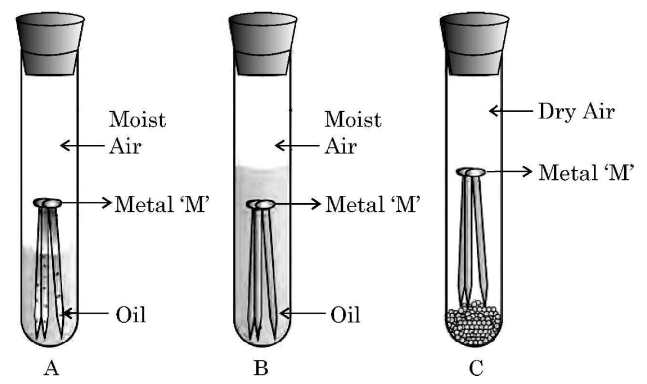
Observe the following diagram showing an experiment to determine the conditions under which a metal ‘M’ corrodes.
List your observations in each of the three cases A, B, and C with reasons, if the metal ‘M’ is generally protected against corrosion by the method of galvanisation.
(a) Write the name and one function of respiratory pigment found in human beings.
(b) Why do lungs always contain a residual volume of air ?
(c) Why is ATP known as energy currency of the living beings ?
(a) Define fertilisation.
(b) What happens to Zygote, Ovule, Ovary and Stamens after fertilisation in a flowering plant ?
The power of a lens is 0.25 D. Based on this information, find out
(a) The type of lens and its focal length.
(b) The eye defect for which it may be used as a corrective lens.
(c) The nature and size of the image formed by this lens when an object is placed between F and 2F from the optical centre of this lens.
The resistance of a wire of 0.01 cm radius is 7 ohms. If the resistivity of the material of the wire is 44 x 10⁻⁶ ohm meter, calculate the length of the wire.
(a) “The third wire of earth connection is very important in domestic electric appliances.” Justify this statement.
(b) List two precautions to be taken to avoid the overloading of domestic electric circuits.
(a) Show the formation of Aluminium Nitride (AIN) by the transfer of electrons. [ At. no. of Al = 13; At. no. of N= 7]
(b) “Ionic compounds are solids and are generally brittle and break into pieces when pressure is applied.” Give reason to justify the statement.
Section E
(a) What is meant by the term homologous series of carbon compounds ? Write molecular formula of any two consecutive members of homologous series of ketones.
(b) Write chemical equation of the reactions of ethanoic acid with
(i) Sodium hydroxide and
(ii) Ethanol (in the presence of an acid); giving the name of the products in each case.
(c) Draw the structure of the molecule of benzene.
(a) Analyse the given situations and interpret the possible reason for each :
(i) Iodine deficiency in diet increases the possibility of a disease of swollen neck in a person.
(ii) Some people in population may have very short heights (dwarfs).
(iii) Thick facial hairs develop in boys at the age of 10-12 years.
(b) Explain two reasons which necessitate the need of chemical communication in multicellular organisms.
(a) Differentiate between voluntary and involuntary action.
(b) Define reflex action. With the help of a flow diagram, show the correct sequence of path of Nerve impulse from place of its origin.
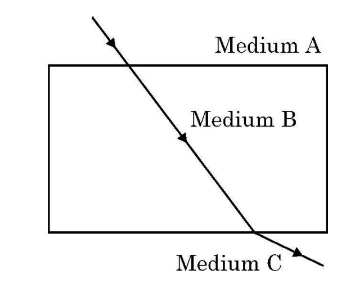
(a) Observe the following diagram and compare (i) speed of light and (ii) optical densities of the three media A, B and C. Also give justification for your answer of any one of the two cases in terms of refractive indices of A, B and C.
(b) Redraw the path of a ray of light through the three media, if the ray of light starting from medium A falls on the medium B
(i) Obliquely and the optical density of medium B is made more than that of A and C.
(ii) The ray falls normally from medium A to medium B.
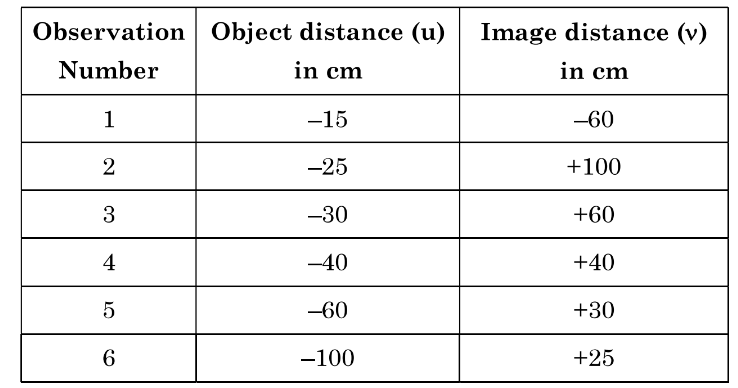
Analyse the following observation table showing variation of image distance (v) with object distance (u) in case of a convex lens and answer the questions that follow without doing any calculations :
(a) Determine the focal length of the lens. Give reason for your answer.
(b) Find magnification of the image formed in Observation No. 3.
(c) The numerical value of magnifications in cases of observation 1 and 2 is same. List two differences in the images formed in these two cases.
(a) Write the molecular formula of ethyne and draw its electron dot structure.
(b) Write chemical equation to show the reaction of ethanol with
(i) Sodium metal
(ii) Ethanoic acid (in the presence of an acid)
(iii) Acidified potassium dichromate
Write the name of the product formed in each case.
Paper Details
CBSE Board Exam 2025
Class
Class 10
Subject
Science
Year
2025
Set
Set 5
Other Years — Science