QUESTION PAPER
2025 BOARD EXAM
CBSE Class 10 Science Board Paper 2025 — Set 2
2025
Science
Class 10
CBSE EXAMINATION PAPER-2025
SCIENCE
(Solved)
General Instructions :
Read the following instructions carefully and follow them :
- This question paper contains 45 questions. All questions are compulsory.
- This question paper is divided into 5 sections.
- Section A – questions number 1 to 3 are case based questions
- Section B – questions number 4 to 23 are multiple choice questions
- Section C – questions number 24 to 31 are very short answer
- Section D – questions number 32 to 39 are short answer
- Section E – questions number 40 to 45 are long answer
- There is no overall choice given in the question paper. However, an internal choice has been provided in few questions.
- Use of calculator is NOT allowed.
Section A
Acid-base indicators can be used to distinguish between an acid and a base. Universal indicator, a mixture of several indicators, shows different colours at different concentrations of acids and bases, thereby indicating their pH on the pH scale of 0 – 14. The pH of a solution is measured by pH paper, which is a paper impregnated with a universal indicator.

(1) When the pH of a solution is decreased from 4 to 2, what effect does it produce on its hydronium ion concentration? State the colour change shown by the pH paper.
[2 Marks](2) Solution P is a strong acid while solution Q is a strong base. On the pH scale, where would you place the solutions P and Q?
[1 Mark](3) A solution has a pH of 7. Name a compound you would use to (i) increase its pH, and (ii) decrease its pH.
(4) A person is feeling pain and irritation in the stomach due to indigestion. What could be the pH of the fluid in the stomach ? Write the common name of the medicines people use for remedy. Give the chemical name of ‘‘milk of magnesia’’ often used for this purpose.
(1) How does the uterus prepare itself to receive and nurture the growing embryo? Explain.
[1 Mark](2) Write the site of fertilization in human female.
[1 Mark](3) What happens when the egg is not fertilized?
[2 Marks](4) How does the developing embryo get nutrition from the mother’s blood ? Explain.
A person allowed a narrow beam of white light from the sun to enter a dark room through a small aperture and placed a glass prism in its path in such a manner that the beam falls on the face AB of the prism as shown in the figure.
A screen S is placed on the other side of the prism, facing AC. On turning the prism slowly, a beautiful band of colours is obtained on the screen. It is the spectrum of sunlight.
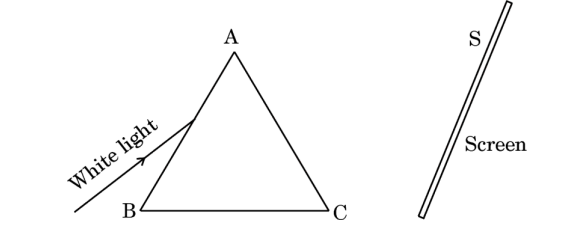
(1) State the reason for getting a band of seven colours in the above case.
[1 Mark](2) Name the phenomenon due to which a prism splits the incident white light into a band of colours.
[1 Mark](3) Explain with the help of a labelled ray diagram, an experimental arrangement to show the recombination of the spectrum of white light.
[2 Marks](4) Draw a labelled ray diagram to show the formation of a rainbow.
Section B
The correct balanced chemical equation showing exothermic reaction in which natural gas burns in air is:
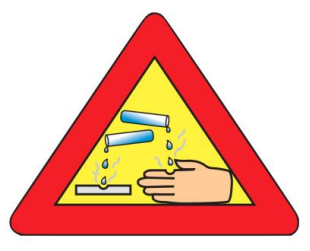
The warning sign shown in the given figure must invariably be displayed/pasted on the containers which contain hydroxide of:
Two metals zinc and tin are dissolved separately in definite proportions in molten copper (the primary metal) to obtain two different alloys respectively known as:
The opening and closing of stomata is regulated by:
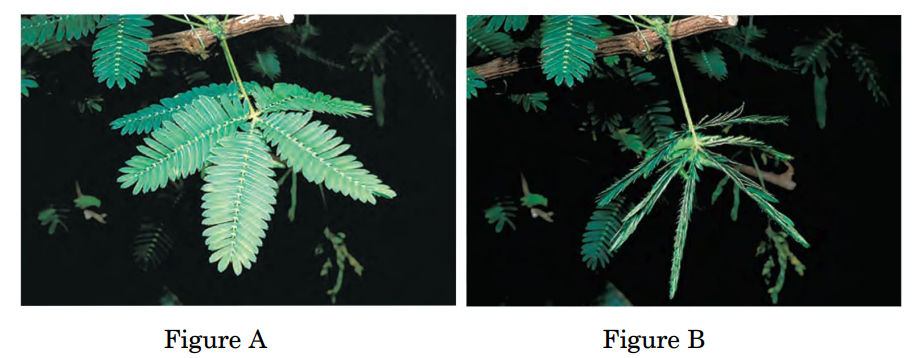
Observe the given figures A and B. When chhui-mui (sensitive) plant is touched, its leaves fold. This is due to :
If the absolute refractive indices of two media X and Y are 6⁄5 and 4⁄3 respectively, then the refractive index of Y with respect to X will be:
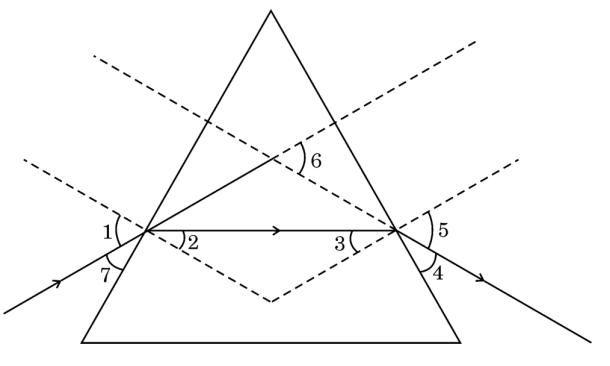
In the given figure the angle of incidence and the angle of deviation respectively are:
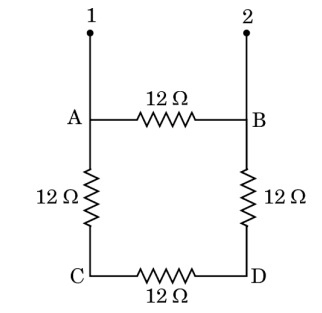
Four identical resistors of 12 Ω each are connected in series to form a square ABCD as shown in the figure. The resistance of the network between the two points 1 and 2 is:
Identify from the following a group containing all non-biodegradable substances:
Assertion (A): The metals high up in the reactivity series cannot be obtained from their compounds by heating with carbon.
Reason (R): Displacement reactions can also be used to obtain metal.
Assertion (A): A mango seed will germinate to form a mango tree.
Reason (R): Heredity determines the process by which traits and characteristics are reliably inherited from parents to offspring.
Assertion (A): Nichrome is an alloy which is commonly used in electrical heating devices such as electric irons, toasters, etc.
Reason (R): The resistivity of nichrome is high and its resistance decreases with increase in temperature.
Assertion (A): Animals will not get energy if they eat (consume) coal as food.
Reason (R): Specific enzymes are needed for the breakdown of a particular food.
Section C
(a) In common practice silver is recovered from silver nitrate solution by the use of copper metal. Name the type of reaction that takes place in this process and give the chemical equation of the reaction involved.
(b) Name the method used for refining silver.
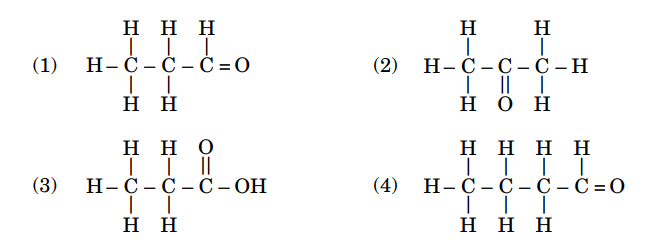
(a) Select from the following the members of the same homologous series:
(b) What happens to (i) the melting point, and (ii) the solubility of compounds as the molecular mass of the compounds in a homologous series increases ?
Write one function each of the following, in a seed:
(i) Seed coat
(ii) Cotyledon
(iii) Radicle
(iv) Plumule
Out of the two lenses, one concave and the other convex, state which one will diverge a parallel beam of light falling on it. Draw a ray diagram to show the principal focus of the lens.
Write the main steps to culture yeast in the laboratory.
A ray of light after refraction from a convex lens emerges parallel to its principal axis.
(i) Draw a labelled ray diagram to show it.
(ii) In this case, the incident ray before refraction from the lens passes through a point on its principal axis. Name the point.
Section D
(i) Define the term decomposition reaction. Write one chemical equation each for decomposition reaction where energy is supplied in the form of heat, light or electricity.
(ii) Decomposition of vegetable matter into compost is considered an exothermic reaction. Why ?
Write the electron-dot structures of (i) sodium, and (ii) oxygen. Using these structures, show the formation of sodium oxide. Mark the anion and cation present in this compound.
(At. No. – Sodium = 11 and Oxygen = 8)
(a) Define hormone.
(b) “Hormones should be secreted in precise quantities. We have a feedback mechanism through which this is done.” With the help of an example justify the statement.
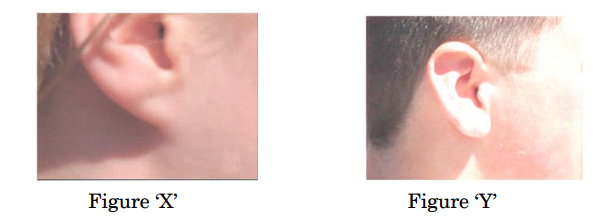
The lowest part of the ear called earlobe, is closely attached to the side of the head in some of us (Figure ‘X’), and not in others, called free earlobe (Figure ‘Y’). Attached and free earlobes are two variants found in human populations. The gene for free earlobe is dominant over attached earlobes.
(a) A man with attached earlobes marries a woman having free earlobes. 50% of their children have free earlobes and 50% have attached earlobes. Explain the inheritance of this trait and write the trait combinations of the progeny.
(b) Write the gene combinations of the father and the mother in the above case.
Why are decomposition reactions called the opposite of combination reactions ? Write one chemical equation each for these two types of reactions mentioning the name of the reactant(s) and the product(s) involved in the reactions.
Section E
(i) A compound ‘X’ having two carbon atoms in its molecule turns blue litmus red and 5 – 8% solution of ‘X’ in water is widely used as a preservative. Identify the compound ‘X’ and write its structure.(1.5)
(ii) Compare its pH nature with a mineral acid. (.5)
(iii) ‘X’ on reacting with alcohols produces sweet smelling compounds, used in making perfumes. Name the reaction and write its chemical equation. (1.5)
(iv) When sodium carbonate is added to ‘X’, a colourless gas is produced which turns lime water milky. Write the chemical equation for the reaction giving the name of the salt produced. (1.5)
(i) Differentiate between saturated and unsaturated hydrocarbons by giving one example each, with a structural formula.
(ii) Write the method of converting an unsaturated hydrocarbon into a saturated hydrocarbon. Name the industry where this reaction is commonly used.
(iii) Write the name and structure of a hydrocarbon having double bond and four carbon atoms in its one molecule.
(i) “The length of the small intestine in various animals depends on the food they eat.” Justify the statement.
(ii) Discuss the role of the pancreas and bile juice in the digestion of food in human beings.
(iii) How is the small intestine designed to absorb digested food ?
(i) State the role of rings of cartilage present in the throat.
(ii) Discuss the role of the ribs and diaphragm when air is taken in during the breathing cycle.
(iii) Why do we get muscle cramps during heavy exercise ? Explain.
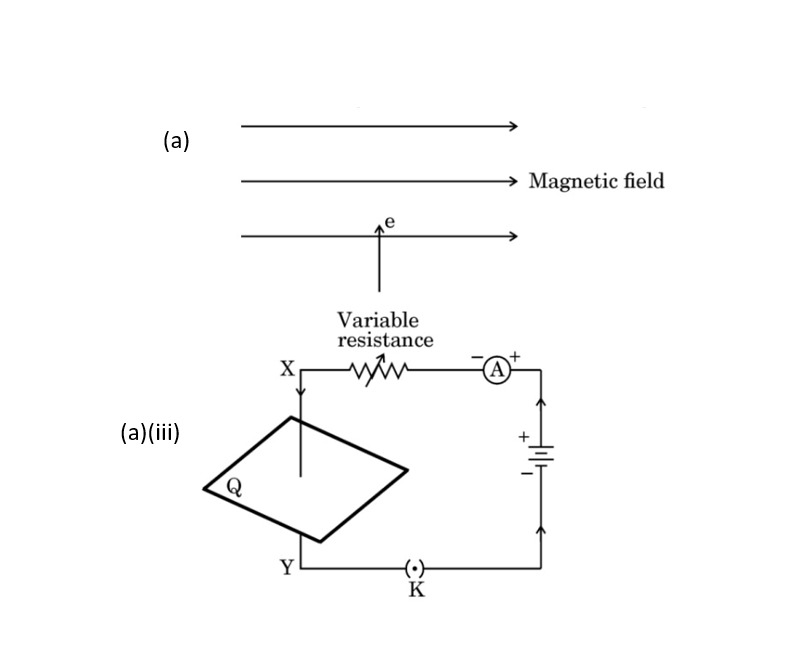
The given figure shows the current passing through the straight conductor XY.
(i) Copy the diagram and draw the magnetic field lines when current flows from conductor X to Y.
(ii) Name and state the rule used in determining the direction of the magnetic field lines in the situation given above.
(iii) State Fleming’s left hand rule. Using this rule, determine the direction of force applied on an electron entering a uniform magnetic field as shown in the figure.
(i) Define the term solenoid. Draw the pattern of the magnetic field lines in and around a current carrying straight solenoid. Mark on the pattern the (i) direction of current, (ii) direction of field lines near the ends of the solenoid, and (iii) region where the magnetic field is uniform.
(ii) How would you make an electromagnet using a current carrying solenoid ?
Paper Details
CBSE Board Exam 2025
Class
Class 10
Subject
Science
Year
2025
Set
Set 2
Other Years — Science