SOLUTIONS
2025 BOARD EXAM
CBSE Class 10 Science Board Paper 2025 — Set 6 Solutions
2025
Science
Class 10
CBSE EXAMINATION PAPER-2025
SCIENCE
(Solved)
General Instructions :
Read the following instructions carefully and follow them :
- This question paper contains 45 questions. All questions are compulsory.
- This question paper is divided into 5 sections.
- Section A – questions number 1 to 3 are case based questions
- Section B – questions number 4 to 23 are multiple choice questions
- Section C – questions number 24 to 31 are very short answer
- Section D – questions number 32 to 39 are short answer
- Section E – questions number 40 to 45 are long answer
- There is no overall choice given in the question paper. However, an internal choice has been provided in few questions.
- Use of calculator is NOT allowed.
Section A
Many pure metals like copper, iron and gold are very soft and as such are considered unsuitable for certain uses. Metallic objects around us such as cooking utensils, statues, ornaments, guns etc. are actually not made up of pure metals. Instead of pure metals, alloys are used in the design of most of the useful objects. Making alloys enhances the basic properties of a metal which is the primary constituent (metal) of an alloy.
(1) Name an alloy used for welding two wires together in an electric circuit. Write its major constituents.
[1 Mark](2) How does electrical conductivity and melting point of a metal change when it is converted to its alloy by mixing a small amount of an element in it?
[1 Mark](3) What is stainless steel ? How is it prepared ? Write one important property which makes it more useful in making cooking utensils as compared to its primary metal.
(4) What are alloys ? How is ‘Brass’ (an alloy) prepared ?
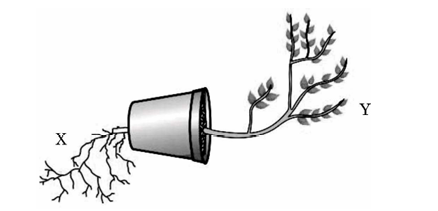
(1) Name the movement which causes ‘X’ and ‘Y to grow downwards and upwards respectively. (Refer above figure)
(2) Write the name of a hormone that plays a major role in (i) falling of leaves (ii) rapid cell division
(3) Leaves of the sensitive plant move very quickly in response to ‘touch’. How is this stimulus of touch communicated and explain how the movement takes place.
(4) Name the plant hormone which is synthesized at the shoot tip. How does this hormone helps the plant to bend towards light ?
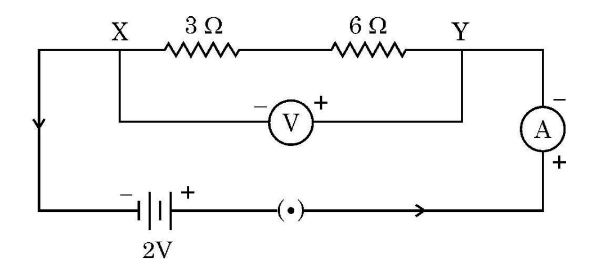
(1) Draw a circuit diagram showing the above two resistors X and Y joined in parallel with same battery and same ammeter and voltmeter.
(2) In which combination of resistors will the (i) potential difference across X and Y and (ii) current through X and Y, be the same ?
(3) Find the current drawn from the battery by the series combination of the two resistors (X and Y).
To find the current drawn from the battery by the series combination of resistors X and Y, we first need to calculate the total resistance in the circuit. The total resistance (Rₜₒₜₐₗ) for resistors in series is the sum of their resistances: Rₜₒₜₐₗ = Rₓ + Rᵧ = 3Ω + 6Ω = 9Ω. Next, we apply Ohm's law to find the current (I) flowing through the circuit. Ohm's law states that I = V/R. Here, the potential difference (V) supplied by the battery is 2V. Hence, I = 2V / 9Ω = 0.222A. Therefore, the current drawn from the battery by the series combination of the two resistors is approximately 0.222 A.
Total resistance (Rₜₒₜₐₗ ) = Rₓ + Rᵧ; Current (I) = V/R; Application of Ohm's law.
(4) Determine the equivalent resistance of the parallel combination of the two resistors (X and Y).
1/R_eq = 1/R1 + 1/R2
Substituting the values:
1/R_eq = 1/3 + 1/6
To add these fractions, we find a common denominator, which is 6:
1/R_eq = 2/6 + 1/6 = 3/6
Thus, 1/R_eq = 3/6, which simplifies to 1/2. Therefore,
R_eq = 2Ω.
Hence, the equivalent resistance of the parallel combination of the two resistors X and Y is 2Ω.
Section B
In the following experimental setup of electrolysis of water, if P and Q are the gases collected in the test tubes enclosing the electrodes R and 8S, then select the option/options in which the matching is correct :
(i) P – Oxygen gas , R – Anode
(ii) P – Hydrogen gas , R – Cathode
(iii) Q – Hydrogen gas , S – Cathode
(iv) Q – Oxygen gas , S – Anode
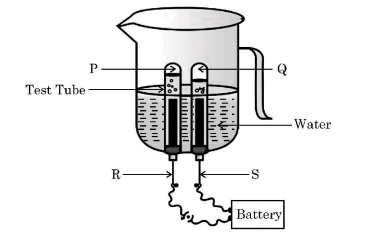
In the electrolysis of water:
Water splits into hydrogen (H₂) and oxygen (O₂) gases.
Hydrogen gas is released at the cathode (negative electrode) — where P = Hydrogen.
Oxygen gas is released at the anode (positive electrode) — where Q = Oxygen.
Thus, the correct match is:
P → Hydrogen
Q → Oxygen
andR → Cathode, S → Anode
Therefore, only statements (i) and (ii) are correct.
You have three aqueous solutions A, B and C as given below:
A – Potassium nitrate
B – Ammonium chloride
C – Sodium carbonate
The ascending order of the pH of these solutions is:
Select from the following a statement which is not true about burning of magnesium ribbon in air :
A Hydrocarbon which does not belong to the same homologous series of carbon compounds is
The given options represent hydrocarbons with different molecular formulas. C10H22, C4H10, and C6H14 all fit the general formula of alkanes (CₙH₂ₙ₊₂), indicating they belong to the alkane homologous series. However, C₇H₁₄ fits the formula CₙH₂ₙ, which corresponds to alkenes, a different homologous series containing one double bond and having different chemical properties. Hence, C₇H₁₄ does not belong to the same homologous series as the other options.
The colour of the solution observed after about 1 hour of placing iron nails in copper sulphate solution is
Juice of tamarind turns blue litmus to red. It is because of the presence of a chemical compound called
The water of crystallization is present in
(i) Bleaching Powder (ii) Plaster of Paris (iii) Washing Soda (iv) Baking Soda
A tall pea plant with round seeds (TTRR) is crossed with a short pea plant with wrinkled seeds (ttrr). The F₁ generation will be:
A pair of endocrine glands located in the human brain is
Select the option having correct matching of the organism given in Column I with the mode of reproduction in Column II:
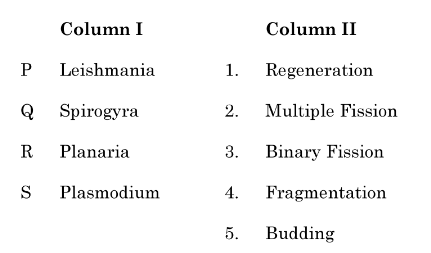
The correct option is P-3, Q-4, R-5, S-2 because Column I refers to specific organisms and their respective modes of reproduction; P matches with its defined method, similarly for Q, R, and S. This aligns with the context provided about the modes of reproduction, which distinguishes between sexual and asexual reproduction in animals.
The basic filtration unit of the excretory system in human beings is :
In human alimentary canal, the digestive juice secreted by the gastric glands are
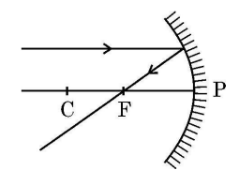
Identify from the following the ray diagram which shows the correct path of the reflected ray for the ray incident on a concave mirror as shown :
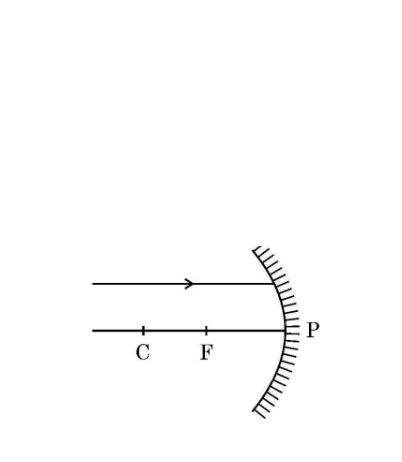
-
(A)
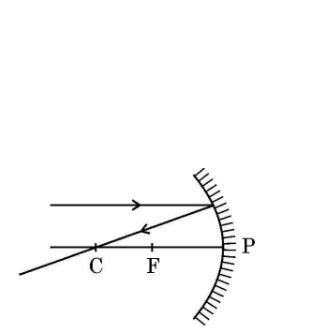
-
(B)
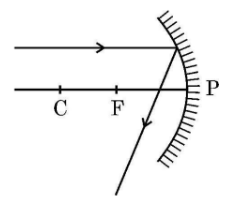
-
(C)
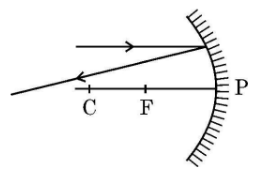
-
(D)
The part of human eye which controls the amount of light entering into it.
Consider the following food chain:
Grass → Grasshopper → Frog → Snake → Eagle
If the amount of energy available at third trophic level is 50 kJ, the available energy at the producer level was:
The incorrect statement about ozone is
(A) It is a deadly poisonous gas.
True. At ground level, ozone is harmful and can cause respiratory problems.
(B) It shields the surface of the earth from UV radiation from the sun.
True. The ozone layer in the stratosphere absorbs harmful ultraviolet (UV) rays, protecting life on Earth.
(C) It is used as a refrigerant and in fire-extinguishers.
False.
Ozone is not used as a refrigerant or fire-extinguisher gas.
CFCs (chlorofluorocarbons) were used as refrigerants and fire suppressants — they damage ozone.
(D) It is formed by combining oxygen molecule with a free oxygen atom.
True.
O2+O→O3
Assertion (A) : Carbon and its compounds are our major sources of fuels.
Reason (R) : Most of the carbon compounds on burning release a large amount of heat and light.
Assertion (A) : Xylem tissue moves water and minerals obtained from the soil by the roots.
Reason (R) : Xylem tissue is found only in the roots of a plant.
Assertion (A):
Xylem tissue moves water and minerals obtained from the soil by the roots.
True
This is the main function of xylem tissue in plants.
Xylem transports water and dissolved minerals from the roots to all parts of the plant.
Reason (R):
Xylem tissue is found only in the root of a plant.
False
Xylem is not limited to roots.
It is found throughout the plant — roots, stems, and leaves — forming a continuous system of water transport.
Assertion (A): In the common domestic circuits the earth wire is connected to a metallic plate buried deep inside the earth.
Reason (R) : Earth wire ensures that any leakage of current to the metallic body of the appliance keeps its potential to that of the earth, so the user may not get a severe electric shock.
Assertion (A) : Food web is a network of several food chains operating in an ecosystem.
Reason (R) : Food web decreases the stability of an ecosystem.
Section C
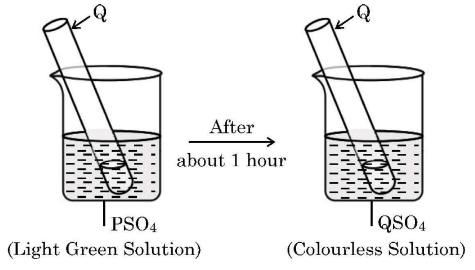
A light green coloured solution of sulphate salt of metal ‘P’ is taken in a beaker, a rod of another metal “Q’ is put in this solution as shown the following figures :
Identify the metals ‘P’ and ‘Q’ and write its chemical equation for the reaction that occurs. State the conclusion of this reaction in terms of reactivity series of metals.
(a) How is brain protected in our body ?
(b) A doctor finds in one of his patients that he is not maintaining a proper posture and balance of his body. State the region of brain and also the part of brain which is responsible for it.
“Proteins control the expression of various characters.” Explain this statement by taking an example of “tallness” as a characteristic in plants.
Explain the mechanism of inheritance used by sexually reproducing organisms to ensure the stability of DNA of the species.
Study the figure in which the path of a ray of light going from Medium 1 to Medium 2 is shown.
(a) Out of the two Media — Medium 1 and Medium 2, in which is the speed of light more ?
(b) State reason of bending of the refracted ray away from the normal.
(c) Express refractive index of Medium 2 with respect to Medium 1 in terms of speed of light in two media.
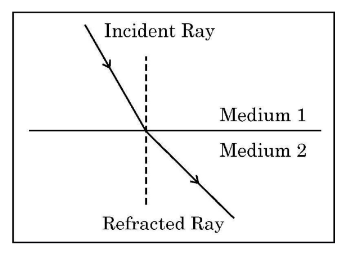
(b) The refracted ray bends away from the normal because the speed of light increases as it moves from Medium 1 to Medium 2. This change in speed causes bending due to refraction.
(c) The refractive index of Medium 2 with respect to Medium 1 is given by n = v1 / v2, where v1 is the speed of light in Medium 1 and v2 is the speed of light in Medium 2.
Give Reasons:-
(i) The sky appears dark to passengers flying at very high altitude.
(ii) ‘Danger’ signal lights are red in colour.
Section D
Write balanced chemical equation for the reactions that occur when
(a) steam is passed over red hot iron.
(b) natural gas is burnt in air.
(c) glucose reacts with oxygen in the cells of our body and provides energy.
(a) When steam is passed over red hot iron, iron reacts with steam to form iron oxide and hydrogen gas. The balanced chemical equation is:
3Fe (s) + 4H₂O (g) → Fe₃O₄ (s) + 4H₂ (g)
(b) When natural gas, which mainly contains methane (CH₄), is burnt in air, it burns in presence of oxygen to give carbon dioxide and water along with heat and light. The balanced chemical equation is:
CH₄(g) + 2O₂(g) → CO₂(g) + 2H₂O(g)
(c) Glucose reacts with oxygen in the cells during respiration to release energy. It produces carbon dioxide and water. The balanced chemical equation is:
C₆H₁₂O₆(s) + 6O₂(g) → 6CO₂(g) + 6H₂O(l) + Energy (heat)
This process is called aerobic respiration and is essential for providing energy to living organisms.
State the chemical property in each case on which the following uses of baking soda are based upon:
(i) as an anti-acid,
(ii) as a constituent in making baking powder,
(iii) in soda-acid fire extinguishers.
Write chemical equations to show what happens when an acid reacts with
(i) metal,
(ii) base,
(iii) carbonate.
Write the name of the main product formed in each case.
When an acid reacts with a metal, it forms a salt and hydrogen gas.
Example: 2HCl + Zn → ZnCl2 + H2
The main product formed is a salt.
(ii) Acid + Base:
When an acid reacts with a base, it gives a salt and water. This is called neutralization.
Example: HCl + NaOH → NaCl + H2O
The main product formed is a salt.
(iii) Acid + Carbonate:
When an acid reacts with a carbonate, it produces a salt, carbon dioxide, and water.
Example: 2HCl + Na2CO3 → 2NaCl + CO2 + H2O
The main product formed is a salt.
The gene combination of purple flowered pea plants is denoted as (WW) and that of white flowered pea plants as (ww). When these two plants are crossed, F₁ generation is obtained.
(a) List two observations made by Mendel in F₁ generation plants.
(b) Give the (i) percentage of white flowered plants and (ii) ratio of the gene combinations WW, Ww and ww in F₁ generation.
(c) Write one difference between dominant and recessive trait.
(b) (i) Percentage of white flowered plants = 0% because all F₁ plants have at least one dominant W allele.
(ii) Ratio of gene combinations in F₁ plants is WW : Ww : ww = 0 : 100 : 0. All plants are heterozygous Ww.
(c) Dominant trait is the one that appears in the offspring when both dominant and recessive alleles are present, while recessive trait is masked in the presence of dominant allele and appears only when both alleles are recessive (ww).
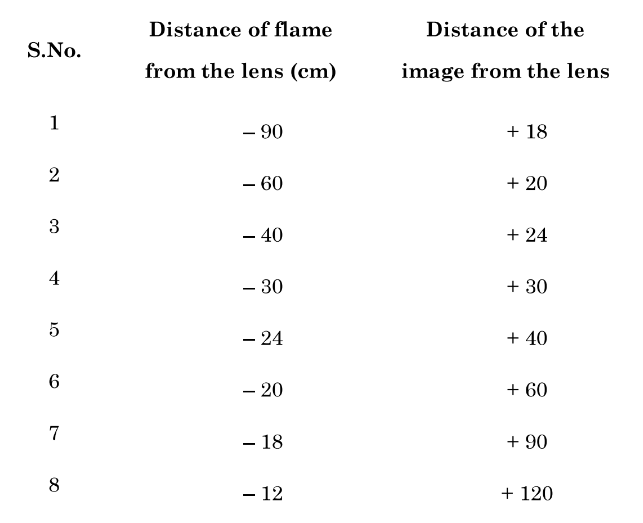
A student placed a candle flame at different distances from a convex lens and focused its image on a screen. He recorded his observation in tabular form as given below :
Analyse the observation table and on the basis of your analysis only, answer the following questions (without doing any calculations) :
(a) What is the focal length of the convex lens used ? Give reason to justify your answer.
(b) Which one of the sets of observations is not correct and why ?
(c) Draw ray diagram to show image formation for any correct set of observation.
(b) Any set of observations where image characteristics contradict the properties of convex lens images is not correct. For example, if an image is described as virtual and formed on the screen, it is incorrect because virtual images cannot be projected on a screen. Also, if magnification or position does not follow the lens formula's logical pattern, that set is wrong.
(c) Ray diagram for object placed beyond 2F (twice the focal length):
- Draw the convex lens vertical line with focal points F on both sides.
- Place the candle flame beyond 2F.
- Draw one ray parallel to principal axis which after refraction passes through the focal point on other side.
- Draw second ray passing through the optical centre which goes straight without deviation.
- The rays converge at a point between F and 2F on the other side forming a real, inverted and smaller image on the screen.
This ray diagram corresponds to a correct observation set with object beyond 2F.
A person uses lenses of +2.0 D power in his spectacles for the correction of his vision.
(a) Name the defect of vision the person is suffering from.
(b) List two causes of this defect.
(c) Determine the focal length of the lenses used in the spectacles.
(b) Two causes of hypermetropia are: (i) The eyeball may be too small from front to back. (ii) The eye lens may have a focal length that is too long.
(c) The power P of a lens is related to its focal length f by the formula P = 100 / f where f is in cm. Given power P = +2.0 D, so focal length f = 100 / 2 = 50 cm = 0.50 m. Hence, the focal length of the lens used is +0.50 meter.
(a) Explain the statement “Potential difference between two points is 1 volt”.
(b) What do the symbols given below represent in an electric circuit ? Write one function of each.
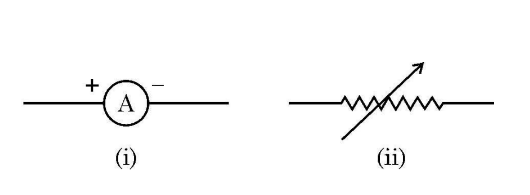
(a) The statement “Potential difference between two points is 1 volt” means that 1 joule of work is done to move 1 coulomb of electric charge from one point to the other in the circuit. Essentially, this means the electric potential energy difference between these two points is equivalent to 1 volt. It indicates how much energy each unit charge gains or loses while moving between those points.
(b) In an electric circuit, different symbols represent various components:
Voltmeter (V): This instrument measures the voltage or potential difference between two points in the circuit. It helps us know how much electric potential energy per unit charge is available between those points.
Key (K): A key is a type of switch that can open or close the circuit. When closed, it allows current to flow; when opened, it stops the current, controlling the working of the circuit.
Section E
Name an alcohol and a carboxylic acid having two carbon atoms in their structures. Draw their structures and state how this alcohol can be converted into a carboxylic acid. What happens when these two compounds react in the presence of an acid ? Write chemical equations for the reactions involved in the two cases mentioned above.
Structure of Ethanol:
CH3 - CH2 - OH
Carboxylic acid with two carbon atoms: Ethanoic acid (Acetic acid) (CH3COOH)
Structure of Ethanoic acid:
CH3 - COOH
(b) Conversion of ethanol into ethanoic acid:
Ethanol can be oxidized to ethanoic acid using an oxidizing agent such as potassium dichromate (K2Cr2O7) in acidic medium (dilute H2SO4). This is an oxidation reaction.
Chemical equation:
CH3CH2OH + [O] --(K2Cr2O7/H2SO4)--> CH3COOH + H2O
(c) Reaction between ethanol and ethanoic acid in presence of acid catalyst:
When ethanol reacts with ethanoic acid in presence of acid catalyst (usually concentrated H2SO4), an esterification reaction occurs forming an ester called ethyl ethanoate and water.
Chemical equation:
CH3COOH + CH3CH2OH --(H2SO4)--> CH3COOCH2CH3 + H2O
This reaction is reversible and acid catalyst helps in increasing the rate of reaction.
Summary:
- Ethanol is an alcohol with two carbon atoms.
- Ethanoic acid is a carboxylic acid with two carbon atoms.
- Ethanol can be oxidized to ethanoic acid.
- Ethanol and ethanoic acid react in presence of acid to form ester (ethyl ethanoate) and water.
(a) Define Puberty. List any two changes seen in boys at the time of puberty.
(b) Why are testes in human males located outside the abdominal cavity in scrotum ?
(c) List any three techniques of contraception used by humans. Which one of these is not meant for males ?
(b) The testes in human males are located outside the abdominal cavity in the scrotum because sperm formation requires a temperature slightly lower than the normal body temperature. The scrotum keeps the testes cooler, which helps in the production of healthy sperm.
(c) Three techniques of contraception used by humans are condoms, oral contraceptive pills, and copper-T (intrauterine device). Among these, oral contraceptive pills are not meant for males; they are used by females to prevent pregnancy.
(a) Name the part performing following functions in human female reproductive system :
(i) production of eggs
(ii) site of fertilization
(iii) site of implantation
(iv) entry of the sperms
(b) What changes are observed in the uterus :
(i) subsequent to implantation of zygote and
(ii) if an egg does not get fertilized ?
(i) Production of eggs: The ovary is responsible for producing eggs or ova.
(ii) Site of fertilization: Fertilization occurs in the fallopian tube (oviduct) where the sperm meets the egg.
(iii) Site of implantation: The fertilized egg implants itself in the lining of the uterus called the endometrium.
(iv) Entry of sperms: Sperms enter the female reproductive system through the vagina.
(b) Changes observed in the uterus:
(i) Subsequent to implantation of zygote: The uterine lining thickens and becomes enriched with blood vessels to nourish the developing embryo. The uterus prepares to support pregnancy by becoming thick and spongy.
(ii) If an egg does not get fertilized: The thickened uterine lining breaks down and is shed from the body as menstrual blood. This process is called menstruation. The uterus returns to its normal state waiting for the next cycle.
What are soaps ? Write the structure of a soap molecule. Explain the cleansing action of a soap. Why are soaps not considered suitable for washing clothes in a region where water is hard ? How is this problem overcomed ?
(b) Structure of Soap Molecule : A soap molecule has a long hydrocarbon chain which is hydrophobic (water repelling) and an ionic carboxylate group (–COO-Na+) which is hydrophilic (water loving).
(c) Cleansing Action : Soap molecules have two different ends: the hydrophobic tail dissolves in grease and oil, while the hydrophilic head remains in water. When soap is added to water containing dirt, the hydrophobic tails attach to the oil and grease, while the hydrophilic heads remain in water. This forms spherical structures called micelles where the dirt is trapped inside. These micelles are suspended in water and can be washed away, cleaning the clothes.
(d) Soap in Hard Water : Hard water contains Ca2+ and Mg2+ ions which react with soap to form insoluble compounds called scum. This scum reduces the cleaning ability of soaps and makes washing ineffective.
(e) Solution : This problem is overcome by using synthetic detergents instead of soaps. Detergents do not form scum in hard water and clean effectively.
What are magnetic field lines ? How is the direction of magnetic field at a point determined ? Draw the pattern of magnetic field lines of the magnetic field produced by a current carrying circular loop. Mark on it the direction of (i) current and (ii) magnetic field lines.
Name the two factors on which the magnitude of the magnetic field due to a current carrying coil depends.
Magnetic field lines are imaginary lines used to represent the magnetic field around a magnet or a current carrying conductor. These lines show the direction of the magnetic force and help visualize the strength and shape of the magnetic field. The magnetic field is stronger where the lines are closer and weaker where they are farther apart.
(b) How is the direction of magnetic field at a point determined?
The direction of the magnetic field at any point is given by the tangent to the magnetic field line at that point. Around a current carrying conductor, the magnetic field direction can be found by using the right-hand thumb rule. If you curl the fingers of your right hand in the direction of the current, your thumb points the direction of the magnetic field.
(c) Pattern of magnetic field lines produced by a current carrying circular loop:
The magnetic field lines form concentric closed loops around the wire. Inside the circular loop, the field lines are almost straight and parallel, showing a uniform magnetic field. Outside the loop, the lines spread out and loop back to the other side. On the diagram, the direction of current is marked as arrows along the circular wire (usually anticlockwise or clockwise), and the direction of magnetic field lines is shown by arrows forming loops around and inside the coil.
(d) Two factors on which the magnitude of magnetic field due to a current carrying coil depends:
1. Magnitude of the current flowing through the coil.
2. Number of turns in the coil.
More current or more turns will increase the magnetic field produced by the coil.
Why can’t two magnetic field lines cross each other ? Draw magnetic field lines showing the direction of the magnetic field due to a current carrying long straight solenoid. State the conclusion which can be drawn from the pattern of magnetic field lines inside the solenoid.
Name any two factors on which the magnitude of the magnetic field due to this solenoid depends.
(b) The magnetic field lines due to a current carrying long straight solenoid are shown as closely spaced, nearly parallel lines inside the solenoid indicating a strong and uniform magnetic field. Outside the solenoid, the field lines spread out and loop from one end to the other, similar to the field of a bar magnet.
(c) The conclusion drawn from the pattern of magnetic field lines inside the solenoid is that the magnetic field inside the solenoid is strong and uniform. The solenoid behaves like a bar magnet with a north and south pole.
(d) Two factors on which the magnitude of the magnetic field due to the solenoid depends are:
1. The number of turns of the coil (N) in the solenoid.
2. The current (I) passing through the solenoid.
Other factors include the length of the solenoid and the presence of a magnetic core.
Paper Details
CBSE Board Exam 2025
Class
Class 10
Subject
Science
Year
2025
Set
Set 6
Other Years — Science