QUESTION PAPER
2024 BOARD EXAM
CBSE Class 10 Science Board Paper 2024 — Set 3
2024
Science
Class 10
CBSE EXAMINATION PAPER-2024
SCIENCE
(Solved)
General Instructions :
Read the following instructions carefully and follow them :
- This question paper contains 44 questions. All questions are compulsory.
- This question paper is divided into 5 sections.
- Section A – questions number 1 to 2 are case based questions
- Section B – questions number 3 to 22 are multiple choice questions
- Section C – questions number 23 to 30 are very short answer
- Section D – questions number 31 to 38 are short answer
- Section E – questions number 39 to 44 are long answer
- There is no overall choice given in the question paper. However, an internal choice has been provided in few questions.
- Use of calculator is NOT allowed.
Section A
(1) Name the glands present in the buccal cavity and write the components of food on which the secretion of these glands act upon.
[1 Mark](2) Two organs have a sphincter muscle at their exit. Name them.
(3) "Bile juice does not contain any enzyme, yet it has important roles in digestion." Justify the statement.
(4) What will happen if: (i) mucus is not secreted by the gastric glands. (ii) Villi are absent in the small intestine.
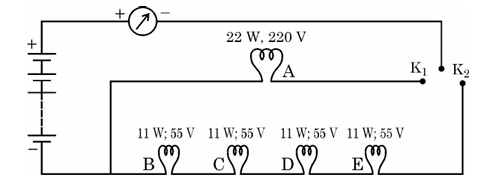
(1) (a) State what happens when (i) key 𝐾₁ is closed. (ii) key 𝐾₂ is closed.
[1 Mark](2) Find the current drawn by the bulb B when it glows.
(3) What would happen to the glow of all the bulbs in the circuit when keys K₁ and K₂ both are closed and the bulb C suddenly get fused? Give reason to justify your answer.
(4) Calculate
(i) the resistance of bulb B, and
(ii) total resistance of the combination of four bulbs B, C, D and E.
Section B
Identify the product 'X' obtained in the following chemical reaction:

Select a pair of natural indicator from the following:
A chemical compound used in glass, soap and paper industries is
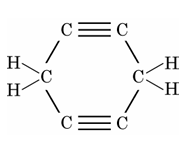
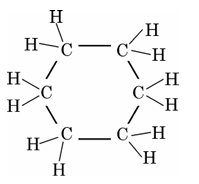
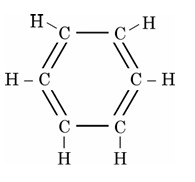
The structural formula of Cyclohexane is
-
(A)
-
(B)
-
(C)
-
(D)
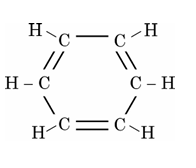
Consider the following Chemical equation: 𝑎Al₂O₃+𝑏HCl→𝑐AlCl₃+𝑑H₂O In order to balance this chemical equation, the values of a, b, c and d must be
Which one of the following hydrocarbons is different from the others?
Which one of the following reactions is different from the remaining three?
Part(s) of a flower which attracts insects for pollination is (are)
Which of the following statement (s) is (are) true about human heart?
(a) Right atrium receives oxygenated blood from lungs through pulmonary artery
(b) Left atrium transfers oxygenated blood to left ventricle which sends it to various parts of the body.
(c) Right atrium receives deoxygenated blood from different parts of the body through vena cava.
(d) Left atrium transfers oxygenated blood to aorta which sends it to different parts of the body.
A cross between two tall pea plants resulted in offsprings having a few dwarf plants. The gene-combination of the parental plants must be
The Phenomena of light involved in the formation of a rainbow in the sky are
In case of four wires of same material, the resistance will be minimum if the diameter and length of the wire respectively are
A food chain will be more advantageous in terms of energy if it has
Consider the following statements about ozone:
(a) Ozone is poisonous gas.
(b) Ozone shields the earth's surface from the infrared radiation from the sun.
(c) Ozone is a product of UV radiations acting on oxygen molecule.
(d) At the lower level of the earth's atmosphere, ozone performs most essential function.
The correct statements are
Assertion (A): A piece of Zinc metal gets reddish brown coating when kept in copper sulphate solution for some time.
Reason (R): Copper is more reactive metal than Zinc.
Assertion (A): Offsprings produced by asexual reproduction are genetically similar to the parents.
Reason (R): Asexual reproduction involves a single parent.
Assertion (A): Red light signals are used to stop the vehicles on the road.
Reason (R): Red coloured light is scattered the most so as to be visible from a large distance.
Assertion (A): The waste we generate daily may be biodegradable or non-biodegradable.
Reason (R): The waste generated, if not disposed off properly may cause serious environmental problems.
Section C
Draw a labelled diagram to show the pattern of magnetic field lines produced due to a current carrying straight conductor. Mark on it the direction of current in the conductor and the direction of magnetic field lines.
Name the device used to magnetise a piece of magnetic material. Draw a labelled diagram to show the arrangement used for the magnetisation of a cylinder made of soft iron.
Section D
State reasons for the following:
(a) Zinc oxide is an amphoteric oxide.
(b) Sodium metal is stored in a bottle filled with kerosene oil.
(c) In the reactions of nitric acid with metals, generally hydrogen gas is not evolved.
(a) State, giving reason, the reduction process to obtain the following metals from their compounds:
(i) Mercury, (ii) Copper, and (iii) Sodium.
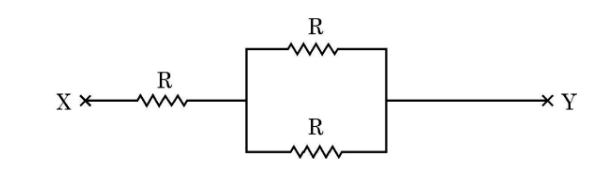
(a) State Ohm's law. Write the formula for the equivalent resistance Rₚ of the parallel combination of three resistors of values R₁, R₂, and R₃. (b) Find the resistance of the following network of resistors.
(b) Find the resistance of the following network of resistors:
(a) List two constituents of the Central Nervous System (CNS). How are these components protected from injuries?
(b) Write two limitations of the use of electrical impulses.
State giving reason the reduction process to obtain the following metals from their compounds:
(i) Sliver
(ii) Copper and
(iii) Iron
Section E
(i) Five solutions A, B, C, D and E when tested with pH paper showed pH as 4, 1, 13, 7 and 10 respectively. Which solution is:
(1) Strongly acidic (2) Strongly alkaline (3) Weakly acidic (4) Neutral and (5) Weakly alkaline? Arrange the solutions in increasing order of H⁺ ion concentration.
(ii) Write the name and formula of (1) an acidic salt and (2) a basic salt giving the name of the parent acid and parent base used to form the salt in each case.
Name and state in brief the process which is used to prepare sodium hydroxide from sodium chloride. In this process along with the main product two gases 'X' and 'Y' are also given off at the two electrodes. Name 'X' and 'Y' specifying the name of their respective electrode at which each gas is obtained. One of these gases when reacts with dry calcium hydroxide produces a compound 'Z' which is widely used in water treatment plants and textile industries. Name 'Z' and write chemical equation for the reaction involved in its formation.
(i) What are spores? On which structures are they formed? How do they overcome unfavourable conditions? Name the organism which multiplies with the help of these structures.
(ii) Give two reasons why some plants are grown by the method of vegetative propagation. List two methods used to grow plants vegetatively.
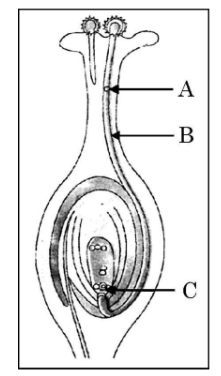
(i) Study the diagram given below and name the parts marked as A, B and C. What happens when B reaches C in the ovary? Mention its significance.
(ii) Write the post fertilisation changes that occur in a flower.
(i) Draw a ray diagram to show the path of the refracted ray in each of the following cases:
A ray of light incident on a concave lens
(1) parallel to its principal axis, and
(2) is directed towards its principal focus.
(ii) A 4 cm tall object is placed perpendicular to the principal axis of convex lens of focal length 24 cm. The distance of object from the lens is 16 cm. Find the position and size of image formed.
Draw a ray diagram to show the path of the reflected ray in each of the following cases:
A ray of light incident on a convex mirror
(1) parallel to its principal axis, and
(2) is directed towards its principal focus
Paper Details
CBSE Board Exam 2024
Class
Class 10
Subject
Science
Year
2024
Set
Set 3
Other Years — Science