SOLUTIONS

2023 BOARD EXAM

CBSE Class 10 Science Board Paper 2023 — Set 5 Solutions

2023

Science

Class 10

CBSE EXAMINATION PAPER-2023

SCIENCE

(Solved)

Time allowed : 3 hours

Maximum Marks : 88

General Instructions :

Read the following instructions carefully and follow them :

  1. This question paper contains 45 questions. All questions are compulsory.
  2. This question paper is divided into 5 sections.
  3. Section A – questions number 1 to 3 are case based questions
  4. Section B – questions number 4 to 23 are multiple choice questions
  5. Section C – questions number 24 to 31 are very short answer
  6. Section D – questions number 32 to 40 are short answer
  7. Section E – questions number 41 to 45 are long answer
  8. There is no overall choice given in the question paper. However, an internal choice has been provided in few questions.
  9. Use of calculator is NOT allowed.

Section A

Question 1.

On the basis of reactivity metals are grouped into three categories -

(i) Metals of low reactivity

(ii) Metals of medium reactivity

(iii) Metals of high reactivity

Therefore metals are extracted in pure form from their ores on the basis of their chemical properties.

Metals of high reactivity are extracted from their ores by electrolysis of the molten ore.

Metals of low reactivity are extracted from their sulphide ores, which are converted into their oxides. The oxides of these metals are reduced to metals by simple heating.

(1)

Name the process of reduction used for a metal that gives vigorous reaction with air and water both.

[1 Mark]
Answer: The process used for extracting a metal that reacts vigorously with air and water is electrolysis. Such metals are highly reactive and cannot be extracted by simple heating or carbon reduction. Electrolysis involves passing an electric current through the molten ore to obtain the pure metal.
Key Points: Highly reactive metals react vigorously with air and water-Electrolysis of molten ore is used for extraction-These metals cannot be extracted by heating or carbon reduction-This method is suitable for metals like sodium and potassium

(2)

Carbon cannot be used as a reducing agent to obtain aluminium from its oxide? Why?

[2 Marks]
Answer: Carbon cannot be used as a reducing agent to obtain aluminium from its oxide because aluminium is a highly reactive metal. Its oxide is very stable and cannot be reduced by carbon. The position of aluminium high up in the reactivity series means that carbon is not strong enough to displace aluminium from its oxide. Therefore, aluminium is extracted by electrolysis of its molten oxide, which is a more efficient method for highly reactive metals.
Key Points: Aluminium is highly reactive-Aluminium oxide is very stable-Carbon cannot reduce aluminium oxide-Highly reactive metals require electrolysis for extraction-Carbon reduction works only for medium reactive metals

(3)

Describe briefly the method to obtain mercury from cinnabar. Write the chemical equation for the reactions involved in the process.

[2 Marks]
Answer: Mercury is obtained from cinnabar (HgS), which is a sulphide ore of mercury. The extraction involves two main steps. First, cinnabar is heated in the presence of air, which causes it to react with oxygen and form mercuric oxide (HgO). Then, on further heating, mercuric oxide decomposes to give mercury metal and oxygen gas. The chemical reactions involved are: 1. 2 HgS + 3 O2 → 2 HgO + 2 SO2 2. 2 HgO → 2 Hg + O2 Thus, mercury is obtained by heating cinnabar, converting it into mercuric oxide, which is then reduced to mercury by thermal decomposition.
Key Points: Mercury is extracted from cinnabar, a sulphide ore- Heating cinnabar in air converts it to mercuric oxide- Mercuric oxide decomposes on further heating to mercury and oxygen- Chemical equations: 2 HgS + 3 O2 → 2 HgO + 2 SO2 and 2 HgO → 2 Hg + O2

(4)

Differentiate between roasting and calcination giving chemical equation for each.

[2 Marks]
Answer: Roasting and calcination are two important processes used in the extraction of metals from their ores. Roasting is the process of heating sulphide ores in the presence of excess air. During roasting, the sulphide ore is converted into its oxide by removing sulphur as sulphur dioxide gas. For example, when zinc sulphide is roasted, it forms zinc oxide and sulphur dioxide gas is released. Example of roasting: 2ZnS + 3O2 → 2ZnO + 2SO2 Calcination is the process of heating carbonate or hydrated ores in the absence or limited supply of air. During calcination, the ore loses water and carbon dioxide, and is converted into its oxide. For example, calcium carbonate on calcination decomposes into calcium oxide and carbon dioxide gas. Example of calcination: CaCO3 → CaO + CO2 In summary, roasting is done for sulphide ores in presence of air to form oxides, whereas calcination is done for carbonate or hydrated ores in limited or no air to form oxides.
Key Points: Roasting is heating of sulphide ores in excess air-Roasting converts sulphides to oxides-Releases sulphur dioxide gas-Example: 2ZnS + 3O2 → 2ZnO + 2SO2-Calcination is heating of carbonate or hydrated ores in limited/no air-Calcination removes water or CO2 and forms oxide-Example: CaCO3 → CaO + CO2-Difference lies in type of ore treated and presence of air
Question 2.

All human chromosomes are not paired. Most human chromosomes have a maternal and a paternal copy, and we have 22 such pairs. But one pair called the sex chromosomes, is odd in not always being a perfect pair. Women have a perfect pair of sex chromosomes. But men have a mismatched pair in which one is normal sized while the other is a short one.

(1)

In humans, how many chromosomes are present in a Zygote and in each gamete?

[1 Mark]
Answer: In humans, a zygote contains 46 chromosomes in total. This is because the zygote is formed by the fusion of two gametes: the egg and the sperm. Each gamete contains only one set of chromosomes, which is 23 in number. The egg always contains 23 chromosomes, including one X chromosome. The sperm contains 23 chromosomes as well, but it may carry either an X or a Y chromosome. When the sperm and egg combine during fertilization, the resulting zygote has 46 chromosomes arranged in 23 pairs, including the sex chromosomes. Therefore, each gamete has 23 chromosomes, and the zygote has 46 chromosomes.
Key Points: A zygote has 46 chromosomes in total-Each gamete (sperm or egg) has 23 chromosomes-Egg always carries an X chromosome-Sperm carries either X or Y chromosome-Zygote has 23 pairs of chromosomes including sex chromosomes

(2)

A few reptiles rely entirely on environmental cues for sex determination. Comment.

[1 Mark]
Answer: In some reptiles, sex determination does not depend on sex chromosomes like in humans but is completely reliant on environmental factors. One common environmental cue is the temperature at which the eggs are incubated. For example, in certain species of turtles and crocodiles, eggs incubated at different temperatures develop into males or females. This method of sex determination is called temperature-dependent sex determination. Unlike humans, where sex is determined genetically by the presence of X and Y chromosomes, these reptiles use external environmental signals to determine the sex of their offspring.
Key Points: Some reptiles determine sex by environmental factors-temperature of eggs incubation-temperature-dependent sex determination-not based on sex chromosomes unlike humans-examples include turtles and crocodiles

(3)

"The sex of a child is a matter of chance and none of the parents are considered to be responsible for it." Justify it through flow chart only.

[2 Marks]
Answer: Sex of a child depends on which sperm fertilizes the egg. The egg always carries an X chromosome, whereas sperm can carry either an X or a Y chromosome. Flow chart: 1. Egg (X chromosome) + Sperm (X chromosome) ---> Child has XX chromosomes ---> Female child 2. Egg (X chromosome) + Sperm (Y chromosome) ---> Child has XY chromosomes ---> Male child Since sperm can carry either X or Y chromosome randomly, the sex of the child is determined by chance and is equally likely to be male or female. Therefore, neither parent can be held responsible for the sex of the child.
Key Points: Egg always carries X chromosome - Sperm carries either X or Y chromosome - Fertilization of egg by X sperm results in female (XX) - Fertilization of egg by Y sperm results in male (XY) - Sex determination is random and by chance

(4)

Why do all the gametes formed in human females have an X chromosome?

[2 Marks]
Answer: All the gametes (eggs) produced by human females have an X chromosome because females have two X chromosomes (XX). During the formation of gametes, the chromosomes are divided such that each egg receives only one sex chromosome. Since females have only X chromosomes to give, every egg ends up with a single X chromosome. Therefore, all eggs contain an X chromosome.
Key Points: Females have two X chromosomes (XX)-During gamete formation, chromosomes separate so each gamete gets one sex chromosome-All female gametes (eggs) receive one X chromosome-Because no Y chromosome is present in females, eggs always have X chromosome
Question 3.

A student took three concave mirrors of different focal lengths and performed the experiment to see the image formation by placing an object at different distances with these mirrors as shown in the following table.
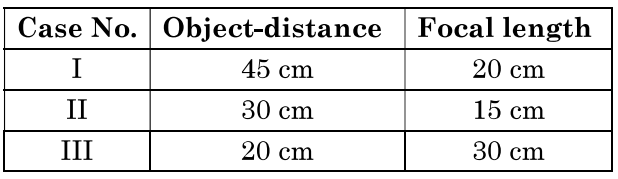
Diagram 1 – CBSE Class 10 Science 2023 Set 5 Solutions

(1)

List two properties of the image formed in Case I.

[1 Mark]
Answer: In Case I, the object is placed beyond the focal length of the concave mirror. The two properties of the image formed in this case are: 1) The image is real and inverted. 2) The image size is smaller than the object, i.e., the image is diminished.
Key Points: Object placed beyond focal length-Image is real and inverted-Image size is diminished

(2)

In which one of the cases given in the table, the mirror will form real image of same size and why?

[1 Mark]
Answer: The concave mirror forms a real image of the same size as the object when the object is placed at the center of curvature (C) of the mirror. This happens because, at this position, the image is formed exactly at the center of curvature on the same side as the object, and the size of the image is equal to the size of the object. The image formed is real and inverted. This occurs due to the way light rays converge after reflection from the mirror when the object is at C.
Key Points: For concave mirror, real and same size image forms when object is at center of curvature-Object at C gives image at C on same side-Inverted and real image-Image size equals object size

(3)

Name the type of mirror used by dentists. Give reason why do they use such type of mirrors.

[2 Marks]
Answer: Dentists use concave mirrors. They use concave mirrors because these mirrors produce enlarged images of the teeth, making it easier for dentists to see small details clearly while examining a patient's mouth.
Key Points: Dentists use concave mirrors-Concave mirrors produce enlarged images-Helps dentists see teeth clearly-Essential for detailed examination

(4)

Look at the table and identify the situation (object distance and focal length) which resembles the situation in which concave mirrors are used as shaving mirrors? Draw a ray diagram to show the image formation in this case.

[2 Marks]
Answer: Concave mirrors are used as shaving mirrors because they produce a magnified, erect, and virtual image when the object is placed very close to the mirror, that is, at a distance less than the focal length of the mirror (object distance < focal length). In this situation, the image appears larger and upright, which helps in seeing the face clearly while shaving. To represent this, we consider the case when the object is placed between the focal point (F) and the mirror (i.e., distance of the object from mirror is less than the focal length). The ray diagram for this case is drawn as follows: 1. Draw a concave mirror with its principal axis, focal point (F), and center of curvature (C). 2. Place the object between the mirror and focal point. 3. Draw one ray parallel to the principal axis; after reflection, it passes through the focal point. 4. Draw another ray passing through the focal point; after reflection, it travels parallel to the principal axis. 5. These two rays diverge after reflection, so extend them backward with dotted lines behind the mirror to locate their point of intersection. 6. The image is formed behind the mirror, it is virtual, erect, and magnified. This magnified virtual image formed when the object is closer than the focal length is why concave mirrors serve well as shaving mirrors.
Key Points: Concave mirrors form magnified, erect, virtual images when object is placed closer than focal length-This magnification aids in shaving as details appear larger-The object distance less than focal length is key to this application-Ray diagram showing rays reflecting and extending behind the mirror to locate the virtual image is essential-The image formed in this case is virtual, erect, and magnified

Section B

Question 4.

Metal oxides generally react with acids, but few oxides of metal also react with bases. Such metallic oxides are :

I. MgO

II. ZnO

III. Al₂O₃

IV. CaO

[1 Mark]
  • (A) I and II
  • (B) I and IV
  • (C) III and IV
  • (D) II and III
Explanation: The correct answer is II and III because zinc oxide (ZnO) and aluminium oxide (Al₂O₃) are amphoteric oxides. They react with both acids and bases to form salts and water. For example, aluminium oxide reacts with hydrochloric acid (acid) to form aluminium chloride and with sodium hydroxide (base) to form sodium aluminate. On the other hand, MgO and CaO are basic oxides and generally react only with acids.
Question 5.

Few drops of aqueous solution of ammonium chloride are put on a universal indicator paper. The paper turns pink.

study the following table and choose the correct option.
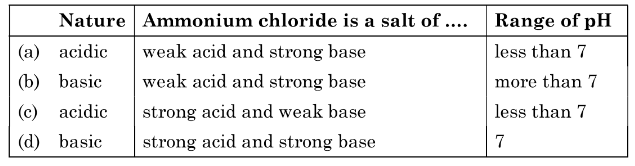
[1 Mark] Diagram 2 – CBSE Class 10 Science 2023 Set 5 Solutions
  • (A) D
  • (B) B
  • (C) A
  • (D) C
Explanation: Ammonium chloride (NH4Cl) is a salt derived from a weak base (NH3) and a strong acid (HCl). When dissolved in water, it produces an acidic solution due to hydrolysis. The universal indicator turning pink indicates an acidic pH. Therefore, the correct option is C, which corresponds to the acidic nature of ammonium chloride solution as indicated by the pink color change on universal indicator paper.
Question 6.

Select the appropriate state symbols of the products given as X and Y in the following chemical equation by choosing the correct option from table given below:
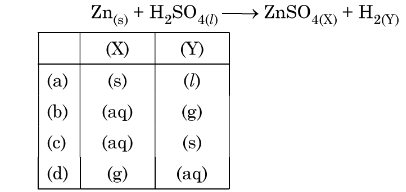
[1 Mark] Diagram 3 – CBSE Class 10 Science 2023 Set 5 Solutions
  • (A) D
  • (B) A
  • (C) C
  • (D) B
Explanation: According to the given context, the gaseous (g), liquid (l), aqueous (aq), and solid (s) states are represented by their respective notations. The products X and Y represent specific compounds formed in the reaction. Based on the examples provided, such as barium chloride (X) and sodium sulphate (Y), typically, the products formed in such double displacement reactions are solids (precipitates) or aqueous solutions. Option B correctly assigns the state symbols to products X and Y consistent with their physical states in solution and precipitate form.
Question 7.

Two salts X and Y are dissolved in water separately. When phenolphthalein is added to these two solutions, the solution 'X' turns pink and the solution Y does not show any change in colour, therefore 'X' and 'Y' are
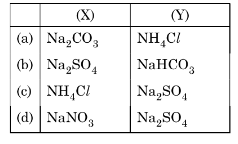
[1 Mark] Diagram 4 – CBSE Class 10 Science 2023 Set 5 Solutions
  • (A) A
  • (B) C
  • (C) B
  • (D) D
Explanation:

The correct answer is Option (a) — X = Na₂CO₃ and Y = NH₄Cl.

Phenolphthalein turns pink in basic (alkaline) solutions and remains colorless in acidic or neutral solutions.

Na₂CO₃ (sodium carbonate) is a salt of a strong base (NaOH) and weak acid (H₂CO₃), so its solution is basic. Therefore, it turns phenolphthalein pink.

NH₄Cl (ammonium chloride) is a salt of a strong acid (HCl) and weak base (NH₄OH), so its solution is acidic. Hence, it shows no colour change (remains colorless).

Question 8.

In the given diagram of a closed stomata (1), (2), (3) and (4) respectively are
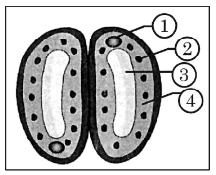
[1 Mark] Diagram 5 – CBSE Class 10 Science 2023 Set 5 Solutions
  • (A) nucleus, chloroplast, guard cell, vacuole
  • (B) vacuole, guard cell, nucleus, chloroplast
  • (C) nucleus, chloroplast,, vacuole, guard cell
  • (D) chloroplast, nucleus, vacuole, guard cell
Explanation: In a closed stomata diagram, the labeling typically refers to the nucleus, chloroplasts, vacuole, and guard cell. Guard cells are the specialized cells controlling the stomatal opening and closing. Chloroplasts are present in guard cells and provide energy for their functioning. The nucleus controls cell activities, and the vacuole regulates water content, affecting guard cell turgidity. Therefore, the correct sequence for (1), (2), (3), and (4) is nucleus, chloroplast, vacuole, and guard cell respectively.
Question 9.

Walking in a straight line and riding a bicycle are the activities which are possible due to a part of the brain. Choose the correct location and name of this part from the given table:
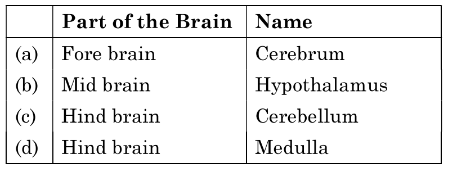
[1 Mark] Diagram 6 – CBSE Class 10 Science 2023 Set 5 Solutions
  • (A) A
  • (B) D
  • (C) B
  • (D) C
Explanation: These activities require balance, coordination, and precision of voluntary movements, which are functions of the cerebellum. The cerebellum is located in the hind-brain. It helps maintain posture and balance, allowing smooth and coordinated movements such as walking straight and riding a bicycle.
Question 10.

A student wants to obtain an erect image of an object using a concave mirror of 10 cm focal length. What will be the distance of the object from mirror?

[1 Mark]
  • (A) Less than 10 cm
  • (B) 10 cm
  • (C) between 10 cm and 20 cm
  • (D) more than 20 cm
Explanation: For a concave mirror, an erect image is formed only when the object is placed between the pole (P) and the focus (F) of the mirror. Since the focal length (F) is 10 cm, the object must be placed at a distance less than 10 cm from the mirror to get an erect image. Therefore, the object distance should be less than 10 cm.
Question 11.

Bronze is an alloy of

[1 Mark]
  • (A) Copper and Zinc
  • (B) Copper, Tin and Zinc
  • (C) Aluminium and Tin
  • (D) Copper and Tin
Explanation: Bronze is an alloy made by mixing copper and tin. The context states that bronze is an alloy of copper and tin (Cu and Sn). Therefore, the correct option is 'Copper and Tin'.
Question 12.

In an experiment with pea plants, a pure tall plant (TT) is crossed with a pure short plant (tt). The ratio of pure tall plants to pure short plants in F₂ generation will be —
[1 Mark]
  • (A) 1:3
  • (B) 3:1
  • (C) 1:1
  • (D) 2:1
Explanation: When a pure tall plant (TT) is crossed with a pure short plant (tt), all F1 generation plants are heterozygous tall (Tt). Crossing these F1 plants among themselves results in F2 generation with genotypes: TT, Tt, and tt in the ratio 1:2:1. Since both TT and Tt plants are tall, the phenotypic ratio of tall to short plants in F2 is 3:1. However, the question asks specifically for the ratio of pure tall (TT) to pure short (tt) plants, which is 1:1.
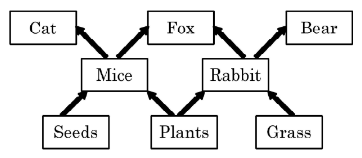
Question 13. Study the given figure of a Food web and identify the primary consumer in the food web:
[1 Mark] Diagram 7 – CBSE Class 10 Science 2023 Set 5 Solutions
  • (A) Mice and Bear
  • (B) Mice and Rabbit
  • (C) Rabbit and Fox
  • (D) Rabbit and Cat
Explanation: Primary consumers are herbivores that feed directly on plants. According to the context, mice and rabbits are primary consumers as they eat shrubs and plants directly. Therefore, the correct option is 'Mice and Rabbit'. Other options include animals like bears, foxes, and cats, which are secondary or tertiary consumers.
Question 14.

Choose the correct order of the stages of binary fission in Leishmania.
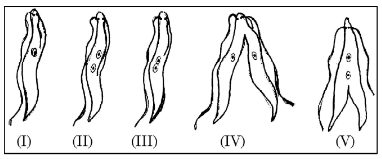
[1 Mark] Diagram 8 – CBSE Class 10 Science 2023 Set 5 Solutions
  • (A) I, III, II, V, IV
  • (B) I, III, V, II, IV
  • (C) I, II, III, V, IV
  • (D) I, II, III, IV, V
Explanation: Binary fission in Leishmania involves duplication of the nucleus and kinetoplast followed by division of the cytoplasm to form two identical daughter cells. The correct sequence must reflect these biological steps. According to the provided context, the stages grouped as I include the initial cell stage with the nucleus and kinetoplast, followed by nuclear and kinetoplast duplication (II and III), then division of the cytoplasm (V), and ending with two daughter cells (IV). Therefore, the correct order is I, III, V, II, IV.
Question 15.

Consider the following chemical equation I and II

I. Mg + 2HCl ⟶ MgCl₂ + H₂

II. NaOH + HCl ⟶ NaCl + H₂O

The correct statement about these equations is -

[1 Mark]
  • (A) Both 'I' and 'II' are displacement reactions.
  • (B) I is a displacement reaction and II' is double displacement reaction.
  • (C) Both 'I' and 'IT' are double-displacement reactions.
  • (D) I is a displacement reaction and II' is a decomposition reaction.
Explanation:

In the first reaction, Mg displaces hydrogen from HCl, so it is a displacement reaction. In the second reaction, NaOH reacts with HCl by exchanging ions to form NaCl and H₂O, which is a double displacement reaction. Therefore, the correct statement is: I is a displacement reaction and II is a double displacement reaction.

Question 16.

In the following diagram showing dispersion of white light by a glass prism, the colours 'P' and 'Q' respectively are -
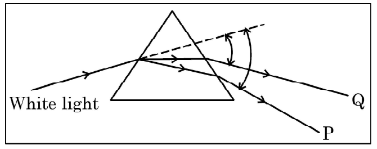
[1 Mark] Diagram 9 – CBSE Class 10 Science 2023 Set 5 Solutions
  • (A) Red and Blue
  • (B) Red and Violet
  • (C) Orange and Green
  • (D) Violet and Red
Explanation:

The correct answer is 'Red and Violet'. When white light passes through a glass prism, it disperses into its component colors due to different degrees of bending (refraction). Red light bends the least and appears at the top, while violet light bends the most and appears at the bottom. Hence, 'P' corresponds to Red and 'Q' corresponds to Violet.

Question 17.

Consider the following three flowers namely X, Y and Z. Which flower(s) would develop into a fruit?
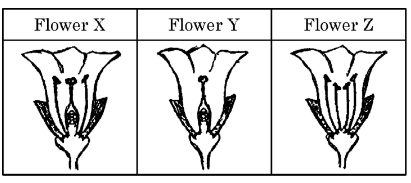
[1 Mark] Diagram 10 – CBSE Class 10 Science 2023 Set 5 Solutions
  • (A) 'Z 'only
  • (B) 'Y' and 'Z'
  • (C) 'X' only
  • (D) 'X' and 'Y' only
Explanation:

According to the context, fruit is the mature ovary of a flower. After fertilization, the ovule develops into a seed while the ovary matures into a fruit. Therefore, only the flower that has undergone fertilization and has a mature ovary (flower Z) will develop into a fruit.

Question 18. The magnetic field inside a long straight current carrying solenoid:
[1 Mark]
  • (A) is zero.
  • (B) increases as we move towards its end.
  • (C) decreases as we move towards its end.
  • (D) is same at all points.
Explanation: The correct option is 'is same at all points.' This is because the magnetic field lines inside the solenoid are nearly parallel and close together, indicating a strong and uniform magnetic field throughout the interior of the solenoid. Therefore, the magnetic field inside a long straight solenoid does not change as we move along its length, making it uniform at all points inside.
Question 19. In human eye the part which allows light to enter into the eye is -
[1 Mark]
  • (A) Retina
  • (B) Pupil
  • (C) Cornea
  • (D) Eye lens
Explanation: The correct answer is Pupil. According to the context, the pupil is a small opening in the iris that regulates and controls the amount of light entering the eye. Although the cornea is transparent and helps focus light, it is the pupil that actually allows the light to pass into the interior of the eye.
Question 20. Assertion (A): It is advised that while diluting an acid one should add water to acid and not acid to water keeping the solution continuously stirred. Reason (R): The process of dissolving an acid into water is highly exothermic.
[1 Mark]
  • (A) Both Assertion (A) and Reason (R) are true and Reason (R) is the correct explanation of (A).
  • (B) Assertion (A) is false, but Reason (R) is true.
  • (C) Assertion (A) is true, but Reason (R) is false.
  • (D) Both Assertion (A) and Reason (R) are true but Reason (R) is not the correct explanation of (A).
Explanation: The assertion is incorrect because it is advised to add acid to water slowly, not water to acid. This is because dissolving an acid in water is a highly exothermic process that releases a lot of heat. Adding water to concentrated acid can cause the mixture to splash and cause burns or break the container due to the sudden release of heat. Therefore, the correct method is to add acid slowly to water with constant stirring to dissipate the heat safely. The reason given is true, but it does not correctly explain the assertion. Hence, 'Assertion (A) is false, but Reason (R) is true.' is the correct choice.
Question 21. Assertion (A): The energy which passes to the herbivores does not come back to autotrophs. Reason (R): The flow of energy in a food chain is unidirectional.
[1 Mark]
  • (A) Both Assertion (A) and Reason (R) are true and Reason (R) is the correct explanation of (A).
  • (B) Both Assertion (A) and Reason (R) are true but Reason (R) is not the correct explanation of (A).
  • (C) Assertion (A) is true, but Reason (R) is false.
  • (D) Assertion (A) is false, but Reason (R) is true.
Explanation: Both Assertion (A) and Reason (R) are true, and Reason (R) correctly explains Assertion (A). The flow of energy in an ecosystem is unidirectional, starting from the sun to autotrophs (producers), then to herbivores, followed by carnivores and top carnivores. Energy once passed on to herbivores does not return to autotrophs because energy moves in one direction through the food chain and decreases at each trophic level due to metabolic losses. Therefore, energy that reaches herbivores cannot flow back to autotrophs.
Question 22. Assertion (A): Amoeba takes in food using finger like extensions of the cell surface. Reason (R) In all unicellular organisms, the food is taken in by the entire cell surface.
[1 Mark]
  • (A) Both Assertion (A) and Reason (R) are true and Reason (R) is the correct explanation of (A).
  • (B) Assertion (A) is true, but Reason (R) is false.
  • (C) Both Assertion (A) and Reason (R) are true but Reason (R) is not the correct explanation of (A).
  • (D) Assertion (A) is false, but Reason (R) is true.
Explanation: Both Assertion (A) and Reason (R) are true but Reason (R) is not the correct explanation of (A). Amoeba takes in food by extending temporary finger-like projections called pseudopodia which surround and engulf the food, forming a food vacuole. While it is true that many unicellular organisms take in food by their entire surface, in Amoeba the food intake is specifically through pseudopodia, not the entire cell surface. Hence, the reason is true but does not correctly explain the assertion.
Question 23. Assertion (A): Melting point and boiling point of ethanol are lower than that of sodium chloride. Reason (R) The forces of attraction between the molecules of ionic compoünds are very strong.
[1 Mark]
  • (A) Both Assertion (A) and Reason (R) are true and Reason (R) is the correct explanation of (A).
  • (B) Both Assertion (A) and Reason (R) are true but Reason (R) is not the correct explanation of (A).
  • (C) Assertion (A) is true, but Reason (R) is false.
  • (D) Assertion (A) is false, but Reason (R) is true.
Explanation: Both Assertion (A) and Reason (R) are true and Reason (R) is the correct explanation of (A). The melting and boiling points of ethanol are lower than those of sodium chloride because ethanol is a molecular compound with weaker intermolecular forces, whereas sodium chloride is an ionic compound with strong electrostatic forces between its positive and negative ions. These strong ionic bonds require a lot of energy to break, resulting in higher melting and boiling points for ionic compounds like sodium chloride.

Section C

Question 24.

State whether the given chemical reaction is a redox reaction or not. Justify your answer.

MnO₂ + 4 HCl → MnCl₂ + 2 H₂O + Cl₂

[2 Marks]
Answer: Yes, the given chemical reaction is a redox reaction. In this reaction, manganese dioxide (MnO₂) is reduced to manganese chloride (MnCl₂) as it gains electrons. At the same time, hydrochloric acid (HCl) is oxidized to chlorine gas (Cl₂) as it loses electrons. Because reduction and oxidation occur simultaneously, this reaction is classified as a redox reaction.
Key Points: MnO2 is reduced to MnCl2 - HCl is oxidized to Cl2 - Both oxidation and reduction occur simultaneously - Therefore, the reaction is a redox reaction
Question 25.

List two differences between the movement of leaves of a sensitive plant and the movement of a shoot towards light.

[2 Marks]
Answer: The movement of leaves of a sensitive plant occurs quickly in response to touch and does not involve growth. It is a rapid movement caused by the loss of water pressure in certain cells, making the leaves fold up. In contrast, the movement of a shoot towards light is a slow, directional growth movement called phototropism, where the shoot grows towards the light due to differential growth on the shaded side. This movement involves growth and takes more time.
Key Points: Movement of sensitive plant leaves is rapid and involves no growth-Movement of shoot towards light is slow and involves growth-Sensitive plant leaves move due to touch; shoot movement is due to light stimulus
Question 26.

What happens at synapse between two neurons? State briefly.

[2 Marks]
Answer: At the synapse between two neurons, an electrical impulse reaching the nerve ending triggers the release of chemicals called neurotransmitters. These chemicals cross the synaptic gap and bind to receptors on the dendrite of the next neuron. This binding initiates a similar electrical impulse in the second neuron, allowing the nerve signal to continue its journey. Thus, the synapse enables communication between neurons.
Key Points: Impulse reaches nerve ending-trigger release of chemicals (neurotransmitters)-Chemicals cross synapse (gap)-Bind to receptors on next neuron's dendrite-Start similar electrical impulse in next neuron-Enables nerve signal transmission between neurons
Question 27.
  1. Give the name of the enzyme present in the fluid in our mouth cavity. State the gland which produces it. What would happen to the digestion process if this gland stops secreting this enzyme?

[2 Marks]
Answer: The enzyme present in the fluid (saliva) in our mouth cavity is called salivary amylase. It is produced by the salivary glands. Salivary amylase begins the digestion of carbohydrates by breaking down starch into simpler sugars in the mouth. If the salivary glands stop secreting this enzyme, the process of carbohydrate digestion will be delayed because the initial breakdown in the mouth will not occur. This means digestion would mainly start later in the small intestine, making the overall digestion process less efficient.
Key Points: Enzyme name: salivary amylase - Produced by: salivary glands - Function: starts carbohydrate digestion in the mouth - Effect if stopped: carbohydrate digestion delayed, less efficient digestion process
Question 28.
  1. Let the resistance of an electrical device remain constant, while the potential difference across its two ends decreases to one fourth of its initial value. What change will occur in the current through it? State the law which helps us in solving the above stated question.

[2 Marks]
Answer: According to Ohm's Law, the current flowing through an electrical device is directly proportional to the potential difference across its ends when the resistance remains constant. Here, the potential difference decreases to one fourth of its initial value, so the current will also decrease to one fourth of its initial value. Ohm's Law, which states Voltage (V) = Current (I) × Resistance (R), helps solve this problem.
Key Points: Ohm's Law states voltage equals current times resistance-Resistance is constant-Potential difference reduces to one fourth-Current also reduces to one fourth-Current is directly proportional to voltage at constant resistance
Question 29.

A light ray enters from medium A to medium B as shown in the figure.

(a) Which one of the two media is denser w.r.t. other medium? Justify your answer.

(b) If the speed of light in medium A is vₐ and in medium B is vᵦ, what is the refractive index of B with respect to A?
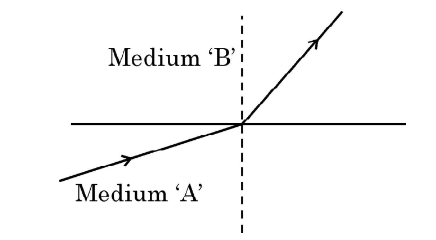
[2 Marks] Diagram 11 – CBSE Class 10 Science 2023 Set 5 Solutions
Answer:

(a) Medium B is denser than medium A because the light ray bends towards the normal when it enters medium B from medium A. This bending towards the normal shows that light travels slower in medium B, which means medium B is optically denser than medium A.

(b) The refractive index of medium B with respect to medium A is the ratio of the speed of light in medium A to the speed of light in medium B. Therefore, refractive index of B with respect to A = vₐ / vᵦ.

Key Points: Medium B is denser because light bends towards the normal in B-Light slows down in denser medium-Refractive index is ratio of speeds of light in the two media-Refractive index of B w.r.t A = speed in A divided by speed in B
Question 30.

(a) A ray of light starting from diamond is incident on the interface separating diamond and water. Draw a labelled ray diagram to show the refraction of light in this case. 

(b) Absolute refractive indices of diamond and water are 2.42 and 1.33 respectively. Find the value of refractive index of water w.r.t. diamond. 

[2 Marks]
Answer:

(a) When a ray of light travels from diamond (higher refractive index 2.42) to water (lower refractive index 1.33), it bends away from the normal at the interface. The ray starts inside the diamond, strikes the surface separating diamond and water, and refracts into water bending away from the normal line because light is moving from a denser to a rarer medium. The diagram should include the diamond region, water region, normal at the interface, incident ray inside diamond, and refracted ray inside water bending away from normal.

(b) Refractive index of water with respect to diamond = (Absolute refractive index of water) / (Absolute refractive index of diamond) = 1.33 / 2.42 ≈ 0.55.

Key Points: Light moves from diamond (n=2.42) to water (n=1.33)-Light bends away from normal during refraction at diamond-water interface-The ray diagram must show incident ray inside diamond, normal, and refracted ray bending away in water-Absolute refractive indices are used to find relative refractive index-Refractive index of water w.r.t diamond = 1.33/2.42 = 0.55
Question 31.

State the rule to determine the direction of a (a) magnetic field produced around a straight conductor carrying current and (b) force experienced by a current carrying straight conductor placed in a magnetic field which is perpendicular to it.

[2 Marks]
Answer: a) To find the direction of the magnetic field around a straight current-carrying conductor, use the Right-Hand Rule: Point your right thumb in the direction of current flow and curl your fingers. The direction your fingers curl shows the magnetic field's circular direction around the wire. b) To find the direction of the force on a current-carrying conductor placed in a magnetic field perpendicular to it, use Fleming's Left-Hand Rule: Stretch your first finger, second finger, and thumb so they are mutually perpendicular. The first finger points in the direction of the magnetic field, the second finger points in the direction of current, and the thumb points in the direction of the force on the conductor.
Key Points: Right-Hand Rule for magnetic field direction around current-carrying wire-Fleming's Left-Hand Rule for force direction on current-carrying conductor in magnetic field-Magnetic field is circular around the conductor-Force is perpendicular to both current and magnetic field

Section D

Question 32.

Explain the process of transport of oxygenated and deoxygenated blood in a human body.

[3 Marks]
Answer: In the human body, blood transport involves two types: oxygenated and deoxygenated blood. Deoxygenated blood, which is rich in carbon dioxide, returns from the body tissues to the right atrium of the heart via the vena cava. From there, it moves to the right ventricle and is pumped through the pulmonary artery to the lungs. In the lungs, carbon dioxide leaves the blood, and oxygen enters it, making the blood oxygenated. This oxygen-rich blood then flows into the left atrium through the pulmonary vein, passes into the left ventricle, and is pumped out through the aorta to the rest of the body. The septum separates the two sides of the heart, preventing mixing of oxygenated and deoxygenated blood. This cycle ensures that oxygen is delivered to body tissues and carbon dioxide is removed efficiently.
Key Points: Deoxygenated blood carries carbon dioxide from body to right heart via vena cava - Right heart pumps this blood to lungs via pulmonary artery - In lungs, CO2 leaves and O2 enters the blood - Oxygenated blood returns to left heart via pulmonary vein - Left heart pumps oxygenated blood to body through aorta - Septum separates left and right sides to prevent mixing of blood - Blood flow sequence body → vena cava → right heart → pulmonary artery → lungs → pulmonary vein → left heart → aorta → body
Question 33.

A substance 'X' is used as a building material and is insoluble in water. When it reacts with dilute HCl, it produces a gas which turns lime water milky.

(i) Write the chemical name and formula of 'X'.

(ii) Write chemical equations for the chemical reactions involved in the above statements.

[3 Marks]
Answer: (i) Substance 'X' is calcium carbonate and its chemical formula is CaCO3.
(ii) When calcium carbonate reacts with dilute hydrochloric acid (HCl), it produces carbon dioxide gas, calcium chloride, and water. The chemical equation is:
CaCO3 + 2HCl → CaCl2 + CO2 + H2O
The carbon dioxide gas (CO2) produced turns lime water milky due to the formation of calcium carbonate precipitate. The reaction is:
CO2 + Ca(OH)2 → CaCO3 + H2O
This shows that calcium carbonate is insoluble in water and produces carbon dioxide gas on reaction with dilute HCl, which turns lime water milky.
Key Points: Substance 'X' is calcium carbonate (CaCO3) - Reaction with dilute HCl produces CO2 gas - CO2 gas turns lime water milky by forming CaCO3 precipitate
Question 34.

A metal 'M' on reacting with dilute acid liberates a gas 'G'. The same metal also liberates gas 'G' when reacts with a base.

(i) Write the name of gas 'G'.

(ii) How will you test the presence of this gas?

(iii) Write chemical equations for the reactions of the metal with

(1) an acid and (2) a base.

[3 Marks]
Answer:

(i) The gas 'G' liberated on reacting the metal 'M' with both dilute acid and base is hydrogen gas (H₂).

(ii) To test for hydrogen gas, bring a burning matchstick near the mouth of the test tube containing the gas. If the gas is hydrogen, it will burn with a 'pop' sound.

(iii) The chemical reactions are:

1. Reaction with acid (e.g., dilute hydrochloric acid):

Metal + Acid → Salt + Hydrogen gas

For metal 'M' reacting with dilute HCl: M + 2HCl → MCl₂ + H₂ ↑

2. Reaction with base (e.g., sodium hydroxide in case of amphoteric metals like zinc or aluminum):

Metal + Base + Water → Complex salt + Hydrogen gas

Example with zinc and sodium hydroxide:

Zn + 2NaOH + 2H₂O → Na₂[Zn(OH)₄] + H₂ ↑

Key Points: Gas G is hydrogen-Hydrogen gas shows pop sound when tested with burning matchstick-Equation for metal reacting with dilute acid forming salt and hydrogen-Equation for metal reacting with base, especially amphoteric metals like zinc or aluminium, also producing hydrogen gas
Question 35.

Name the gland and the hormone secreted by it in scary situations in human beings. List any two responses shown by our body when this hormone is secreted into the blood.

[3 Marks]
Answer: The gland that secretes the hormone in scary situations is the adrenal gland. The hormone secreted by it is called adrenaline. When a person faces a scary or stressful situation, the adrenal gland releases adrenaline directly into the blood. This hormone prepares the body for a 'fight or flight' response. Two main responses shown by the body when adrenaline is secreted are: firstly, the heart beats faster, which increases the supply of oxygen and nutrients to the muscles; secondly, the body produces more energy to respond quickly and effectively to the situation. These changes help the body to cope with stress, fear, or danger.
Key Points: Adrenal gland-Adrenaline hormone-Secreted during scary situations-Adrenaline prepares body for fight or flight response-Heart beats faster-Increased oxygen supply to muscles-Body produces more energy
Question 36.

In the given diagram

(1) Name the parts labelled A, B, and C.

(ii) Write the functions of A and C.

(iii) Reflex arcs have evolved in animals? Why?
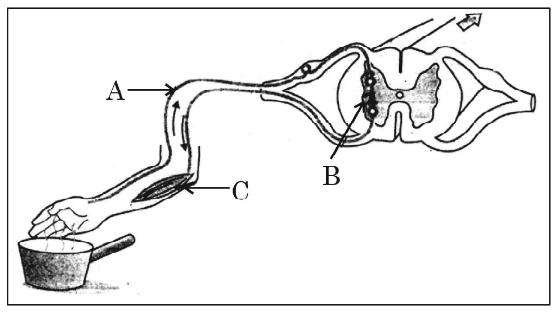
[3 Marks] Diagram 12 – CBSE Class 10 Science 2023 Set 5 Solutions
Answer:

(i) The parts labelled in the diagram are: A - Receptor, B - Sensory Neuron, C - Motor Neuron.

(ii) Functions of A and C:
A (Receptor) detects the stimulus like heat or pain from the environment.
C (Motor Neuron) carries the message from the spinal cord to the effector (muscle) to produce a response such as pulling the hand away.

(iii) Reflex arcs have evolved in animals because the brain's thinking process is not fast enough to respond to sudden harmful stimuli. Reflex actions provide a quick, automatic response by bypassing the brain, allowing immediate reaction to danger. Many animals also lack a complex nervous system for thinking, so reflex arcs enable them to survive by reacting quickly to stimuli.

Key Points: Label A is Receptor, B is Sensory Neuron, C is Motor Neuron - Function of A is to detect stimulus - Function of C is to send impulses to the effector - Reflex arcs provide quick response bypassing brain - Brain is slow for reflex actions - Some animals lack complex nerve networks - Reflex arcs help in quick survival response
Question 37.

With the help of an appropriate example, justify that some of the chemical reactions are determined by

(a) Change in temperature,

(b) Evolution of a gas, and

(c) Change in colour

Give chemical equation for the reaction involved in each case.

[3 Marks]
Answer: (a) Change in temperature: When quicklime (CaO) is mixed with water, it produces slaked lime (Ca(OH)2) and releases heat, showing increase in temperature indicating a chemical reaction.
Chemical equation: CaO + H2O -> Ca(OH)2 + heat

(b) Evolution of a gas: When zinc reacts with dilute hydrochloric acid, hydrogen gas is evolved which is a sign of chemical change.
Chemical equation: Zn + 2HCl -> ZnCl2 + H2(gas)

(c) Change in colour: When iron reacts with copper sulfate solution, the blue color of copper sulfate fades and reddish-brown copper metal is deposited showing a color change.
Chemical equation: Fe + CuSO4 -> FeSO4 + Cu (deposited)
Key Points: Chemical reactions show changes in temperature - Chemical reactions involve evolution of gas - Chemical reactions involve change in color
Question 38.

State reasons for Myopia. With the help of ray diagrams, show the

(a) image formation by a myopic eye, and

(b) correction of myopia using an appropriate lens.

[3 Marks]
Answer:

Reasons for Myopia: Myopia or nearsightedness occurs when the eye ball is longer than normal or the cornea is too curved. This causes light rays from distant objects to focus in front of the retina instead of on it, making distant objects appear blurry.

(a) Image formation by a myopic eye: In a myopic eye, parallel rays of light from distant objects converge and meet before the retina. Hence, the image formed is blurred on the retina since the focus is in front of it.

(b) Correction of myopia using a concave lens: Myopia is corrected by using a concave (diverging) lens in front of the eye. The concave lens diverges the incoming rays before they enter the eye, moving the effective focus back so the rays focus exactly on the retina. This corrects the blurred vision and allows the person to see distant objects clearly.

Key Points: Myopia caused by elongated eyeball or overly curved cornea-Light focuses before retina in myopic eye-Causes blurry distant vision-Concave lens diverges light rays before eye-Concave lens moves focus to retina-Corrects vision by allowing clear image formation
Question 39.

(a) Write the percentage of (i) solar energy captured by the autotrophs and (ii) energy transferred from autotrophs to the next level in a food chain.

(b) What are trophic levels? Why do different food chains in an ecosystem not have more than four to five trophic levels? Give reason.

[3 Marks]
Answer:

(a) (i) Autotrophs capture only a small fraction of the total solar energy available. Although the exact percentage is not explicitly stated in the given context, it is generally understood that only about 1% to 5% of solar energy is captured by autotrophs (producers) through photosynthesis.

(ii) About 10% of the energy stored in the autotrophs is transferred to the next trophic level in the food chain, which is usually the herbivores or primary consumers.

(b) Trophic levels refer to the different steps or levels in a food chain, representing organisms that share the same function in the feeding process. The first trophic level consists of autotrophs (producers) that capture solar energy and produce organic matter. The second level consists of herbivores (primary consumers) that feed on producers. Higher levels include secondary consumers (small carnivores) and tertiary consumers (larger carnivores).

Food chains generally do not have more than four to five trophic levels because at each step there is a loss of energy, mainly as heat. Only about 10% of the energy is transferred from one level to the next, so the amount of usable energy decreases significantly as we move up the trophic levels. After four or five levels, there is too little energy left to support higher trophic levels, limiting the length of the food chain.

Key Points: autotrophs capture a small percentage of solar energy-about 1% to 5%-only about 10% energy transfer between trophic levels-definition of trophic levels-autotrophs at first trophic level-herbivores second trophic level-secondary and tertiary consumers at higher levels-energy loss at each trophic level-energy available decreases at higher levels-food chains rarely exceed four to five trophic levels due to energy loss
Question 40.

What is a solenoid? When does a solenoid behave as a magnet? Draw the pattern of the magnetic field produced inside it showing the directions of the magnetic field lines.

[3 Marks]
Answer: (a) A solenoid is a long coil of wire wound in the form of loops, like a spring.
(b) When an electric current passes through the solenoid, it behaves like a magnet with two poles; this happens because the current produces a magnetic field around the coil.
(c) The magnetic field inside the solenoid is strong and uniform with magnetic field lines running parallel to each other. The directions of the magnetic field lines inside the solenoid are from the south pole to the north pole.
Outside, these lines loop from the north pole back to the south pole, forming closed loops similar to those of a bar magnet.
The polarity of the solenoid depends on the direction of the current.
Diagram: The magnetic field lines inside the solenoid are shown as straight, parallel lines directed from the south to north pole inside, and curved lines outside forming closed loops returning to the south pole.
Key Points: Solenoid is a coil of wire - Current through solenoid creates magnetic field - Solenoid behaves as magnet when current flows - Magnetic field lines inside are parallel and uniform - Field lines form closed loops outside - Polarity depends on current direction

Section E

Question 41.

(i) A compound ‘A’ with a molecular formula of C₂H₄O₂ reacts with a base to give salt and water. Identify ‘A’, state its nature and the name of the functional group it possesses. Write the chemical equation for the reaction involved.

(ii) When the above stated compound ‘A’ reacts with another compound ‘B’ having molecular formula C₂H₆O in the presence of an acid, a sweet-smelling compound ‘C’ is formed.

(1) Identify ‘B’ and ‘C’.

(2) State the role of acid in this reaction.

(3) Write the chemical equation for the reaction involved.

[5 Marks]
Answer: (a) The compound ‘A’ with molecular formula C2H4O2 is ethanoic acid (commonly called acetic acid). It is an acid by nature because it releases H+ ions in water. The functional group present in ‘A’ is the carboxyl group (-COOH). When ethanoic acid reacts with a base such as sodium hydroxide (NaOH), it forms a salt and water. The chemical equation is:
C2H4O2 + NaOH → CH3COONa + H2O

(b)(1) The compound ‘B’ with molecular formula C2H6O is ethanol (CH3CH2OH). When ethanoic acid (‘A’) reacts with ethanol (‘B’) in the presence of an acid catalyst, a sweet-smelling compound ‘C’ called ethyl ethanoate (an ester) is formed along with water.
(2) The acid acts as a catalyst in this esterification reaction. It helps in speeding up the reaction without being consumed.
(3) The chemical equation for this esterification reaction is:
CH3COOH + CH3CH2OH → CH3COOCH2CH3 + H2O (in presence of acid catalyst)
Key Points: Compound A is ethanoic acid - Compound A is acidic in nature - Functional group is carboxyl (-COOH) - Reaction with base gives salt and water - Compound B is ethanol - Compound C is ethyl ethanoate (ester) - Acid acts as catalyst in esterification reaction - Write balanced chemical equations for both reactions
Question 42.

(i) Name the compound formed when ethanol is heated at 443 K in the presence of conc. H₂SO₄ and draw its electron-dot structure. State the role of conc. H₂SO₄ in this reaction.

(ii) What is hydrogenation? Explain it with the help of a chemical equation. State the role of this reaction in industry.

[5 Marks]
Answer: (i) When ethanol (C2H5OH) is heated at 443 K in the presence of concentrated H2SO4, it undergoes dehydration to form ethene (C2H4). The reaction is: C2H5OH --(conc. H2SO4, 443 K)--> C2H4 + H2O. The concentrated sulfuric acid acts as a dehydrating agent which removes water from ethanol.
Electron-dot structure of ethene (C2H4):
Each carbon atom shares two electrons to form a double bond between them and also forms single bonds with two hydrogen atoms each.
(ii) Hydrogenation is the process of adding hydrogen (H2) to unsaturated compounds like alkenes to convert them into saturated compounds like alkanes.
For example, ethene reacts with hydrogen in the presence of a catalyst (like nickel) to form ethane: C2H4 + H2 --(Ni catalyst)--> C2H6.
This reaction is important in industry for converting vegetable oils (which are unsaturated fats) into saturated fats (like margarine), thereby improving texture and shelf life.
Key Points: Ethanol undergoes dehydration to form ethene - Conc. H2SO4 acts as dehydrating agent - Hydrogenation is addition of hydrogen to unsaturated compounds - Hydrogenation converts alkenes into alkanes - Used in industry to convert unsaturated fats to saturated fats
Question 43.

Give Reason for the following :
(a) During reproduction inheritance of different proteins will lead to altered body designs.
(b) Fertilization cannot take place in flowers if pollination does not occur.

(c) All multicellular organisms cannot give rise to new individuals through fragmentation or regeneration.

(d) Vegetative propagation is practised for growing only some type of plants.

(e) The parents and off-springs of organisms reproducing sexually have the same number of chromosomes.

[5 Marks]
Answer:

(a) During reproduction, the inheritance of different proteins and genetic factors from parents leads to variation in the offspring. These variations can result in altered body designs or characteristics. Sexual reproduction increases such diversity because the combination of genes from two parents leads to new traits in the offspring.

(b) Fertilization in flowers requires the fusion of male and female gametes, which can only occur after pollination. Pollination is the transfer of pollen grains from the male part (anther) to the female part (stigma) of the flower. Without pollination, the male gametes cannot reach the female gametes, and fertilization cannot occur.

(c) Not all multicellular organisms can give rise to new individuals through fragmentation or regeneration. While some simple organisms like Hydra can regenerate or reproduce asexually by fragmentation, most multicellular organisms reproduce by other means, such as sexual reproduction. Regeneration is limited to certain organisms with this ability.

(d) Vegetative propagation is practiced only for certain types of plants. It is an asexual reproductive method where new plants are produced from vegetative parts like stems, roots, or leaves. This method is used for plants that do not produce viable seeds or where we want to preserve the characteristics of the parent plant exactly.

(e) In organisms that reproduce sexually, the parents and offspring have the same number of chromosomes. This is because gametes are formed by meiosis, which reduces the chromosome number by half. During fertilization, the chromosomes from each parent combine to restore the normal chromosome number in the offspring.

Key Points: Inheritance leads to variation in offspring due to different proteins and genes-Fertilization requires pollination for fusion of gametes-Not all multicellular organisms can reproduce through fragmentation or regeneration-Vegetative propagation is limited to certain plant types and is asexual-Sexual reproduction maintains the chromosome number in parents and offspring
Question 44.

(i) What is meant by resistance of a conductor? Define its SI unit.

(ii) List two factors on which the resistance of a rectangular conductor depends.

(iii) How will the resistance of a wire be affected if its

(1) length is doubled, and

(2) radius is also doubled?

Give justification for your answer.

[5 Marks]
Answer:

(i) Resistance of a conductor is the property of the conductor that opposes or resists the flow of electric current through it. It is denoted by R and is measured in ohms (Ω). The SI unit of resistance is ohm, defined as the resistance of a conductor in which a current of one ampere flows when a potential difference of one volt is applied across its ends.

(ii) The resistance of a rectangular conductor depends on the following two factors: (1) Length of the conductor – resistance is directly proportional to length, so if length increases, resistance increases. (2) Cross-sectional area of the conductor – resistance is inversely proportional to the cross-sectional area, so if area increases, resistance decreases.

(iii) (1) If the length of the wire is doubled, the resistance also doubles. This is because resistance R is directly proportional to the length (L), so R ∝ L.

(2) If the radius of the wire is doubled, its resistance decreases to one-fourth of the original resistance. This is because the cross-sectional area A of the wire depends on the radius r as A = πr². Doubling the radius increases the area by four times, and since resistance is inversely proportional to area, resistance becomes one-fourth.

Thus, the factors affecting resistance follow the relationships: R ∝ L and R ∝ 1/A, where A depends on radius.

Key Points: Resistance is the opposition to electric current flow - SI unit is ohm (Ω) - Resistance depends on length and cross-sectional area - Resistance ∝ length (doubling length doubles resistance) - Resistance ∝ 1/area (doubling radius quadruples area, so resistance becomes one-fourth)
Question 45.

In an electric circuit three bulbs of 100 W each are connected in series to a source. In another circuit set of three bulbs of the same wattage are connected in parallel to the same source.

(i) Will the bulb in the two circuits glow with the same brightness? Justify your answer.

(ii) Now, let one bulb in both the circuits get fused. Will the rest of the bulbs continue to glow in each circuit? Give reason for your answer.

[5 Marks]
Answer:

(i) Brightness of bulbs in series and parallel circuits:
When three bulbs of 100 W each are connected in series to a source, the same current flows through each bulb. Because of series connection, total resistance is the sum of individual resistances, which reduces the current through the bulbs. Consequently, each bulb receives less current and glows with less brightness than its rated brightness.
In contrast, when three bulbs of the same rating are connected in parallel across the same source, each bulb receives the full voltage of the source. Hence, each bulb draws the current it requires according to its rating and glows with full brightness.
Therefore, bulbs connected in parallel glow brighter than those connected in series under the same voltage supply.

(ii) Effect of one fused bulb in series and parallel circuits:
If one bulb gets fused in the series circuit, the circuit becomes open because the connection is broken at that point. As a result, the current stops flowing through the circuit and all bulbs stop glowing.
However, if one bulb gets fused in the parallel circuit, only that particular branch is broken, but the other two parallel branches remain connected. Therefore, current can still flow through the other bulbs, and they will continue to glow.
Hence, bulbs in series stop glowing if one bulb fuses, while bulbs in parallel continue to glow except the fused bulb.

Key Points: Bulbs in series share the voltage and have lower current, so glow less bright - Bulbs in parallel get full voltage, glow brighter - Fused bulb breaks series circuit, no current flows - Fused bulb breaks only one branch in parallel, others glow - Series bulbs affected by one fuse, parallel bulbs mostly unaffected

Paper Details

CBSE Board Exam 2023

Class

Class 10

Subject

Science

Year

2023

Set

Set 5

Other Years — Science

2022 Set-1

2022 Set-2

2022 Set-3

2022 Set-4

2023 Set-1

2023 Set-2

2023 Set-3

2023 Set-4

2023 Set-5

2024 Set-1

2024 Set-2

2024 Set-3

2024 Set-4

2024 Set-5

2025 Set-1

2025 Set-2

2025 Set-3

2025 Set-4

2025 Set-5

2025 Set-6

CBSE Class 10 Science 2023 Set 5 Solutions | Prepzy