QUESTION PAPER
2023 BOARD EXAM
CBSE Class 10 Science Board Paper 2023 — Set 4
2023
Science
Class 10
CBSE EXAMINATION PAPER-2023
SCIENCE
(Solved)
General Instructions :
Read the following instructions carefully and follow them :
- This question paper contains 45 questions. All questions are compulsory.
- This question paper is divided into 5 sections.
- Section A – questions number 1 to 3 are case based questions
- Section B – questions number 4 to 23 are multiple choice questions
- Section C – questions number 24 to 31 are very short answer
- Section D – questions number 32 to 40 are short answer
- Section E – questions number 41 to 45 are long answer
- There is no overall choice given in the question paper. However, an internal choice has been provided in few questions.
- Use of calculator is NOT allowed.
Section A
Metals are required for a variety of purposes. For this, we need their extraction from their ores. Ores mined from the earth are usually contaminated with many impurities which must be removed prior to the extraction of metals. The extraction of pure metal involves the following steps:
(1) Concentration of ore
(2) Extraction of the metal from the concentrated ore
(3) Refining of the metal.
(1) Name an ore of Mercury and state the form in which Mercury is present in it.
[1 Mark](2) What happens to zinc carbonate when it is heated strongly in a limited supply of air?
[1 Mark](3) The reaction of a metal A with (Fe₂O₃) is highly exothermic and is used to join railway tracks. (i) Identify the metal A and name the reaction taking place. (ii) Write the chemical equation for the reaction of metal A with (Fe₂O₃).
(4) We cannot use carbon to obtain sodium from sodium oxide. Why ? State the reactions taking place at cathode and anode during electrolytic reduction of sodium chloride.
(1) State the basis on which the sex of a newborn baby is determined in humans.
[1 Mark](2) Why is the pair of sex chromosomes called a mismatched pair in males?
[1 Mark](3) How is the original number of chromosomes present in the parents restored in the progeny?
[2 Marks](4) Explain by giving two examples of the organisms in which the sex is not genetically determined.
Many optical instruments consist of a number of lenses. They are combined to increase the magnification and sharpness of the image. The net power (P) of the lenses placed in contact is given by the algebraic sum of the powers of the individual lenses P₁, P₂, P₃ … as
P = P₁ + P₂ + P₃ …
This is also termed as the simple additive property of the power of lens, widely used to design lens systems of cameras, microscopes and telescopes. These lens systems can have a combination of convex lenses and also concave lenses.
(1) What is the nature (convergent / divergent) of the combination of a convex lens of power +4 D and a concave lens of power −2 D?
(2) Calculate the focal length of a lens of power −2.5 D.
(3) Draw a ray diagram to show the nature and position of an image formed by a convex lens of power +0.1 D, when an object is placed at a distance of 20 cm from its optical centre.
(4) How is a virtual image formed by a convex lens different from that formed by a concave lens ? Under what conditions do a convex and a concave lens form virtual images ?
Section B
The balanced chemical equation showing reaction between quicklime and water is:
Study the following chemical reaction: 2 Na (s) + 2 H₂O (l) → 2 NaOH (aq) + H₂ (g)↑. The reducing agent in this reaction is:
The correct representation of covalent bonding in an oxygen molecule is:
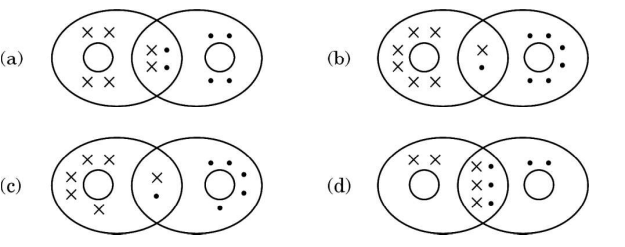
Consider the following two statements:
(i) The trait that expresses itself in F₁ generation.
(ii) The trait that keeps on passing from one generation to another.
The appropriate terms for the statements (i) and (ii) respectively are:
The bacterial and the viral infections that may be caused due to unsafe sex respectively are:
The expressions that relate (i) Q, I and t and (ii) Q, V and W respectively are (Here the symbols have their usual meanings):
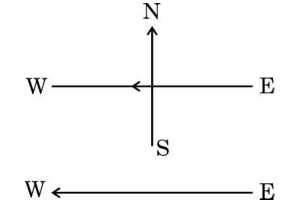
A constant current flows in a horizontal wire in the plane of the paper from east to west as shown in the figure. The direction of the magnetic field will be north to south at a point:
Assertion (A): In the reaction ZnO + C → Zn + CO,
ZnO undergoes reduction.
Reason (R): Carbon is a reducing agent that reduces ZnO to Zn.
Assertion (A): Human populations show a great deal of variations in traits.
Reason (R): All variations in a species have equal chances of surviving in the environment in which they live.
Assertion (A): The walls of atria are thicker than those of the ventricles.
Reason (R): Ventricles have to pump blood into various organs at high pressure.
Assertion (A): Two magnetic field lines around a current carrying straight wire do not intersect each other.
Reason (R): The magnitude of the magnetic field produced at a given point increases as the current through the wire increases.
Section C
On heating 'X' at 373 K, it loses water molecules and becomes 'Y'. 'Y' is a substance which doctors use for supporting fractured bones in the right position.
(i) Identify 'X' and 'Y'.
(ii) How can 'X' be reobtained from 'Y'?
Two solutions M and N give Red and Blue colour respectively with a universal indicator.
(i) In which solution will the hydrogen ion concentration be more? Justify your answer.
(ii) If both M and N solutions are mixed and the resultant mixture is tested with a universal indicator, it turns green. What is the nature of the salt formed? Justify your answer.
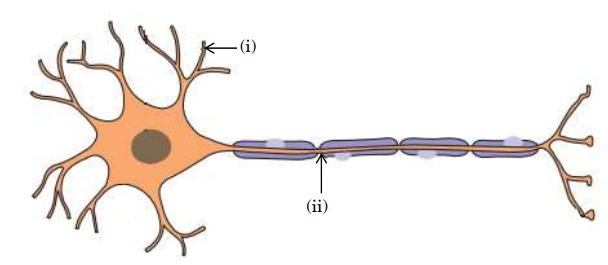
Write the name and function of parts (i) and (ii) in the diagram of a neuron given below.
List the events in proper sequence that take place during the process of photosynthesis.
Explain in brief two ways by which leaves of a plant help in excretion.
In the process of digestion of food in human beings, two protein-digesting enzymes are secreted. Name the enzymes along with the glands that secrete them.
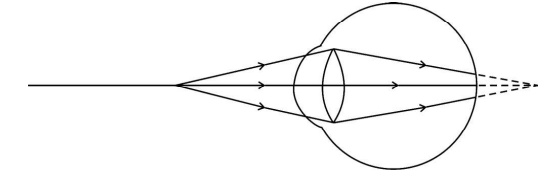
Observe the following diagram showing an image formation in an eye :
(a) Identify the defect of vision shown in the figure.
(b) List its two causes and suggest a suitable corrective lens to overcome this defect.
In the given food chain, if 50 J of energy is available to the hawk, how much energy is present at the first and third trophic levels? Justify your answer.
Grass → Grasshopper → Frog → Snake → Hawk
Section D
(a) Define a double displacement reaction.
(b) Write the chemical equation of a double displacement reaction which is also a
(i) Neutralization reaction and
(ii) Precipitation reaction. Give justification for your answer.
(a) Sometimes the pH of our mouth gets lower than 5.5. Why?
(b) A basic salt X' is obtained by heating baking soda followed by crystallisation. Identify 'X' and state its two industrial uses.
(c) Why do copper sulphate crystals turn white on heating?
(i) An object of 5 cm height is placed at a distance of 20 cm from the optical centre of a concave lens of focal length 18 cm. Calculate
(1) image distance and
(2) the magnification in this case.
(ii) Compare the values of magnification obtained by a concave lens and a convex lens when both the lenses form virtual images.
A convex lens can form a
(i) real, inverted and magnified image as well as
(ii) virtual, erect and magnified image of an object. If the focal length of the lens is 10 cm, what should be the range of the object distance in both cases ? Draw ray diagrams to justify your answer.
(a) State one important function of the following parts of the human eye :
(i) Retina
(ii) Pupil
(b) State the role of ciliary muscles in focussing objects at varying distances from the eye.
(i) A straight cylindrical conductor is suspended with its axis perpendicular to the magnetic field of a horse-shoe magnet. The conductor gets displaced towards left when a current is passed through it. What will happen to the displacement of the conductor if the
(1) current through it is increased ?
(2) horse-shoe magnet is replaced by another stronger horse-shoe magnet ?
(3) direction of current through it is reversed?
(ii) Name and state the rule for determining the direction of force on a current carrying conductor in a magnetic field.
Draw the pattern of the magnetic field produced around a vertical current carrying straight conductor passing through a horizontal cardboard. Mark the direction of current and the magnetic field lines. Name and state the rule which is used to determine the direction of magnetic field associated with a current carrying conductor.
How is ozone formed in the higher levels of the atmosphere? "Damage to the ozone layer is a cause of concern." Justify this statement.
(a) With the help of an activity, explain the action of saliva on the food we eat.
(b) Why is bile juice important in the process of digestion ?
Section E
A neutral organic compound ‘X’ (Molecular formula C₂H₆O) on reacting with acidified K₂Cr₂O₇ gives an organic compound ‘Y’ which is acidic in nature. ‘X’ reacts with ‘Y’ on warming in the presence of conc. H₂SO₄ to give a sweet smelling compound ‘Z’.
(i) Identify ‘X’, ‘Y’ and ‘Z’.
(ii) Write the chemical equations for the reactions in the conversion of (1) ‘X’ to ‘Y’ and (2) ‘X’ to ‘Z’.
(iii) State the role of (1) acidified K₂Cr₂O₇ in the conversion of ‘X’ to ‘Y’ and (2) conc. H₂SO₄ in the reaction of ‘X’ and ‘Y’.
(iv) Name the reaction which occurs when ‘Z’ reacts with an alkali.
Carry out the following conversions, stating the condition(s) for each:
(i) Ethanol ⟶ Ethene
(ii) Ethene ⟶ Ethane
(iii) Ethane ⟶ Chloroethane
(iv) Ethanol ⟶ Ethanoic acid
(v) Ethanoic acid ⟶ Ethyl ethanoate
(i) Where are testes located in the human males and why ? State two function of the testes.
(ii) In the human female, one of the ovaries releases an egg every month. State the changes that take place if
(1) the egg is fertilized, and
(2) the egg is not fertilized.
(iii) What is done during the surgical method in males and females to prevent pregnancy ?
(i) What happens when :
(1) Leaves of Bryophyllum fall on the soil ?
(2) Planaria is cut into many pieces ?
(3) Sporangia of Rhizopus on maturation liberate spores ? Mention the modes of reproduction in each of the above three cases.
(ii) Write the changes that occur in a flower once the fertilisation has taken place.
(a) State Ohm’s Law.
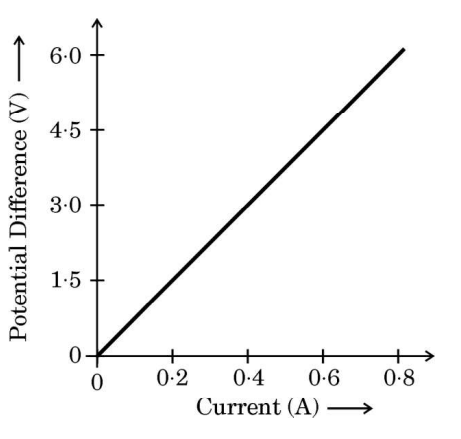
(b) Name and define the physical quantity determined by the slope of V–I curve given in the diagram. Use this graph to find the value of this physical quantity in SI units.
(c) Establish the relationship between 1 kWh and 1 joule.
Paper Details
CBSE Board Exam 2023
Class
Class 10
Subject
Science
Year
2023
Set
Set 4
Other Years — Science