QUESTION PAPER
2024 BOARD EXAM
CBSE Class 10 Science Board Paper 2024 — Set 4
2024
Science
Class 10
CBSE EXAMINATION PAPER-2024
SCIENCE
(Solved)
General Instructions :
Read the following instructions carefully and follow them :
- This question paper contains 45 questions. All questions are compulsory.
- This question paper is divided into 5 sections.
- Section A – questions number 1 to 3 are case based questions
- Section B – questions number 4 to 23 are multiple choice questions
- Section C – questions number 24 to 31 are very short answer
- Section D – questions number 32 to 39 are short answer
- Section E – questions number 40 to 45 are long answer
- There is no overall choice given in the question paper. However, an internal choice has been provided in few questions.
- Use of calculator is NOT allowed.
Section A
Three metal samples of magnesium, aluminium and iron were taken and rubbed with sand paper. These samples were then put separately in test tubes containing dilute hydrochloric acid. Thermometers were also suspended in each test tube so that their bulbs dipped in the acid. The rate of formation of bubbles was observed. The above activity was repeated with dilute nitric acid and the observations were recorded. Answer the following questions:
(1) When activity was done with dilute hydrochloric acid, then in which one of the test tubes was the rate of formation of bubbles the fastest and the thermometer showed the highest temperature?
[1 Mark](2) Which metal did not react with dilute hydrochloric acid? Give reason.
[1 Mark](3) Why is hydrogen gas not evolved when a metal reacts with dilute nitric acid? Name the ultimate products formed in the reaction
(4) Name the type of reaction on the basis of which reactivity of metals is decided. You have two metals X and Y. How would you decide which is more reactive than the other?
Kidneys are vital organs for survival. Several factors like infections, injury or restricted blood flow to kidneys reduce the activity of kidneys. This leads to accumulation of poisonous wastes in the body, which can even lead to death. In case of kidney failure, an artificial kidney can be used. An artificial kidney is a device to remove waste products from the blood through dialysis.
(1) In human excretory system name the organ which stores urine. Is this organ under hormonal control or nervous control?
[1 Mark](2) (i) Name the artery that brings oxygenated blood to the kidney. (ii) Name the cluster the thin-walled blood capillaries present in the Bowian's capsule.
(3) List two major steps involved in the formation of urine and state in brief their functions.
(4) In which part of the nephron does selective reabsorption take place ? List the factors which the amount of water reabsorbed depends on.
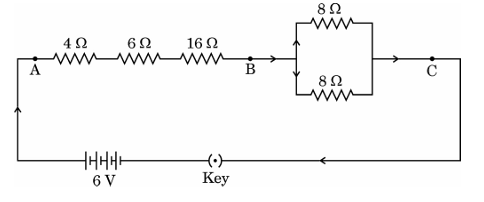
(1) Find the value of total resistance between the points A and B.
[1 Mark](2) Find the resistance between the points B and C.
(3) Calculate the current drawn from the battery, when the key is closed.
(4) In the above circuit, the 16 Ω resistor or the parallel combination of two resistors of 8Ω , which one of the two will have more potential difference across its two ends ? Justify your answer.
Section B
Zn + 2CH₃COOH → (CH₃COO) ₂ Zn + H₂. The above reaction is a:
An aqueous solution of a salt turns blue litmus to red. The salt could be the one obtained by the reaction of:
The metals which are found in both free state as well as combined state are:
The number of single and double bonds present in a molecule of benzene (C₆H₆) respectively, are:
Absolute refractive index of glass and water is 3/2 and 4/3 respectively. If the speed of light in glass is 2 x 10⁸ m/s, the speed of light in water is:
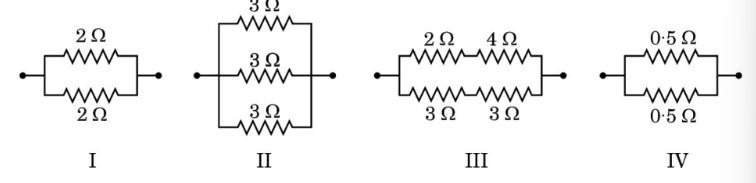
Consider the following combinations of resistors: The combinations having equivalent resistance 1 is/are:
An electric iron of resistance 20 Ω draws a current of 5 A. The heat developed in the iron in 30 seconds is:
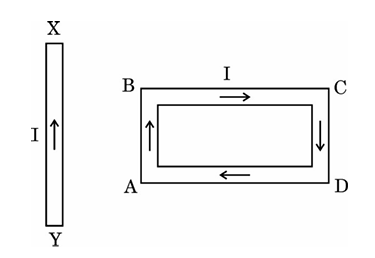
A rectangular loop ABCD carrying a current I is situated near a straight conductor XY, such that the conductor is parallel to the side AB of the loop and is in the plane of the loop. If a steady current I is established in the conductor, the conductor XY will:
Assertion (A): The extraction of metals from their sulphide ores cannot take place without roasting of the ore. Reason (R): Roasting converts sulphide ores directly into metals.
Assertion (A): In the human heart ventricles have thicker muscular walls than atria.
Reason (R): Ventricles have to pump the blood into various organs.
Assertion (A): Magnetic field lines never intersect each other.
Reason (R): If they intersect, then at the point of intersection, the compass needle would point towards two directions, which is not possible.
Assertion (A): Oxygen is essential for all aerobic forms of life.
Reason (R): Free oxygen atoms combine with molecular oxygen to form ozone.
Section C
1 gram of solid sodium chloride was taken in a clean and dry test tube and concentrated sulphuric acid was added to it.
(i) Name the gas evolved in the reaction.
(ii) What will be observed when this gas is tested with (I) dry, and (II) wet blue litmus paper? Write your conclusion about the nature (acidic/basic) of this gas.
Some metals react with acids to produce salt and hydrogen gas. Illustrate it with an example. How will you test the presence of this gas ?
Name the type of nutrition exhibited by Amoeba. Explain how food is taken in and digested by this organism.
Section D
Write the common name and the chemical name of the compound CaSO₄ · 1/2 H₂O. Write the method of its preparation. Give chemical equation for the reaction, when water reacts with CaSO₄ · 1/2 H₂O.
Why is the conversion of ethanol to ethanoic acid an oxidation reaction ? Name the oxidising agent used in this conversion. Write chemical equation for this oxidation reaction. How is this reaction different from the reaction in which ethanol burns in the presence of oxygen ?
List two differences between dominant traits and recessive traits. What percentage of pea plants in the F₂ generation were with yellow seeds in yellow (YY) and green coloured (yy) seeds?
A student fixes a sheet of white paper on a drawing board. He places a bar magnet in the center of it. He sprinkles some iron filings uniformly around the bar magnet. Then he taps the drawing board gently and observes that the iron filings arrange themselves in a particular pattern.
(a) Why do iron filings arrange in a particular pattern?
(b) What does the crowding of iron filings at the ends of the magnet indicate?
(c) What do the lines, along which the iron filings align, represent?
(d) If the student places a cardboard horizontally in a current carrying solenoid and repeats the above activity, in what pattern would the iron filings arrange? State the conclusion drawn about the magnetic field based on the observed pattern of the lines.
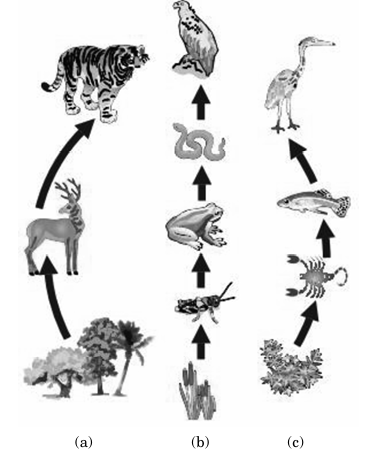
Study the picture given below showing three food chains (a), (b), and (c) and answer the following questions:
(i) Name the type of ecosystems that exist in food chains (b) and (c).
(ii) The first trophic level in all food chains are producers. Why? What percentage of solar energy do these producers capture for their use?
(iii) Why are the arrows shown in the diagram in one direction only and not vice versa? Justify.
List two roles of each of the following in human reproductive system : (i) Seminal vesicles and prostate gland (ii) Oviduct (iii) Testis
Section E
(i)Define a reflex arc. Why have reflex arcs evolved in animals? Trace the sequence of events which occur when you suddenly touch a hot object.
(ii) Name the part of nervous system which helps in communication between the central nervous system and other parts of the body. What are the two components of this system ?
(i) Leaves of 'chhui-mui'plant begin to fold up and droop in response to a stimulus. Name the stimulus and write the cause for such a rapid movement. Is there any growth involved in the movement?
(ii) Define geotropism in plants. What is meant by positive and negative geotropism ? Give one example of each type.
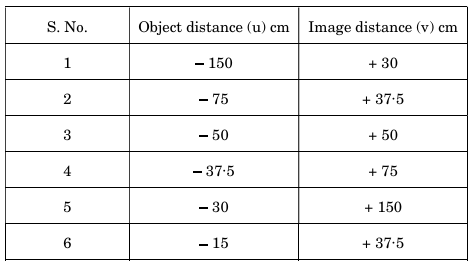
The variation of image distance (v) with object distance (u) for a convex lens is given in the following observation table. Analyse it and answer the questions that follow :
(i) Without calculation, find the focal length of the convex lens. Justify your answer.
(ii) Which observation is not correct ? Why ? Draw ray diagram to find the position of the image formed for this position of the object.
(iii) Find the approximate value of magnification for u = 30 cm.
(i) Define principal axis of a lens. Draw a ray diagram to show what happens when a ray of light parallel to the principal axis of a concave lens passes through it.
(ii) The focal length of a concave lens is 20 cm. At what distance from the lens should a 5 cm tall object be placed so that its image is formed at a distance of 15 cm from the lens? Also calculate the size of the image formed.
(i) Define a decomposition reaction. How can we say that (I) electrolysis of water, and (II) blackening of silver bromide when exposed to sunlight, are decomposition reactions ? Mention the type of energy involved in each case.
(ii) The type of reactions in which (I) calcium oxide is formed, and (II) calcium hydroxide is formed are opposite reactions to each other. Justify this statement with the help of chemical equations.
Paper Details
CBSE Board Exam 2024
Class
Class 10
Subject
Science
Year
2024
Set
Set 4
Other Years — Science