SOLUTIONS

2024 BOARD EXAM

CBSE Class 10 Science Board Paper 2024 — Set 3 Solutions

2024

Science

Class 10

CBSE EXAMINATION PAPER-2024

SCIENCE

(Solved)

Time allowed : 3 hours

Maximum Marks : 90

General Instructions :

Read the following instructions carefully and follow them :

  1. This question paper contains 44 questions. All questions are compulsory.
  2. This question paper is divided into 5 sections.
  3. Section A – questions number 1 to 2 are case based questions
  4. Section B – questions number 3 to 22 are multiple choice questions
  5. Section C – questions number 23 to 30 are very short answer
  6. Section D – questions number 31 to 38 are short answer
  7. Section E – questions number 39 to 44 are long answer
  8. There is no overall choice given in the question paper. However, an internal choice has been provided in few questions.
  9. Use of calculator is NOT allowed.

Section A

Question 1. Human digestive system is a tube running from mouth to anus. Its main function is to breakdown complex molecules present in the food which cannot be absorbed as such into smaller molecules. These molecules are absorbed across the walls of the tube and the absorbed food reaches each and every cell of the body where it is utilised for obtaining energy.

(1) Name the glands present in the buccal cavity and write the components of food on which the secretion of these glands act upon.

[1 Mark]
Answer: The glands present in the buccal cavity are the salivary glands. The secretion of these glands, called saliva, contains the enzyme amylase which acts on carbohydrates in the food. Amylase breaks down starch, a complex carbohydrate, into simpler sugars like maltose. This is the first step of digestion that begins in the mouth.
Key Points: Salivary glands are present in the buccal cavity - Saliva contains enzyme amylase - Amylase acts on carbohydrates (starch) - Breaks starch into simpler sugars - Digestion begins in the mouth

(2)

Two organs have a sphincter muscle at their exit. Name them.

[-1 Marks]
Answer: The two organs that have a sphincter muscle at their exit are the stomach and the anus. The pyloric sphincter controls the exit of food from the stomach into the small intestine, and the anal sphincter controls the exit of waste material from the rectum through the anus.
Key Points: Sphincter muscle controls exit-Organs with sphincter muscles are stomach and anus-Pyloric sphincter at stomach exit-Anal sphincter at anus exit-Function is to regulate passage of food or waste

(3)

"Bile juice does not contain any enzyme, yet it has important roles in digestion." Justify the statement.

[2 Marks]
Answer: Bile juice, produced by the liver and stored in the gallbladder, does not contain any digestive enzymes. However, it plays an important role in digestion by breaking down large fat globules into smaller droplets. This process is called emulsification. By doing so, bile juice increases the surface area of fats, making it easier for the pancreatic enzymes, such as lipase, to act on fats and digest them efficiently. Additionally, bile juice helps in the absorption of fat-soluble vitamins (A, D, E, and K) and neutralizes the acidic chyme from the stomach, facilitating smooth digestion in the small intestine.
Key Points: Bile juice contains no enzymes-Bile emulsifies fats by breaking large fat globules into smaller droplets-Emulsification increases surface area for enzyme action-Bile facilitates digestion of fats by pancreatic enzymes-Bile assists in absorption of fat-soluble vitamins-Bile neutralizes acidic chyme for better digestion in small intestine

(4)

What will happen if:

(i) mucus is not secreted by the gastric glands.

(ii) Villi are absent in the small intestine.
[2 Marks]
Answer: (i) If mucus is not secreted by the gastric glands, the lining of the stomach will not be protected from the acidic gastric juice. This can cause damage to the stomach walls leading to ulcers and pain. The mucus acts as a protective barrier to prevent the stomach walls from getting eroded by the acid. (ii) If villi are absent in the small intestine, the absorption of nutrients will be severely affected. Villi increase the surface area of the small intestine, allowing maximum absorption of digested food into the bloodstream. Without villi, nutrients cannot be absorbed efficiently, causing malnutrition and other digestive problems.
Key Points: Role of mucus in protecting stomach lining from acid damage - Consequences of no mucus secretion like ulcers - Function of villi in small intestine for nutrient absorption - Impact on nutrient absorption if villi are absent - Importance of villi in increasing surface area for absorption
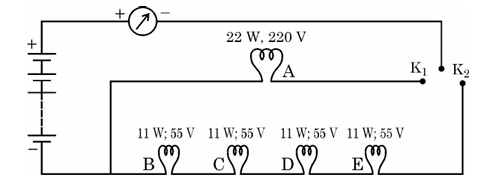
Question 2. In a domestic circuit five LED bulbs are arranged as shown. The source voltage is 220 V and the power rating of each bulb is marked in the circuit diagram. Based on the following circuit diagram, answer the following questions:
Diagram 1 – CBSE Class 10 Science 2024 Set 3 Solutions

(1) (a) State what happens when (i) key 𝐾₁ is closed. (ii) key 𝐾₂ is closed.

[1 Mark]
Answer: (i) When key K₁ is closed, the circuit through the LEDs it controls is completed, allowing electric current to flow. As a result, the LED bulbs connected in that part of the circuit light up. (ii) When key K₂ is closed, the circuit through the LEDs it controls is completed. Therefore, the LEDs connected to this part of the circuit receive electric current and begin to glow.
Key Points: Closing key K₁ completes the circuit allowing current flow - LED bulbs connected with K₁ light up - Closing key K₂ completes its respective circuit - LEDs connected with K₂ light up - A bulb glows only when the circuit is closed and current flows

(2)

Find the current drawn by the bulb B when it glows.

Answer: To find the current drawn by bulb B, we use the formula relating power, voltage, and current: Power (P) = Voltage (V) × Current (I). Rearranging, Current I = Power P / Voltage V. Given the power rating of bulb B (which needs to be taken from the circuit diagram) and the source voltage of 220 V, we calculate the current by dividing the power rating by 220 V. For example, if bulb B has a power rating of 11 W, then the current drawn by bulb B is I = 11 W / 220 V = 0.05 A. Therefore, bulb B draws a current of 0.05 amperes when it glows.
Key Points: Use the formula I = Power / Voltage-Identify the power rating of bulb B from the circuit diagram-Voltage supply is 220 V-Calculate the current value by dividing power rating by 220 V-State the current unit as amperes

(3)

What would happen to the glow of all the bulbs in the circuit when keys K₁ and K₂ both are closed and the bulb C suddenly get fused? Give reason to justify your answer.

[2 Marks]
Answer: When keys K₁ and K₂ are both closed, bulbs A, B, D, and E are connected in the circuit along with bulb C. If bulb C suddenly gets fused (its filament breaks), the circuit through bulb C will be broken. As a result, no current will flow through the path containing bulb C. However, depending on the arrangement of the bulbs in the circuit (whether they are in series or parallel), the glow of the other bulbs will be affected differently. If bulbs are connected in series, the fusing of bulb C will cause the entire circuit to break and all bulbs will go off. If bulbs are connected in parallel, only bulb C will stop glowing while the other bulbs will continue to glow brightly, as the parallel paths will still carry current. Therefore, the effect on the other bulbs depends on how they are connected in the circuit. The reason is that for a bulb to glow, electric current must flow through it, and a break in the circuit stops current flow in that path.
Key Points: Bulb filament fusing breaks the circuit path-current stops through that bulb-Effect depends on series or parallel connection-Series: all bulbs go off-Parallel: only fused bulb goes off, others glow normally-Electric current required for bulb to glow

(4)

Calculate
(i) the resistance of bulb B, and
(ii) total resistance of the combination of four bulbs B, C, D and E.

[2 Marks]
Answer: (i) To calculate the resistance of bulb B, use the formula: Resistance (R) = Voltage (V) squared divided by Power (P). Assuming bulb B has a power rating of P_B watts and the supply voltage is 220 V, Resistance of bulb B, R_B = (220 × 220) / P_B = 48400 / P_B ohms. (ii) To find the total resistance of bulbs B, C, D, and E combined, first find the resistance of each bulb using the same formula R = 220² / Power of the respective bulb. Then, depending on the arrangement of the bulbs (series or parallel), calculate the total resistance: - For series, total resistance is the sum of individual resistances. - For parallel, total resistance is given by 1/R_total = 1/R_B + 1/R_C + 1/R_D + 1/R_E. Finally, compute the total resistance accordingly.
Key Points: Use the formula Resistance R = Voltage² / Power to find resistance of each bulb-Calculate resistance of bulb B using its power rating-Calculate resistance of bulbs C, D, and E similarly-Know the bulb arrangement (series or parallel) to find total resistance-Use sum of resistances for series and reciprocal of sum of reciprocals for parallel-Apply these to find total resistance of bulbs B, C, D, and E

Section B

Question 3.

Identify the product 'X' obtained in the following chemical reaction:

[1 Mark] Diagram 2 – CBSE Class 10 Science 2024 Set 3 Solutions
  • (A) Quick lime
  • (B) Gypsum
  • (C) Lime Stone
  • (D) Plaster of Paris
Explanation:

The correct product 'X' formed when Plaster of Paris (CaSO₄ · ½ H₂O) is mixed with water is Gypsum (CaSO₄ · 2H₂O). This reaction involves the absorption of water molecules into the crystal structure of Plaster of Paris resulting in the formation of Gypsum. This process is called hydration. Therefore, the correct option is Gypsum.

Question 4.

Select a pair of natural indicator from the following:

[1 Mark]
  • (A) Litmus and methyl orange
  • (B) Methyl orange and Turmeric
  • (C) Phenolphthalein and methyl orange
  • (D) Turmeric and Litmus
Explanation: The correct option is 'Turmeric and Litmus' because both turmeric and litmus are naturally occurring indicators. Litmus is made from lichens, and turmeric is a natural dye that changes color in the presence of a base. On the other hand, phenolphthalein and methyl orange are synthetic indicators. Therefore, 'Turmeric and Litmus' is the pair of natural indicators.
Question 5.

A chemical compound used in glass, soap and paper industries is

[1 Mark]
  • (A) Bleaching Powder
  • (B) Washing Soda
  • (C) Baking Soda
  • (D) Common Salt
Explanation:

The correct answer is Washing Soda. According to the context, sodium carbonate (washing soda) is used in the glass, soap, and paper industries. It is an important raw material for these industries, making washing soda the suitable choice among the options provided.

Question 6.

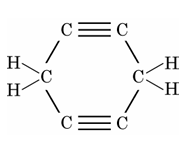
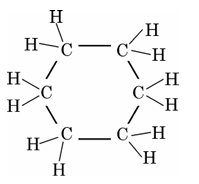
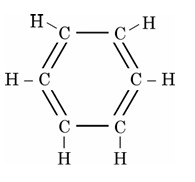
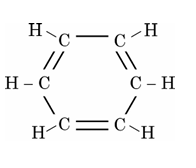
The structural formula of Cyclohexane is

[1 Mark]
  • (A) Diagram 3 – CBSE Class 10 Science 2024 Set 3 Solutions
  • (B) Diagram 4 – CBSE Class 10 Science 2024 Set 3 Solutions
  • (C) Diagram 5 – CBSE Class 10 Science 2024 Set 3 Solutions
  • (D) Diagram 6 – CBSE Class 10 Science 2024 Set 3 Solutions
Explanation:

The correct structural formula of cyclohexane shows six carbon atoms connected in a ring with single bonds, each carbon atom bonded to two hydrogen atoms, making the molecular formula C₆H₁₂. Cyclohexane is a cycloalkane, which means it is a saturated hydrocarbon with carbon atoms arranged in a ring structure without any double or triple bonds.

Question 7.

Consider the following Chemical equation: 𝑎Al₂O₃+𝑏HCl→𝑐AlCl₃+𝑑H₂O In order to balance this chemical equation, the values of a, b, c and d must be

[1 Mark]
  • (A) 1, 6, 2 and 3
  • (B) 1, 6, 3 and 2
  • (C) 2, 6, 2 and 3
  • (D) 2, 6, 3 and 2
Explanation: The balanced chemical equation is: Al₂O₃ + 6HCl → 2AlCl₃ + 3H₂O. Here, a = 1, b = 6, c = 2, and d = 3. This is because one unit of Al₂O₃ contains 2 aluminum atoms and 3 oxygen atoms. On the right side, each AlCl₃ contains 1 aluminum atom and 3 chlorine atoms, so 2AlCl₃ will balance the 2 aluminum atoms on the left. 6HCl provides 6 chlorine atoms and 6 hydrogen atoms. The hydrogen atoms combine with oxygen atoms from Al₂O₃ to form 3 water molecules (3H₂O), balancing both hydrogen and oxygen atoms.
Question 8.

Which one of the following hydrocarbons is different from the others?

[1 Mark]
  • (A) 𝐶₅𝐻₁₂
  • (B) 𝐶₂𝐻₆
  • (C) 𝐶₇𝐻₁₄
  • (D) 𝐶₄𝐻₁₀
Explanation:

𝐶₂𝐻₆, 𝐶₅𝐻₁₂, and 𝐶₄𝐻₁₀ are all saturated hydrocarbons, meaning they are alkanes with single bonds only, following the general formula CₙH₂ₙ₊₂. However, 𝐶₇𝐻₁₄ has fewer hydrogen atoms compared to what the alkane formula would predict (which should be C₇H₁₆), indicating it is an alkene or cycloalkane with at least one double bond or a ring structure. Therefore, 𝐶₇𝐻₁₄ is different from the others because it is not a saturated hydrocarbon (alkane), while the others are.

Question 9.

Which one of the following reactions is different from the remaining three?

[1 Mark]
  • (A) 𝑁𝑎𝐶𝑙+𝐴𝑔𝑁𝑂₃→𝐴𝑔𝐶𝑙+𝑁𝑎𝑁𝑂₃
  • (B) 𝑍𝑛𝐶𝑙₂+𝐻₂𝑆→𝑍𝑛𝑆+2𝐻𝐶𝑙
  • (C) 𝐾𝑁𝑂₃+𝐻₂𝑆𝑂₄→𝐾𝐻𝑆𝑂4+𝐻𝑁𝑂₃
  • (D) 𝐶𝑎𝑂+𝐻₂𝑂→𝐶𝑎(𝑂𝐻)₂
Explanation:

The correct option is '𝐶𝑎𝑂+𝐻₂𝑂→𝐶𝑎(𝑂𝐻)₂'. This reaction is a combination reaction where calcium oxide reacts with water to form calcium hydroxide. The other three reactions are examples of double displacement reactions involving the exchange of ions between reactants to form new products. Therefore, the reaction of CaO with water is different from the others.

Question 10. Select from the following a plant hormone which promotes cell division.
[1 Mark]
  • (A) Gibberellins
  • (B) Auxins
  • (C) Abscissic Acid
  • (D) Cytokinins
Explanation: The correct answer is Cytokinins. According to the context, cytokinins promote cell division and are found in greater concentration in areas of rapid cell division such as fruits and seeds. Other plant hormones like auxins and gibberellins help in stem growth, while abscisic acid inhibits growth.
Question 11.

Part(s) of a flower which attracts insects for pollination is (are)

[1 Mark]
  • (A) petals and Sepals
  • (B) anther and Stigma
  • (C) petals only
  • (D) sepals only
Explanation: The correct answer is 'petals only' because petals are colorful parts of the flower that attract insects and other animals for pollination. Sepals protect the flower bud and do not attract insects. Anther and stigma are reproductive parts and are not involved in attracting insects.
Question 12. In an experiment to study independent inheritance of two separate traits: shape and colour of seeds, the ratio of the different combinations in F₂ progeny would be
[1 Mark]
  • (A) 1:3
  • (B) 9:3:3:1
  • (C) 1:2:1
  • (D) 9:1:1:3
Explanation: The correct answer is 9:3:3:1. According to Mendel’s Law of Independent Assortment, when two traits are inherited independently, the F2 generation produced from crossing heterozygous parents for both traits shows a phenotypic ratio of 9 (both dominant traits) : 3 (dominant for first trait and recessive for second) : 3 (recessive for first trait and dominant for second) : 1 (both recessive traits). In this experiment, seed shape and colour are two separate traits, and their combinations in the F2 progeny demonstrate this classic 9:3:3:1 ratio.
Question 13.

Which of the following statement (s) is (are) true about human heart?

(a) Right atrium receives oxygenated blood from lungs through pulmonary artery

(b) Left atrium transfers oxygenated blood to left ventricle which sends it to various parts of the body.

(c) Right atrium receives deoxygenated blood from different parts of the body through vena cava.

(d) Left atrium transfers oxygenated blood to aorta which sends it to different parts of the body.

[1 Mark]
  • (A) (b) only
  • (B) (b) and (c)
  • (C) (a) and (d)
  • (D) (b) and (d)
Explanation:

Option (b) is correct because the left atrium receives oxygenated blood from the lungs and transfers it to the left ventricle, which then pumps this blood to various parts of the body. Option (c) is also correct because the right atrium receives deoxygenated blood from different parts of the body through the vena cava. Option (a) is incorrect since the right atrium receives deoxygenated blood, not oxygenated, and it receives this blood through the vena cava, not the pulmonary artery. Option (d) is incorrect because the left atrium does not transfer blood directly to the aorta; it passes oxygenated blood to the left ventricle, which then pumps it into the aorta.

Question 14.

A cross between two tall pea plants resulted in offsprings having a few dwarf plants. The gene-combination of the parental plants must be

[1 Mark]
  • (A) TT and Tt
  • (B) Tt and tt
  • (C) Tt and Tt
  • (D) TT and tt
Explanation:

The presence of dwarf (short) plants among the offspring indicates that both parental plants must carry the recessive allele for shortness (t). Since both parents are tall, their genotypes must be heterozygous (Tt). A cross between Tt and Tt can produce offspring with genotypes TT, Tt (both tall), and tt (short). Thus, the correct gene combination of the parental plants is Tt and Tt.

Question 15.

The Phenomena of light involved in the formation of a rainbow in the sky are

[1 Mark]
  • (A) Refraction, dispersion and reflection
  • (B) Dispersion, refraction and internal reflection
  • (C) Dispersion, scattering and reflection
  • (D) Refraction, dispersion and total internal reflection
Explanation:

The correct answer is 'Refraction, dispersion and total internal reflection

Question 16.

In case of four wires of same material, the resistance will be minimum if the diameter and length of the wire respectively are

[1 Mark]
  • (A) D/4 and 4L
  • (B) 4D and 2L
  • (C) D/2 and L/4
  • (D) 2D and L
Explanation:

Resistance R of a wire is given by R = ρ * (L / A), where ρ is the resistivity of the material, L is the length and A is the cross-sectional area. The cross-sectional area A is proportional to the square of the diameter (A ∝ D²). To minimize resistance, L should be as small as possible and A should be as large as possible. Among the options, '4D and 2L' means the diameter is increased four times (which increases cross-sectional area by 16 times) and the length is doubled. This results in minimum resistance compared to other options where either length is longer or diameter is smaller.

Question 17.

A food chain will be more advantageous in terms of energy if it has

[1 Mark]
  • (A) 2 trophic levels
  • (B) 5 trophic levels
  • (C) 4 trophic levels
  • (D) 3 trophic levels
Explanation:

The correct answer is '2 trophic levels'. According to the context, energy transfer between trophic levels is inefficient, and significant energy is lost at each step. Therefore, food chains generally consist of only two or four trophic levels because beyond this, too little usable energy remains. A shorter food chain with fewer trophic levels (like 2) is more energy efficient compared to longer chains (like 5 trophic levels).

Question 18.

Consider the following statements about ozone:

(a) Ozone is poisonous gas.

(b) Ozone shields the earth's surface from the infrared radiation from the sun.

(c) Ozone is a product of UV radiations acting on oxygen molecule.

(d) At the lower level of the earth's atmosphere, ozone performs most essential function.

The correct statements are

[1 Mark]
  • (A) (a) and (b)
  • (B) (a) and (c)
  • (C) (b) and (d)
  • (D) (b) and (c)
Explanation:

The correct statements are (a) and (c). Ozone is indeed a poisonous gas (a). It is also formed when ultraviolet (UV) radiation from the sun acts on oxygen (O₂) molecules, splitting them and forming ozone (c). Statement (b) is incorrect because ozone shields the Earth from ultraviolet (UV) radiation, not infrared radiation. Statement (d) is incorrect as the essential function of ozone occurs in the higher levels of the atmosphere (ozone layer) where it protects life by absorbing UV radiation.

Question 19.

Assertion (A): A piece of Zinc metal gets reddish brown coating when kept in copper sulphate solution for some time.

Reason (R): Copper is more reactive metal than Zinc.

[1 Mark]
  • (A) Both (A) and (R) are true and (R) is the correct explanation of (A).
  • (B) (A) is true, but (R) is false.
  • (C) (A) is false, but (R) is true.
  • (D) Both (A) and (R) are true and (R) is not correct explanation of (A).
Explanation:

The correct answer is: Both (A) and (R) are true and (R) is not the correct explanation of (A). This is because zinc is more reactive than copper, so zinc displaces copper ions from the copper sulphate solution. Zinc atoms lose electrons (oxidation) and go into the solution as zinc ions, while copper ions gain electrons (reduction) and deposit as solid copper metal (reddish brown coating) on the zinc surface. Therefore, copper is less reactive than zinc, contradicting the reason given. Hence, while the assertion is true, the reason is false.

Question 20.

Assertion (A): Offsprings produced by asexual reproduction are genetically similar to the parents.

Reason (R): Asexual reproduction involves a single parent.

[1 Mark]
  • (A) Both A and R are true and R is the correct explanation of A.
  • (B) A is true, but R is false.
  • (C) A is false, but R is true.
  • (D) Both A and R are true, but R is NOT the correct explanation of A
Explanation:

Both Assertion and Reason are true, and Reason is the correct explanation for Assertion A. In asexual reproduction, since the offspring are produced from a single parent without the involvement of gametes from two different parents, the offspring are genetically similar or exact copies of the parent. This is supported by the context which states that new plants produced asexually are exact copies as they are produced from a single parent.

Question 21.

Assertion (A): Red light signals are used to stop the vehicles on the road.

Reason (R): Red coloured light is scattered the most so as to be visible from a large distance.

[1 Mark]
  • (A) Both A and R are true and R is the correct explanation of A
  • (B) Both A and R are true, but R is NOT the correct explanation of A.
  • (C) A is false, but R is true.
  • (D) A is true, but R is false.
Explanation:

The correct answer is: A is true, but R is false. Explanation: Red light signals are indeed used to stop vehicles on the road, so the assertion is true. However, red coloured light is actually scattered the least, not the most, especially by fog or smoke, which allows it to be seen clearly from a long distance. Therefore, the reason given is false.

Question 22.

Assertion (A): The waste we generate daily may be biodegradable or non-biodegradable.

Reason (R): The waste generated, if not disposed off properly may cause serious environmental problems.

[1 Mark]
  • (A) A is false, but R is true.
  • (B) Both A and R are true, but R is NOT the correct explanation of A
  • (C) A is true, but R is false.
  • (D) Both A and R are true and R is the correct explanation of A
Explanation:

Both A and R are true and R is NOT the correct explanation of A. The daily waste includes biodegradable and non-biodegradable materials, and improper disposal of this waste leads to pollution and environmental harm, as indicated in the context where improper waste disposal causes soil and water pollution and environmental problems.

Section C

Question 23. When magnesium ribbon is burnt in air, an ash of white colour is produced. Write the chemical equation for the reaction giving the chemical name of the ash produced. State the type of chemical reaction giving justification for your answer.
[2 Marks]
Answer: When magnesium ribbon burns in air, it reacts with oxygen forming a white ash called magnesium oxide. The chemical equation for the reaction is: Magnesium + Oxygen → Magnesium oxide or Mg + O₂ → MgO. This is a combination reaction, where two elements combine to form one compound. It is also an oxidation reaction because magnesium gains oxygen atoms during the process.
Key Points: Magnesium reacts with oxygen-White ash is magnesium oxide-Chemical equation: Mg + O₂ → MgO-Formation of one compound from elements-Combination reaction-Oxidation reaction as magnesium gains oxygen
Question 24. Where are auxins synthesized? How do they promote phototropism?
[2 Marks]
Answer: Auxins are synthesized mainly at the shoot tips of plants. They promote phototropism by diffusing towards the shaded side of the shoot when light comes from one direction. This causes a higher concentration of auxin on the side away from light, stimulating the cells there to elongate more. As a result, the shoot bends towards the light source, allowing the plant to maximize light absorption for photosynthesis.
Key Points: Auxins synthesis location-shoot tips; Auxin diffuses to shaded side; Higher auxin concentration on shaded side; Auxin promotes cell elongation; Shoot bends towards light due to unequal cell growth
Question 25. List any two pairs of visible contrasting characters of garden pea plants used by Mendel for his experiments stating the dominant and recessive characters in each pair.
[2 Marks]
Answer: Mendel used several pairs of contrasting characters in garden pea plants to study inheritance. Two such pairs are: 1. Seed Shape: Round seeds are dominant (represented as R), while wrinkled seeds are recessive (represented as r). 2. Plant Height: Tall plants are dominant (T), and short plants are recessive (t). These contrasting characters helped Mendel analyze how traits are passed from one generation to the next.
Key Points: Mendel studied visible contrasting characters-Mendel used pairs such as round (dominant) and wrinkled (recessive) seed shapes-Mendel used tall (dominant) and short (recessive) plant heights-Identification of dominant and recessive traits in each pair
Question 26. In human beings, the probability of getting a male or a female child is 50%. Explain with the help of a flow diagram only.
[2 Marks]
Answer: In humans, the mother has two X chromosomes (XX), so eggs always carry an X chromosome. The father has one X and one Y chromosome (XY), so sperm can carry either an X or a Y chromosome. When an X-carrying sperm fertilizes the egg (X), the child will be female (XX). When a Y-carrying sperm fertilizes the egg (X), the child will be male (XY). Since sperm carrying X or Y chromosomes are produced in equal amounts, the chance of having a male or female child is 50% each.
Key Points: Mother has XX chromosomes; Father has XY chromosomes - Eggs always carry X; Sperm can carry X or Y - Fertilization with X sperm results in a girl (XX) - Fertilization with Y sperm results in a boy (XY) - Equal number of X and Y sperm leads to 50% chance of boy or girl
Question 27. When do we say that a particular person is suffering from hypermetropia? List two causes of this defect. Name the type of lens used to correct this defect.
[2 Marks]
Answer: A person is said to be suffering from hypermetropia (or farsightedness) when they find it difficult to see nearby objects clearly but can see distant objects clearly. This happens because the image of nearby objects is formed behind the retina. Two main causes of this defect are: (1) the focal length of the eye lens is too long, and (2) the eyeball is smaller than normal. Hypermetropia can be corrected by using convex lenses, which help focus the image correctly onto the retina.
Key Points: Definition of hypermetropia - Difficulty in seeing nearby objects clearly - Image formed behind the retina - Cause 1: focal length of lens too long - Cause 2: eyeball too small - Correction by convex lenses
Question 28.

Draw a labelled diagram to show the pattern of magnetic field lines produced due to a current carrying straight conductor. Mark on it the direction of current in the conductor and the direction of magnetic field lines.

[2 Marks]
Answer: A straight conductor carrying current creates magnetic field lines that form concentric circles around it. The direction of the magnetic field lines can be determined by the right-hand thumb rule: if the right thumb points along the current direction, the curled fingers indicate the magnetic field direction. In the labelled diagram, the straight wire is drawn vertically with an arrow showing current flowing upwards. Around the wire, concentric circles are drawn with arrows indicating magnetic field direction as anti-clockwise when viewed from above. This illustrates the circular pattern of magnetic field lines around the straight current-carrying conductor.
Key Points: Straight conductor carrying current-Magnetic field lines form concentric circles around the wire-Right-hand thumb rule to determine field direction-Current direction labelled on conductor-Magnetic field direction shown by arrows on concentric circles
Question 29.

Name the device used to magnetise a piece of magnetic material. Draw a labelled diagram to show the arrangement used for the magnetisation of a cylinder made of soft iron.

[2 Marks]
Answer: The device used to magnetise a piece of magnetic material is called an electromagnet. It consists of a coil of insulated copper wire wrapped around a soft iron cylinder. When an electric current passes through the coil, it produces a magnetic field that magnetises the soft iron core. This method is commonly used to create temporary magnets. A labelled diagram would show a battery connected to the coil, the coil wrapped around the soft iron cylinder, and a switch to control the current.
Key Points: Electromagnet-device used-current carrying coil of insulated wire-soft iron cylinder as core-electric current produces magnetic field-magnetises the soft iron-Temporary magnet-Labelled diagram should include battery, coil, soft iron core, and switch
Question 30. What are decomposers? List two consequences of their absence in an ecosystem.
[2 Marks]
Answer: Decomposers are organisms like fungi and bacteria that break down dead plants, animals, and waste products into simpler inorganic substances. This process is called decomposition. These nutrients are then released back into the soil and used by plants for growth. In the absence of decomposers, dead organisms and waste would accumulate, leading to a buildup of garbage in the ecosystem. Moreover, the natural replenishment of soil nutrients would not take place, affecting plant growth and disrupting the entire food chain.
Key Points: Decomposers are fungi and bacteria-Decompose dead plants, animals, and waste-Break down complex substances into simple inorganic nutrients-Nutrients returned to soil for plant use-Without decomposers, dead matter accumulates-Soil nutrients not replenished-Plants cannot grow properly-Food chain is disturbed

Section D

Question 31.

State reasons for the following:

(a) Zinc oxide is an amphoteric oxide.

(b) Sodium metal is stored in a bottle filled with kerosene oil.

(c) In the reactions of nitric acid with metals, generally hydrogen gas is not evolved.

[3 Marks]
Answer: (a) Zinc oxide is an amphoteric oxide because it reacts with both acids and bases to form salts. For example, it reacts with hydrochloric acid (an acid) to form zinc chloride, and it also reacts with sodium hydroxide (a base) to form sodium zincate. This dual behavior shows zinc oxide has both acidic and basic properties.

(b) Sodium metal is stored in a bottle filled with kerosene oil because it is a very reactive metal, especially with moisture and air. It reacts violently with water producing hydrogen gas and heat, which can cause fire or explosion. Storing sodium under kerosene prevents its contact with water and air, ensuring safety.

(c) Hydrogen gas is generally not evolved in the reactions of nitric acid with metals because nitric acid is a strong oxidizing agent. Instead of releasing hydrogen gas, it oxidizes the hydrogen to form water, and the metals form nitrates or other products. Hence, no hydrogen gas is observed in these reactions.
Key Points: Zinc oxide reacts with both acids and bases-Zinc oxide forms salts with acid and base showing amphoteric behavior-Sodium metal reacts violently with water and air-Sodium stored in kerosene prevents contact with moisture and air-Nitric acid is a strong oxidizing agent-Nitric acid oxidizes hydrogen, so hydrogen gas is not evolved-Nitric acid reacts differently compared to other acids
Question 32.

(a) State, giving reason, the reduction process to obtain the following metals from their compounds:

(i) Mercury, (ii) Copper, and (iii) Sodium.

[3 Marks]
Answer:

(i) Mercury: Mercury is obtained from its ore cinnabar (HgS). When cinnabar is heated in air, it first converts into mercuric oxide (HgO). On further heating, mercuric oxide decomposes and reduces to mercury metal due to heating alone. This is possible because mercury is a metal low in the activity series and is less reactive, so heat is sufficient to reduce its oxide to metal.

(ii) Copper: Copper is a metal that is moderately reactive. It is mainly obtained by roasting and reducing its ores like copper oxide. Copper oxide is reduced by heating with carbon (a reducing agent) which removes the oxygen to give pure copper. This process is used as copper has moderate reactivity and can be reduced by carbon.

(iii) Sodium: Sodium is a highly reactive metal and cannot be obtained by heating with carbon. It is extracted by electrolytic reduction of molten sodium chloride. During electrolysis, sodium ions are reduced at the cathode (negative electrode) to form sodium metal, while chlorine gas is liberated at the anode (positive electrode). This method is used because sodium has a strong affinity for oxygen and cannot be reduced chemically by carbon.

Key Points: Mercury is obtained by heating cinnabar to form mercuric oxide which decomposes to mercury - Mercury is low in activity series and can be reduced by heat alone - Copper is obtained by reducing copper oxide with carbon - Carbon acts as reducing agent removing oxygen - Sodium is highly reactive and obtained by electrolysis of molten sodium chloride - Sodium ions gain electrons at cathode to form sodium metal - Chlorine gas released at anode
Question 33. We water the soil but it reaches the topmost leaves of the plants. Explain in brief the process involved.
[3 Marks]
Answer: When we water the soil, the water is first absorbed by the roots of the plant through a process called osmosis. From the roots, water moves upward through special tubes called xylem vessels that run through the stem and branches. This upward movement of water is helped by root pressure and the pull created by transpiration, which is the evaporation of water from tiny openings called stomata in the leaves. As water evaporates from the leaves, it pulls more water from the roots to the leaves, ensuring a continuous flow. This process not only transports water but also helps in the movement of minerals and keeps the plant cool. Thus, water travels from the soil through the roots, moves up through the xylem, and finally reaches the topmost leaves.
Key Points: Water absorption by roots-Water transport through xylem-Upward movement helped by root pressure and transpiration-Evaporation of water from leaves (stomata)-Continuous water movement and nutrient transport
Question 34. Name and explain the phenomenon of light due to which the path of a beam of light becomes visible when it enters a smoke-filled room through a small hole. Also, state the dependence of the colour of the light we receive on the size of the particle of the medium through which the beam of light passes.
[3 Marks]
Answer: The phenomenon is called the Tyndall effect. It occurs when a beam of light passes through a colloidal solution or a medium containing fine particles, such as smoke or dust in the air. These tiny particles scatter the light in different directions, making the path of the beam visible to our eyes. For example, when sunlight enters a smoke-filled room through a small hole, the scattered light by the smoke particles makes the beam's path clearly visible. The colour of the light we receive depends on the size of the particles in the medium. Larger particles scatter longer wavelengths of light, like red or orange, while smaller particles mostly scatter shorter wavelengths like blue. This is why the sky appears blue, as the smaller particles in the atmosphere scatter blue light more effectively.
Key Points: The phenomenon is called Tyndall effect-The Tyndall effect is scattering of light by colloidal particles-Path of beam visible due to scattering by smoke/dust particles-Light scattering makes path visible in a smoke-filled room-Colour depends on particle size-Larger particles scatter longer wavelengths (red/orange)-Smaller particles scatter shorter wavelengths (blue)-Explains natural observations like blue sky
Question 35. Explain in brief the function of an electric fuse in a domestic circuit. An electric heater of current rating 3 kW; 220 V is to be operated in an electric circuit of rating 5 A. What is likely to happen when the heater is switched ON? Justify your answer with necessary calculations.
[3 Marks]
Answer: An electric fuse is a safety device used in a domestic circuit to protect electrical appliances and wiring from damage due to excessive current. It contains a thin wire that melts when the current exceeds a specific limit (called the rated current), thereby breaking the circuit and stopping the flow of electricity. This prevents overheating, short circuits, or electrical fires. For the electric heater rated at 3 kW and 220 V, the current drawn can be calculated as Current = Power / Voltage = 3000 W / 220 V = 13.64 A approximately. Since the circuit has a rating of only 5 A, the current drawn by the heater is much higher than the rated current of the circuit. When the heater is switched ON, the current will exceed 5 A, causing the fuse wire to heat up and melt quickly. This will break the circuit, preventing any damage to the wiring or appliances and avoiding hazards. Hence, the fuse acts as a protective device and the heater should not be used on a 5 A circuit.
Key Points: Fuse protects appliances and circuit from excessive current-Fuse wire melts on overcurrent-breaking the circuit and stopping electricity flow-Calculating current of heater as 3000/220=13.64 A-Current exceeds circuit rating 5 A-Fuse will melt and break the circuit-Safe operation and prevention of damage
Question 36.

(a) State Ohm's law. Write the formula for the equivalent resistance Rₚ of the parallel combination of three resistors of values R₁, R₂, and R₃. (b) Find the resistance of the following network of resistors.

(b) Find the resistance of the following network of resistors:
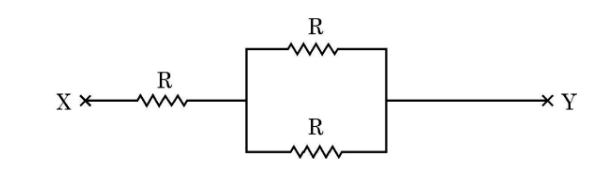
[3 Marks] Diagram 7 – CBSE Class 10 Science 2024 Set 3 Solutions
Answer: (a) Ohm's law states that the current flowing through a conductor between two points is directly proportional to the voltage across the two points provided the temperature remains constant. Mathematically, V = IR, where V is voltage, I is current, and R is resistance.
The formula for the equivalent resistance Rₚ of three resistors R₁, R₂, and R₃ connected in parallel is given by: 1/Rₚ = 1/R₁ + 1/R₂ + 1/R₃.
(b) To find the resistance of the given network, first identify which resistors are in series and which are in parallel. Calculate the equivalent resistance of the parallel groups using the formula above and then add the resistances in series. For example, if R₁ and R₂ are in series, their combined resistance R_{12} = R₁ + R₂. If R₃, R₄, and R₅ are in parallel, then 1/R_{345} = 1/R₃ + 1/R₄ + 1/R₅. Finally, the total resistance R_total = R_{12} + R_{345}. This method helps to simplify the circuit step by step to get the total equivalent resistance.
Key Points: Ohm's law states V = IR - Formula for parallel resistance 1/R_p = 1/R_1 + 1/R_2 + 1/R_3 - Method to calculate total resistance by combining series and parallel resistors
Question 37.

(a) List two constituents of the Central Nervous System (CNS). How are these components protected from injuries?

(b) Write two limitations of the use of electrical impulses.

[3 Marks]
Answer: (a) The two main constituents of the Central Nervous System (CNS) are the brain and the spinal cord. These components are protected from injuries by the bones that surround them; the brain is protected by the skull and the spinal cord is protected by the vertebral column. Additionally, both are cushioned by cerebrospinal fluid which acts as a shock absorber and prevents damage from sudden impacts.
(b) Two limitations of the use of electrical impulses are: 1. Electrical impulses can only travel through cells connected by nervous tissue, so they do not reach every cell in the body. 2. Once an electrical impulse is generated, it cannot be stopped halfway through its transmission, which can be a limitation in controlling the signal.
Key Points: Constituents of CNS - Brain and Spinal Cord - Protection by skull and vertebral column - Cushioning by cerebrospinal fluid - Limitations of electrical impulses - Travel only through connected nervous tissue - Cannot stop once generated
Question 38.

State giving reason the reduction process to obtain the following metals from their compounds:
(i) Sliver
(ii) Copper and
(iii) Iron

[3 Marks]
Answer: (i) Silver: Silver is a low reactive metal and is found in its free state or as silver compounds which decompose on heating. Therefore, it can be obtained by simple heating or by reduction with carbon or even by displacement using a more reactive metal.
(ii) Copper: Copper is a moderately reactive metal. It is extracted from its sulphide ore by roasting to form copper oxide, followed by reduction using carbon because carbon can remove oxygen from copper oxide to obtain pure copper.
(iii) Iron: Iron is a moderately reactive metal extracted from its oxide ore (hematite) by reduction using carbon in a blast furnace. Carbon removes oxygen from the iron oxide to give pure iron. This process works because iron is less reactive than carbon.
Key Points: Silver is low reactive and extracted by simple heating or reduction - Copper is moderately reactive and extracted by reduction using carbon - Iron is moderately reactive and extracted by reduction using carbon in blast furnace

Section E

Question 39.

(i) Five solutions A, B, C, D and E when tested with pH paper showed pH as 4, 1, 13, 7 and 10 respectively. Which solution is:

(1) Strongly acidic (2) Strongly alkaline (3) Weakly acidic (4) Neutral and (5) Weakly alkaline? Arrange the solutions in increasing order of H⁺ ion concentration.

(ii) Write the name and formula of (1) an acidic salt and (2) a basic salt giving the name of the parent acid and parent base used to form the salt in each case.

[5 Marks]
Answer: (i) To identify the nature of solutions based on their pH values:
1. Strongly acidic solution has very low pH (close to 1). Among given solutions, B has pH 1, so B is strongly acidic.
2. Strongly alkaline solution has very high pH (close to 14). Among given, C has pH 13, so C is strongly alkaline.
3. Weakly acidic solution has pH less than 7 but closer to neutral. A has pH 4, so A is weakly acidic.
4. Neutral solution has pH 7. D has pH 7, hence D is neutral.
5. Weakly alkaline solution has pH just above 7 but less than strong base. E has pH 10, so E is weakly alkaline.
The increasing order of H+ ion concentration is inverse of pH values:
C (pH 13) < E (pH 10) < D (pH 7) < A (pH 4) < B (pH 1).

(ii) Examples of salts:
1. Acidic salt: Name - Sodium hydrogen sulfate, Formula - NaHSO4.
Parent acid - Sulfuric acid (H2SO4), Parent base - Sodium hydroxide (NaOH). It is acidic because it contains replaceable hydrogen atom.
2. Basic salt: Name - Sodium carbonate, Formula - Na2CO3.
Parent acid - Carbonic acid (H2CO3), Parent base - Sodium hydroxide (NaOH). It is basic because it yields OH- ions in solution.
Thus, acidic salts partly neutralize acids and basic salts partly neutralize bases.
Key Points: pH indicates acidity or alkalinity - Solutions classified by pH values - Acidic and basic salts formed from respective acids and bases
Question 40.

Name and state in brief the process which is used to prepare sodium hydroxide from sodium chloride. In this process along with the main product two gases 'X' and 'Y' are also given off at the two electrodes. Name 'X' and 'Y' specifying the name of their respective electrode at which each gas is obtained. One of these gases when reacts with dry calcium hydroxide produces a compound 'Z' which is widely used in water treatment plants and textile industries. Name 'Z' and write chemical equation for the reaction involved in its formation.

[5 Marks]
Answer:

The process used to prepare sodium hydroxide from sodium chloride is called the chlor-alkali process. In this process, an aqueous solution of sodium chloride, known as brine, undergoes electrolysis. When electric current passes through the brine, it decomposes to form sodium hydroxide, chlorine gas, and hydrogen gas. The overall reaction is:
2NaCl (aqueous) + 2H₂O (liquid) → 2NaOH (aqueous) + Cl₂ (gas) + H₂ (gas).

In this electrolysis process, chlorine gas (Cl₂) is released at the anode (the positive electrode), and hydrogen gas (H₂) is released at the cathode (the negative electrode). Sodium hydroxide solution is formed near the cathode.

The two gases produced are X = Chlorine (Cl₂) at the anode and Y = Hydrogen (H₂) at the cathode.

When chlorine gas reacts with dry calcium hydroxide (Ca(OH)₂), it produces calcium oxychloride (called bleaching powder), represented as compound 'Z'. This compound is widely used for disinfecting water in water treatment plants and also in the textile industry.

The chemical reaction for the formation of bleaching powder is:
Ca(OH)₂ + Cl₂ → CaOCl₂ + H₂O.

Key Points: Chlor-alkali process-electrolysis of brine-Products: NaOH, Cl₂, H₂-Explanation of gases at electrodes-Cl₂ at anode, H₂ at cathode-Reaction of Cl₂ with Ca(OH)₂ to form bleaching powder (CaOCl₂)-Usage of bleaching powder in water treatment and textile industries-Chemical equation of reaction forming bleaching powder
Question 41.

(i) What are spores? On which structures are they formed? How do they overcome unfavourable conditions? Name the organism which multiplies with the help of these structures.

(ii) Give two reasons why some plants are grown by the method of vegetative propagation. List two methods used to grow plants vegetatively.

[5 Marks]
Answer: (i) Spores are tiny reproductive units produced inside special structures called sporangia which are usually found at the tip of hyphae in fungi. Spores help the organism survive unfavourable conditions by remaining dormant for a long time until the environment becomes favourable again for growth. The fungus Rhizopus multiplies with the help of spores.

(ii) Some plants are grown by the method of vegetative propagation because (1) it helps to produce new plants quickly and (2) the offspring are genetically identical to the parent, preserving desired traits. Two common methods of vegetative propagation are cuttings and grafting. In cuttings, a part of the plant such as stem or leaf is cut and planted to grow a new plant. In grafting, a part of one plant is joined to another plant to grow together.
Key Points: Spores are reproductive units formed in sporangia - Spores survive unfavourable conditions by dormancy - Rhizopus multiplies by spores - Vegetative propagation helps quick multiplication and preserves traits - Methods include cuttings and grafting
Question 42.

(i) Study the diagram given below and name the parts marked as A, B and C. What happens when B reaches C in the ovary? Mention its significance.

(ii) Write the post fertilisation changes that occur in a flower.
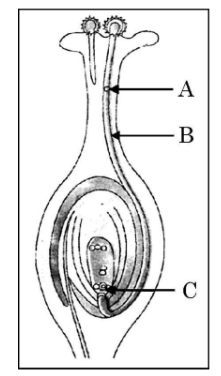
[5 Marks] Diagram 8 – CBSE Class 10 Science 2024 Set 3 Solutions
Answer: (i) The parts marked A, B and C are: A - Stigma, B - Style, C - Ovary.
When B (the pollen tube) reaches C (the ovary), the male gamete travels through the pollen tube to the ovule present in the ovary. Fertilization occurs when the male gamete fuses with the female gamete (egg) inside the ovule. This fusion forms a zygote, which eventually develops into an embryo. The significance of this process is that it leads to the formation of seeds, which help in the reproduction of flowering plants.
(ii) Post fertilisation changes in a flower include: the zygote formed in the ovule develops into the embryo; the ovule develops into a seed; the ovary enlarges and transforms into a fruit; the petals, sepals, stamens, and style wither and fall off as their purpose is fulfilled; the seed contains the embryo and stored food to nourish it during germination. These changes ensure the formation of fruit and seeds for the next generation of plants.
Key Points: A - Stigma - B - Style - C - Ovary - Fertilisation occurs in ovary - Formation of zygote and seed - Ovary develops into fruit - Post fertilisation changes include development of embryo, seed and fruit formation
Question 43.

(i) Draw a ray diagram to show the path of the refracted ray in each of the following cases:

A ray of light incident on a concave lens
(1) parallel to its principal axis, and
(2) is directed towards its principal focus.

(ii) A 4 cm tall object is placed perpendicular to the principal axis of convex lens of focal length 24 cm. The distance of object from the lens is 16 cm. Find the position and size of image formed.

[5 Marks]
Answer: (i) Ray diagrams for a concave lens:
1. When a ray of light is incident parallel to the principal axis, it refracts through the concave lens and appears to diverge from the principal focus on the same side of the lens. The refracted ray bends away from the principal axis as if it is coming from the principal focus.
2. When a ray is directed towards the principal focus on the opposite side of the lens, after refraction through the concave lens, the ray emerges parallel to the principal axis.

(ii) Given: Object height (h) = 4 cm, Focal length (f) = 24 cm (convex lens, so f is positive), Object distance (u) = -16 cm (since the object is on the left side of the lens, sign convention: object distance is negative).
Using lens formula: 1/f = 1/v - 1/u => 1/v = 1/f + 1/u = 1/24 + 1/(-16) = (2 - 3)/48 = -1/48
So, image distance v = -48 cm (negative implies image is on the same side as object, so it is virtual).
Magnification m = v/u = -48 / -16 = 3 (positive, so image is upright).
Image height h' = m * h = 3 * 4 = 12 cm.

Therefore, the image is formed at 48 cm on the same side of the lens as the object, is virtual, upright and magnified 3 times with size 12 cm tall.
Key Points: Concave lens rays diverge as if from principal focus - Ray parallel to axis refracts through lens and appears to come from focus - Ray towards focus refracts to become parallel to axis - Lens formula 1/f = 1/v - 1/u used for image position - Magnification m = v/u used for image size - Image formed is virtual, upright, and magnified when object is within focal length of convex lens
Question 44.

Draw a ray diagram to show the path of the reflected ray in each of the following cases:

A ray of light incident on a convex mirror
(1) parallel to its principal axis, and
(2) is directed towards its principal focus

[5 Marks]
Answer:

A convex mirror always diverges light rays, meaning the reflected rays spread out. When drawing ray diagrams for convex mirrors, we need to consider that the focal point is virtual and located behind the mirror.

Case 1: Ray parallel to the principal axis
When a ray of light is incident parallel to the principal axis on a convex mirror, it reflects off the mirror such that the reflected ray appears to come from the principal focus (F) located behind the mirror. To represent this in a diagram, draw the incident ray parallel to the principal axis, then the reflected ray diverging outwards. By extending the reflected ray backward behind the mirror, it should pass through the focal point (F).

Case 2: Ray directed towards the principal focus
If the incident ray is directed towards the principal focus (F) behind the mirror, it reflects from the convex surface and travels parallel to the principal axis. In the diagram, you will show the incident ray heading towards the focal point behind the mirror, and after reflection, the ray runs parallel to the principal axis.

Thus, in both cases, the law of reflection applies: angle of incidence equals angle of reflection, and the behavior of rays for a convex mirror shows that parallel rays appear to diverge from the virtual focus behind the mirror.

Key Points: Convex mirror diverges incident rays-Principal focus is virtual and behind the mirror-Case 1: Ray parallel to principal axis reflects appearing to come from focus-Case 2: Ray directed towards focus reflects parallel to principal axis-Law of reflection applies (angle of incidence equals angle of reflection)-Reflected rays diverge but can be extended backward to meet at virtual focus

Paper Details

CBSE Board Exam 2024

Class

Class 10

Subject

Science

Year

2024

Set

Set 3

Other Years — Science

2022 Set-1

2022 Set-2

2022 Set-3

2022 Set-4

2023 Set-1

2023 Set-2

2023 Set-3

2023 Set-4

2023 Set-5

2024 Set-1

2024 Set-2

2024 Set-3

2024 Set-4

2024 Set-5

2025 Set-1

2025 Set-2

2025 Set-3

2025 Set-4

2025 Set-5

2025 Set-6

CBSE Class 10 Science 2024 Set 3 Solutions | Prepzy