QUESTION PAPER
2024 BOARD EXAM
CBSE Class 10 Science Board Paper 2024 — Set 5
2024
Science
Class 10
CBSE EXAMINATION PAPER-2024
SCIENCE
(Solved)
General Instructions :
Read the following instructions carefully and follow them :
- This question paper contains 45 questions. All questions are compulsory.
- This question paper is divided into 5 sections.
- Section A – questions number 1 to 3 are case based questions
- Section B – questions number 4 to 23 are multiple choice questions
- Section C – questions number 24 to 31 are very short answer
- Section D – questions number 32 to 39 are short answer
- Section E – questions number 40 to 45 are long answer
- There is no overall choice given in the question paper. However, an internal choice has been provided in few questions.
- Use of calculator is NOT allowed.
Section A
(1) What are hydrocarbons?
[1 Mark](2) List two properties by virtue of which carbon can form a large number of compounds.
[1 Mark](3) Write the formula of the functional group present in (1) aldehydes, and (2) ketones. Write a chemical equation for the reaction that occurs between ethanoic acid and ethanol in the presence of a catalyst.
[2 Marks](4) What are structural isomers? Write the structures of two isomers of butane (C₄H₁₀)
(1) Name the part of the flower which attracts insects for pollination. What happens to this part after fertilisation?
[1 Mark](2) Write the main difference between self-pollination and cross-pollination.
[1 Mark](3) Define fertilisation. What is the fate of ovules and the ovary in a flower after fertilisation?
[2 Marks](4) In a germinating seed, which parts are known as future shoot and future root ? Mention the function of cotyledon.
A highly polished surface such as a mirror reflects most of the light falling on it. In our daily life we use two types of mirrors plane and spherical. The reflecting surface of a spherical mirrors may be curved inwards or outwards. In concave mirrors, reflection takes place from the inner surface, while in convex mirrors reflection takes place from the outer surface.
(1) A ray of light is incident on a concave mirror, parallel to its principal axis. If this ray after reflection from the mirror passes through the principal axis from a point at a distance of 10 cm from the pole of the mirror, find the radius of curvature of the mirror.
[1 Mark](2) Define the principal axis of a concave mirror.
[1 Mark](3) An object is placed at a distance of 10 cm from the pole of a convex mirror of focal length 15 cm. Find the position of the image.
[2 Marks](4) A mirror forms a virtual, erect and diminished image of an object. Identify the type of this mirror. Draw a ray diagram to show the image formation in this case.
Section B
To balance the following chemical equation, the values of the coefficients x, y, and z must be respectively:

Which of the following is a redox reaction, but not a combination reaction?
Select from the following the conditions responsible for the rapid spread of bread mould on a slice of bread:
(i) Formation of large number of spores
(ii) Presence of moisture and nutrients in bread
(iii) Low temperature
(iv) Presence of hyphae
The correct sequence of events when someone's hand touches a hot object unconsciously:
The phenomena of light involved in the formation of rainbow are:
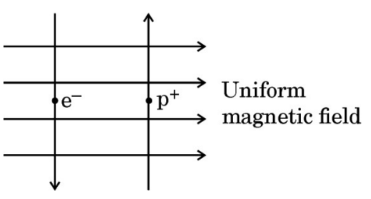
A uniform magnetic field exists in the plane of paper as shown in the diagram. In this field, an electron
(e⁻) and a positron (p⁺) enter and shown. The electron and positron experience forces:
Assertion (A): Some vegetable oils are healthy.
Reason (R): Vegetable oils generally have long unsaturated carbon chains.
Assertion (A): Sex of the children will be determined by what they inherit from their mother.
Reason (R): Women have XX sex chromosomes.
Assertion (A): Electrons move from lower potential to higher potential in a conductor.
Reason (R): A dry cell maintains electric potential difference across the ends of a conductor.
Assertion (A): Ozone layer protects the surface of the Earth from harmful UV radiations.
Reason (R): Chlorofluorocarbons (CFCs) are responsible for depletion of ozone layer.
Section C
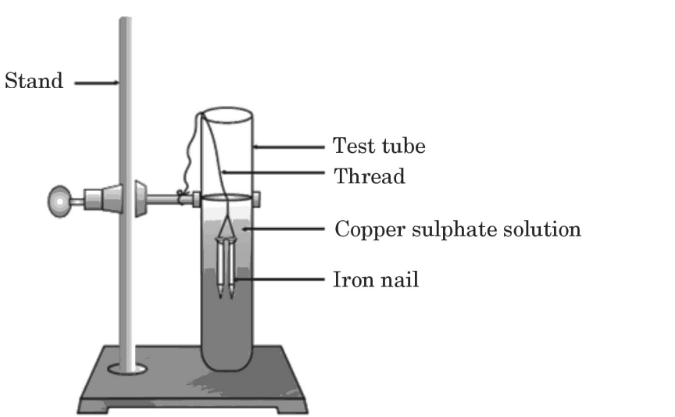
Copper powder is taken in a china dish and heated over a burner. Name the product formed and state its colour. Write the chemical equation for the reaction involved.
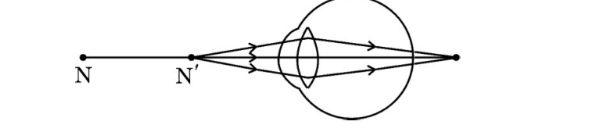
The heat produced at a point due to concentration of sunlight by a convex lens burns a paper. (a)Explain why it happens. (b) Name the term given to the point at which the paper starts burning.
Write chemical equation for the chemical reaction which occurs when the aqueous solutions of barium chloride and sodium sulphate react together. Write the symbols of the ions present in the compound precipitated in the reaction.
Section D
Mendel crossed pure tall pea plants (TT) with pure short pea plants (tt) and obtained F₁ progeny. When the plants of F₁ progeny were self-pollinated, plants of F₂ progeny were obtained.
(a) What did the plants of F₁ progeny look like? Give their gene combination.
(b) Why could the gene for shortness not be expressed in plants of F₁ progeny?
(c) Write the ratio of the plants obtained in F₂ progeny and state the conclusion that can be drawn from this experiment.
(a) What happens when a bundle of wires of soft iron is placed inside the coil of a solenoid carrying a steady current? Name the device obtained. Why is it called so?
(b) Draw the magnetic field lines inside a current carrying solenoid. What does this pattern of magnetic field lines indicate ?
What is dispersion of white light ? State its cause. Draw a diagram to show dispersion of a beam of white light by a glass prism.
Section E
A few crystals of ferrous sulphate were taken in a dry boiling tube and heated. Tiny water droplets were observed in the tube after some time.
(i) From where did these water droplets appear? Explain.
(ii) What colour change will be observed during heating?
(iii) How many molecules of water are attached per molecule of FeSO₄ crystal? Write the molecular formula of crystalline forms of (I) Copper sulphate, and (II) Sodium carbonate.
(iv) State how is Plaster of Paris obtained from gypsum. Write two uses of Plaster of Paris.
(i) The potential difference across the two ends of a circuit component is decreased to one-third of its initial value while its resistance remains constant. What change will be observed in the current flowing through it? Name and state the law which helps us to answer this question.
(ii) Draw a schematic diagram of a circuit consisting of a battery of four 1.5 V cells, a 5 Ω resistor, a 10 Ω resistor and a 15 Ω resistor connected in series. Now find (I) the electric current passing through the circuit, and (II) potential difference across the 10 Ω resistor when the plug key is closed.
An acid 'X' present in tamarind when mixed with 'Y', produces a mixture 'Z'. 'Z' on addition to a dough when heated makes cakes soft and spongy. 'Y' is prepared from common salt and helps in faster cooking.
(i) Write the common names of 'X', 'Y' and 'Z', and the chemical formula of 'Y'.
(ii) How is 'Y' prepared and how does it help in making cakes soft and spongy? Illustrate the reaction with suitable chemical equation.
(iii) Write the name and chemical formula of a mild base other than 'Y' used as an antacid.
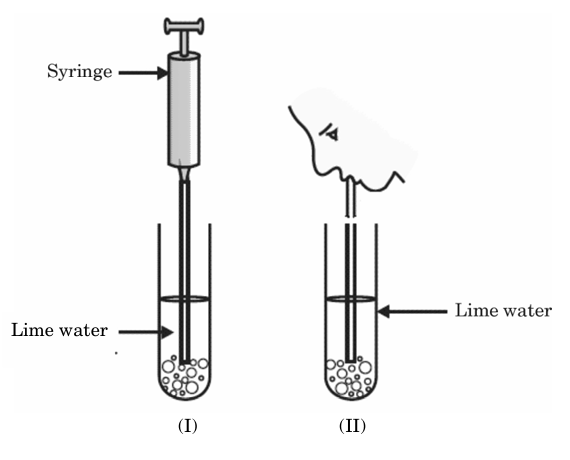
(i) In the experimental set-up shown above in diagram (I) atmospheric air is being passed into lime water with a syringe while in diagram (II) air is being exhaled into lime water. The time taken for the lime water to turn milky in both the test tubes is different. Give reason.
(ii) Draw the diagram of an open stomatal pore and label (I) Guard cells, and (II) Chloroplast on it. Mention two functions performed by stomata.
(i) When is the potential difference between two points said to be 1 volt ?
(ii) A copper wire has a diameter of 0·2 mm and resistivity of 1·6 ×10⁻⁸ Ωm. What will be the length of this wire to make its resistance 14Ω ? How much does the resistance change, if the diameter of the wire is doubled ?
Paper Details
CBSE Board Exam 2024
Class
Class 10
Subject
Science
Year
2024
Set
Set 5
Other Years — Science