SOLUTIONS

2025 BOARD EXAM

CBSE Class 10 Science Board Paper 2025 — Set 5 Solutions

2025

Science

Class 10

CBSE EXAMINATION PAPER-2025

SCIENCE

(Solved)

Time allowed : 3 hours

Maximum Marks : 92

General Instructions :

Read the following instructions carefully and follow them :

  1. This question paper contains 46 questions. All questions are compulsory.
  2. This question paper is divided into 5 sections.
  3. Section A – questions number 1 to 3 are case based questions
  4. Section B – questions number 4 to 23 are multiple choice questions
  5. Section C – questions number 24 to 32 are very short answer
  6. Section D – questions number 33 to 40 are short answer
  7. Section E – questions number 41 to 46 are long answer
  8. There is no overall choice given in the question paper. However, an internal choice has been provided in few questions.
  9. Use of calculator is NOT allowed.

Section A

Question 1. The combining capacity of various elements depends on the number of valence electrons. Also the reactivity of elements is explained as their tendency to attain a completely filled outer shell, that is, to attain a noble gas configuration. This may be either through gain of electrons or loss of electrons or sharing of electrons.

(1) An element A has atomic number 16, how will it attain its nearest noble gas configuration?

[1 Mark]
Answer: Element A, with atomic number 16, is sulfur (S). Sulfur has six valence electrons in its outermost shell. To attain the nearest noble gas configuration, which is that of argon (the nearest noble gas with atomic number 18), sulfur needs to achieve a total of eight electrons in its outer shell. This can be achieved by gaining two electrons, therefore, sulfur typically forms anions with a charge of -2 when it reacts with other elements. This electron gain allows it to achieve a stable octet configuration, thus attaining the noble gas status.
Key Points: Atomic number 16 refers to sulfur; it has 6 valence electrons; to attain the noble gas configuration of argon (8 electrons), sulfur needs to gain 2 electrons; forms an anion with -2 charge.

(2) Write the number of (i) single and (ii) double covalent bonds in a molecule of butene (C4H8).

[1 Mark]
Answer:

In a molecule of butene (C₄H₈), there are a total of 10 covalent bonds. This consists of 6 single covalent bonds and 1 double covalent bond. The double bond occurs between the second and third carbon atoms, while the remaining bonds connect the carbon atoms to hydrogen atoms and form C-H bonds. Therefore, the molecule contains 6 single bonds and 1 double bond.

Key Points: Butene has 4 carbon atoms and 8 hydrogen atoms - It has 1 double covalent bond between C2 and C3 - The remaining bonds are single covalent bonds between carbon and hydrogen

(3)

Explain the formation of a molecule of ammonia (NH₃), using electron dot structure. (Atomic number of nitrogen is 7)

[2 Marks]
Answer:

The formation of ammonia (NH3) involves the combination of one nitrogen atom and three hydrogen atoms. The atomic number of nitrogen is 7, which means it has 5 valence electrons (since the electron configuration is 1s² 2s² 2p³). In order to achieve a stable octet, nitrogen needs to gain or share three more electrons. On the other hand, hydrogen has an atomic number of 1, which gives it 1 valence electron. Each hydrogen atom needs to share one additional electron to achieve the duet configuration. In the electron dot structure for ammonia, the nitrogen atom shares its three valence electrons with three hydrogen atoms. This results in three N-H bonds, where each bond consists of a shared pair of electrons. The electron dot structure can be depicted as follows: N with three dots (representing its 5 valence electrons and the three pairs shared with hydrogen) surrounded by three H's each showing their single dots. This shared electrons between nitrogen and hydrogen atoms enable both to attain a more stable electron configuration. Therefore, ammonia (NH₃) is formed.

Key Points: Atomic number of nitrogen is 7; nitrogen has 5 valence electrons; nitrogen shares 3 electrons with 3 hydrogen atoms; each hydrogen shares 1 electron; forms 3 N-H bonds; resulting structure depicts shared electrons.

(4)

Why does carbon share its valence electrons with other atoms of carbon or with atoms of other elements ?

[2 Marks]
Answer: Carbon shares its valence electrons because it has four valence electrons and needs four more to achieve a full outer shell, or an octet, which is a stable electron configuration similar to that of noble gases. By sharing electrons with other atoms, carbon forms covalent bonds, allowing it to complete its outermost shell. This property is crucial for the formation of a variety of compounds, making carbon a fundamental element in organic chemistry. The sharing of electrons not only helps carbon attain greater stability but also facilitates the creation of diverse and complex molecular structures.
Key Points: 4 valence electrons-carbon needs 4 more for octet-share electrons to achieve stability-forms covalent bonds for variety in compounds
Question 2.

In human beings, there are 23 pairs of chromosomes. Out of these 23 pairs of chromosomes (i.e. 46 chromosomes), 22 pairs of chromosomes are called autosomes and one pair of chromosomes. i.e. two chromosomes are called sex chromosomes. The sex chromosomes are of two types — ‘X’ chromosomes and ‘Y chromosomes. The sex of a child (i.e. progeny), is decided at the time of fertilisation. In other words, at the time of zygote formation the sex chromosomes inherited from the parents of a child decide whether the new born will be a boy or a girl.

(1) What are chromosomes?

[1 Mark]
Answer: Chromosomes are thread-like structures found inside the nucleus of every cell in human beings. They are composed of DNA and proteins, and carry genetic information essential for determining the traits and characteristics of an organism. Humans have a total of 46 chromosomes, arranged in 23 pairs, where 22 pairs are autosomes and one pair consists of sex chromosomes. The sex chromosomes, which are either X or Y, play a crucial role in determining the sex of an individual. Females have two X chromosomes (XX), while males have one X and one Y chromosome (XY). The specific combination of sex chromosomes inherited from the parents during fertilization dictates whether the child will be a boy or a girl.
Key Points: Chromosomes are found in the nucleus of cells-Chromosomes carry genetic information-Humans have 46 chromosomes in 23 pairs (22 autosomes and 1 pair of sex chromosomes-Sex chromosomes determine the sex of the individual

(2) Why is the pair of sex chromosomes in human males called mismatched pair?

[1 Mark]
Answer: The sex chromosomes in human males are referred to as a mismatched pair because males possess one normal-sized X chromosome and one shorter Y chromosome. Unlike females, who have a perfect pair of X chromosomes (XX), males have an XY configuration. This discrepancy between the size and structure of the X and Y chromosomes results in the designation of a mismatched pair. The Y chromosome is shorter and carries different genes compared to the X chromosome, which contributes to the determination of male characteristics. Thus, the variation between the X and Y chromosomes in males is what distinguishes them from females in terms of sex chromosome pairing.
Key Points: Males have one X and one Y chromosome; Females have two X chromosomes; The Y chromosome is shorter than the X chromosome; Mismatched due to differences in size and genetic content

(3) Show with the help of a flow chart that the statistical probability of getting a boy or a girl is 50 : 50.

[2 Marks]
Answer: To illustrate the statistical probability of having a boy or a girl, we can represent the information in a flow chart form. The fertilization process involves one egg from the mother (always carrying an X chromosome) and one sperm from the father, which can carry either an X or a Y chromosome.
1. Start with a fertilized egg.
2. The maternal contribution is X (from the egg).
3. The paternal contribution can be either X (resulting in a girl) or Y (resulting in a boy).
Thus, there are two possible combinations at fertilization:
- XX = Female (Girl)
- XY = Male (Boy)
This leads us to the conclusion that there is a 50% chance of having a boy and a 50% chance of having a girl.
Key Points: Chromosomes determine sex; X from mother, X or Y from father; XX = girl, XY = boy; statistical probability is 50:50

(4)

Mention two examples of animals where sex is not determined genetically like human beings. Describe in brief the method of sex determination in these animals.

[2 Marks]
Answer: Two examples of animals where sex is not determined genetically are certain species of turtles and crocodiles. In these animals, the sex of the offspring is determined by environmental factors, primarily temperature, during the incubation period of their eggs. For instance, in some turtle species, higher incubation temperatures can lead to the development of females, while cooler temperatures may result in males. Similarly, in crocodiles, temperatures above a certain threshold can favor the production of females, while lower temperatures lead to males. This form of sex determination is known as temperature-dependent sex determination (TSD).
Key Points: Examples: turtles and crocodiles; Method: temperature-dependent sex determination; Female/male development based on incubation temperature.
Question 3.

In order to obtain magnetic field lines around a bar magnet, a student performed an experiment using a magnetic compass and a bar magnet. The magnet was placed on a sheet of white paper fixed on a drawing board. Using magnetic needle he obtained on the paper a pattern of magnetic field lines (as shown below) around the bar magnet.
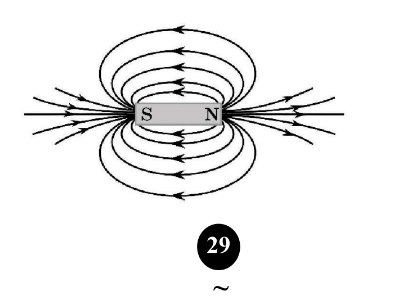
Diagram 1 – CBSE Class 10 Science 2025 Set 5 Solutions

(1) By convention, the field lines emerge from the north pole and merge at the south pole. Why? Give reason.

[1 Mark]
Answer: The field lines of a magnetic field are a visual representation of the direction and strength of the magnetic field around a magnet. By convention, field lines are drawn to emerge from the north pole of the magnet and terminate at the south pole. This convention is based on how a magnetic compass behaves in the presence of a magnet. The north pole of a compass needle is attracted towards the south pole of a magnet, while the south pole of the compass needle is repelled from the north pole of the magnet. Hence, it is observed that the direction of the magnetic field at any point is the same as the direction in which the north pole of a compass needle points. Therefore, to maintain consistency and clarity in understanding the magnetic field, it is established that the lines are drawn originating from the north pole and converging at the south pole.
Key Points: Direction of magnetic field lines; Compass behavior; North pole attraction and south pole repulsion

(2)

State the relationship between strength of the magnetic field and the degree of closeness of the field lines.

[1 Mark]
Answer: The strength of the magnetic field is directly related to the degree of closeness of the magnetic field lines. When field lines are closer together, it indicates a stronger magnetic field in that region, as the intensity of the magnetic force is higher. Conversely, when the field lines are further apart, the magnetic field is weaker. This pattern can be observed when using a compass near the bar magnet; the compass needle shows greater deflection near the poles where the field lines are denser, indicating a stronger magnetic field.
Key Points: Strength of magnetic field directly proportional to closeness of field lines-closer lines indicate stronger field-further lines indicate weaker field- observed using compass deflection near poles

(3)

(i) No two field lines can ever intersect each other. Give reason.

(ii) The magnetic field in a given region is uniform. Draw a diagram to represent it.

[2 Marks]
Answer: (i) No two magnetic field lines can intersect because if they did, it would imply that at the point of intersection, a compass needle would point in two different directions at the same time. Since a magnetic field has a specific direction at every point, this is impossible. Therefore, the magnetic field lines cannot cross. (ii) A uniform magnetic field is represented by parallel, straight lines that are evenly spaced apart, indicating that the strength and direction of the magnetic field are the same throughout the region. [Here, a diagram of parallel lines should be included].
Key Points: No two magnetic field lines intersect-Compass needle points in one direction-Uniform magnetic field represented by parallel lines.

(4)

Draw the pattern of the magnetic field lines through and around a current carrying solenoid. What does the pattern of field lines inside the solenoid represent ?

[2 Marks]
Answer: To illustrate the magnetic field lines through and around a current carrying solenoid, we can draw a cylinder representing the solenoid with field lines emanating from both ends. The lines should emerge from one end, curve around the outside, and enter at the other end, resembling a bar magnet. Inside the solenoid, the field lines should appear as straight, parallel lines, indicating that the magnetic field is uniform in strength and direction throughout the interior. This uniformity of the magnetic field inside the solenoid signifies that the magnetic field is consistent at all points, similar to the behavior of the magnetic field in a bar magnet, where one end acts as the North Pole and the other as the South Pole.
Key Points: Draw the solenoid shape; Indicate parallel field lines inside the solenoid; Explain uniformity of magnetic field

Section B

Question 4.

The main observations while performing the experiment of burning magnesium ribbon in air are:

(i) Magnesium ribbon burns with a dazzling white flame.

(ii) A white powder is formed.

(iii) Magnesium ribbon vapourises.

(iv) Aqueous solution of the white powder turns blue litmus to red.

[1 Mark]
  • (A) (ii) and (iii)
  • (B) (i) and (iv)
  • (C) (i) and (ii)
  • (D) (iii) and (iv)
Explanation:

When magnesium ribbon is burned in air, the following observations are made:


(i) Magnesium burns with a dazzling white flame

  • True: This is the most noticeable observation — magnesium produces a very bright white flame.

(ii) A white powder is formed

  • True: The white powder is magnesium oxide (MgO), which forms as a result of the reaction:

    2Mg + O₂ → 2MgO

Question 5. A metal, M, displaces iron from aqueous solution of ferrous sulphate but fails to do so in case of aqueous solution of aluminium sulphate. The metal M is:
[1 Mark]
  • (A) Zinc
  • (B) Magnesium
  • (C) Copper
  • (D) Lead
Explanation: The correct option is Zinc. Zinc is more reactive than iron, which allows it to displace iron from ferrous sulphate. However, zinc is less reactive than aluminum, which is why it cannot displace aluminum from aluminum sulphate. This follows the principle of the reactivity series where a more reactive metal displaces a less reactive metal from its compounds.
Question 6.

A common feature observed in the crystals of washing soda, copper sulphate, gypsum and ferrous sulphate is that all:

[1 Mark]
  • (A) exhibit acidic nature
  • (B) are coloured
  • (C) exhibit basic nature
  • (D) have fixed number of molecules of water of crystallisation in one formula unit of these salts.
Explanation: All these salts contain water of crystallisation, which means they have a fixed number of water molecules chemically bound within one formula unit of the salt. For example, copper sulphate is CuSO4·5H2O, indicating five water molecules. This water of crystallisation is responsible for certain properties of these crystals. Other options like exhibiting basic nature, acidic nature, or being coloured are not common to all these salts.
Question 7. A metal, ‘X’, on treatment with sodium hydroxide liberates a gas ‘G’. It also liberates the same gas, ‘G’ on treatment with dilute sulphuric acid. Based on above information, ‘X’ and ‘G’ respectively are:
[1 Mark]
  • (A) Copper and Sulphur dioxide
  • (B) Zinc and Sulphur dioxide
  • (C) Copper and Hydrogen
  • (D) Zinc and Hydrogen
Explanation: The correct answer is 'Zinc and Hydrogen'. Zinc reacts with sodium hydroxide and dilute sulphuric acid to displace hydrogen, producing hydrogen gas (G) in both reactions.
Question 8.

The values of a, b, c, and d in the following balanced chemical equation are respectively:

a Pb(NO₃)₂ ⟶(heat) b PbO + c NO₂ + d O₂

[1 Mark]
  • (A) 2,2,1,4
  • (B) 1,1,1,2
  • (C) 1,1,2,1
  • (D) 2,2,4,1
Explanation: The correct values are a=2, b=2, c=4, and d=1. The balanced equation from the context is: 2Pb(NO3)2 ⟶ 2PbO + 4NO2 + O2. This confirms that for every 2 moles of lead nitrate decomposing, we produce 2 moles of lead oxide, 4 moles of nitrogen dioxide, and 1 mole of oxygen.
Question 9. During electrolytic refining of copper, the anode, the cathode, and the electrolyte used respectively are:
[1 Mark]
  • (A) Impure copper, pure copper, acidified copper sulphate solution
  • (B) Pure copper, impure copper, sulphuric acid
  • (C) Impure copper, pure copper, distilled water
  • (D) Pure copper, impure copper, acidified copper sulphate solution
Explanation: The correct option is 'Impure copper, pure copper, acidified copper sulphate solution.' In the process of electrolytic refining of copper, impure copper is used as the anode, pure copper serves as the cathode, and the electrolyte is an acidified copper sulfate solution. This allows pure copper to be deposited at the cathode while impurities dissolve into the electrolyte.
Question 10.

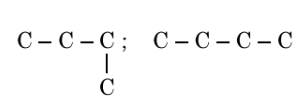
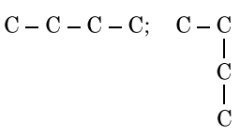
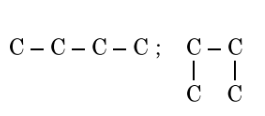
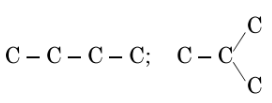
If we make a carbon skeleton with four carbon atoms, the two different possible skeletons will be:
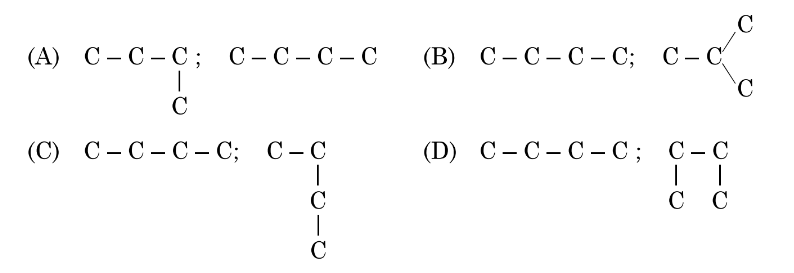
[1 Mark] Diagram 2 – CBSE Class 10 Science 2025 Set 5 Solutions
  • (A) Diagram 3 – CBSE Class 10 Science 2025 Set 5 Solutions
  • (B) Diagram 4 – CBSE Class 10 Science 2025 Set 5 Solutions
  • (C) Diagram 5 – CBSE Class 10 Science 2025 Set 5 Solutions
  • (D) Diagram 6 – CBSE Class 10 Science 2025 Set 5 Solutions
Explanation: When we make the carbon skeleton with four carbon atoms, there are two possible arrangements: a straight-chain skeleton where all four carbons are connected in a line (C—C—C—C), and a branched skeleton where three carbons form a chain and the fourth carbon is attached as a branch to the middle carbon atom of the chain. Both structures have the same molecular formula C₄H₁₀ but different arrangements, representing structural isomers.
Question 11.

Listed below are the steps of nutrition in Amoeba. Select the correct sequence of these steps :

(i) Diffusion of simple nutrients into cytoplasm

(ii) Food vacuole formation

(iii) Formation of finger like temporary extensions of cell surface

(iv) Complex substances broken to simpler ones

(v) Undigested material thrown out of the cell surface

[1 Mark]
  • (A) (iii) (ii) (iv) (i) (v)
  • (B) (iii) (iv) (i) (ii) (v)
  • (C) (iv) (i) (ii) (iii) (v)
  • (D) (ii) (i) (iv) (v) (iii)
Explanation:

The correct sequence of nutrition in Amoeba starts with the formation of finger-like temporary extensions of the cell surface called pseudopodia (iii) which engulf the food particle to form a food vacuole (ii). Inside the food vacuole, complex substances are broken down into simpler ones by enzymes (iv). These simpler nutrients then diffuse into the cytoplasm (i). Finally, the undigested material is thrown out of the cell surface (v). This sequence matches the provided context describing the process of nutrition in Amoeba.

Question 12.

Which among the following is not a neural action controlled by the part of the human brain labelled ‘X’ in the figure above?
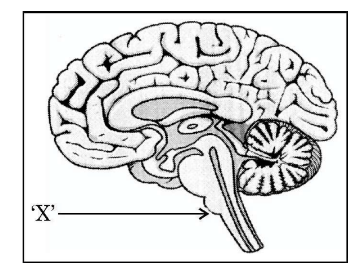
[1 Mark] Diagram 7 – CBSE Class 10 Science 2025 Set 5 Solutions
  • (A) Blood Pressure
  • (B) Salivation
  • (C) Hunger
  • (D) Vomiting
Explanation:

Hunger is not a neural action controlled by the mid-brain and hind-brain, but rather a sensation associated with a center in the fore-brain. The other options—blood pressure, salivation, and vomiting—are involuntary actions controlled by the medulla in the hind-brain.

Question 13. The modes of reproduction in Spirogyra and Planaria respectively are:
[1 Mark]
  • (A) Regeneration and budding
  • (B) Regeneration and fragmentation
  • (C) Budding and regeneration
  • (D) Fragmentation and regeneration
Explanation: The correct answer is 'Fragmentation and regeneration.' Spirogyra reproduces asexually by fragmentation, where it breaks into smaller pieces that can grow into new individuals. Planaria, a flatworm, reproduces through regeneration, where it can regrow lost parts and form new individuals from cut pieces.
Question 14. The plant hormones promoting rapid cell division in seeds and wilting of leaves respectively are:
[1 Mark]
  • (A) Auxins and Abscisic acid
  • (B) Cytokinins and Abscisic acid
  • (C) Gibberellins and Auxins
  • (D) Abscisic acid and Gibberellins
Explanation: The correct answer is 'Cytokinins and Abscisic acid.' Cytokinins promote rapid cell division, particularly in seeds and fruits, while Abscisic acid is responsible for signaling the plant to stop growth and can cause wilting of leaves.
Question 15. In aerobic respiration, the steps are: breakdown of glucose to pyruvate and its further conversion to carbon dioxide. Both processes respectively occur in —
[1 Mark]
  • (A) Vacuole and Cytoplasm
  • (B) Chloroplast and Mitochondria
  • (C) Mitochondria and Cytoplasm
  • (D) Cytoplasm and Mitochondria
Explanation: The breakdown of glucose to pyruvate occurs in the cytoplasm, and the further conversion of pyruvate to carbon dioxide takes place in the mitochondria. Therefore, the correct answer is 'Cytoplasm and Mitochondria'.
Question 16. In order to obtain large images of the teeth of patients, the dentist holds the concave mirror in such a manner that the teeth are positioned:
[1 Mark]
  • (A) at the focus of mirror.
  • (B) between pole and focus of the mirror.
  • (C) between focus and center of curvature of the mirror.
  • (D) at the center of curvature of the mirror.
Explanation: The correct option is 'between the pole and focus of the mirror.' This is because when an object is placed between the pole (P) and the focus (F) of a concave mirror, it creates an enlarged, virtual image that the dentist can use to examine the teeth closely. This is a fundamental property of concave mirrors, which produce larger images when the object is positioned within this range.
Question 17. The possible way to restore clear vision of those people whose eyeball has elongated is the use of suitable:
[1 Mark]
  • (A) concave lens
  • (B) bifocal lens
  • (C) converging lens
  • (D) convex lens
Explanation: The correct option is 'concave lens'. An elongated eyeball often leads to myopia (nearsightedness), where distant objects appear blurry. Concave lenses are specifically designed to diverge light rays in a way that allows these individuals to see distant objects more clearly. Convex lenses, on the other hand, are used for correcting hyperopia (farsightedness), not myopia.
Question 18.

The examples of natural and manmade (artificial) ecosystems are respectively:

[1 Mark]
  • (A) Forests and ponds
  • (B) Crop fields and lakes
  • (C) Lakes and gardens
  • (D) Crop fields and forests
Explanation:

The correct answer is 'Forests and ponds'. Forests and ponds are natural ecosystems formed by nature, while gardens and crop fields are human-made (artificial) ecosystems. The context specifically mentions that lakes, forests, and ponds are natural ecosystems.

Question 19.

Human activities that are affecting the environment are:

[1 Mark]
  • (A) excessive use of disposable cups and plates.
  • (B) minimising the use of chlorofluorocarbons.
  • (C) segregating the wastes into biodegradable and non-biodegradable before disposal.
  • (D) maximising the use of reusable utensils for eating food and drinking fluids.
Explanation: The excessive use of disposable cups and plates increases the amount of non-biodegradable waste, which negatively impacts the environment by polluting soil and water. This is supported by the context which mentions that changes in packaging have led to more non-biodegradable waste. On the other hand, maximising the use of reusable utensils and segregating waste help reduce environmental harm, and minimising the use of chlorofluorocarbons helps protect the ozone layer.
Question 20.

Assertion (A): Silver chloride turns grey in sunlight.

Reason (R): Decomposition of silver chloride into silver and chlorine takes place by sunlight.

[1 Mark]
  • (A) Both Assertion (A) and Reason (R) are true and Reason (R) is the correct explanation of Assertion (A).
  • (B) Assertion (A) is false, but Reason (R) is true.
  • (C) Assertion (A) is true, but Reason (R) is false.
  • (D) Both Assertion (A) and Reason (R) are true, but Reason (R) is not the correct explanation of Assertion (A).
Explanation: Both Assertion (A) and Reason (R) are true and Reason (R) is the correct explanation of Assertion (A) because the context clearly states that silver chloride decomposes into silver and chlorine when exposed to sunlight, causing it to turn grey.
Question 21.

Assertion (A): The embryo gets nutrition from the mother’s blood with the help of a tissue called placenta.

Reason (R): Placenta is a disc embedded in the uterine wall.

[1 Mark]
  • (A) Assertion (A) is true, but Reason (R) is false.
  • (B) Both Assertion (A) and Reason (R) are true, but Reason (R) is not the correct explanation of Assertion (A).
  • (C) Assertion (A) is false, but Reason (R) is true.
  • (D) Both Assertion (A) and Reason (R) are true and Reason (R) is the correct explanation of Assertion (A).
Explanation: Both Assertion (A) and Reason (R) are true and Reason (R) is the correct explanation of Assertion (A) because the context clearly states that the placenta serves as a tissue that allows the embryo to receive nutrition from the mother's blood and is described as a disc embedded in the uterine wall.
Question 22.

Assertion (A): The pattern of the magnetic field of a solenoid carrying current is similar to that of a bar magnet.

Reason (R): The pattern of the magnetic field around a current carrying conductor is independent of the shape conductor.

[1 Mark]
  • (A) Both Assertion (A) and Reason (R) are true, but Reason (R) is not the correct explanation of Assertion (A).
  • (B) Assertion (A) is false, but Reason (R) is true.
  • (C) Assertion (A) is true, but Reason (R) is false.
  • (D) Both Assertion (A) and Reason (R) are true and Reason (R) is the correct explanation of Assertion (A).
Explanation:

Assertion (A):

The pattern of the magnetic field of a solenoid carrying a current is similar to that of a bar magnet.
True

  • A current-carrying solenoid produces a magnetic field similar to a bar magnet, with north and south poles and similar field lines.


Reason (R):

The pattern of the magnetic field around a current-carrying conductor is independent of the shape of the conductor.
False

  • The shape of the conductor does affect the magnetic field pattern.

    • For example:

      • A straight wire has concentric circular field lines.

      • A loop has a different pattern.

      • A solenoid forms a bar-magnet-like field.

So, the magnetic field depends on the shape of the conductor.

Question 23.

Assertion (A): All organisms can make organic compounds like sugar and starch from inorganic substances using radiant energy of the sun.

Reason (R): The Organisms producing food by photosynthesis are called producers.

[1 Mark]
  • (A) Assertion (A) is false, but Reason (R) is true.
  • (B) Both Assertion (A) and Reason (R) are true, but Reason (R) is not the correct explanation of Assertion (A).
  • (C) Assertion (A) is true, but Reason (R) is false.
  • (D) Both Assertion (A) and Reason (R) are true and Reason (R) is the correct explanation of Assertion (A).
Explanation:

Assertion (A):

All organisms can make organic food like sugar and starch from inorganic substances using radiant energy of the sun.
This is true for autotrophs (e.g., green plants, algae, some bacteria) through the process of photosynthesis.

  • They convert CO₂ + H₂O → Glucose (C₆H₁₂O₆) using sunlight and chlorophyll.


Reason (R):

The organisms which can produce food by photosynthesis are called producers.
This is true.

  • Producers are organisms that make their own food using photosynthesis.


Relation:

The reason correctly explains the assertion — only producers can make food from sunlight, and thus the assertion is valid only for producers, not all organisms.

Section C

Question 24.

A crystalline substance of green colour ‘X’ emits gases of characteristic odour when heated over a flame. It first loses water and changes colour. On further heating, it decomposes and produces a solid compound Y.

(a) Identify ‘X’ and ‘Y.

(b) State the change in colour observed when ‘X’ is heated.

[2 Marks]
Answer: The green crystalline substance 'X' is barium chloride, and the solid compound 'Y' produced upon decomposition is sodium sulphate. When barium chloride is heated, it first loses water and changes from green to a white or off-white colour as it dehydrates. Further heating leads to decomposition, resulting in the release of gases with a characteristic odour and the formation of sodium sulphate as the solid compound.
Key Points: X is barium chloride - Y is sodium sulphate - Change in colour from green to white
Question 25.

Give reasons:

(a) The male reproductive organ responsible for formation of germ cells is located outside the abdominal cavity.

(b) The roles of the glands, present along the path of the vas-deferens, are very significant.

[2 Marks]
Answer: The testes, responsible for germ cell formation, are located outside the abdominal cavity in the scrotum. This external positioning allows for a lower temperature, which is essential for optimal sperm production. The glands along the vas deferens, such as the seminal vesicles and prostate, secrete fluids that nourish the sperm and facilitate their transport during ejaculation. These secretions are crucial for successful fertilization.
Key Points: Testes are outside abdominal cavity; lower temperature is vital for sperm formation; glands like seminal vesicles add fluids; secretions nourish sperm; facilitate transport.
Question 26.

How is lymph formed ? State its important function.

[2 Marks]
Answer: Lymph is formed when plasma, proteins, and blood cells escape through the pores in capillary walls into the intercellular spaces of tissues, creating tissue fluid or lymph. It resembles blood plasma but is colourless and has less protein content. The lymph drains into lymphatic capillaries, merges into larger lymph vessels, and eventually empties into bigger veins. An important function of lymph is to transport digested fats from the intestine and drain excess fluid back into the bloodstream.
Key Points: Formation through capillary pores - Colourless and less protein - Drains into lymphatic capillaries - Transports digested fats - Drains excess fluid back to blood
Question 27.

(a) Identify ‘X’ in the figure of human nephron shown below. What role does it play in the process of urine formation ?

(b) Why some substances are selectively reabsorbed from the initial filtrate of urine, as it flows along the tabular part of nephron ?
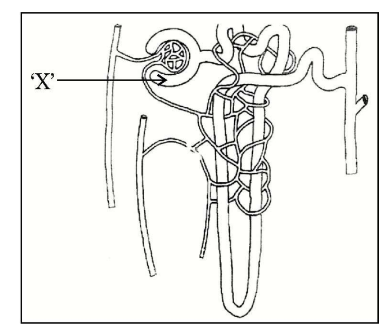
[2 Marks] Diagram 8 – CBSE Class 10 Science 2025 Set 5 Solutions
Answer: (a) X is the Tubular part of the nephron. It plays a role in selective reabsorption where important substances like glucose, salts, amino acids and water are reabsorbed back into the blood from the filtrate. This helps retain useful substances and form urine with waste products.
(b) Some substances are selectively reabsorbed because they are necessary for the body’s functions, such as glucose and salts. The body retains these useful substances while waste products remain in the tubule to be excreted as urine.
Key Points: X is Tubular part of nephron - It reabsorbs useful substances like glucose, salts, water - Selective reabsorption retains useful substances and removes wastes
Question 28.

The values of absolute refractive indices of kerosene and water are 1.44 and 1.33 respectively. Compare the two media on the basis of their

(a) optical density

(b) mass density

(c) relative speed of propagation of light.

What do you infer on the basis of above comparisons?

[2 Marks]
Answer: (a) Optical density: Kerosene has a higher refractive index (1.44) than water (1.33), so kerosene is optically denser than water.
(b) Mass density: Water has a higher mass density than kerosene. Although kerosene is optically denser, its mass density is less than water.
(c) Relative speed of propagation of light: Light travels slower in kerosene than in water because higher refractive index means lower light speed.
Inference: A medium having higher optical density does not necessarily have higher mass density. Optical density depends on how much light slows down in the medium, not on mass density directly.
Key Points: Kerosene is optically denser than water - Water has greater mass density than kerosene - Light travels slower in kerosene; higher refractive index means lower speed
Question 29. State two applications of Joule’s heating in domestic electric circuits.
[2 Marks]
Answer: Applications of Joule’s heating in domestic electric circuits:
1. Electric iron: The heating effect is used to heat the iron plate, allowing clothes to be ironed and smoothed.
2. Fuse: The fuse wire melts due to heating effect when there is an excessive current, protecting the circuit from damage.
Key Points: Electric iron - Fuse protection - Heating effect of current
Question 30. Determine the total resistance of the parallel combination of three resistances of 2Ω, 4Ω, and 6Ω.
[2 Marks]
Answer: Solution: When resistors are connected in parallel, the reciprocal of the total resistance Rtotal is equal to the sum of the reciprocals of the individual resistances.
1/Rtotal = 1/R1 + 1/R2 + 1/R3
Given, R1 = 2 ohms, R2 = 4 ohms, R3 = 6 ohms
So,
1/Rtotal = 1/2 + 1/4 + 1/6 = 6/12 + 3/12 + 2/12 = 11/12
Therefore,
Rtotal = 12/11 ohms which is approximately 1.09 ohms.
Hence, the total resistance of the parallel combination is about 1.09 ohms.
Key Points: Formula for total resistance in parallel-Calculate reciprocal of each resistance-Sum reciprocals and find reciprocal of result
Question 31.

(a) Why are the organisms of first trophic level important in any food chain ?

(b) Justify the following statement :

‘The flow of energy in an ecosystem is unidirectional.’

[2 Marks]
Answer: (a) Organisms of the first trophic level, called producers, are important because they produce their own food through photosynthesis using sunlight and provide energy to all other organisms in the food chain.
(b) The flow of energy in an ecosystem is unidirectional because energy enters the ecosystem through producers and passes on to consumers. At each trophic level, some energy is lost as heat, so energy cannot flow back to the previous level, making the energy flow one-way only.
Key Points: Producers make their own food and provide energy to consumers - Energy flows from producers to consumers in one direction - Energy loss occurs at each trophic level making flow unidirectional
Question 32.

Establish the relationship between the commercial unit of electric energy and the SI unit of electric energy.

[2 Marks]
Answer: The commercial unit of electric energy is the kilowatt hour (kW h), also called a unit.
1 kW h = 1000 watts * 3600 seconds = 3,600,000 joules (J).
The SI unit of electric energy is the joule (J).
Therefore, 1 unit (1 kW h) = 3.6 * 106 joules (J).
Key Points: Commercial unit of electric energy is kilowatt hour (kW h) - SI unit of electric energy is joule (J) - 1 kW h = 3.6 * 10^6 J

Section D

Question 33. Write the chemical formula of washing soda. How is it obtained from baking soda? List two uses of washing soda.
[3 Marks]
Answer: (a) The chemical formula of washing soda is Na2CO3.10H2O.
(b) Washing soda is obtained from baking soda (NaHCO3) by heating it strongly. Baking soda on heating decomposes to form sodium carbonate, carbon dioxide gas, and water. The sodium carbonate formed is then recrystallised to get washing soda which contains 10 molecules of water of crystallisation.
(c) Two uses of washing soda are:
1. It is used in glass, soap, and paper industries.
2. It is used for removing permanent hardness of water.
Key Points: Chemical formula of washing soda - Na2CO3.10H2O - Obtained by heating baking soda to form sodium carbonate - Recrystallisation gives washing soda - Uses in glass and soap industry - Used to remove hardness of water
Question 34.

Observe the following diagram showing an experiment to determine the conditions under which a metal ‘M’ corrodes.

List your observations in each of the three cases A, B, and C with reasons, if the metal ‘M’ is generally protected against corrosion by the method of galvanisation.
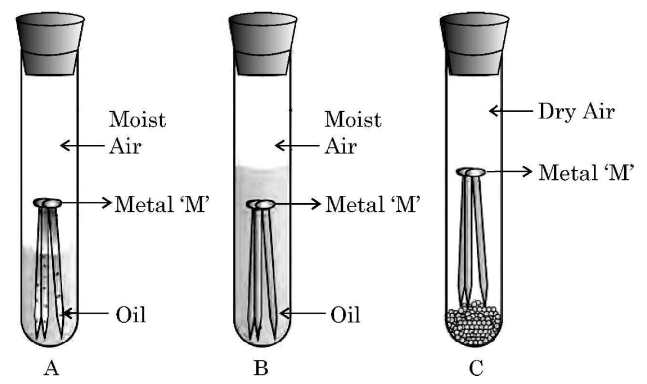
[3 Marks] Diagram 9 – CBSE Class 10 Science 2025 Set 5 Solutions
Answer: (a) In case A, where metal M is exposed to both air and moisture, corrosion occurs and rust forms on the metal surface. This happens because both oxygen and water are necessary for corrosion to take place.
(b) In case B, where metal M is exposed only to air but no moisture, there is no visible corrosion. This is because moisture is required for the electrochemical reactions during corrosion.
(c) In case C, where metal M is exposed to moisture but no air, corrosion is very slow or negligible. Although moisture is present, lack of oxygen limits the corrosion process.
Reason for protection by galvanisation: Galvanisation protects the metal by coating it with a layer of zinc, which is more reactive than iron or steel. Zinc corrodes first, acting as a sacrificial anode and protecting the underlying metal even if the zinc layer is damaged. This prevents rusting of the metal M and increases its life.
Key Points: Case A: Corrosion occurs due to air and moisture - Case B: No corrosion without moisture - Case C: Slow or no corrosion without air - Galvanisation protects by sacrificial action of zinc coating
Question 35.

(a) Write the name and one function of respiratory pigment found in human beings.

(b) Why do lungs always contain a residual volume of air ?

(c) Why is ATP known as energy currency of the living beings ?

[3 Marks]
Answer: The primary respiratory pigment in human beings is hemoglobin. Its main function is to bind oxygen in the lungs and transport it to tissues throughout the body that require oxygen for cellular respiration. Additionally, hemoglobin helps transport carbon dioxide back to the lungs for exhalation. Lungs always retain a residual volume of air, even after exhalation, to ensure continuous gas exchange, allowing sufficient time for the oxygen to be absorbed into the blood and for carbon dioxide to be released. ATP, or adenosine triphosphate, is considered the energy currency of living beings because it stores and provides usable energy for biochemical processes in cells, supporting vital functions such as muscle contraction, nerve impulse propagation, and synthesis of macromolecules.
Key Points: Hemoglobin; binds and transports oxygen; residual volume aids continuous gas exchange; time for oxygen absorption and carbon dioxide release; ATP stores and provides energy for cell functions.
Question 36.

(a) Define fertilisation.

(b) What happens to Zygote, Ovule, Ovary and Stamens after fertilisation in a flowering plant ?

[3 Marks]
Answer: (a) Fertilisation is the process in which the male gamete (pollen) and the female gamete (ovum) fuse to form a zygote.
(b) After fertilisation in a flowering plant: The zygote develops into an embryo which forms the new plant. The ovule develops into a seed that contains the embryo. The ovary enlarges and develops into a fruit which protects the seed and helps in its dispersal. The stamens wither and fall off as they have completed their role of producing pollen.
Key Points: Fertilisation is fusion of male and female gametes - Zygote develops into embryo - Ovule becomes seed - Ovary becomes fruit - Stamens wither and fall off
Question 37.

The power of a lens is 0.25 D. Based on this information, find out

(a) The type of lens and its focal length.

(b) The eye defect for which it may be used as a corrective lens.

(c) The nature and size of the image formed by this lens when an object is placed between F and 2F from the optical centre of this lens.

[3 Marks]
Answer: (a) The power of the lens P = 0.25 D is positive, so the lens is a convex lens. The focal length f is given by f = 100 / P = 100 / 0.25 = +400 cm = +4 m.
(b) A convex lens is used to correct farsightedness or hypermetropia. This defect occurs when the eye cannot focus on near objects properly because the focal length of the eye lens is too long or the eyeball is shorter. So, a convex lens helps to converge light rays and form the image on the retina.
(c) When an object is placed between F and 2F of a convex lens, the image formed is real, inverted, magnified, and located beyond 2F on the opposite side of the lens. The size of the image is larger than the object.
Key Points: Lens power positive means convex lens - Focal length calculated using f = 100 / P - Convex lens corrects farsightedness (hypermetropia) - Image formed between F and 2F is real, inverted and magnified
Question 38.

The resistance of a wire of 0.01 cm radius is 7 ohms. If the resistivity of the material of the wire is 44 x 10⁻⁶ ohm meter, calculate the length of the wire.

[3 Marks]
Answer: Given:
Resistance, R = 7 ohms
Radius of wire, r = 0.01 cm = 0.01 / 100 = 0.0001 m
Resistivity, ρ = 44 x 10-6 ohm meter

Formula for resistance of a wire is:
R = ρ * L / A
where A = π * r2 is the cross-sectional area of the wire

Calculating A:
A = 3.1416 * (0.0001)2 = 3.1416 * 10-8 m2

Rearranging the formula to find length L:
L = R * A / ρ
= 7 * 3.1416 * 10-8 / (44 * 10-6)
= (21.9912 * 10-8) / (44 * 10-6)
= 21.9912 / 44 * 10-8+6
= 0.4998 * 10-2 m
= 4.998 * 10-3 m = 0.005 m

Therefore, the length of the wire is approximately 0.005 meters or 5 millimeters.
Key Points: Use formula R = ρ * L / A - Convert radius into meters - Calculate cross-sectional area A = π * r2 - Rearrange formula to find length L - Substitute values carefully and calculate
Question 39.

(a) “The third wire of earth connection is very important in domestic electric appliances.” Justify this statement.

(b) List two precautions to be taken to avoid the overloading of domestic electric circuits.

[3 Marks]
Answer: (a) The third wire, called the earth wire, is very important in domestic electric appliances because it provides a path for the fault current to flow safely to the ground in case of any insulation failure or fault in the appliance. This prevents the metallic body of the appliance from becoming live and protects the user from electric shock.
(b) Two precautions to avoid overloading of domestic electric circuits are: 1. Do not connect too many appliances to a single socket or circuit to prevent excessive current flow. 2. Use electrical appliances within their rated power limits and ensure proper wiring and fuses are installed for safety.
Key Points: Earth wire provides safety by directing fault current to ground - Prevents electric shocks by keeping metallic parts safe - Avoid overloading by limiting appliances per circuit - Use appliances within rated power limits
Question 40.

(a) Show the formation of Aluminium Nitride (AIN) by the transfer of electrons. [ At. no. of Al = 13; At. no. of N= 7]

(b) “Ionic compounds are solids and are generally brittle and break into pieces when pressure is applied.” Give reason to justify the statement.

[3 Marks]
Answer: (a) Aluminium (Al) has 13 electrons with electronic configuration 2, 8, 3. It loses 3 electrons to become Al3+ ion. Nitrogen (N) has 7 electrons with electronic configuration 2, 5. It gains 3 electrons to complete its octet and becomes N3- ion. Transfer of electrons occurs from Al to N forming Al3+ and N3- ions that combine to form Aluminium Nitride (AlN) as shown:
Al → Al3+ + 3e-
N + 3e- → N3-
The ionic bond between Al3+ and N3- forms AlN.
(b) Ionic compounds are solids due to the strong electrostatic force of attraction between positive and negative ions. These ions are arranged in a regular, repeating pattern known as a crystal lattice. When pressure is applied, layers of ions shift and similar charges repel each other causing the crystal to break into pieces. Hence, ionic compounds are generally brittle and break upon applying pressure.
Key Points: Formation of Al3+ and N3- ions - Transfer of electrons from Al to N - Strong electrostatic forces hold ions in crystal lattice - Pressure causes repulsion between like charges - Ionic compounds are brittle solids

Section E

Question 41.

(a) What is meant by the term homologous series of carbon compounds ? Write molecular formula of any two consecutive members of homologous series of ketones.

(b) Write chemical equation of the reactions of ethanoic acid with

(i) Sodium hydroxide and

(ii) Ethanol (in the presence of an acid); giving the name of the products in each case.

(c) Draw the structure of the molecule of benzene.

[5 Marks]
Answer: (a) A homologous series is a group of compounds in which each member differs from the next by a CH2 unit and has the same functional group. They have similar chemical properties but differ in physical properties like boiling point and melting point.
Two consecutive members of ketones are propanone (C3H6O) and butanone (C4H8O).
(b) (i) Reaction of ethanoic acid with sodium hydroxide:
CH3COOH + NaOH → CH3COONa + H2O
Product formed is sodium ethanoate (CH3COONa) and water.
(ii) Reaction of ethanoic acid with ethanol in presence of acid catalyst:
CH3COOH + C2H5OH ⇌ CH3COOC2H5 + H2O
Product formed is ethyl ethanoate (an ester) and water.
(c) The structure of benzene is a hexagonal ring of six carbon atoms with alternating double bonds, each carbon atom bonded to one hydrogen atom.

H
|
H-C=C-H
|
C C
|
H H
Key Points: Definition of homologous series - Consecutive ketones propanone and butanone formulas - Reaction of ethanoic acid with NaOH forming sodium ethanoate - Esterification of ethanoic acid and ethanol forming ethyl ethanoate - Structure of benzene as hexagonal ring with alternating double bonds
Question 42.

(a) Analyse the given situations and interpret the possible reason for each :

(i) Iodine deficiency in diet increases the possibility of a disease of swollen neck in a person.

(ii) Some people in population may have very short heights (dwarfs).

(iii) Thick facial hairs develop in boys at the age of 10-12 years.

(b) Explain two reasons which necessitate the need of chemical communication in multicellular organisms.

[5 Marks]
Answer: (a) (i) Iodine deficiency causes the thyroid gland to enlarge because it cannot produce enough thyroxin hormone without iodine. This leads to a disease called goitre, which causes swelling in the neck.
(ii) Very short height or dwarfism in some people may be due to hormonal imbalance, especially insufficient production of growth hormone by the pituitary gland during childhood.
(iii) Thick facial hairs develop in boys around 10-12 years of age due to the increase in sex hormones like testosterone during puberty, which leads to the development of secondary sexual characteristics.

(b) Two reasons for the need of chemical communication in multicellular organisms are:
1. Coordination: Different cells, tissues, and organs need to work together in a coordinated manner to perform complex functions, which is achieved by chemical messengers like hormones.
2. Regulation: Chemical signals regulate growth, development, metabolism, and response to environmental changes by sending messages from one part of the body to another.
Key Points: Iodine deficiency causes goitre - Growth hormone deficiency causes dwarfism - Sex hormones cause development of secondary sexual characteristics - Chemical communication enables coordination - Chemical communication enables regulation
Question 43.

(a) Differentiate between voluntary and involuntary action.

(b) Define reflex action. With the help of a flow diagram, show the correct sequence of path of Nerve impulse from place of its origin.

[5 Marks]
Answer:

Voluntary actions are those that are consciously controlled and executed by an individual. They involve the brain's decision-making processes and include activities such as walking, writing, or speaking. In contrast, involuntary actions are automatic and occur without conscious thought. These actions, like breathing or digestion, are regulated by the autonomic nervous system and ensure the body functions without requiring active control.

Reflex action is an involuntary and nearly instantaneous movement in response to a stimulus, typically following a reflex arc. When a sensory nerve detects a stimulus, such as heat, it sends signals to the spinal cord, where interneurons transmit the signal to motor neurons, leading to a quick response, such as pulling your hand away from a hot surface.

To summarize the flow of a nerve impulse in a reflex action:

  1. Stimulus (e.g., heat)

  2. Sensory neuron (detects stimulus)

  3. Interneuron (in spinal cord processes the signal)

  4. Motor neuron (sends signal to muscles)

  5. Effector (muscles respond)

This pathway allows for rapid reactions that protect the body from harm.

Key Points:

Voluntary actions are conscious; Involuntary actions are automatic; Reflex actions are fast, involving a reflex arc; Steps in reflex arc: stimulus, sensory neuron, interneuron, motor neuron, effector.

Question 44.

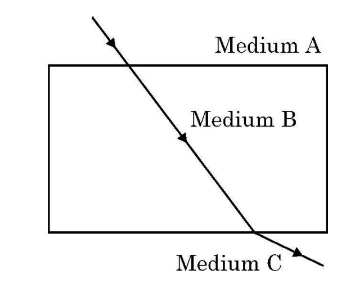
(a) Observe the following diagram and compare (i) speed of light and (ii) optical densities of the three media A, B and C. Also give justification for your answer of any one of the two cases in terms of refractive indices of A, B and C.

(b) Redraw the path of a ray of light through the three media, if the ray of light starting from medium A falls on the medium B

(i) Obliquely and the optical density of medium B is made more than that of A and C.

(ii) The ray falls normally from medium A to medium B.
[5 Marks] Diagram 10 – CBSE Class 10 Science 2025 Set 5 Solutions
Answer: (a) (i) Speed of light in the three media A, B, and C varies depending on their optical densities. The speed is fastest in the least optically dense medium and slowest in the most optically dense one.
(ii) Optical density is a measure of how much a medium slows down light. Among A, B, and C, the medium with the highest refractive index is most optically dense.
Justification using refractive indices: The refractive index n of a medium is given by n = speed of light in vacuum / speed of light in the medium. If nA < nB < nC, then speed of light vA > vB > vC and optical density increases from A to C.
(b) When light moves from medium A to B:
(i) If the ray falls obliquely on B and the optical density of B is more than A and C, the ray bends towards the normal at the interface AB because the speed of light decreases in a denser medium. After passing through B and entering C, since C is less dense than B, the ray bends away from the normal.
(ii) If the ray falls normally from A to B, the ray continues in the same straight path without bending because the angle of incidence is zero and refraction does not cause deviation at normal incidence.
Key Points: Speed of light inversely proportional to optical density - Optical density directly related to refractive index - Light bends towards normal entering denser medium - No bending of light at normal incidence
Question 45.

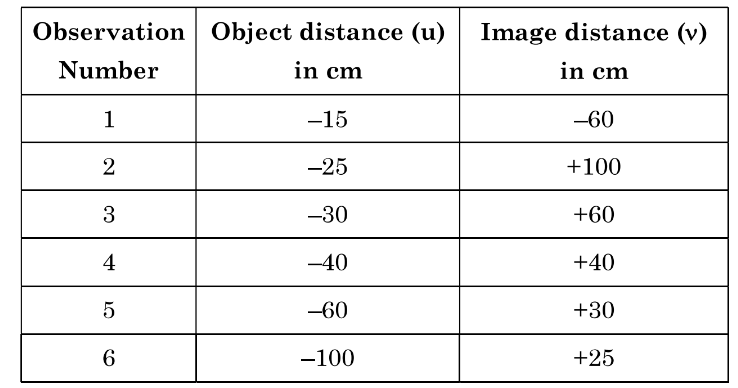
Analyse the following observation table showing variation of image distance (v) with object distance (u) in case of a convex lens and answer the questions that follow without doing any calculations :

(a) Determine the focal length of the lens. Give reason for your answer.

(b) Find magnification of the image formed in Observation No. 3.

(c) The numerical value of magnifications in cases of observation 1 and 2 is same. List two differences in the images formed in these two cases.
[5 Marks] Diagram 11 – CBSE Class 10 Science 2025 Set 5 Solutions
Answer: (a) The focal length of the convex lens is equal to the image distance when the object is at infinity. This is because when the object distance u tends to infinity, the image formed is at the focal point of the lens. Hence, the image distance v in observation with very large u gives the focal length.
(b) Magnification (m) is defined as m = image distance (v) / object distance (u). In Observation No. 3, substitute the values of v and u in this formula to find magnification. The sign of magnification also tells about the nature of the image (real or virtual).
(c) Although the numerical values of magnifications in observations 1 and 2 are same, the images differ as follows: (1) In Observation 1, the image is real and inverted, whereas in Observation 2, the image is virtual and erect. (2) In Observation 1, the image is formed on the opposite side of the lens, whereas in Observation 2, the image is formed on the same side as the object. Thus the size may be same but the nature and position of images are different.
Key Points: Focal length equals image distance when object is at infinity - Magnification formula m = v/u - Images with same magnification can differ in nature and position
Question 46.

(a) Write the molecular formula of ethyne and draw its electron dot structure.

(b) Write chemical equation to show the reaction of ethanol with

(i) Sodium metal

(ii) Ethanoic acid (in the presence of an acid)

(iii) Acidified potassium dichromate

Write the name of the product formed in each case.

[5 Marks]
Answer: (a) The molecular formula of ethyne is C2H2. Its electron dot structure shows a triple bond between two carbon atoms. Each carbon atom shares three pairs of electrons with the other carbon atom and one electron with a hydrogen atom.

C : C with three bonds between the carbons and one bond each to a hydrogen:
H • • C     • • • • • • C • • H

(b) Reactions of ethanol:
(i) Reaction with sodium metal:
2Na + 2CH3CH2OH → 2CH3CH2O-Na+ + H2
Product formed: Sodium ethoxide and hydrogen gas.

(ii) Reaction with ethanoic acid in the presence of an acid catalyst:
CH3CH2OH + CH3COOH ⟶ CH3COOCH2CH3 + H2O (acid catalyst sulfuric acid)
Product formed: Ethyl ethanoate (an ester) and water.

(iii) Reaction with acidified potassium dichromate:
3CH3CH2OH + 2K2Cr2O7 + 8H2SO4 → 3CH3CHO + 2Cr2(SO4)3 + 2K2SO4 + 11H2O
Product formed: Ethanal (an aldehyde).
Key Points: Molecular formula of ethyne is C2H2 - Ethyne has a triple bond between carbon atoms - Ethanol reacts with sodium to produce sodium ethoxide and hydrogen gas - Ethanol reacts with ethanoic acid (acid catalyst) to form ethyl ethanoate and water - Ethanol oxidized by acidified potassium dichromate forms ethanal

Paper Details

CBSE Board Exam 2025

Class

Class 10

Subject

Science

Year

2025

Set

Set 5

Other Years — Science

2022 Set-1

2022 Set-2

2022 Set-3

2022 Set-4

2023 Set-1

2023 Set-2

2023 Set-3

2023 Set-4

2023 Set-5

2024 Set-1

2024 Set-2

2024 Set-3

2024 Set-4

2024 Set-5

2025 Set-1

2025 Set-2

2025 Set-3

2025 Set-4

2025 Set-5

2025 Set-6

CBSE Class 10 Science 2025 Set 5 Solutions | Prepzy