SOLUTIONS
2025 BOARD EXAM
CBSE Class 10 Science Board Paper 2025 — Set 4 Solutions
2025
Science
Class 10
CBSE EXAMINATION PAPER-2025
SCIENCE
(Solved)
General Instructions :
Read the following instructions carefully and follow them :
- This question paper contains 45 questions. All questions are compulsory.
- This question paper is divided into 5 sections.
- Section A – questions number 1 to 3 are case based questions
- Section B – questions number 4 to 23 are multiple choice questions
- Section C – questions number 24 to 31 are very short answer
- Section D – questions number 32 to 39 are short answer
- Section E – questions number 40 to 45 are long answer
- There is no overall choice given in the question paper. However, an internal choice has been provided in few questions.
- Use of calculator is NOT allowed.
Section A
(1) Name the acid and the base from which common salt can be obtained.
[1 Mark](2) State the nature (acidic/basic/neutral) of sodium chloride. Give reason for the justification for your answer.
Reason: It is formed by the neutralization of a strong acid (hydrochloric acid) and a strong base (sodium hydroxide), so it does not change the acidity or basicity of the solution. As given in the passage, sodium chloride is a neutral salt used commonly in daily life.
(3) What happens when electric current is passed through an aqueous solution of sodium chloride (called brine)? Name the products obtained along with the corresponding places in the electrolytic cell where each of these products is obtained.
(4) How is washing soda obtained from sodium chloride? Give the chemical equations of the reactions involved in the process.
Washing soda (Na₂CO₃·10H₂O) is obtained from sodium chloride by first producing sodium hydroxide and carbon dioxide through the chlor-alkali process and then reacting them. In the process, sodium chloride solution is electrolysed to form NaOH and Cl₂. Then, sodium hydroxide is reacted with carbon dioxide to form sodium carbonate (washing soda). The main reactions are:
2NaCl + 2H₂O (electrolysis) → 2NaOH + Cl₂ + H₂
2NaOH + CO₂ → Na₂CO₃ + H₂O
Na₂CO₃ + 10H₂O → Na₂CO₃·10H₂O(washing soda). This method uses common salt as a raw material, as mentioned in the case.
In life there are certain changes in the environment called ‘stimuli’ to which we respond appropriately. Touching a flame suddenly is a dangerous situation for us. One way is to think consciously about the possibility of burning and then moving the hand. But our body has been designed in such a way that we save ourself from such situations immediately.
(1) Write the role of (a) motor and (b) relay neuron.
[1 Mark](2) Name the action by which we protect ourselves in the situation mentioned above and define it.
[1 Mark](3) Which part of the human brain is responsible for (a) thinking (b) picking up a pencil (c) controlling blood pressure (d) controlling hunger?
(4) What are the two types of nervous system in the human body? Name the components of each of them.
The students in a class took a thick sheet of cardboard and made a small hole in its centre. Sunlight was allowed to fall on this small hole and they obtained a narrow beam of white light. A glass prism was taken and this white light was allowed to fall on one of its faces. The prism was turned slowly until the light that comes out of the opposite face of the prism appeared on the nearby screen. They studied this beautiful band of light and concluded that it is a spectrum of white light.
(1) List two conditions necessary to observe a rainbow.
(2) What happens to white light in the above case?
[1 Mark](3) Give any one more instance in which this type of spectrum is observed.
[1 Mark](4) Draw a ray diagram to show the formation of a rainbow. Mark on it, points (a), (b) and (c) as given below : (a) where dispersion of light occurs, (b) where light gets reflected internally, (c) where final refraction occurs.
Section B
In which one of the following situations a chemical reaction does not occur?
The correct answer is 'Melting of glaciers'. This is a physical change where the state of water changes from solid to liquid but the chemical composition (H₂O) remains the same. In contrast, the other options involve chemical changes where new substances are formed.
In order to prepare dry hydrogen chloride gas in humid atmosphere the gas produced is passed through a guard tube (drying tube) which contains:
The correct option is 'Calcium oxide' because it is a dehydrating agent that can absorb moisture from the gas, ensuring that dry hydrogen chloride gas is obtained. Calcium chloride can also absorb moisture, but for preparing dry gases, calcium oxide is generally preferred.
Select from the following a hydrocarbon having one C–C bond and one C≡C bond:
Select TRUE statements about lymph from the following :
A. Lymph vessels carry lymph through the body and finally open into larger arteries.
B. Lymph contains some amount of plasma, proteins and blood cells.
C. Lymph contains some amount of plasma, proteins and red blood cells.
D. Lymph vessels carry lymph through the body and finally open into larger veins.
Plants like rose and banana have lost the capacity to produce :
Ina bisexual flower the male gametes are present in the :
When a pure-tall pea plant is crossed with a pure-dwarf pea plant, the percentage of tall pea plants in F₁, and F₂, generation pea plants will be respectively:
To get an image of magnification —1 on a screen using a lens of focal length 20 cm, the object distance must be :
An optical device ‘X’ is placed obliquely in the path of a narrow parallel beam of light. If the emergent beam gets displaced laterally, the device ‘X’ is:
A piece of wire of resistance ‘R’ is cut lengthwise into three identical parts. These parts are then connected in parallel. If the equivalent resistance of this combination is R’, then the value of R/R’ is :
When a wire of resistance R is cut into three identical parts, each part has a resistance of R/3. When these three resistors are connected in parallel, the equivalent resistance R' can be calculated using the formula 1/R' = 1/(R/3) + 1/(R/3) + 1/(R/3) = 3/(R/3) = 9/R. Therefore, R' = R/9. Thus, R/R' = R/(R/9) = 9, making the correct answer 9.
An electric bulb is rated 220 V; 11W. The resistance of its filament when it glows with a power supply of 220 V is :
The minimum number of identical bulbs of rating 4V; 6W, that can work safely with desired brightness, when connected in series with a 240 V mains supply is :
In the food chains given below. Select the most efficient food chain in terms of energy :
The most efficient food chain in terms of energy is 'Phytoplankton → Zooplankton → Small Fish → Big Fish'. This chain consists of fewer trophic levels, which generally allows for a higher retention of energy at each level. According to the context, with each step in the food chain, energy is lost significantly, so shorter chains retain more energy. The other options contain more steps, which leads to higher energy loss.
Which one of the following gets biomagnified at different levels in a food chain ?
Assertion (A): In large animals, oxygen can reach different parts of the animal’s body easily.
Reason (R): Respiratory pigments take up oxygen from the air and carry it to body tissues.
Assertion (A):
In large animals, oxygen can reach different parts of the animal's body easily.
True
Large animals have specialized transport systems like blood vessels and lungs/gills, which help oxygen reach all body parts effectively.
Reason (R):
Respiratory pigments take up oxygen from the air and carry it to body tissues.
True
Hemoglobin and other respiratory pigments bind oxygen in the lungs/gills and help transport it through blood to tissues.
Relationship:
While both statements are true, the reason is not the direct explanation for why oxygen reaches all parts of a large animal’s body easily.
That happens due to the circulatory system, not just the presence of respiratory pigments alone.
Assertion (A): In reptiles, the temperature at which the fertilized eggs are kept decides the sex of the offsprings.
Reason (R): Sex is not genetically determined in some animals.
Assertion (A):
In reptiles, the temperature at which the fertilized eggs are kept decides the sex of the offspring.
True
In some reptiles like turtles, crocodiles, and lizards, temperature-dependent sex determination (TSD) occurs.
The incubation temperature during a critical period of embryo development decides whether the offspring will be male or female.
Reason (R):
Sex is not genetically determined in some animals.
True
In animals with TSD, sex is determined by environmental factors (like temperature), not by sex chromosomes.
So, genetic mechanisms are not involved in these cases.
Relationship:
The Reason correctly explains why temperature affects the sex in some reptiles — because genetic determination is absent, and environmental factors control sex.
Assertion (A): When ciliary muscles contract, eye lens becomes thin.
Reason (R): — Ciliary muscles control the power of the eye lens.
Assertion (A) is false, because when ciliary muscles contract, the eye lens becomes thicker, not thinner, as this increases its curvature to focus on near objects. Reason (R) is true, as ciliary muscles do indeed control the power of the eye lens, affecting its shape for focusing on objects at different distances.
Assertion (A): Concentrated nitric acid is diluted by adding water slowly to acid with constant stirring.
Reason (R): Concentrated nitric acid is easily soluble in water.
The correct procedure is to add acid slowly to water with constant stirring, not water to acid, because mixing water into concentrated acid releases a lot of heat and can cause splattering. Concentrated nitric acid is indeed easily soluble in water, which makes the reason true. Hence, Assertion (A) is false and Reason (R) is true.
Section C
Define oxidation. Identify and name the substance oxidized in the following reaction:
CuO + H₂ → Cu + H₂O
(b) In the reaction CuO + H₂ → Cu + H₂O, hydrogen (H₂) is oxidized because it gains oxygen to form water (H₂O). So, the substance oxidized is hydrogen (H₂).
Show the formation of magnesium chloride by electron transfer. Write the name of the cation and anion present in the compound formed. (Atomic Number of Mg = 12, Cl = 17)
Magnesium atom (Mg) has 2 electrons in its outermost shell and chlorine atom (Cl) has 7 electrons in its outermost shell. Magnesium transfers its 2 electrons, one to each chlorine atom. This forms Mg2+ ion and two Cl- ions.
Equation: Mg → Mg2+ + 2e-
2Cl + 2e- → 2Cl-
These oppositely charged ions (Mg2+ and Cl-) attract each other and form an ionic bond, resulting in magnesium chloride with formula MgCl2.
Cation: Magnesium ion (Mg2+)
Anion: Chloride ion (Cl-)
Explain with the help of a flow chart that in human beings father is responsible for the sex (male or female) of the child.
1. Humans have 23 pairs of chromosomes including one pair of sex chromosomes.
2. Mothers have two X chromosomes (XX), so eggs always carry X.
3. Fathers have one X and one Y chromosome (XY), so sperms carry either X or Y.
4. During fertilization:
- If sperm carrying X fertilizes the egg (X), the child will be female (XX).
- If sperm carrying Y fertilizes the egg (X), the child will be male (XY).
5. Therefore, the father determines the sex of the child by contributing either X or Y chromosome.
Flow chart:
Father (XY) -- produces sperm with X or Y --> Egg (X) from Mother
--X sperm + X egg = Female (XX)
--Y sperm + X egg = Male (XY)
Two important properties of magnetic field lines are:
1. Magnetic field lines never cross each other.
2. The tangent to a magnetic field line at any point gives the direction of the magnetic field at that point.
How is zinc extracted from its ore? Name the processes involved in the extraction and write chemical equations for the reactions that occur during these processes.
Zinc is mainly extracted from its ore zinc blende (ZnS) by the following processes:
(a) Roasting: The zinc sulphide ore is heated in the presence of excess air to convert it into zinc oxide. This process is called roasting.
Chemical equation:
2ZnS (s) + 3O2 (g) --Heat--> 2ZnO (s) + 2SO2 (g)
(b) Reduction of Zinc Oxide: The zinc oxide obtained is then reduced to zinc metal by heating with carbon (coke). This process is called reduction.
Chemical equation:
ZnO (s) + C (s) --Heat--> Zn (s) + CO (g)
Thus zinc is extracted from its ore by roasting followed by reduction.
Section D
Why do we balance a chemical equation? Name and state the law that suggests the balancing of a chemical equation? Balance the following chemical equation:
Zn + H₃PO₄ → Zn₃(PO₄)₂ + H₂
(b) The law that suggests balancing is the Law of Conservation of Mass. It states that mass of reactants is always equal to the mass of products in a chemical reaction.
(c) To balance Zn + H₃PO₄ → Zn₃(PO₄)₂ + H₂:
Step 1: Count atoms on both sides:
Zn: Reactant=1, Product=3
H: Reactant=3, Product=2
P: Reactant=1, Product=2
O: Reactant=4, Product=8
Step 2: Balance Zn atoms by putting 3 before Zn:
3Zn + H₃PO₄ → Zn₃(PO₄)₂ + H₂
Step 3: Balance PO₄ groups by putting 2 before H₃PO₄:
3Zn + 2H₃PO₄ → Zn₃(PO₄)₂ + H₂
Step 4: Balance H atoms: Reactants= 2*3=6, Products= H₂ so put 3 before H₂:
3Zn + 2H₃PO₄ → Zn₃(PO₄)₂ + 3H₂
All atoms are balanced now. This is the balanced equation.
Example: When silver nitrate solution (AgNO3) is mixed with sodium chloride solution (NaCl), a white precipitate of silver chloride (AgCl) is formed.
Reaction: AgNO3(aq) + NaCl(aq) → AgCl(s) + NaNO3(aq)
Here, AgCl is the precipitate which is insoluble in water and appears as a white solid.
This reaction is an example of a double displacement reaction followed by the formation of a precipitate, hence a precipitation reaction.
Design an activity to show that metals are good conductors of heat and have high melting points.
Observation: After some time, the heat travels through the wire and melts the wax, causing the pin to fall off. This shows that heat is conducted through the metal wire.
Note: The metal wire does not melt even after heating for long, which shows that metals have high melting points.
This activity proves that metals are good conductors of heat and have high melting points as they conduct heat rapidly and do not melt easily.
The digestion of food in human alimentary canal is a complex process. State the enzyme/salt present in the following and mention their function in the process of digestion :
(i) Saliva
(ii) Bile Juice
(iii) Pancreatic Juice
(ii) Bile Juice: Bile juice contains bile salts which emulsify fats, breaking large fat globules into smaller droplets. This increases the surface area for the action of lipase enzymes, aiding fat digestion. Bile juice is produced by the liver and stored in the gall bladder.
(iii) Pancreatic Juice: Pancreatic juice contains several digestive enzymes such as pancreatic amylase (breaks down starch into maltose), pancreatic lipase (breaks down fats into glycerol and fatty acids), and proteases like trypsin (break down proteins into smaller peptides). It is secreted by the pancreas into the small intestine where it helps in the digestion of carbohydrates, proteins, and fats.
State two limitations of electrical impulses in multicellular organisms. Why is chemical communication better than electrical impulses as a means of communication between cells in multicellular organisms?
1. Electrical impulses can only travel through cells that are connected by nervous tissue, so they cannot reach every cell in the body.
2. After sending an electrical impulse, a cell needs time to reset before it can send another impulse, so continuous and rapid communication is not possible.
(b) Chemical communication is better than electrical impulses because chemicals released by cells can diffuse to many nearby cells, not just cells connected by nerves. This allows wider and more flexible communication. Also, chemicals can cause longer-lasting effects and regulate several processes at once, which electrical impulses cannot do efficiently.
If we want to obtain a virtual and magnified image of an object by using a concave mirror of focal length 18 cm, where should the object be placed? Use mirror formula to determine the object distance for an image of magnification +2 produced by this mirror to justify your answer.
Focal length, f = -18 cm (negative for concave mirror)
Magnification, m = +2 (positive sign indicates virtual and magnified image)
Magnification formula: m = -v / u
So, v = -m * u = -2u
Using mirror formula: 1/f = 1/v + 1/u
Substitute values: 1/(-18) = 1/(-2u) + 1/u
1/(-18) = (-1/2u) + 1/u = ( -1/2u + 2/2u ) = 1/(2u)
Therefore, 1/(-18) = 1/(2u) => 2u = -18 => u = -9 cm
Since object distance u is negative, the object is 9 cm in front of the mirror.
This position is between the focal point (18 cm) and the mirror (0 cm).
Hence, placing the object 9 cm in front of the concave mirror of focal length 18 cm will produce a virtual and magnified image with magnification +2.
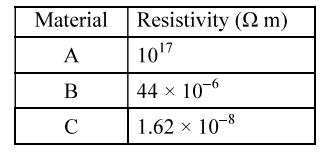
The electrical resistivity of three materials A, B and C at 20°C is given below:
(i) Classify these materials as conductor, alloy and insulator.
(ii) Give one example of each of these materials and state one use of each material in the design of an electrical appliance say an electric stove or an electric iron.
(ii) Examples and uses:
Conductor - Copper: Used in electric iron for wiring because it allows efficient current flow.
Alloy - Nichrome: Used in the heating element of electric stove or electric iron because it resists oxidation at high temperatures and produces heat when current passes.
Insulator - Bakelite: Used as the handle of electric stove or iron to prevent electric shock because it does not conduct electricity.
What are decomposers? Give two examples. State how they maintain a balance in an ecosystem.
(b) Two examples of decomposers are fungi and bacteria.
(c) Decomposers maintain balance in an ecosystem by breaking down dead material and releasing nutrients back into the soil. These nutrients are then used by plants to grow, thus keeping the nutrient cycle going and supporting life in the ecosystem.
Section E
A carbon compound ‘A’ on heating with excess conc. H₂SO₄, forms a compound ‘B’, which on addition of one mole of hydrogen gas in the presence of nickel catalyst forms a compound ‘C’. ‘C’ on combustion in air forms 2 moles of carbon dioxide and 3 moles of water. Identify ‘A’, ‘B’ and ‘C’ and write their structures. Give chemical equations of the reactions involved. Also state the role of concentrated sulphuric acid in the formation of ‘B’ from ‘A’.
Structures:
A: Ethanol (C2H5OH) - CH3-CH2OH
B: Ethene (C2H4) - CH2=CH2
C: Ethane (C2H6) - CH3-CH3
(b) Chemical equations of the reactions involved:
1. Dehydration of ethanol:
CH3-CH2OH (A) →[hot conc. H2SO4] CH2=CH2 (B) + H2O
2. Hydrogenation of ethene:
CH2=CH2 (B) + H2 →[Ni catalyst] CH3-CH3 (C)
3. Combustion of ethane:
CH3-CH3 (C) + 3.5 O2 → 2 CO2 + 3 H2O
(c) Role of concentrated sulphuric acid: Concentrated H2SO4 acts as a dehydrating agent which removes a molecule of water from ethanol (A) during heating. It also acts as an acid catalyst to speed up the elimination reaction, converting ethanol into ethene (B). It provides acidic medium and helps in protonation of hydroxyl group facilitating water removal.
Summary:
CH3-CH2OH (A) --hot conc. H2SO4--> CH2=CH2 (B) + H2O
CH2=CH2 (B) + H2 --Ni catalyst--> CH3-CH3 (C)
CH3-CH3 (C) + 3.5 O2 --> 2 CO2 + 3 H2O
A carbon compound ‘A’ is widely used as a preservative in pickles and has a molecular formula C₂H₄O₂. This compound reacts with ethanol to form a sweet smelling compound ‘B’.
(i) Identify the compound ‘A’ and write its structure.
(ii) Write the chemical equation for the reaction of ‘A’ with ethanol to form compound ‘B’. State the role of presence of an acid in the reaction.
(iii) How can we get compound ‘A’ back from ‘B’ ?
(iv) How can ‘A’ be obtained from ethanol ?
(v) Name the gas produced when compound ‘A’ reacts with washing soda.
CH3 - COOH
(b) When acetic acid reacts with ethanol, it forms an ester known as ethyl acetate – compound ‘B’, which has a sweet smell. The chemical equation is:
CH3COOH + CH3CH2OH → CH3COOCH2CH3 + H2O
Here, an acid catalyst such as concentrated H2SO4 is used to speed up the reaction without getting consumed. It helps in protonating the carbonyl group of acetic acid and making it more reactive towards ethanol.
(c) Compound ‘A’, acetic acid, can be obtained back from compound ‘B’ by hydrolysis in the presence of acid or base. This process breaks the ester bond and reforms acetic acid and ethanol.
(d) Acetic acid can be obtained from ethanol by oxidation. When ethanol is heated with an oxidizing agent like acidified potassium dichromate (K2Cr2O7) or potassium permanganate (KMnO4) in acidic medium, it gets oxidized first to acetaldehyde and then further oxidized to acetic acid:
CH3CH2OH + [O] → CH3CHO → CH3COOH
(e) When acetic acid reacts with washing soda (Na2CO3), carbon dioxide (CO2) gas is produced along with sodium acetate and water:
2CH3COOH + Na2CO3 → 2CH3COONa + H2O + CO2
This gas causes fizzing or effervescence.
(i) What is regeneration? Give one example of an organism that shows this process and one organism that does not. Why does regeneration not occur in the latter?
(ii) Water in a pond appears dark green and contains filamentous structures. Name these structures and the method by which they reproduce. Explain the process.
(ii) The dark green filamentous structures in pond water are algae, specifically filamentous algae such as Spirogyra. These reproduce by a method called conjugation. In conjugation, two filaments of algae come close, and a tube forms between adjacent cells of the two filaments. The contents of one cell (male gamete) move through this tube to fuse with the contents of the other cell (female gamete). This fusion results in the formation of a zygote, which develops into a new filament. This process helps in sexual reproduction and increases genetic variation.
(i)Name the part performing following functions in human male reproductive system :
(a) Carries sperm
(b) Production of male gametes
(c) Whose secretion makes the transport of sperms easier
(d) Provide suitable temperature for sperm formation
(ii) Write any two characteristics of sperms.
(iii) What are surgical contraceptive methods? Give the side effect caused by this procedure.
(a) The part that carries sperm is called the vas deferens or sperm duct.
(b) The production of male gametes or sperms takes place in the testes.
(c) The secretion that makes the transport of sperms easier is produced by the prostate gland and seminal vesicles. These secretions form the semen which nourishes and helps sperms to move.
(d) The part that provides a suitable temperature for sperm formation is the scrotum. It keeps the testes at a temperature slightly lower than the body temperature which is important for healthy sperm production.
(ii) Two characteristics of sperms:
1. Sperms have a tail called flagellum that helps them to swim towards the ovum.
2. Sperms are very small and have a head containing genetic material (DNA) to fertilize the female egg.
(iii) Surgical contraceptive methods:
Surgical methods are permanent methods of birth control used to prevent the production or transport of sperms.
In males, this method is called vasectomy, where the vas deferens is cut and tied to stop sperm from entering semen.
Side effect: The main side effect is that vasectomy is permanent and difficult to reverse. Some men may also experience pain or swelling after the surgery.
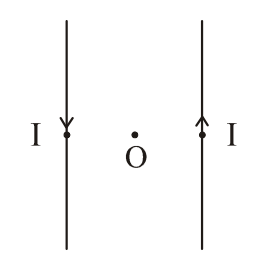
(i) Draw the pattern of the magnetic field lines for the two parallel straight conductors carrying current of same magnitude ‘I’ in opposite directions as shown. Show the direction of magnetic field at a point O which is equidistant from the two conductors. (Consider that the conductors are inserted normal to the plane of a rectangular cardboard.)
(ii) In our houses we receive A.C. electric power of 220 V. In electric iron or electric heater cables having three wires with insulation of three different colours — red, black and green are used to draw current from the mains.
(a) What are these three different wires called? Name them colourwise.
(b) What is the potential difference between the red wire and the black wire?
(c) What is the role of the wire with green insulation in case of accidental leakage of electric current to the metallic body of an electrical appliance?
(ii) (a) The three wires are called live wire (red), neutral wire (black), and earth wire (green).
(ii) (b) The potential difference between the red wire (live) and the black wire (neutral) is 220 V.
(ii) (c) The green wire is the earth wire. Its role is to safely conduct any leakage current from the metallic body of the appliance to the ground, preventing electric shocks to the user and protecting the appliance from damage.
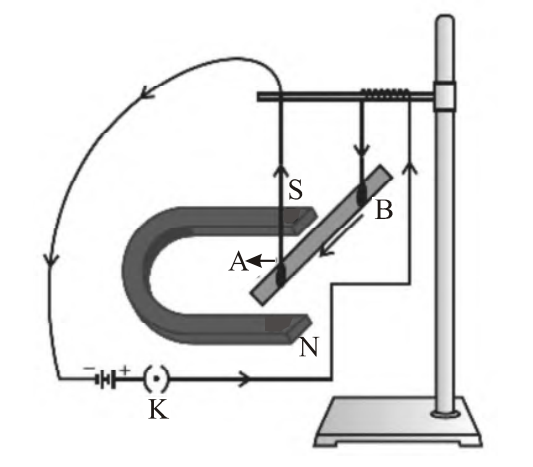
(i) By using the given experimental set-up. How can it be shown that:
(a) a force is exerted on the current-carrying B conductor AB when it is At placed in a magnetic field.
(b) the direction of force can be reversed in two ways.
(ii) When will the magnitude of the force be highest?
(iii) State Fleming’s left hand rule.
(b) The direction of force on the current-carrying conductor can be reversed in two ways:
1. By reversing the direction of the current in the conductor.
2. By reversing the direction of the magnetic field.
In both cases, the direction of force changes as predicted by Fleming's left-hand rule.
(ii) The magnitude of the force on the conductor is highest when the conductor is placed perpendicular to the magnetic field and the current is also perpendicular to the magnetic field. This means the conductor, current and magnetic field are mutually perpendicular.
(iii) Fleming’s left hand rule states that if you stretch the thumb, forefinger, and middle finger of your left hand such that they are mutually perpendicular to each other:
- The Forefinger points in the direction of the magnetic Field (from North to South).
- The seCond finger points in the direction of the Current (from positive to negative).
- The thuMb points in the direction of the Motion or the force acting on the conductor.
This rule helps to find the direction of force on a current-carrying conductor placed in a magnetic field.
Paper Details
CBSE Board Exam 2025
Class
Class 10
Subject
Science
Year
2025
Set
Set 4
Other Years — Science