Class 10 . Science . Science . Acids Bases and Salts
Chapter 2: ACIDS, BASES AND SALTS
Ch 2
Science
Class 10
Introduction & Understanding the Chemical Properties of Acids and Bases
Acids, Bases and Indicators
Base — A substance that is generally bitter and turns red litmus blue.
Indicators and neutralisation
- Indicators help identify whether a substance is acidic or basic by a colour or odour change.
- Natural indicators include litmus and turmeric; synthetic indicators include phenolphthalein and methyl orange.
- Turmeric becomes reddish-brown when soap, a base, is rubbed on a curry stain; after plenty of water washes away the base, the stain turns yellow again.
- Neutralisation is the cancelling of the effects of an acid and a base. Baking soda solution is a basic remedy suggested for acidity; lemon juice and vinegar are acidic.
| Indicator | Acid | Base |
|---|---|---|
| Blue litmus | Turns red | No change stated |
| Red litmus | No change stated | Turns blue |
| Turmeric | No change stated | Turns reddish-brown |
Testing Acids and Bases in the Laboratory
Laboratory examples
- Acids tested: hydrochloric acid (HCl), sulphuric acid (H₂SO₄), nitric acid (HNO₃) and acetic acid (CH₃COOH).
- Bases tested: sodium hydroxide (NaOH), calcium hydroxide [Ca(OH)₂], potassium hydroxide (KOH), magnesium hydroxide [Mg(OH)₂] and ammonium hydroxide (NH₄OH).
- Indicator colours: Phenolphthalein is colourless in acids and pink in bases; methyl orange is red in acids and yellow in bases.
Olfactory indicator — A substance whose odour changes in acidic or basic media.
Olfactory indicator examples examined
- Examples examined: onion, vanilla essence and clove oil.
- Key idea: their odour is checked in acidic and basic media; no specific odour-change results are stated in this lecture.
How Acids and Bases React with Metals
Acid + metal
- General reaction: a metal displaces hydrogen from an acid, producing a salt and hydrogen gas.
- Example: zinc reacts with dilute sulphuric acid to form zinc sulphate and hydrogen.
- Acid–metal observations: Zinc reacts with hydrochloric, sulphuric and acetic acids to release hydrogen gas; the reaction with acetic acid is slower. Nitric acid generally does not release hydrogen because it is a strong oxidising agent.
Zinc with a base
- Some metals also react with bases to produce hydrogen; such reactions do not occur with all metals.
- Product: zinc reacts with sodium hydroxide to form sodium zincate and hydrogen.
What is the general reaction of a metal with an acid?
What products form when zinc reacts with sodium hydroxide?
Quick recap
- Acids are generally sour and turn blue litmus red; bases are generally bitter and turn red litmus blue.
- Litmus and turmeric are natural indicators; phenolphthalein and methyl orange are synthetic indicators.
- Turmeric becomes reddish-brown in a basic medium and returns to yellow when the base is washed away.
- An olfactory indicator is identified by an odour change in acidic or basic media; onion, vanilla essence and clove oil are examined.
- Many metals react with acids to form a salt and hydrogen gas.
- Zinc reacts with sodium hydroxide to form sodium zincate and hydrogen; not all metals react with bases.
How Do Metal Carbonates and Metal Hydrogencarbonates React with Acids?
Metal Carbonates and Hydrogencarbonates React with Acids
Acids and Bases React with Each Other
Metallic Oxides React with Acids
What happens when carbon dioxide is passed through lime water, first in limited and then in excess amounts?
What is a neutralisation reaction? Give an example.
Why are metallic oxides called basic oxides?
Quick recap
- Metal carbonates and hydrogencarbonates react with acids to form a salt, carbon dioxide and water.
- Carbon dioxide turns lime water milky by forming calcium carbonate; excess gas produces soluble calcium hydrogencarbonate.
- Neutralisation is the reaction of an acid with a base to form salt and water.
- Phenolphthalein is pink in a basic solution; adding acid removes the pink colour, and added base restores it.
- Metallic oxides react with acids to form salt and water, so they are classified as basic oxides.
- Copper oxide and hydrochloric acid form blue-green copper(II) chloride solution and water.
Reaction of a Non-metallic Oxide with Base
Non-metallic Oxides React with Bases
Acidic Nature of Non-metallic Oxides
- Reaction: Carbon dioxide reacts with calcium hydroxide (lime water) to form calcium carbonate and water.
- Inference: This resembles an acid–base reaction; therefore, non-metallic oxides are acidic in nature.
What Acids and Bases Have in Common
Ions and Electrical Conductivity
- Acids and metals: Acids react with metals to release hydrogen gas; hydrogen is common to acids, but its presence alone does not make a compound acidic.
- Acids in water: Acids produce hydrogen ions, written as ; these ions are responsible for acidic properties.
- Electrical conduction: Acid solutions conduct electricity because mobile ions carry electric current; glucose and alcohol solutions do not conduct electricity.
- Acid ions: Acids have as the cation, with anions such as in , in , in , and in .
Acids and Bases in Aqueous Solution
Acids Need Water to Produce Hydrogen Ions
- Ionisation: Hydrogen chloride produces ions in water; without water, separation of from molecules does not occur.
- Hydronium: A hydrogen ion does not exist alone in water; it combines with a water molecule to form a hydronium ion, .
- Acidic character: Acids show their acidic properties in aqueous solution, where they produce (or ).
- Litmus test: Dry hydrogen chloride gas does not change dry blue litmus; HCl in water changes blue litmus red.
Bases Produce Hydroxide Ions
- Bases in water: Bases produce hydroxide ions, , in aqueous solution.
- Alkali: A base that dissolves in water is called an alkali; not all bases are water-soluble.
- Properties and safety: Alkalis may feel soapy, taste bitter and be corrosive; never taste or touch them.
Neutralisation and Dilution
Neutralisation
- Neutralisation: An acid reacts with a base to form salt and water.
- Ionic change: The essential reaction is between hydrogen ions from the acid and hydroxide ions from the base, producing water.
Dilution and Safe Mixing
- Exothermic process: Dissolving an acid or a base in water releases heat.
- Safe dilution: Slowly add concentrated acid to water while stirring constantly; never add water to concentrated acid.
- Why this matters: Adding water to concentrated acid can cause intense heating, splashing and burns; local heating may also break the container.
- Dilution: Adding water lowers the concentration of or ions per unit volume.
Do not pour water into concentrated acid. Add acid slowly to water with constant stirring to reduce the risk of splashing and burns.
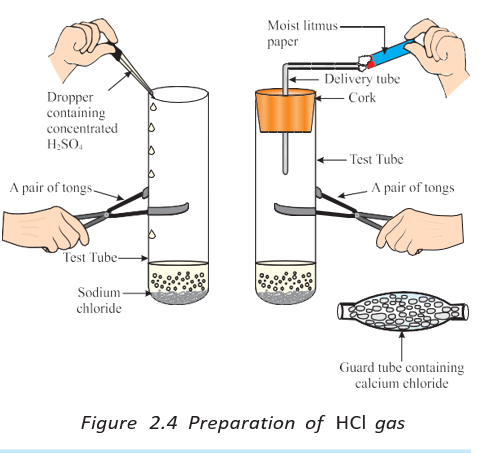
Why do acids conduct electricity in aqueous solution?
What is the difference between a base and an alkali?
Quick recap
- Carbon dioxide reacts with lime water to form calcium carbonate and water; non-metallic oxides are acidic in nature.
- Acids react with metals to release hydrogen gas and produce hydrogen ions in aqueous solution.
- Acids conduct electricity in solution because their mobile ions carry current; glucose and alcohol solutions do not.
- Hydrogen ions combine with water to form hydronium ions, ; dry HCl gas does not show acidic behaviour on dry litmus.
- Bases produce ions in water, and water-soluble bases are called alkalis.
- Neutralisation forms salt and water; the net ionic reaction is .
- Dissolving acids or bases in water releases heat; dilute by adding acid slowly to water.
How Strong Are Acid or Base Solutions?
The pH Scale and Strength of Acids and Bases
Universal indicator — A mixture of indicators that shows different colours at different hydrogen-ion concentrations; universal-indicator paper is commonly used to estimate pH.
pH scale — A scale that indicates how acidic or basic a solution is, generally ranging from 0 (very acidic) to 14 (very alkaline). The “p” comes from German “potenz,” meaning power.
Reading pH
- pH 7 is neutral; values below 7 are acidic, and values above 7 are basic.
- Hydronium ions: A higher concentration means a lower pH and greater acidity.
- Hydroxide ions: As pH rises from 7 to 14, the concentration of increases, indicating stronger alkaline character.
- Measurement: Universal-indicator paper changes colour according to the solution’s pH.
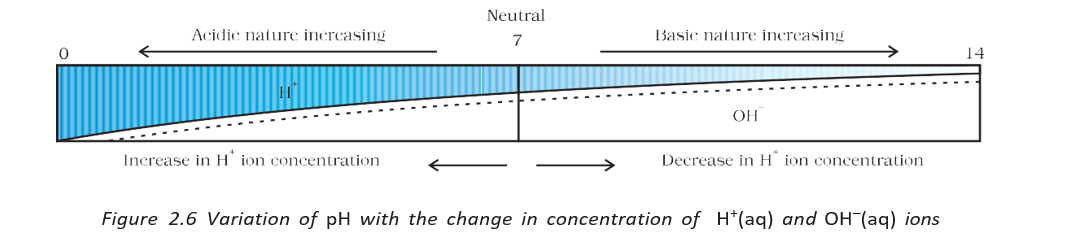
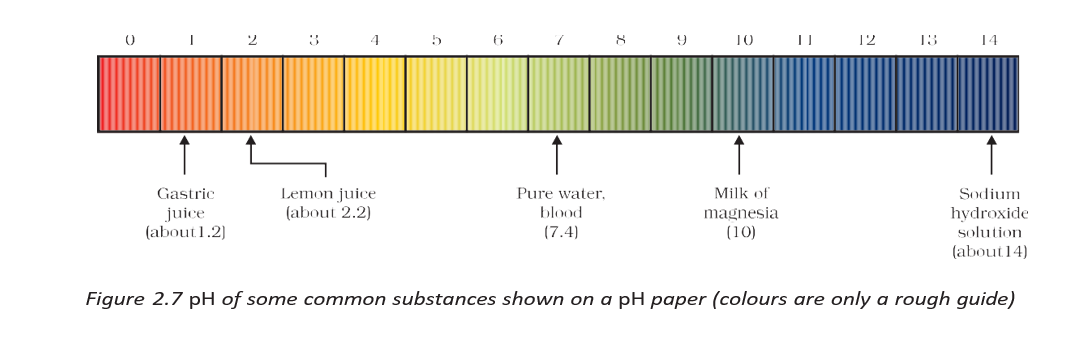
Strength of acids and bases — Acid or base strength depends on the amount of or ions produced, respectively.
| Type | Strong | Weak |
|---|---|---|
| Acid | Produces more ions in solution. | Produces fewer ions in solution. |
| Base | Produces more ions in solution. | Produces fewer ions in solution. |
Example of Acid Strength
- Same concentration: A 1 M solution of hydrochloric acid produces more hydrogen ions than a 1 M solution of acetic acid.
- Conclusion: Hydrochloric acid is strong, while acetic acid is weak.
Importance of pH in Everyday Life
pH and Living Organisms
- Narrow tolerance: Living organisms can survive only within a limited range of pH change.
- Human body: It functions within a pH range of 7.0–7.8.
- Acid rain: Rainwater with pH below 5.6 is called acid rain; it lowers river-water pH and makes survival difficult for aquatic life.
- Soil: Plants need a suitable pH range for healthy growth, and different plants may grow well in different soils.
pH Change and Tooth Decay
- Bacteria break down leftover sugars and food particles in the mouth.
- This produces acids and lowers mouth pH.
- When mouth pH falls below 5.5, tooth decay begins.
- Acid corrodes enamel, which is made of calcium hydroxyapatite, a crystalline form of calcium phosphate.
pH in Digestion
- Stomach acid: The stomach produces hydrochloric acid, which helps digest food without normally harming the stomach.
- Indigestion: Excess stomach acid can cause pain and irritation.
- Relief: Antacids neutralise excess acid; magnesium hydroxide (milk of magnesia) is a commonly used mild base.
pH and Tooth Care
- Prevention: Cleaning the mouth after eating removes food particles that bacteria could break down.
- Toothpaste: Toothpastes are generally basic, so they can neutralise excess mouth acid and help prevent tooth decay.
Stings and Neutralisation
- Bee sting: The sting leaves an acid that causes pain and irritation; applying a mild base such as baking soda can give relief.
- Nettle sting: Stinging hairs inject methanoic acid, causing a burning pain.
- Traditional remedy: Dock leaves, which often grow near nettles, are traditionally rubbed on the affected area; their use is associated with neutralising the sting.
| Natural source | Acid |
|---|---|
| Vinegar | Acetic acid |
| Sour milk (curd) | Lactic acid |
| Orange | Citric acid |
| Lemon | Citric acid |
| Tamarind | Tartaric acid |
| Ant sting | Methanoic acid |
| Tomato | Oxalic acid |
| Nettle sting | Methanoic acid |
Quick recap
- Universal indicator is a mixture that shows different colours at different hydrogen-ion concentrations; pH generally ranges from 0 to 14.
- pH 7 is neutral, below 7 is acidic, and above 7 is basic; more hydronium ions mean lower pH.
- Strong acids and bases produce more and ions, respectively, than weak ones.
- The body functions at pH 7.0–7.8; acid rain has pH below 5.6 and can harm aquatic life.
- Tooth decay begins below mouth pH 5.5; basic toothpaste can help neutralise excess acid.
- Antacids such as magnesium hydroxide relieve excess stomach acid, and baking soda can ease an acidic bee sting.
- Natural acids include acetic, lactic, citric, tartaric, oxalic and methanoic acids.
More About Salts
Families of Salts
- Salt families: Salts are grouped into families when they share the same positive or negative ion.
- Examples: NaCl and Na₂SO₄ are sodium salts, while NaCl and KCl are chloride salts.
pH of Salts
Examples of Salt Solutions
- Neutral: Sodium chloride () and potassium nitrate () are formed from a strong acid and a strong base.
- Acidic: Aluminium chloride (), zinc sulphate () and copper sulphate () are formed from a strong acid and a weak base.
- Basic: Sodium acetate (), sodium carbonate () and sodium hydrogencarbonate () are formed from a strong base and a weak acid.
Chemicals from Common Salt
How does the strength of the parent acid and base affect a salt solution's pH?
Quick recap
- Salts sharing a positive or negative ion belong to the same family.
- Strong acid + strong base gives a neutral salt solution with pH 7.
- Strong acid + weak base gives an acidic salt solution with pH below 7.
- Strong base + weak acid gives a basic salt solution with pH above 7.
- Common salt is neutral sodium chloride, formed from hydrochloric acid and sodium hydroxide.
- Rock salt deposits formed as ancient seas dried; impurities often make its crystals brown.
Common Salt - a Raw Material for Chemicals
Common Salt as a Raw Material
Products made from common salt
- Common salt (sodium chloride) is an important raw material for making sodium hydroxide, bleaching powder, baking soda and washing soda.
Sodium Hydroxide: The Chlor-Alkali Process
Chlor-alkali process — Electrolysis of aqueous sodium chloride (brine), producing chlorine, hydrogen and sodium hydroxide.
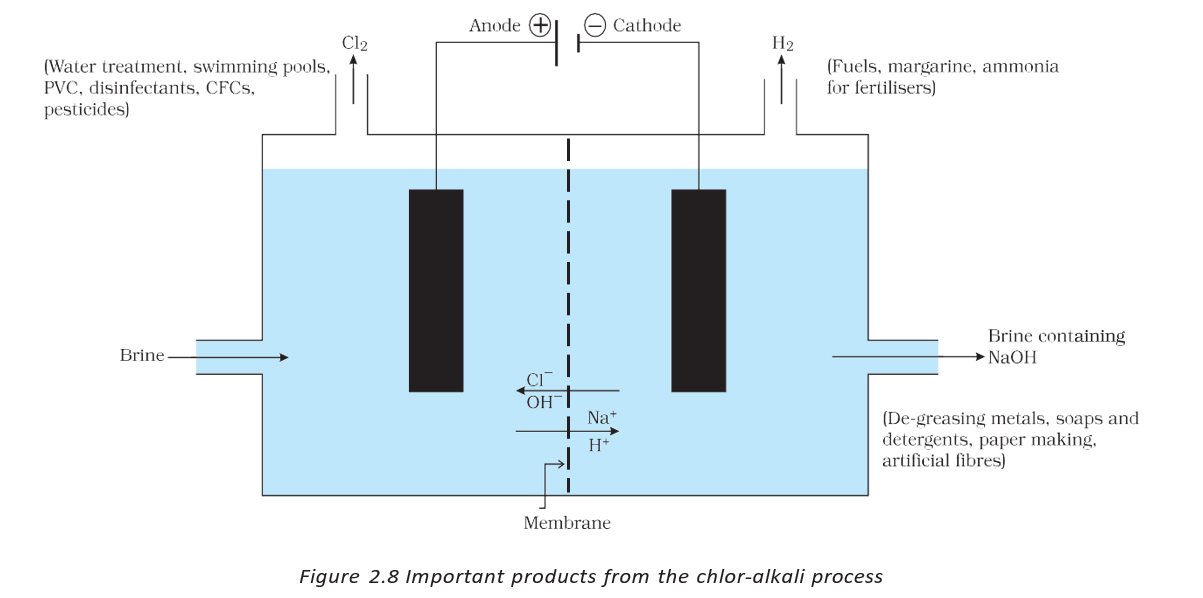
Bleaching Powder
Bleaching powder — A chlorine-containing compound represented as ; its actual composition is complex.
Uses of bleaching powder
- Bleaching: Cotton, linen, wood pulp and washed clothes.
- Chemical industry: Used as an oxidising agent.
- Water treatment: Helps make drinking water free from germs.
Baking Soda
Baking soda — Sodium hydrogencarbonate, , a mild, non-corrosive basic salt.
Uses of baking soda
- Cooking: Added to foods such as pakoras; it can help them cook faster.
- Baking powder: A mixture of baking soda and a mild edible acid, such as tartaric acid. The carbon dioxide released makes bread and cakes rise and become soft and spongy.
- Antacids: Its alkaline nature neutralises excess stomach acid.
- Fire extinguishers: Used in soda-acid fire extinguishers.
Washing Soda
Washing soda — Sodium carbonate decahydrate, , a basic salt.
Uses of washing soda
- Industries: Used in glass, soap and paper manufacture.
- Manufacture: Used to make sodium compounds such as borax.
- Cleaning: Used as a domestic cleaning agent.
- Water softening: Removes permanent hardness of water.
Water of Crystallisation
Water of crystallisation — The fixed number of water molecules present in one formula unit of a salt.
Hydrated salts
- Copper sulphate: Blue crystals contain five water molecules per formula unit: . Heating removes this water and leaves white copper sulphate; adding water restores the blue colour.
- Washing soda: The in is water of crystallisation, so it does not mean the crystals are simply wet.
- Gypsum: Contains two water molecules per formula unit and has the formula .
Plaster of Paris
Formation and properties
- Formation: Heating gypsum at removes some water and forms calcium sulphate hemihydrate, called Plaster of Paris (POP).
- Setting: Mixing POP with water converts it back to gypsum, forming a hard solid mass.
- Half-water notation: The per formula unit means one water molecule is shared between two formula units.
Uses of Plaster of Paris
- Medical use: Supports fractured bones in the correct position.
- Other uses: Makes toys and decorative materials, and smooths surfaces.
Water in a hydrated salt formula is not ordinary surface moisture; it is a fixed part of the crystal structure.
Why is the chlor-alkali process given that name?
What happens when baking soda is heated?
What is water of crystallisation?
Quick recap
- Electrolysis of brine produces sodium hydroxide, chlorine and hydrogen.
- Chlorine reacts with dry slaked lime to make bleaching powder.
- Baking soda is sodium hydrogencarbonate; heating it forms sodium carbonate, water and carbon dioxide.
- Washing soda is sodium carbonate decahydrate and is useful in industry, cleaning and water softening.
- Water of crystallisation is a fixed part of a salt’s formula and crystal structure.
- Heating gypsum forms Plaster of Paris; adding water reforms hard gypsum.
Science — ALL CHAPTERS
1
CHEMICAL REACTIONS AND EQUATIONS
2
ACIDS, BASES AND SALTS
3
METALS AND NON-METALS
4
CARBON AND ITS COMPOUNDS
5
LIFE PROCESSES
6
CONTROL AND COORDINATION
7
HOW DO ORGANISMS REPRODUCE?
8
HEREDITY
9
LIGHT – REFLECTION AND REFRACTION
10
THE HUMAN EYE AND THE COLOURFUL WORLD
11
ELECTRICITY
12
MAGNETIC EFFECTS OF ELECTRIC CURRENT
13
OUR ENVIRONMENT