Class 10 . Science . Science . Life Processes
Chapter 5: LIFE PROCESSES
Ch 5
Science
Class 10
Introduction & What Are Life Processes?
Recognising Living Things
- Evidence of life: Movement and growth can suggest that an organism is alive, but neither is always visibly apparent.
- Molecular movement: Living structures need continual molecular activity to maintain their organised state.
Life Processes and the Need for Energy
- Life processes: These are the processes that maintain an organism, even during rest or sleep.
- Energy and materials: Organisms obtain food and raw materials from outside the body to maintain and grow their structures.
- Energy conversion: Chemical reactions convert food into a usable energy source for cellular activities.
Major Maintenance Processes
Why Multicellular Organisms Need Transport
- Body size and complexity increase → many cells are no longer in direct contact with the environment.
- Diffusion alone cannot meet every cell’s needs → specialised tissues take up food and oxygen.
- Materials enter at particular places → a transport system carries food and oxygen to body cells.
- Cells produce waste → the transport system carries it to specialised excretory tissue for removal.
| Point | Single-celled organism | Multicellular organism |
|---|---|---|
| Contact with environment | The whole surface is in contact with the environment. | Many cells are not in direct contact with the environment. |
| Exchange and transport | Diffusion across the surface may meet the organism’s needs; specialised organs may not be needed. | Specialised tissues and a transport system move materials between uptake sites and cells. |
Nutrition
| Type | Food source and method | Examples | Dependence |
|---|---|---|---|
| Autotrophs | Use simple materials from inorganic sources, such as carbon dioxide and water. | Green plants and some bacteria | Provide the basic food source for other organisms. |
| Heterotrophs | Use complex substances, which must be broken down into simpler ones by enzymes. | Animals and fungi | Depend directly or indirectly on autotrophs for food. |
Why is visible movement not enough to identify a living organism?
Why do multicellular organisms need a transport system?
Quick recap
- Visible movement is not essential for life; continuous molecular activity supports maintenance.
- Life processes maintain an organism and require energy and raw materials from outside.
- Nutrition obtains food; respiration uses oxygen to break down food for cellular needs.
- Multicellular organisms need transport to distribute food and oxygen and carry waste away.
- Excretion removes waste by-products that may be harmful to cells.
- Autotrophs use simple inorganic sources; heterotrophs use complex food and depend on autotrophs directly or indirectly.
Autotrophic Nutrition
Autotrophic Nutrition
- Autotrophs: Green plants and some bacteria make food from simple inorganic substances.
- Photosynthesis: Autotrophs use light energy to make carbohydrates, which can be stored as starch.
Photosynthesis: Steps and Requirements
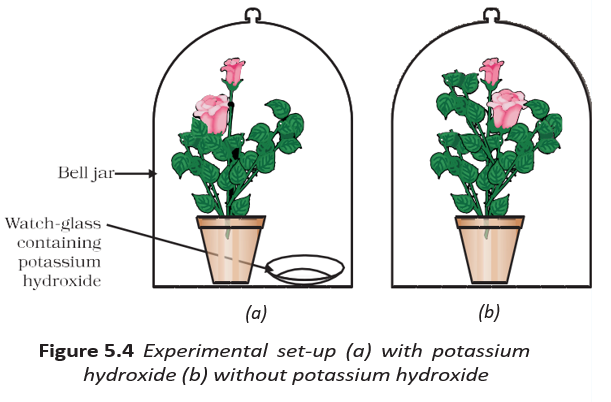
- Raw materials: Photosynthesis uses carbon dioxide and water to produce carbohydrates.
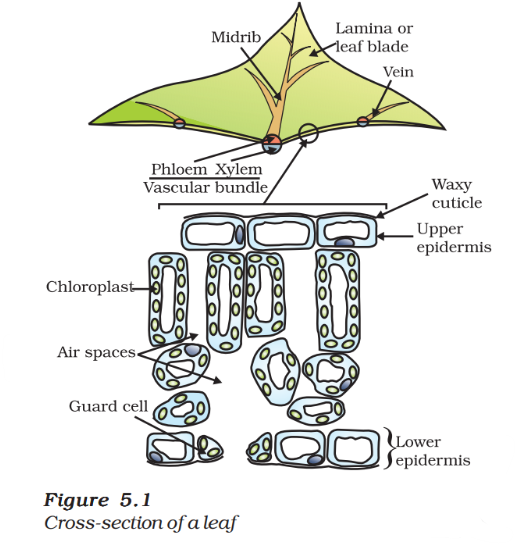
- Energy source: Sunlight supplies energy, which is absorbed by chlorophyll.
- Main steps: Light energy is absorbed and converted to chemical energy; water is split, and carbon dioxide is reduced to carbohydrates.
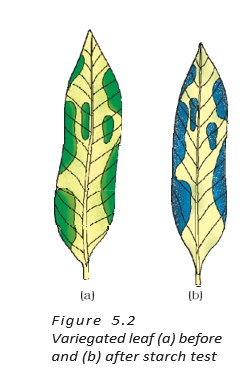
Chlorophyll and Starch Formation
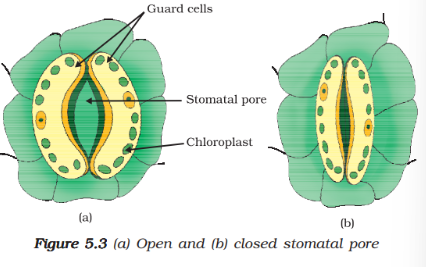
Gas Exchange and Stomata
Carbon Dioxide and Other Raw Materials
Heterotrophic Nutrition
- Heterotrophs: These organisms obtain complex food directly or indirectly from autotrophs and break it down with enzymes.
- External digestion: Fungi such as bread moulds, yeast and mushrooms digest food outside the body and absorb the simpler substances.
- Ingestion: Many organisms take food into the body and digest it internally; their methods depend on body design and food availability.
- Parasitism: Parasites obtain nutrition from living plants or animals without killing them; examples include cuscuta, ticks, lice, leeches and tapeworms.
Quick recap
- Photosynthesis uses carbon dioxide and water to form carbohydrates with sunlight and chlorophyll.
- Plants use carbohydrates for energy and store unused food as starch; animals store energy as glycogen.
- Chlorophyll-containing green leaf areas form starch, demonstrating chlorophyll’s role in photosynthesis.
- Guard cells open and close stomata, regulating gas exchange and water loss.
- Plants obtain water and minerals from soil; nitrogen is needed for proteins and other compounds.
- Heterotrophs may digest food externally, digest it internally, or obtain it as parasites.
How Do Organisms Obtain Their Nutrition?
Nutrition in Unicellular Organisms
How unicellular organisms obtain food
- Specialisation: In single-celled organisms, food may enter through the entire cell surface; as organisms become more complex, different parts specialise in different functions.
- Amoeba: Temporary finger-like extensions surround and engulf food, forming a food vacuole.
- Digestion in Amoeba: Complex substances break down inside the food vacuole; simpler substances diffuse into the cytoplasm, and undigested matter is expelled at the cell surface.
- Paramoecium: It has a definite shape and takes in food at a specific spot; cilia move food to this spot.
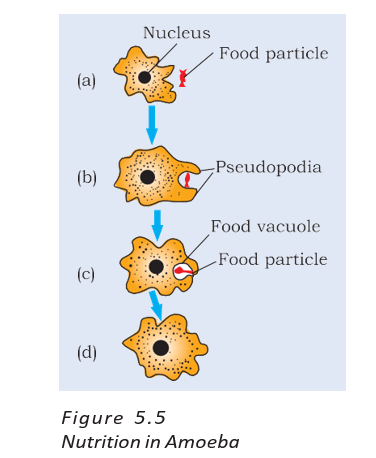
The Human Alimentary Canal
Alimentary canal — A long digestive tube extending from the mouth to the anus, with different regions specialised for different functions.
Mouth: Ingestion and Initial Digestion
Processing food in the mouth
- Teeth: Crush food into smaller pieces; saliva moistens it to help it pass smoothly through the digestive tract.
- Saliva: Secreted by salivary glands; its enzyme salivary amylase breaks starch into simple sugar.
- Tongue: Moves food around the mouth and mixes it thoroughly with saliva during chewing.
Peristalsis — Rhythmic contractions of muscles in the digestive canal that push food forward in a regulated manner.
Stomach
Stomach digestion
- Oesophagus: Carries food from the mouth to the stomach by peristaltic movements.
- Muscular walls: The stomach expands as food enters and churns it with digestive juices.
- Gastric glands: Release hydrochloric acid, the protein-digesting enzyme pepsin, and mucus.
- Hydrochloric acid: Creates the acidic medium needed for pepsin to act.
- Mucus: Protects the stomach’s inner lining from the acid under normal conditions.
- Stomach exit: A sphincter muscle releases food into the small intestine in small amounts.
Small Intestine: Digestion
Length and role
- Small intestine: The longest part of the alimentary canal; extensive coiling fits it into a compact space.
- Length and diet: Herbivores need a longer small intestine to digest grass cellulose; meat is easier to digest, so carnivores such as tigers have a shorter one.
- Main role: The small intestine is where carbohydrates, proteins and fats are completely digested.
| Source | Secretion and action |
|---|---|
| Liver | Bile makes acidic food from the stomach alkaline for pancreatic enzymes; bile salts emulsify large fat globules into smaller ones. |
| Pancreas | Pancreatic juice contains trypsin for protein digestion and lipase for breaking down emulsified fats. |
| Small-intestine walls | Intestinal juice completes digestion: proteins become amino acids, complex carbohydrates become glucose, and fats become fatty acids and glycerol. |
Absorption and Removal of Waste
Absorption and use of digested food
- Villi: Numerous finger-like projections lining the small intestine increase its surface area for absorption.
- Blood supply: Villi contain many blood vessels that carry absorbed food to body cells.
- Use by cells: Absorbed nutrients provide energy and help build new tissues and repair old tissues.
Large intestine and egestion
- Large intestine: Receives unabsorbed material and absorbs more water from it.
- Waste exit: The remaining material leaves through the anus; the anal sphincter regulates its exit.
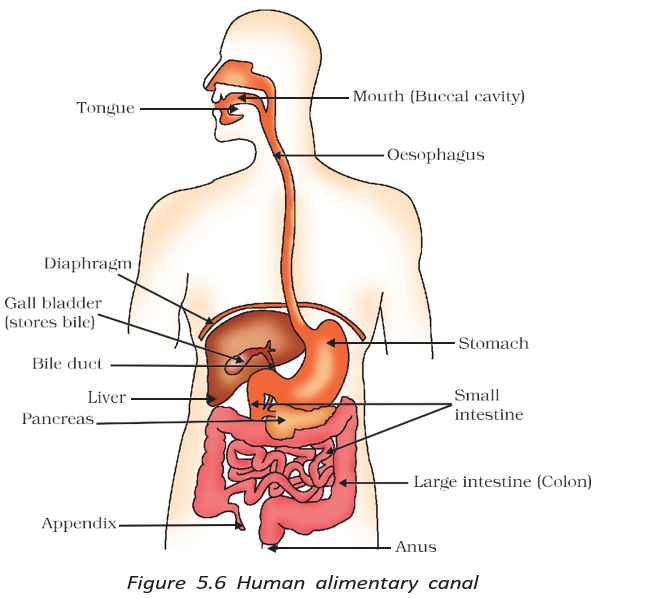
Dental Caries
Tooth decay
- Dental caries: Gradual softening of tooth enamel and dentine.
- Cause: Bacteria act on sugars and produce acids that demineralise the enamel.
- Plaque: A mass of bacterial cells and food particles that sticks to teeth; it blocks saliva from reaching the tooth surface to neutralise acid.
- Prevention: Brushing after eating removes plaque before bacteria produce acids.
- If untreated: Microorganisms may reach the pulp, causing inflammation and infection.
Quick recap
- In unicellular organisms, food may enter through the entire cell surface; greater complexity brings greater functional specialisation.
- Amoeba engulfs food into a food vacuole; Paramoecium uses cilia to move food to a specific intake spot.
- Teeth crush food, saliva starts starch digestion, and peristalsis pushes food through the canal.
- Gastric glands release acid, pepsin and protective mucus; a sphincter controls food leaving the stomach.
- Bile, pancreatic juice and intestinal juice complete digestion in the small intestine.
- Villi absorb nutrients into blood; the large intestine absorbs water and the anal sphincter regulates waste exit.
- Dental caries begins when bacterial acids damage enamel; brushing removes plaque and helps prevent decay.
Respiration
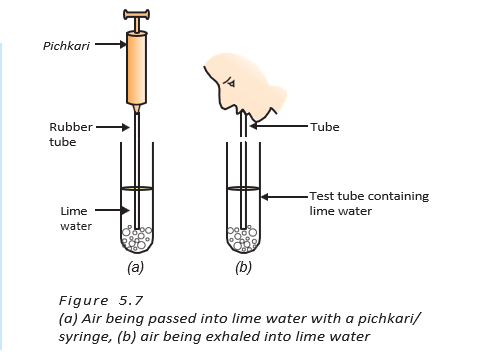
Detecting Carbon Dioxide
Respiration — The cellular breakdown of food, especially glucose, releases energy for life processes.
Carbon dioxide test
- Exhaled air: Contains more carbon dioxide than ordinary air; it turns lime water milky faster.
- Reason: Carbon dioxide reacts with lime water to form insoluble calcium carbonate, making it cloudy.
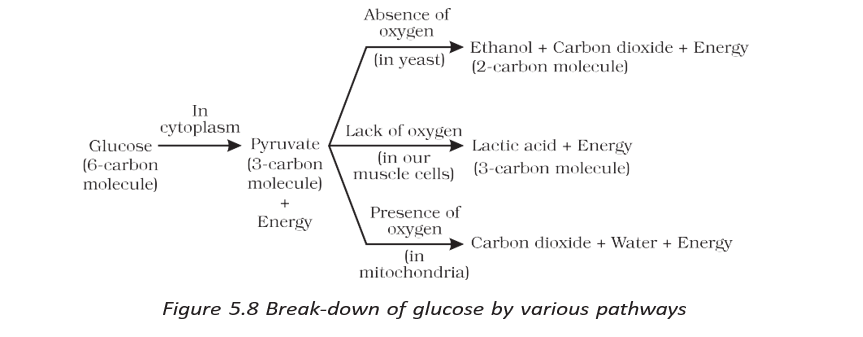
Glucose Breakdown and Respiration Pathways
First step
- Glucose breakdown: In all pathways, six-carbon glucose first breaks into three-carbon pyruvate in the cytoplasm.
- Next step: Pyruvate is broken down differently depending on oxygen availability and the cell's conditions.
| Type | Condition / site | Products | Energy / example |
|---|---|---|---|
| Aerobic respiration | Oxygen present; pyruvate is broken down in mitochondria. | Carbon dioxide and water | Releases much more energy than anaerobic respiration. |
| Anaerobic respiration in yeast | Oxygen absent; fermentation occurs in the cytoplasm. | Ethanol and carbon dioxide | Occurs during yeast fermentation; the carbon dioxide can turn lime water milky. |
| Anaerobic breakdown in muscles | When muscle cells do not get enough oxygen. | Lactic acid | Lactic acid build-up during sudden activity can cause muscle cramps. |
ATP: The Cell's Energy Currency
- ATP: Energy from respiration is used to make ATP from ADP and inorganic phosphate.
- Cell work: ATP supplies energy for activities such as muscle contraction, protein synthesis and nerve impulse conduction.
- Energy release: Breaking ATP's terminal phosphate linkage using water releases to drive energy-requiring reactions.
Gas Exchange in Plants
- Exchange: Plants exchange oxygen and carbon dioxide by diffusion through stomata; large intercellular spaces bring air close to cells.
- Direction: Gas movement depends on environmental conditions and the plant's needs.
- At night: With no photosynthesis, elimination of respiratory carbon dioxide is the major gas-exchange activity.
- During the day: Carbon dioxide from respiration is used in photosynthesis, so oxygen release is the major exchange event.
Gas Exchange in Animals
| Point | Aquatic organisms | Terrestrial organisms |
|---|---|---|
| Oxygen source | Oxygen dissolved in water; available in lower amounts than in air. | Oxygen in the atmosphere. |
| Breathing rate | Generally faster because water contains less oxygen. | Generally slower than in aquatic organisms. |
| Example | Fish take water through the mouth and pass it over the gills; blood absorbs dissolved oxygen. | Different animals absorb atmospheric oxygen using specialised respiratory organs. |
Features of respiratory surfaces
- Large area: Increases contact with oxygen-rich surroundings and allows efficient gas exchange.
- Thin and delicate: Allows oxygen and carbon dioxide to diffuse across the surface.
- Protection: The exchange surface is usually inside the body, with passages to carry air to and from it; ventilation moves the air.
Human Respiratory System
Air pathway
- Nostrils filter incoming air using fine hairs and mucus.
- Air passes through the throat into the lungs; cartilage rings keep the air passage from collapsing.
- Inside the lungs, air passages branch into smaller tubes that end in alveoli.
Breathing and alveolar gas exchange
- Inhalation: Ribs lift and the diaphragm flattens, enlarging the chest cavity; air is drawn into the lungs and expanded alveoli.
- Alveoli: Thin-walled, balloon-like air sacs with an extensive blood-vessel network provide a large gas-exchange surface.
- Oxygen: Diffuses from alveolar air into blood and is carried to body cells.
- Carbon dioxide: Blood brings it from body tissues; it diffuses into the alveoli and is breathed out.
- Residual air: Some air remains in the lungs between breaths, allowing time for oxygen absorption and carbon dioxide release.
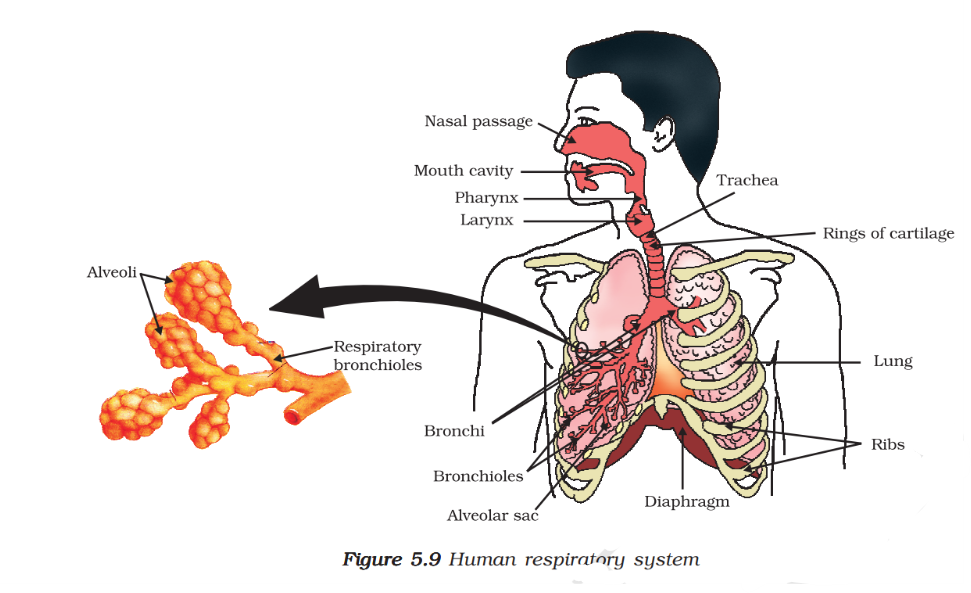
Transport of Respiratory Gases and Health
- Need for respiratory pigments: In large animals, diffusion alone cannot deliver oxygen to every body part; respiratory pigments carry oxygen from the lungs to oxygen-deficient tissues.
- Haemoglobin: This respiratory pigment in red blood cells binds oxygen with high affinity and transports it from the lungs to oxygen-poor tissues.
- Carbon dioxide transport: It is more soluble in water than oxygen and is transported mostly dissolved in blood.
- Cilia: Hair-like structures in the upper respiratory tract help remove germs, dust and other harmful particles from inhaled air.
- Tobacco risk: Smoking damages cilia and exposes the respiratory system to harmful substances; tobacco use raises the risk of lung disease and cancers, including oral cancer from chewing tobacco.
Quick recap
- Glucose first breaks down into pyruvate in the cytoplasm.
- Aerobic respiration uses oxygen and produces carbon dioxide and water; anaerobic pathways produce ethanol and carbon dioxide in yeast or lactic acid in muscles.
- ATP is made using energy from respiration and releases energy when its terminal phosphate linkage is broken.
- Plants exchange gases by diffusion; at night carbon dioxide elimination is prominent, while daytime oxygen release is the major event.
- Aquatic organisms breathe faster because water has less dissolved oxygen; fish pass water over their gills to absorb oxygen.
- Human alveoli exchange gases with blood; haemoglobin transports oxygen, while most carbon dioxide travels dissolved in blood.
- Large animals need respiratory pigments because diffusion alone cannot supply oxygen throughout the body.
Transport Ansportation Transportation in Human Beings
Transportation in Human Beings
- Transport in blood: Blood carries food, oxygen, carbon dioxide, nitrogenous wastes and salts around the body.
- Blood components: Plasma transports dissolved substances, while red blood corpuscles carry oxygen.
- Transport system: A pumping organ and a network of vessels deliver materials to tissues and help carry wastes away.
The Heart and Double Circulation
Heart structure and blood flow
- Heart A muscular organ about the size of a fist, with chambers that keep oxygen-rich and carbon-dioxide-rich blood apart.
- Right atrium Receives deoxygenated blood from the body; contraction transfers it to the right ventricle.
- Right ventricle Pumps deoxygenated blood to the lungs, where it becomes oxygenated.
- Left atrium Receives oxygenated blood from the lungs; contraction transfers it to the left ventricle.
- Left ventricle Pumps oxygenated blood to the rest of the body.
- Ventricles Have thicker muscular walls than atria because they pump blood out of the heart.
- Valves Prevent backward flow when the atria or ventricles contract.
Route of blood through the human heart
- Deoxygenated blood from the body enters the right atrium.
- It passes into the right ventricle and is pumped to the lungs.
- Oxygenated blood returns to the left atrium and passes into the left ventricle.
- The left ventricle pumps it to the body.
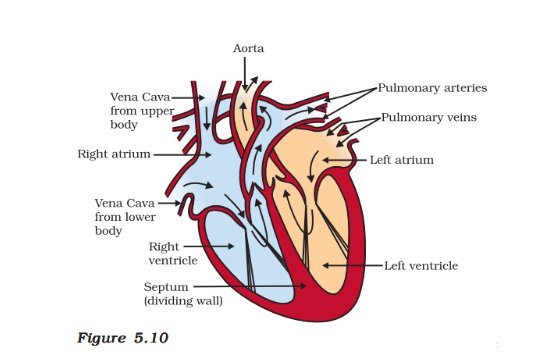
Double circulation — In one complete cycle of circulation through the body, blood passes through the heart twice.
| Animal group | Heart chambers and blood flow | Note |
|---|---|---|
| Birds and mammals | Four chambers; blood passes through the heart twice per cycle. | Oxygenated and deoxygenated blood remain separate. |
| Amphibians and many reptiles | Three chambers; some mixing occurs. | Body temperature depends on the environment. |
| Fish | Two chambers; blood passes through the heart once per cycle. | Blood is oxygenated at the gills before flowing to the body. |
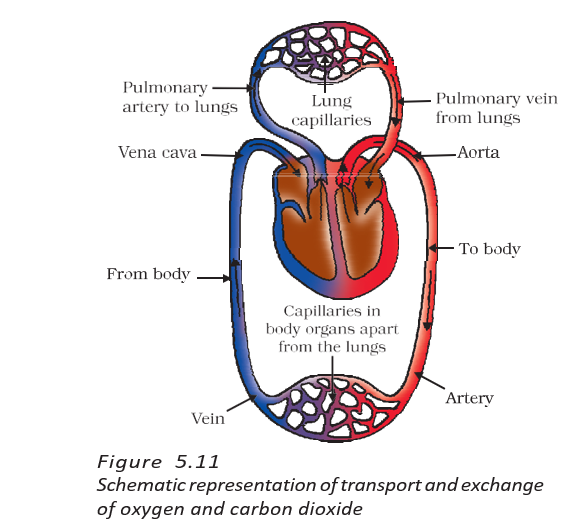
| Vessel | Direction and role | Structure |
|---|---|---|
| Arteries | Carry blood away from the heart to organs. | Thick, elastic walls withstand the high pressure of blood leaving the heart. |
| Veins | Return blood from organs to the heart. | Thinner walls; valves ensure one-way flow. |
| Capillaries | Bring blood close to individual cells and connect small vessels. | Walls are one cell thick, allowing exchange between blood and tissues. |
Platelets — Platelets help clot blood at an injury, plugging vessel leaks and reducing blood loss.
Lymph (tissue fluid) — Lymph forms when some plasma, proteins and blood cells pass through capillary walls into the spaces between tissues.
Transportation in Plants
Why plants need transport
- Raw materials Roots absorb water and minerals such as nitrogen and phosphorus from the soil; leaves make food by photosynthesis.
- Need for a transport system Diffusion is insufficient when roots and leaves are far apart in a large plant.
- Energy needs Plants are stationary and have many dead cells in some tissues, so their energy needs are relatively low and transport can be slower.
- Transport tissues Xylem carries water and minerals; phloem carries photosynthesis products from leaves to other parts.
| Tissue | Materials transported | Direction |
|---|---|---|
| Xylem | Water and minerals absorbed from the soil | From roots towards stems and leaves |
| Phloem | Soluble products of photosynthesis, amino acids and other substances | Upward or downward, according to the plant’s needs |
Root pressure — Root pressure is the upward push on water in xylem created as water enters roots after active ion uptake.
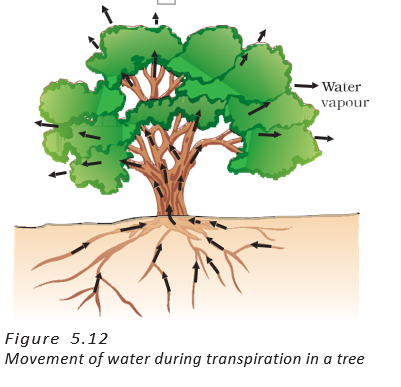
Transpiration — Transpiration is the loss of water as vapour from the aerial parts of a plant.
Translocation — Translocation is the movement of soluble products of photosynthesis and other substances through phloem.
Why are the ventricles more muscular than the atria?
What is double circulation, and why is separation of the heart’s sides useful?
How does transpiration help move water upwards in a plant?
Quick recap
- Blood Plasma carries dissolved substances; red blood corpuscles carry oxygen.
- Heart Valves direct blood flow, and the septum separates oxygenated from deoxygenated blood.
- Vessels and repair Arteries carry blood away, veins return it, capillaries exchange materials, and platelets help clot blood.
- Lymph Returns excess tissue fluid to the blood and carries absorbed fats from the intestine.
- Xylem Its interconnected vessels and tracheids conduct water and minerals; root pressure and daytime transpiration pull move water upwards.
- Phloem Translocates sugars and other substances in either direction using ATP and pressure flow.
Excretion Cretion
Excretion: Overview
- Excretion: The removal of harmful metabolic wastes from the body is called excretion.
- Simple organisms: Many unicellular organisms remove wastes by diffusion across their body surface.
- Complex organisms: Multicellular organisms use specialised organs to remove wastes.
Excretion in Human Beings
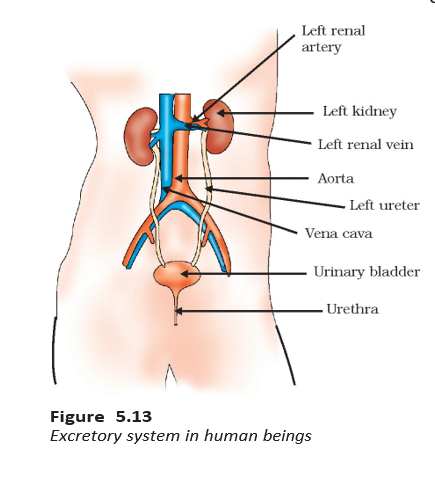
Urine Formation in the Kidneys
Urine Formation and Passage
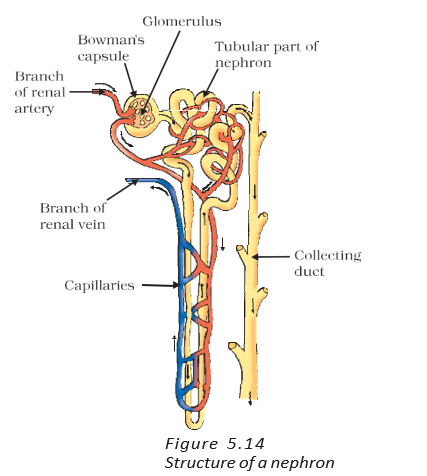
- Blood is filtered in capillary clusters associated with Bowman’s capsules.
- The filtrate flows through the nephron tubule; useful substances and varying amounts of water are selectively reabsorbed.
- The remaining urine collects in the kidneys and enters the ureters.
- Urine is stored in the bladder and leaves the body through the urethra.
Organ Donation and Transplantation
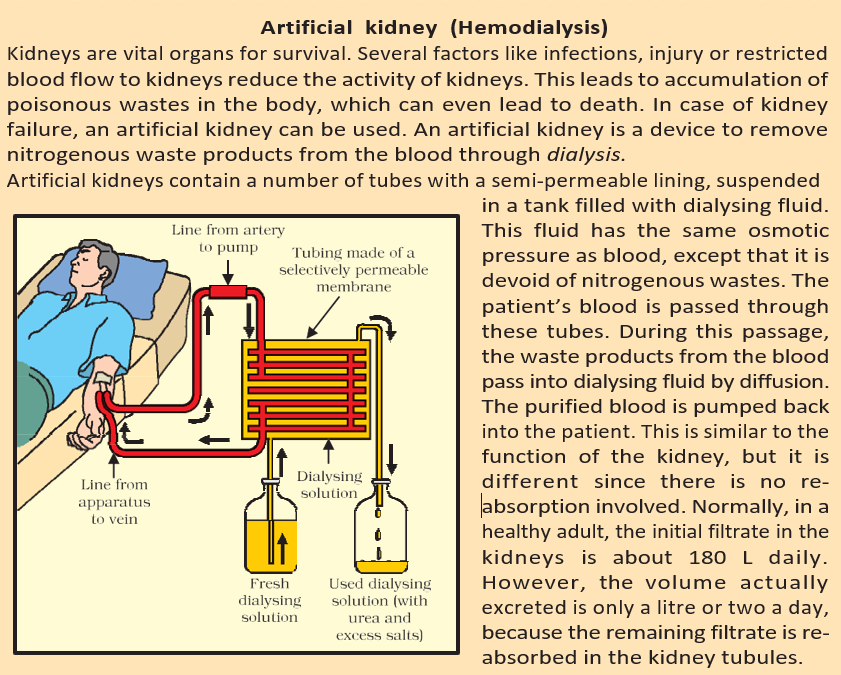
- Organ donation: A donor gives an organ or tissue for transplantation to a person whose organ has failed or been damaged.
- Consent: Donation is made with the consent of the donor and, where applicable, the donor’s family.
- Examples: Kidneys, corneas, heart, liver and bone marrow can be transplanted; some organs and tissues may be donated by a living donor.
Excretion in Plants
How does selective reabsorption help in urine formation?
Name the main routes by which plants remove or manage wastes.
Quick recap
- Excretion removes harmful metabolic wastes from the body.
- The human excretory system includes kidneys, ureters, urinary bladder and urethra.
- Nephrons filter blood and selectively reabsorb useful substances and varying amounts of water.
- Urine travels from the kidneys through the ureters to the bladder, then exits through the urethra.
- Plants manage wastes through gas exchange, transpiration, storage, shedding and release into soil.
Science — ALL CHAPTERS
1
CHEMICAL REACTIONS AND EQUATIONS
2
ACIDS, BASES AND SALTS
3
METALS AND NON-METALS
4
CARBON AND ITS COMPOUNDS
5
LIFE PROCESSES
6
CONTROL AND COORDINATION
7
HOW DO ORGANISMS REPRODUCE?
8
HEREDITY
9
LIGHT – REFLECTION AND REFRACTION
10
THE HUMAN EYE AND THE COLOURFUL WORLD
11
ELECTRICITY
12
MAGNETIC EFFECTS OF ELECTRIC CURRENT
13
OUR ENVIRONMENT