Class 10 . Science . Science . How Do Organisms Reproduce
Chapter 7: HOW DO ORGANISMS REPRODUCE?
Ch 7
Science
Class 10
Introduction & Do Organisms Create Exact Copies of Themsel Themselves?
Why Do Organisms Reproduce?
Why reproduction matters
- Purpose: Reproduction creates new individuals and helps a species continue; it is not required for an individual organism to stay alive.
- Energy cost: Reproduction uses energy, unlike essential life processes such as nutrition, respiration and excretion.
- Species recognition: Members of a species usually look similar because they have similar body designs.
DNA Copying and the Formation of New Cells
DNA (Deoxyribo Nucleic Acid) — DNA is the hereditary information in chromosomes in the cell nucleus; it provides instructions for making proteins.
How reproduction produces new cells
- Body design: Similar body designs depend on similar blueprints, and DNA carries information for these blueprints.
- Protein link: DNA guides protein production. Changed DNA can lead to different proteins and, eventually, an altered body design.
- DNA copying: Chemical reactions copy DNA, making two copies inside a reproducing cell.
- Cellular apparatus: The cell forms additional cellular structures so each DNA copy has the apparatus needed to maintain life processes; the cell then divides.
From DNA Copying to Two Cells
- DNA is copied
- Additional cellular apparatus is formed
- DNA copies separate, each with cellular apparatus
- The cell divides into two cells
Why New Individuals Are Not Exact Copies
Variation During DNA Copying
- Imperfect copying: Biochemical reactions are not completely reliable, so DNA copying can introduce variations.
- Result: New DNA copies are usually similar to the original but may not be identical; resulting cells are similar, with subtle differences.
- Severe changes: A drastic variation may make a DNA copy unable to function with the cellular apparatus it inherits, causing the new cell to die.
- Evolution: Variation arising during reproduction forms the basis for evolution.
New cells are not necessarily exact copies: DNA copying is generally accurate enough to preserve similarity, but it can produce variations.
Importance of Variation
Niche — A niche is the particular place or set of conditions in an ecosystem that a population is suited to occupy.
Variation and Survival
- Population stability: Consistent DNA copying preserves body features that help organisms use their niche, supporting population stability.
- Changing niches: Temperature, water levels or events such as meteorite impacts can alter environmental conditions beyond organisms’ control.
- Survival advantage: A drastic niche change may wipe out a population, but individuals with useful variations may survive and reproduce.
- Bacterial example: If water warms, most bacteria suited to temperate water may die; heat-resistant variants may survive and multiply.
How Variation Helps a Species Persist
- Environmental conditions change
- Some individuals have variations suited to the new conditions
- Those individuals are more likely to survive
- Survivors reproduce, helping the species persist over time
Why does reproduction involve both DNA copying and formation of cellular apparatus?
How can variation help a population survive environmental change?
Quick recap
- Reproduction creates new individuals and supports the continuation of a species.
- DNA (Deoxyribo Nucleic Acid) in chromosomes carries inherited information and guides protein production.
- DNA copying and the formation of cellular apparatus allow a cell to divide into two cells.
- DNA copying is not perfectly reliable, so new cells are similar but may vary.
- Drastic variations may prevent a new cell from functioning; other variations can be useful.
- Useful variations can help organisms survive environmental changes and support a species over time.
Modes of Reproduction Used by Single Organisms
How Body Design Shapes Reproduction
- Body design: The method of reproduction depends on how an organism is organised.
- Reproductive modes: Organisms use different methods, from simple processes in single-celled forms to specialised methods in multicellular organisms.
Fission
Fission — A form of reproduction in which a unicellular organism divides to form new individuals.
| Mode | How it occurs | Example | Key point |
|---|---|---|---|
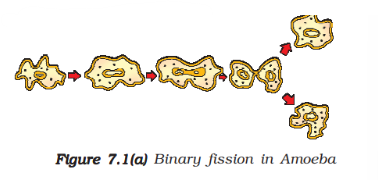
| Binary fission | One cell divides into two equal halves. | Many bacteria, protozoa and Amoeba | In Amoeba, division can occur in any plane. |
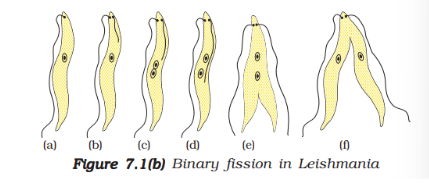
| Oriented binary fission | The cell divides in a definite orientation in relation to its body structure. | Leishmania | It has a whip-like structure at one end and causes kala-azar. |
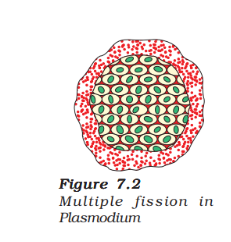
| Multiple fission | The cell divides to form many daughter cells simultaneously. | Plasmodium | Many new individuals form from one parent cell. |
| Budding | A small outgrowth develops on the parent, then separates and grows. | Yeast | The bud grows into a new individual. |
Fragmentation
Fragmentation — A mode of reproduction in which an organism breaks into pieces, and each fragment grows into a new individual.
Fragmentation in Spirogyra
- When it occurs: A mature Spirogyra breaks into smaller pieces.
- Outcome: Each fragment grows into a new Spirogyra individual.
- Why it works: Spirogyra has relatively simple body organisation, so fragments can develop into new individuals.
| Point | Simple body organisation | Highly organised body |
|---|---|---|
| Structure | Relatively simple organisation, as in Spirogyra. | Specialised cells form tissues, and tissues form organs placed at definite positions. |
| Reproductive implication | Methods such as fragmentation may work. | Cell-by-cell division is impractical; more complex reproductive methods are needed. |
Specialised Cells and Reproduction
- Organisation: Multicellular organisms are not random collections of cells; specialised cells form tissues and organs in definite positions.
- Reproductive role: A particular cell type must be capable of growing, multiplying and producing other cell types under the right circumstances.
How does binary fission in Amoeba differ from that in Leishmania?
Why is cell-by-cell division impractical for highly organised multicellular organisms?
Quick recap
- Reproductive modes depend on an organism’s body design and level of organisation.
- Many bacteria and protozoa divide into two equal halves by binary fission; Amoeba can divide in any plane.
- Leishmania divides in a definite orientation in relation to its whip-like structure.
- Plasmodium reproduces by multiple fission; yeast reproduces by budding.
- In fragmentation, mature Spirogyra pieces grow into new individuals.
- Highly organised multicellular organisms need a reproductive cell type that can grow, multiply and produce other cell types.
Regeneration
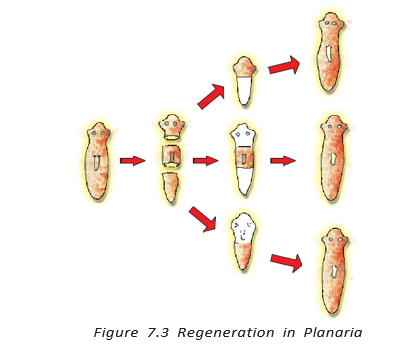
Regeneration — The ability of many fully differentiated organisms to form new individuals from their body parts.
How Regeneration Occurs
- Cell division: Specialised cells proliferate and produce a large number of cells.
- Development: Cells in this mass change into different cell types and tissues in an organised sequence.
- Examples: In Hydra and Planaria, body pieces can grow into complete organisms.
- Difference from reproduction: Most organisms do not normally rely on being cut or broken to reproduce.
| Point | Regeneration | Reproduction |
|---|---|---|
| Role | Can form a complete organism from a body part. | Produces new individuals through a normal reproductive process. |
| Typical occurrence | Most organisms do not normally depend on being cut or broken. | A usual way organisms produce a new generation. |
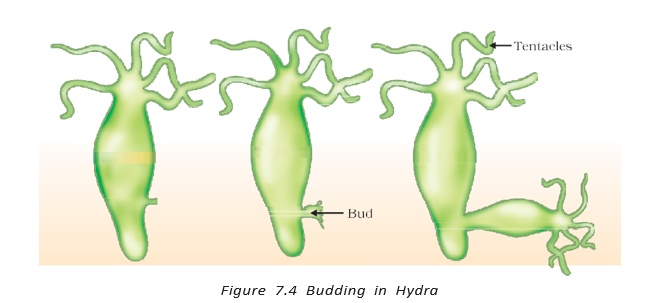
Budding in Hydra
Budding — A form of reproduction in which a new individual grows as an outgrowth, or bud, on the parent.
- Role of regenerative cells: Hydra uses these cells for reproduction through budding.
- Bud formation: Repeated cell division at one site on Hydra forms a bud.
- Maturation: The bud develops into a tiny individual, then detaches when mature and lives independently.
Vegetative Propagation
Vegetative propagation — A form of plant reproduction in which roots, stems or leaves develop into new plants under suitable conditions.
Uses and Advantages
- Methods: Layering and grafting are used to grow plants such as sugarcane, roses and grapes.
- Earlier yield: Plants propagated this way can flower and fruit earlier than plants grown from seeds.
- Seedless plants: It can propagate banana, orange, rose and jasmine, which have lost the capacity to produce seeds.
- Parent characteristics: New plants are genetically similar to the parent and retain its characteristics.
Examples
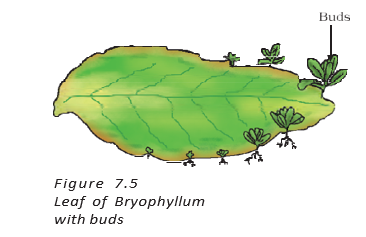
- Potato: Buds occur in surface notches; pieces containing a bud can produce fresh shoots and roots.
- Bryophyllum: Buds along leaf margins can fall onto soil and develop into new plants.
- Money plant: Stem pieces containing a leaf can grow and produce fresh leaves.
Tissue Culture
Tissue culture — A method of growing new plants from plant tissue or cells in an artificial medium.
Tissue Culture Process
- Tissue or cells are taken from a plant’s growing tip.
- Cells divide rapidly in an artificial medium to form a mass called a callus.
- The callus is moved to a hormone-containing medium for growth and differentiation.
- Plantlets are transferred to soil and grow into mature plants.
Uses of Tissue Culture
- Advantages: Many plants can be produced from one parent in disease-free conditions.
- Common use: The technique is often used for ornamental plants.
Spore Formation
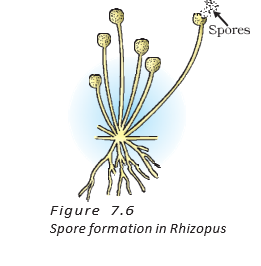
Spore formation — A type of reproduction in which spores develop into new individuals.
Spore Formation in Rhizopus
- Hyphae: Thread-like structures of bread mould; they are not reproductive parts.
- Sporangia: Blob-on-a-stick structures that contain spores.
- Protection and growth: Thick spore walls protect spores until they reach a moist surface, where they can begin to grow.
Asexual reproduction — Reproduction in which a new generation is produced from a single individual.
How does budding occur in Hydra?
State two advantages of vegetative propagation.
Quick recap
- Many fully differentiated organisms can regenerate complete individuals from body parts, but this is not the usual reproductive method for most organisms.
- Hydra uses regenerative cells to reproduce by budding; a mature bud detaches from the parent.
- Roots, stems and leaves can produce new plants through vegetative propagation.
- Vegetative propagation can produce earlier flowers and fruits, propagate plants without seeds, and retain parental characteristics.
- Tissue culture grows plantlets from a callus formed in an artificial medium.
- Rhizopus spores form in sporangia and are protected by thick walls; asexual reproduction involves a single individual.
Sexual Reproduction
Why Sexual Reproduction?
Maintaining chromosome number
- Meiosis produces germ-cells with half the chromosomes and half the DNA of ordinary body cells.
- Fertilisation joins germ-cells from two individuals.
- Restoration of the usual chromosome number and DNA content occurs in the new generation.
Gamete specialisation
- Simple organisms may have germ-cells that are similar to each other.
- More complex organisms often have two specialised gametes: a large one with food stores and a smaller, often motile one.
- Female gamete is conventionally the large, food-storing germ-cell; male gamete is the smaller, motile germ-cell.
Sexual Reproduction in Flowering Plants
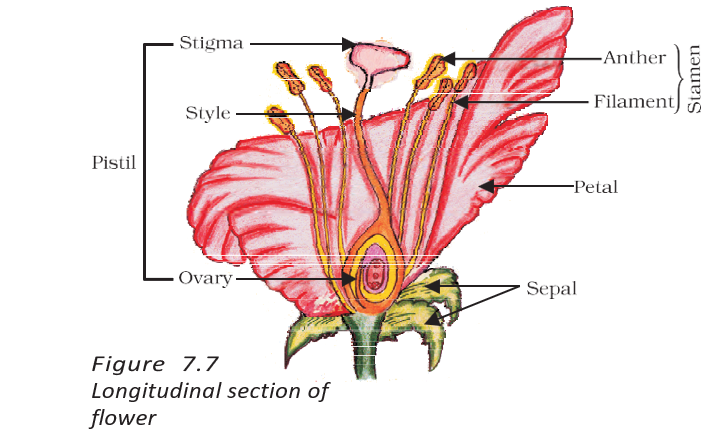
Flower reproductive parts
- Stamen is the male reproductive part and produces yellowish pollen grains.
- Pistil is the female reproductive part, usually at the centre of the flower; it has a stigma, style and ovary.
- Ovary contains ovules, and each ovule contains an egg cell.
| Type | Reproductive parts present | Examples |
|---|---|---|
| Unisexual | Either stamens or pistil | Papaya, watermelon |
| Bisexual | Both stamens and pistil | Hibiscus, mustard |
Pollination — The transfer of pollen from a stamen to a stigma.
| Point | Self-pollination | Cross-pollination |
|---|---|---|
| Pollen transfer | To the stigma of the same flower | From one flower to another |
| Transfer agents | Not specified here | Wind, water or animals |
Fertilisation and seed formation
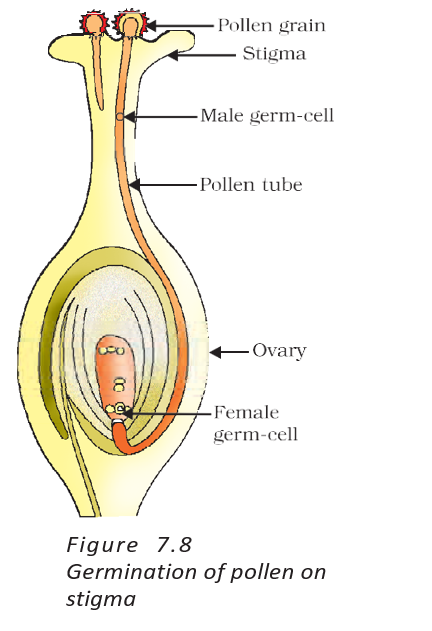
- Pollen lands on a suitable stigma.
- Pollen tube grows through the style to the ovary, carrying the male germ-cell toward the egg cell.
- Fertilisation: the male and female germ-cells fuse to form a zygote.
- Embryo forms as the zygote divides repeatedly inside the ovule.
- Seed and fruit develop: the ovule forms a seed with a tough coat, while the ovary ripens into a fruit; other flower parts may shrivel and fall.
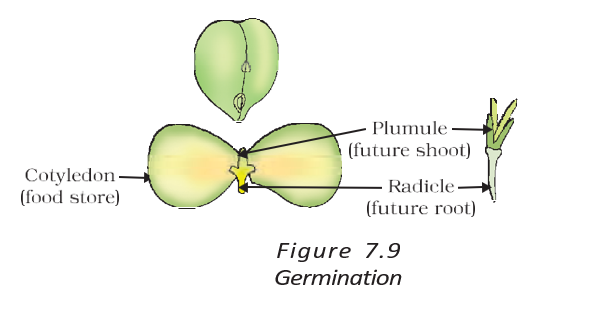
Germination — The development of the embryo in a seed into a seedling under suitable conditions.
Reproduction in Human Beings
Puberty — The period during adolescence when reproductive tissues mature, usually as the rate of general body growth begins to slow.
Changes during puberty
- Common changes: thicker hair grows in the armpits and genital area; thinner hair may appear on the limbs and face.
- Common changes: skin may become oily and pimples may develop; awareness of one's body and others also changes.
- Girls: breasts enlarge, nipples darken and menstruation begins.
- Boys: facial hair grows thicker, the voice may crack, and the penis may become enlarged and erect, including during sleep.
Timing and variation
- Gradual changes occur over months and years; they do not all begin or finish at the same time.
- Different timing is normal: puberty may begin earlier or later and progress at different rates in different people.
- Individual differences in hair growth and the size or shape of breasts and the penis are natural patterns of variation.
Why puberty matters
- Body growth uses much of the body's resources during childhood.
- Growth rate slows as the body approaches adult size.
- Reproductive tissues mature, enabling the production and transfer of germ-cells.
- Puberty changes can signal sexual maturity; reproductive organs and breasts also mature for reproduction, pregnancy and later breast-feeding.
| Point | Flowering plants | Many animals |
|---|---|---|
| How germ-cells meet | Germ-cells are transferred through pollen; the pollen tube reaches the ovary | Individuals mate, allowing internal transfer of germ-cells |
| Reproductive maturity | Pollen and ovules develop in flowers | Sexual maturity is associated with puberty and mature reproductive organs |
How does meiosis prevent DNA content from doubling in every generation?
Describe the events from pollination to fruit and seed formation.
What is puberty, and why do its timing and changes vary?
Quick recap
- Sexual reproduction combines germ-cell DNA from two individuals, creating new combinations of variations.
- Making DNA copying less accurate is not a safe way to speed variation because many resulting copies would not function.
- Meiosis halves chromosome number in germ-cells; fertilisation restores it.
- The four main flower parts are sepals, petals, stamens and pistil; stamens and pistil are reproductive parts.
- Flowers may be unisexual or bisexual; the stamen produces pollen and the pistil contains ovules.
- Pollination allows a pollen tube to deliver the male germ-cell to the ovary for fertilisation.
- After fertilisation, the ovule becomes a seed and the ovary becomes a fruit; a seed can germinate into a seedling.
- Puberty is the gradual maturation of reproductive tissues, with changes that vary in timing and pace among individuals.
Reproductive System
Male Reproductive System
Male reproductive system — The male reproductive system produces sperm and delivers them towards the site where fertilisation may occur.
Organs and Sperm Transport
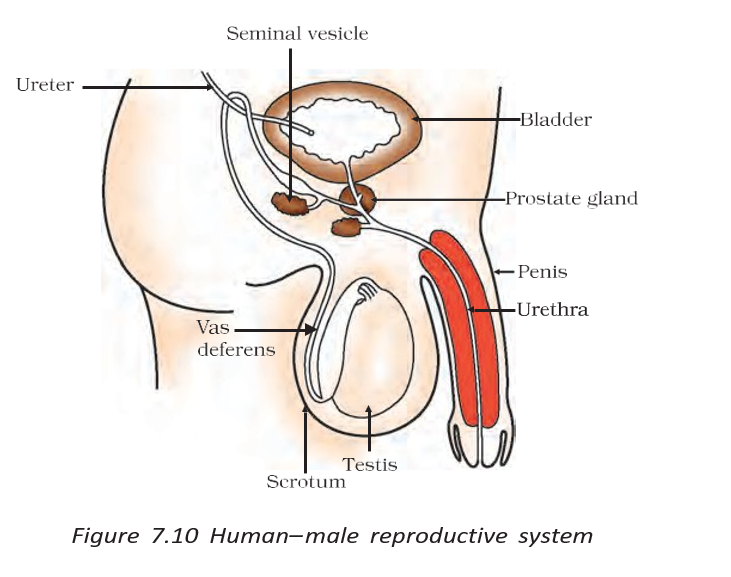
- Testes: Produce sperm and testosterone; they lie in the scrotum, outside the abdominal cavity.
- Scrotum: Keeps the testes at a lower temperature than the body, which is needed for sperm formation.
- Testosterone: Helps regulate sperm formation and causes changes in boys’ appearance during puberty.
- Sperm pathway: Sperm pass through the vas deferens, which joins a tube from the urinary bladder; the urethra is a common passage for sperm and urine.
- Gland secretions: The prostate and seminal vesicles add fluid that nourishes sperm and helps transport them.
- Sperm structure: Sperm contain mainly genetic material and have a long tail that helps them move towards the egg.
Female Reproductive System and Development
Female reproductive system — The female reproductive system produces eggs and provides for fertilisation and development of the embryo.
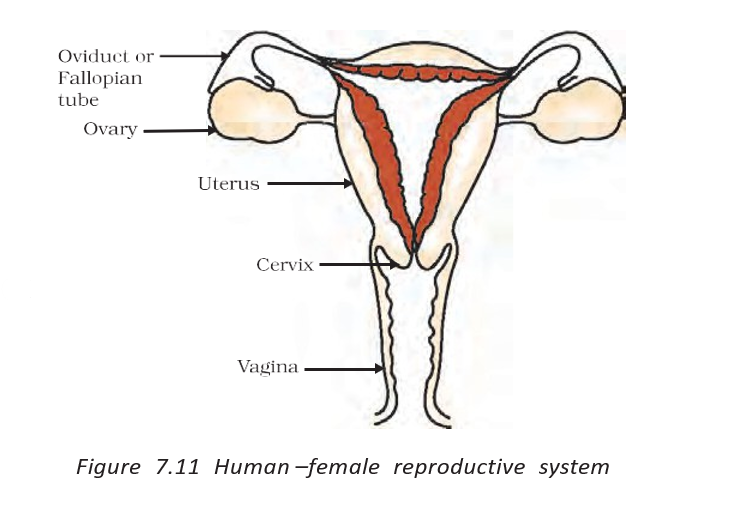
| Part | Main role |
|---|---|
| Ovaries | Produce eggs and some hormones; contain immature eggs from birth |
| Oviducts (fallopian tubes) | Carry eggs towards the uterus; fertilisation may occur here |
| Uterus | Supports implantation and development of the embryo |
| Cervix | Opening between the uterus and vagina |
| Vagina | Receives sperm and forms the birth passage |
Egg Release and Uterine Preparation
- Egg maturation: After puberty, some of the immature eggs already in the ovaries begin to mature.
- Monthly release: Usually, one egg is released each month by one of the ovaries and travels through an oviduct.
- Uterine lining: Each month, the uterus prepares to receive a fertilised egg; its lining thickens and becomes richly supplied with blood to nourish a growing embryo.
From Fertilisation to Birth
- Sperm enter through the vagina and travel upwards to an oviduct → a sperm may meet an egg.
- Fertilisation → the zygote forms and begins dividing into a ball of cells called an embryo.
- The embryo implants in the uterine lining → develops organs and becomes a foetus.
- The embryo develops in the uterus for approximately nine months → rhythmic uterine muscle contractions lead to birth.
Placenta — A special tissue embedded in the uterine wall that exchanges substances between the mother’s blood and the embryo.
Placental Exchange
- Structure: Villi on the embryo’s side are surrounded by blood spaces on the mother’s side, providing a large exchange surface.
- Supply: Glucose and oxygen pass from the mother’s blood to the embryo through the placenta.
- Waste removal: Wastes from the embryo pass through the placenta into the mother’s blood.
What Happens When the Egg Is Not Fertilised?
Menstruation — The roughly monthly shedding of the uterine lining when the egg is not fertilised.
Menstrual Cycle
- Egg lifespan: If not fertilised, the egg lives for about one day.
- Lining breakdown: The thickened lining is no longer needed and breaks down.
- Shedding: The lining leaves through the vagina as blood and mucus; menstruation usually lasts about two to eight days.
Reproductive Health
Readiness and Health Risks
- Readiness: Sexual maturation is gradual and occurs alongside general growth; puberty alone does not mean the body or mind is ready for sex or parenthood.
- Pressures: Friends, family and government agencies may exert pressure about sexual activity, marriage or having children.
- Pregnancy: Sexual activity can lead to pregnancy, which makes major demands on a woman’s body and mind; an unready pregnancy may harm her health.
| Type | Examples named in the text |
|---|---|
| Bacterial | Gonorrhoea, syphilis |
| Viral | Warts, HIV-AIDS |
Preventing Infection
- Sexual transmission: Some infections pass from person to person during sexual contact.
- Condoms: A condom worn on the penis during sex helps prevent transmission of many infections to some extent.
| Method | How it works | Examples and cautions |
|---|---|---|
| Mechanical barrier | Prevents sperm from reaching the egg | Condom on the penis or a similar covering in the vagina |
| Hormonal | Changes hormonal balance so eggs are not released and fertilisation cannot occur | Oral pills; may cause side effects |
| Intrauterine device | A device placed in the uterus helps prevent pregnancy | Loop, copper-T; may irritate the uterus and cause side effects |
| Surgical blocking | Blocks the route of sperm or egg so fertilisation cannot occur | Blocking the vas deferens in males or the fallopian tube in females; safe in the long run, but improper surgery can cause infections or other problems |
Surgical Blocking and Fertilisation
- Vas deferens blocked → sperm transfer is prevented.
- Fallopian tube blocked → the egg cannot reach the uterus.
- Either blockage → sperm and egg do not meet → fertilisation does not occur.
Sex Selection and Sex Ratio
- Misuse: Surgical methods may be misused to end unwanted pregnancies through illegal sex-selective abortion of female foetuses.
- Sex ratio: Reckless female foeticide reduces the child sex ratio; a healthy society needs the female-male sex ratio to be maintained.
- Law: Prenatal sex determination is prohibited by law.
Population and Living Standards
Population Size
- Reproduction: Increases the number of organisms in a population.
- Birth and death rates: Together determine the size of a population.
- Population growth: An expanding human population can make improving everyone’s standard of living harder.
- Inequality: Unequal distribution in society may be a more important cause of poor living standards than population size alone.
How does the placenta support a developing embryo?
What is menstruation, and why does it occur?
Name two types of contraceptive methods and explain how they prevent pregnancy.
Quick recap
- Testes produce sperm and testosterone; the scrotum keeps the testes cooler for sperm formation.
- Ovaries release eggs; fertilisation may occur in an oviduct, followed by embryo development in the uterus.
- The uterine lining thickens and becomes richly supplied with blood to nourish a possible embryo.
- The placenta transfers oxygen and glucose to the embryo and carries its wastes to the mother’s blood.
- If fertilisation does not occur, the uterine lining is shed through menstruation, usually for two to eight days.
- Contraceptive methods include barriers, hormonal pills, intrauterine devices and surgical blocking; condoms also help reduce transmission of many infections.
- Surgical contraceptive methods are safe in the long run, but poorly performed surgery can cause infection or other problems; inequality may also contribute to poor living standards.
Science — ALL CHAPTERS
1
CHEMICAL REACTIONS AND EQUATIONS
2
ACIDS, BASES AND SALTS
3
METALS AND NON-METALS
4
CARBON AND ITS COMPOUNDS
5
LIFE PROCESSES
6
CONTROL AND COORDINATION
7
HOW DO ORGANISMS REPRODUCE?
8
HEREDITY
9
LIGHT – REFLECTION AND REFRACTION
10
THE HUMAN EYE AND THE COLOURFUL WORLD
11
ELECTRICITY
12
MAGNETIC EFFECTS OF ELECTRIC CURRENT
13
OUR ENVIRONMENT