Class 10 . Science . Science . Carbon and Its Compounds
Chapter 4: CARBON AND ITS COMPOUNDS
Ch 4
Science
Class 10
Introdcution & Bonding in Carbon – the Covalent Bond
Importance and abundance of carbon
Why carbon matters
- Importance: Food, clothes, medicines, books, and living structures are largely based on carbon compounds.
- Earth’s crust: Carbon makes up about , mainly in minerals such as carbonates and hydrogencarbonates, coal, and petroleum.
- Atmosphere: Carbon is present as carbon dioxide, which makes up about of the atmosphere.
- Significance: Carbon is essential to life and many useful materials, despite its small abundance in nature.
Bonding in carbon: the covalent bond
Properties of carbon compounds
- Electrical conductivity: Most carbon compounds are poor conductors because their bonding does not produce ions.
- Melting and boiling points: They are generally lower than those of ionic compounds, indicating weak attractions between separate molecules.
- Ionic compounds: They usually have high melting and boiling points and conduct electricity when molten or dissolved in water.
| Compound | Melting point (K) | Boiling point (K) |
|---|---|---|
| Acetic acid () | 290 | 391 |
| Chloroform () | 209 | 334 |
| Ethanol () | 156 | 351 |
| Methane () | 90 | 111 |
Covalent bond — A bond formed when two atoms share one or more pairs of electrons.
Why carbon shares electrons
- Electron configuration: Carbon has atomic number and configuration , so it has four valence electrons.
- Octet goal: Carbon would need to gain or lose four electrons to reach a noble-gas configuration.
- Gaining electrons: Forming is difficult because a nucleus with six protons cannot easily hold ten electrons.
- Losing electrons: Forming requires a very large amount of energy to remove four electrons.
- Solution: Carbon shares its valence electrons with other atoms, allowing both atoms to complete their outer shells without forming ions.
Single, double, and triple covalent bonds
| Bond type | Shared electron pairs | Example | Symbol |
|---|---|---|---|
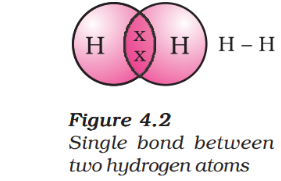
| Single | 1 | Hydrogen molecule | |
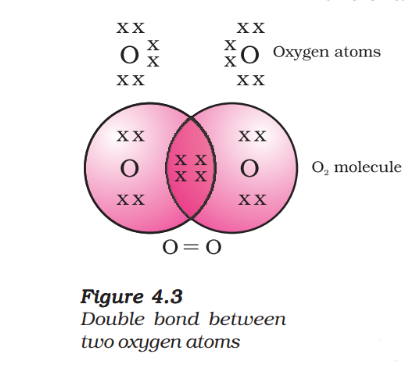
| Double | 2 | Oxygen molecule | |
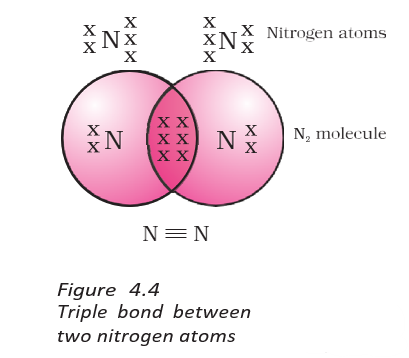
| Triple | 3 | Nitrogen molecule |
Examples of covalent bonding
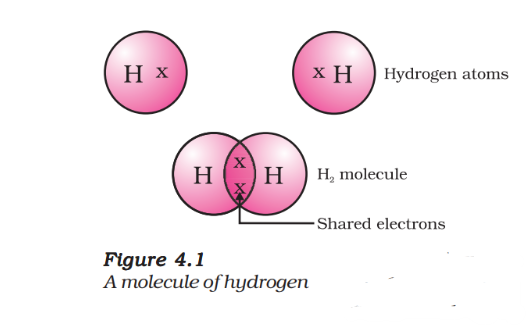
- Hydrogen, : Each hydrogen atom has one electron and needs one more to fill its K shell. Sharing one pair gives each the helium-like configuration.
- Oxygen, : Each oxygen atom has six electrons in its outer shell and shares two electrons, forming two shared pairs and a double bond.
- Nitrogen, : Nitrogen has atomic number and configuration . Each atom shares three electrons, forming three shared pairs and a triple bond.
- Water, : Oxygen shares one pair with each of two hydrogen atoms, so the molecule contains two single covalent bonds.
Methane: carbon’s tetravalency
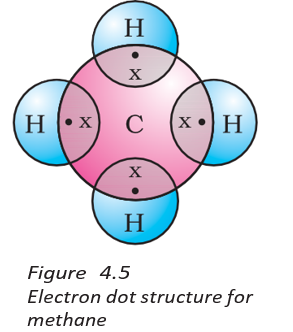
Tetravalent — An atom is tetravalent when it forms four bonds, as carbon does by sharing its four valence electrons.
Methane
- Formula: Methane is ; each hydrogen has valency .
- Bonding: Carbon shares one electron with each of four hydrogen atoms, forming four single covalent bonds.
- Uses: Methane is widely used as a fuel and is a major component of biogas and compressed natural gas (CNG).
| Property | Covalent compounds | Ionic compounds |
|---|---|---|
| Bonding | Atoms share electron pairs; ions are not formed. | Ions form through electron transfer. |
| Melting and boiling points | Generally low, due to weak attractions between molecules. | Generally high. |
| Electrical conductivity | Generally poor conductors. | Conduct electricity when molten or in solution. |
Allotropes of carbon
Allotropes — Different structural forms of the same element, with different physical properties.
| Allotrope | Structure | Key physical properties |
|---|---|---|
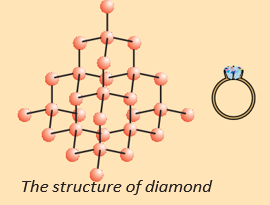
| Diamond | Each carbon atom bonds to four others in a rigid three-dimensional structure. | Hardest substance known. |
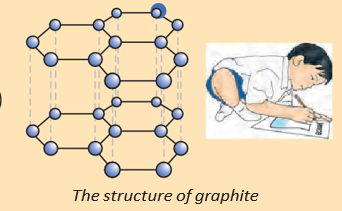
| Graphite | Each carbon atom bonds to three others in a plane; hexagonal networks form layers. | Smooth, slippery, and a good conductor of electricity. |
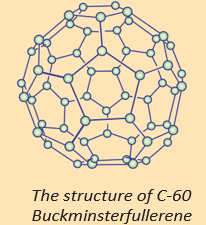
| Fullerene () | Carbon atoms are arranged in a football-like structure. | The first identified fullerene; named after Buckminster Fuller, whose geodesic dome it resembles. |
Comparing carbon allotropes
- Structure and properties: Diamond and graphite have the same chemical properties but very different physical properties because their carbon atoms are bonded differently.
- Graphite bonding: In the layer structure described here, one bond is a double bond, satisfying carbon’s valency.
- Synthetic diamonds: Pure carbon can be converted into small diamonds under very high pressure and temperature; they are otherwise indistinguishable from natural diamonds.
Why does carbon form covalent bonds instead of forming or ions?
How do covalent bonds explain the usual low melting and boiling points and poor electrical conductivity of carbon compounds?
Quick recap
- Carbon has electron configuration and shares electrons rather than gaining or losing four.
- One, two, or three shared electron pairs make single, double, or triple covalent bonds.
- Methane () has four single bonds because carbon is tetravalent.
- Covalent compounds generally have low melting and boiling points and conduct electricity poorly.
- Diamond, graphite, and fullerenes are carbon allotropes with different structures and physical properties.
Versatile Nature of Carbon
Why Carbon Forms So Many Compounds
Catenation — The ability of carbon atoms to bond with one another and form chains, branches, or rings.
Two key properties
- Catenation: Carbon forms chains, branched chains, and rings; carbon atoms can be joined by single, double, or triple bonds.
- Strong C–C bonds: Carbon–carbon bonds are stable, allowing long-lasting molecules with many carbon atoms. Silicon forms shorter, more reactive chains.
- Tetravalency: Carbon has valency 4 and can bond with four other atoms, including carbon or atoms of elements such as hydrogen, oxygen, nitrogen, sulphur, and chlorine.
- Small atomic size: Carbon’s small size lets its nucleus hold shared electrons strongly, producing strong, stable bonds with many elements.
Organic Compounds
Organic compounds — Carbon compounds, apart from carbides, carbon oxides, carbonates, and hydrogencarbonate salts, are studied in organic chemistry.
Origin and synthesis
- Early belief: Organic compounds were thought to form only in living systems through a necessary “vital force.”
- Wöhler’s result: In 1828, Friedrich Wöhler prepared urea from ammonium cyanate, disproving the vital-force idea.
Saturated and Unsaturated Compounds
| Point | Saturated | Unsaturated |
|---|---|---|
| Carbon–carbon bonds | Only single bonds | One or more double or triple bonds |
| Hydrocarbon class | Alkanes | Alkenes have double bonds; alkynes have triple bonds |
| Typical reactivity | Usually not very reactive | No reactivity claim specified here |
Building Simple Molecules
- Structure rule: Join carbon atoms first, then add hydrogen atoms to satisfy carbon’s four bonds; each hydrogen forms one bond.
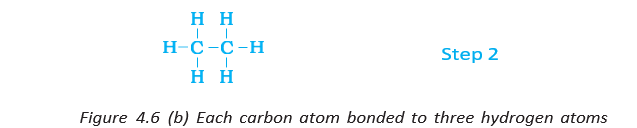
- Ethane: In , the two carbon atoms share a single bond and each carbon also bonds to three hydrogen atoms.
- Propane: has a three-carbon chain with single bonds; all carbon valencies are satisfied.
Ethene and Multiple Bonds
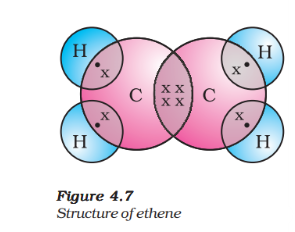
- Ethene: Its formula is . A single bond between its carbon atoms leaves one bond unsatisfied on each carbon.
- Double bond: The two carbon atoms share an additional pair of electrons, forming a carbon–carbon double bond and satisfying their valencies.
Chains, Branches, and Rings
| Number of carbon atoms | Name | Formula | Condensed structure |
|---|---|---|---|
| 1 | Methane | ||
| 2 | Ethane | ||
| 3 | Propane | ||
| 4 | Butane | ||
| 5 | Pentane | ||
| 6 | Hexane |
Structural isomers — Compounds with the same molecular formula but different structures.
Different Carbon Skeletons
- Butane isomers: can have a straight chain or a branched carbon skeleton.
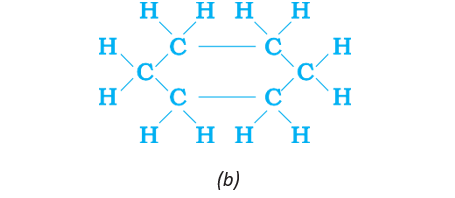
- Ring structures: Carbon atoms may form rings; cyclohexane has formula and a six-carbon ring.
- Saturation applies to shapes too: Straight-chain, branched, and cyclic compounds may be saturated or unsaturated.

Hydrocarbons and Their Classes
- Hydrocarbons: Compounds containing only carbon and hydrogen.
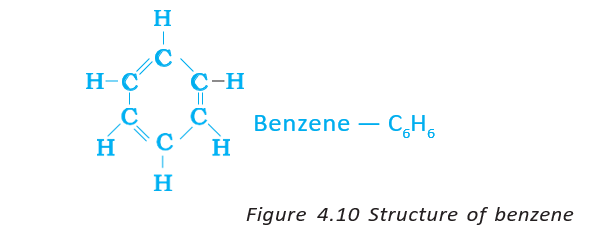
- Benzene: is an unsaturated hydrocarbon with six carbon atoms arranged in a ring and alternating double bonds.
| Type | Carbon–carbon bonds | Example |
|---|---|---|
| Alkanes | Only single bonds; saturated hydrocarbons | Ethane, |
| Alkenes | One or more double bonds; unsaturated hydrocarbons | Ethene, |
| Alkynes | One or more triple bonds; unsaturated hydrocarbons | No example specified in this lecture |
Why does carbon form such a large number of compounds?
What are structural isomers? Give an example from this lecture.
State the difference between alkanes, alkenes, and alkynes.
Quick recap
- Carbon’s tetravalency and catenation, supported by strong bonds, explain its exceptional variety of compounds.
- Carbon chains can be straight, branched, or cyclic, and may contain single, double, or triple bonds.
- Saturated carbon compounds have only single carbon–carbon bonds; unsaturated compounds have double or triple bonds.
- Structural isomers share a molecular formula but have different structures; butane has two such skeletons.
- Hydrocarbons contain only carbon and hydrogen: alkanes are saturated, alkenes contain double bonds, and alkynes contain triple bonds.
- In 1828, Wöhler prepared urea from ammonium cyanate, disproving the vital-force belief.
Will You Be My Friend?
Functional Groups
Heteroatom — An atom such as a halogen, oxygen, nitrogen or sulphur that replaces one or more hydrogen atoms in a carbon chain.
Functional group — A heteroatom or group of atoms that gives a carbon compound its characteristic properties, largely regardless of the carbon-chain length.
How functional groups attach
- Replacement: A functional group attaches to a carbon chain by replacing one or more hydrogen atoms.
- Valency: The carbon atom’s valency remains satisfied; the single line in a group formula marks its free valency.
| Heteroatom | Class of compounds | Functional group |
|---|---|---|
| Chlorine or bromine | Haloalkane (chloro- or bromo-) | or |
| Oxygen | Alcohol | |
| Oxygen | Aldehyde | |
| Oxygen | Ketone | |
| Oxygen | Carboxylic acid |
Homologous Series
Homologous series — A family of carbon compounds with the same functional group and similar chemical properties, in which consecutive members differ by a unit.
Key features
- Structure: Successive members differ by , so their molecular masses differ by .
- Chemical properties: Members have similar chemical properties because they contain the same functional group.
- Physical properties: Melting and boiling points generally increase as molecular mass increases; other physical properties, such as solubility, also show gradual change.
- Chains: Carbon chains may be straight or branched, and hydrogen atoms may be replaced by functional groups.
| Series | Members | Successive difference |
|---|---|---|
| Alkanes | (mass difference ) | |
| Alcohols | (mass difference ) | |
| Alkenes | (mass difference ) |
For the open-chain hydrocarbon series discussed here, is the number of carbon atoms.
Nomenclature of Carbon Compounds
Naming rules
- Carbon-chain root: Identify the number of carbon atoms; common roots include 1 meth-, 2 eth-, 3 prop- and 4 but-.
- Functional group: Indicate the group using a prefix or suffix. Halo groups use prefixes such as chloro- and bromo-; the groups in the table below use suffixes.
- Vowel-starting suffix: If the suffix starts with a vowel, remove the final “e” from the chain name before adding it: propane → propanone.
- Unsaturation: Replace the final “ane” with “ene” for a double bond or “yne” for a triple bond.
| Class | Naming part | Example |
|---|---|---|
| Haloalkane | Prefix: chloro-, bromo- | 1-chloropropane: ; 1-bromopropane: |
| Alcohol | Suffix: -ol | Propanol: |
| Aldehyde | Suffix: -al | Propanal: |
| Ketone | Suffix: -one | Propanone: |
| Carboxylic acid | Suffix: -oic acid | Propanoic acid: |
| Alkene | Suffix: -ene | Propene: |
| Alkyne | Suffix: -yne | Propyne: \ce{CH3C#CH} |
- Same functional group → similar chemical properties; each next homolog → one unit and greater mass.
- For a three-carbon chain: propane → propene (double bond) or propyne (triple bond); propane → propanone when adding the ketone suffix.
Quick recap
- A heteroatom replaces hydrogen in a carbon chain; the functional group gives the compound characteristic properties.
- Functional groups covered: halo, alcohol, aldehyde, ketone and carboxylic acid.
- Members of a homologous series differ successively by , or , and have similar chemical properties.
- Increasing molecular mass generally brings gradual changes in physical properties, including higher melting and boiling points.
- General formulae: alkanes , alkenes and alkynes .
- Names use a carbon-chain root plus a functional-group prefix/suffix; unsaturated chains use -ene or -yne.
Chemical Properties of Carbon Compounds
Combustion
Combustion — Combustion is the burning of a substance in oxygen, releasing heat and often light.
Key points
- Carbon All its allotropes burn in oxygen to form carbon dioxide, with heat and light released.
- Carbon compounds Many burn with the release of substantial heat and light; combustion is an oxidation reaction.
- Flames A flame forms when gaseous substances burn. Volatile substances released from burning wood or charcoal can produce a flame at first.
- Luminous flame Heated atoms in a gas can glow. A yellow, sooty flame commonly contains glowing carbon particles from incomplete combustion.
- Air supply Unsaturated compounds often burn with a yellow, smoky flame; saturated hydrocarbons usually burn cleanly when oxygen is sufficient. Limited air can make even saturated fuels burn incompletely.
- Stoves Gas and kerosene stoves admit air to help the fuel burn with a clean blue flame. Blackened cookware can indicate blocked air inlets and wasted fuel.
- Pollution Burning coal and petroleum can release sulphur and nitrogen oxides, which pollute the environment.
| Fuel | Balanced combustion equation |
|---|---|
| Carbon | |
| Methane | |
| Ethanol |
Fossil fuels
- Coal Formed from ancient plant remains buried and compressed under layers of earth and rock over millions of years.
- Petroleum and natural gas Formed from tiny marine organisms buried under silt; pressure and bacterial action transformed their remains, while the silt became rock.
- Trapping Oil and gas seep into porous rock and can become trapped there. Coal and petroleum are called fossil fuels because they formed from ancient life.
Oxidation
Oxidation — Oxidation is the addition of oxygen to a substance or the removal of hydrogen from it.
Oxidation of alcohols
- Conversion Ethanol can be oxidised to ethanoic acid (acetic acid), the acid found in vinegar.
- Oxidising agents Alkaline potassium permanganate or acidified potassium dichromate supplies oxygen for this conversion.
- Conditions The conversion is carried out with heat; these agents oxidise alcohols to carboxylic acids.
Addition Reaction
Addition reaction — An addition reaction adds atoms to an unsaturated compound, converting it into a more saturated compound.
Hydrogenation
- Reaction Unsaturated hydrocarbons add hydrogen in the presence of a catalyst such as nickel or palladium to form saturated hydrocarbons.
- Catalyst A catalyst changes the rate of a reaction without itself being affected by the reaction.
- Use Hydrogenation with a nickel catalyst is used to convert unsaturated vegetable oils into more saturated fats.
- Food comparison Vegetable oils generally contain long unsaturated carbon chains; animal fats generally contain saturated fatty acids. The text recommends choosing oils containing unsaturated fatty acids for cooking.
Substitution Reaction
Substitution reaction — A substitution reaction occurs when an atom or group of atoms in a compound is replaced by another atom or group.
Chlorination of alkanes
- Reactivity Saturated hydrocarbons are generally unreactive with most reagents.
- Sunlight In sunlight, chlorine reacts rapidly with saturated hydrocarbons and replaces hydrogen atoms one by one.
- Products Repeated replacement can produce several products, especially with higher alkanes.
Why can a gas stove produce a yellow, sooty flame?
How does ethanol change into ethanoic acid?
Quick recap
- Combustion Carbon compounds burn in oxygen, releasing heat and often light; incomplete burning can produce soot.
- Flames Flames form when gases burn; enough air supports clean, blue combustion.
- Oxidation Ethanol can be oxidised to ethanoic acid by strong oxidising agents and heat.
- Addition Unsaturated hydrocarbons add hydrogen with a catalyst to become saturated.
- Substitution Sunlight enables chlorine to replace hydrogen in saturated hydrocarbons.
Some Important Carbon Compounds – Ethanol and Ethanoic Acid
Ethanol: Properties and Uses
- Physical state: Ethanol is a liquid at room temperature and is soluble in water in all proportions.
- Uses: It is the alcohol in alcoholic drinks and is used as a solvent in products such as tincture iodine and cough syrups.
Reactions of Ethanol
Reaction with sodium
- Reaction: Alcohols react with sodium metal, releasing hydrogen gas.
- Products: Ethanol forms sodium ethoxide and hydrogen.
Dehydration to ethene
- Condition: Heat ethanol at with excess concentrated sulphuric acid.
- Dehydration: Concentrated sulphuric acid removes water from ethanol, producing ethene.
Alcohols: Health Effects and Use as Fuel
Ethanol, methanol and denatured alcohol
- Heavy ethanol consumption: Slows metabolic processes and depresses the central nervous system, causing impaired coordination, confusion, drowsiness and, in severe cases, stupor.
- Methanol: Even a very small quantity can cause death. It is oxidised in the liver to methanal, which reacts with cell components and coagulates protoplasm; methanol also affects the optic nerve and can cause blindness.
- Denatured alcohol: Industrial ethanol is made unfit for drinking by adding poisonous substances such as methanol; dye may be added to colour it blue for identification.
Ethanol from sugarcane and its use as fuel
- Sugarcane juice → molasses → fermentation → ethanol.
- Ethanol can be added to petrol as a cleaner fuel.
- With sufficient oxygen, ethanol burns to form carbon dioxide and water.
Ethanoic Acid: Properties
- Common name: Ethanoic acid is also called acetic acid and belongs to the carboxylic acid group.
- Vinegar: A 5–8% solution of acetic acid in water is used as a preservative in pickles.
- Acidic nature: Ethanoic acid is a weak acid; pure ethanoic acid freezes near 290 K and is called glacial acetic acid.
Reactions of Ethanoic Acid
Esterification
- Esterification: An acid reacts with an alcohol, usually with an acid catalyst, to form an ester and water.
- Esters: Often sweet-smelling; used in perfumes and as flavouring agents.
Saponification
- Saponification: An ester reacts with sodium hydroxide to form an alcohol and the sodium salt of a carboxylic acid.
- Soap: Soaps are sodium or potassium salts of long-chain carboxylic acids; saponification is used in soap preparation.
Reaction with a base
- Neutralisation: Ethanoic acid reacts with sodium hydroxide to form sodium ethanoate (sodium acetate) and water.
Reactions with carbonates and hydrogencarbonates
- Products: Ethanoic acid reacts with carbonates and hydrogencarbonates to form a salt, carbon dioxide and water.
- Gas test: The carbon dioxide produced turns freshly prepared lime-water milky.
What is denatured alcohol?
What is esterification, and give one use of esters.
What are the products when ethanoic acid reacts with sodium hydrogencarbonate?
Quick recap
- Ethanol is a water-soluble alcohol used as a solvent and as a fuel additive.
- Ethanol reacts with sodium to form sodium ethoxide and hydrogen; dehydration produces ethene.
- Methanol is poisonous: it is oxidised to methanal, which damages cell components, and methanol can damage the optic nerve.
- Ethanoic acid is a weak carboxylic acid; its aqueous solution is vinegar.
- Esterification forms sweet-smelling esters; saponification forms an alcohol and a carboxylate salt.
- Ethanoic acid reacts with bases, carbonates and hydrogencarbonates to form salts; carbonate reactions also produce carbon dioxide and water.
Soaps and Detergents
Soaps and Micelles
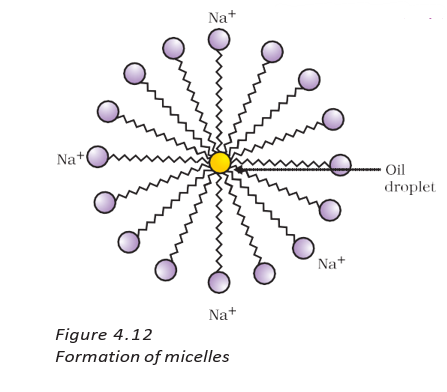
Soaps in Hard Water
- Hard water: Calcium and magnesium salts react with soap to form an insoluble curdy scum.
- Effect: Soap produces less foam in hard water, so more soap is needed for cleaning.
Detergents
| Point | Soap | Detergent |
|---|---|---|
| Reaction with calcium and magnesium ions | Forms an insoluble precipitate (scum) | Does not form an insoluble precipitate |
| Foam and cleaning in hard water | Less effective; more soap is needed | Remains effective |
Quick recap
- Soap is a sodium or potassium salt of a long-chain carboxylic acid.
- Soap molecules surround oily dirt in micelles and disperse it in water.
- Calcium and magnesium salts in hard water react with soap to form insoluble scum.
- Soap needs to be used in larger amounts in hard water and forms less foam.
- Detergents have long hydrocarbon chains and do not form insoluble precipitates with calcium and magnesium ions.
- Detergents are used in shampoos and clothes-cleaning products.
Science — ALL CHAPTERS
1
CHEMICAL REACTIONS AND EQUATIONS
2
ACIDS, BASES AND SALTS
3
METALS AND NON-METALS
4
CARBON AND ITS COMPOUNDS
5
LIFE PROCESSES
6
CONTROL AND COORDINATION
7
HOW DO ORGANISMS REPRODUCE?
8
HEREDITY
9
LIGHT – REFLECTION AND REFRACTION
10
THE HUMAN EYE AND THE COLOURFUL WORLD
11
ELECTRICITY
12
MAGNETIC EFFECTS OF ELECTRIC CURRENT
13
OUR ENVIRONMENT