Class 10 . Science . Science . Metals and Non Metals
Chapter 3: METALS AND NON-METALS
Ch 3
Science
Class 10
Introduction & Physical Properties
Classifying Elements
Introduction
- Elements are commonly grouped as metals or non-metals according to their properties.
- Uses are linked to properties: metals are used in wires because they conduct electricity and can be drawn into wires.
Physical Properties of Metals
| Property | Meaning | Example / use |
|---|---|---|
| Metallic lustre | Pure metals usually have a shining surface. | Cleaning a dull metal surface can reveal its lustre. |
| Hardness | Metals are generally hard, but hardness varies. | Sodium and other alkali metals are soft enough to cut with a knife. |
| Malleability | Ability to be beaten into thin sheets. | Gold and silver are the most malleable metals. |
| Ductility | Ability to be drawn into thin wires. | Gold is the most ductile metal; about 1 g can be drawn into a wire about 2 km long. |
| Heat conduction | Metals generally conduct heat well and usually have high melting points. | Silver and copper are the best heat conductors; lead and mercury are comparatively poor. |
| Electrical conduction | Metals generally conduct electricity. | PVC or rubber coatings insulate electrical wires. |
| Sonority | Metals produce a sound when struck against a hard surface. | This property makes metals suitable for bells. |
Uses of Metals
- Cooking vessels are commonly made from metals because metals conduct heat well and generally have high melting points.
- Electrical wires use metals as conductors; PVC or rubber coatings act as insulators.
Physical Properties of Non-metals
| Property | Metals | Non-metals |
|---|---|---|
| Appearance | Usually lustrous. | Usually dull; iodine is a lustrous exception. |
| Hardness and shaping | Generally hard; often malleable and ductile. | Solid non-metals are generally brittle and not malleable or ductile. |
| Heat and electricity | Generally good conductors. | Generally poor conductors; graphite conducts electricity. |
| Sound | Generally sonorous. | Generally non-sonorous. |
| State at room temperature | All are solids except mercury, which is liquid. | May be solids or gases; bromine is the only liquid non-metal. |
Important Exceptions
Allotrope — Each different structural form of an element, such as carbon, is called an allotrope.
Exceptions to General Trends
- Mercury is the only metal that is liquid at room temperature.
- Gallium and caesium have low melting points and can melt in the warmth of a palm.
- Iodine is a lustrous non-metal.
- Carbon allotropes: diamond is the hardest natural substance and has very high melting and boiling points; graphite conducts electricity.
- Alkali metals—lithium, sodium and potassium—are soft enough to cut with a knife and have low densities and melting points.
Do not classify elements using physical properties alone: lustrous iodine and electrically conducting graphite are exceptions. Chemical properties give a clearer basis for distinguishing metals and non-metals.
Oxides of Metals and Non-metals
General Behaviour with Oxygen
- Metal oxides are generally basic; magnesium oxide forms a basic solution in water.
- Non-metal oxides are generally acidic; sulphur dioxide forms an acidic solution in water.
- General rule: most metals form basic oxides, while most non-metals form acidic oxides.
Define malleability and ductility.
Give two exceptions to the usual physical properties of metals or non-metals.
Quick recap
- Metals are generally lustrous, hard, malleable, ductile, sonorous, and good conductors of heat and electricity.
- Non-metals are generally dull, brittle when solid, non-sonorous, and poor conductors.
- Key exceptions include liquid mercury and bromine, lustrous iodine, conducting graphite, and soft alkali metals.
- Different forms of an element, such as diamond and graphite, are allotropes.
- Physical properties alone do not reliably classify every element; chemical properties give a clearer distinction.
- Most metal oxides are basic, while most non-metal oxides are acidic.
Chemical Properties of Metals
Metals Reacting with Oxygen
Reaction with oxygen — Almost all metals combine with oxygen to form metal oxides.
Reactivity and appearance
- Sodium and potassium: React very vigorously with oxygen and may catch fire in the open; they are stored under kerosene to prevent contact with air and accidental fires.
- Magnesium: Burns in air with a dazzling white flame; it is less reactive than sodium.
- Iron: A piece of iron does not burn readily, but iron filings burn vigorously in a flame.
- Copper: Does not burn; hot copper forms a black coating of copper(II) oxide.
- Silver and gold: Do not react with oxygen even at high temperatures.
- Oxide layers: Magnesium, aluminium, zinc and lead develop a thin protective oxide layer at ordinary temperature, slowing further oxidation.
- Comparing reactivity: Sodium is the most reactive of the sampled metals with oxygen. Burning does not establish the relative reactivity of zinc, iron, copper and lead.
Properties of metal oxides
- Basic nature: Most metal oxides are basic.
- Solubility: Most metal oxides are insoluble in water; some dissolve in water to form alkalis.
- Amphoteric oxides: Aluminium oxide and zinc oxide react with both acids and bases to form salts and water.
Amphoteric oxides — Metal oxides that react with both acids and bases to produce salts and water.
Oxides that form alkalis
- Sodium oxide and potassium oxide: Dissolve in water and form the alkalis sodium hydroxide and potassium hydroxide.
Anodising aluminium
- Anodising: A process that thickens aluminium's protective oxide coating by electrolysis in dilute sulphuric acid, with the aluminium article as the anode.
- Effect: The thicker aluminium oxide layer improves corrosion resistance and can be dyed for an attractive finish.
Metals Reacting with Water
Reaction with water — Some metals react with water to produce a metal oxide or hydroxide and hydrogen gas.
A soluble metal oxide can further react with water to form a metal hydroxide.
| Water condition | Metals and behaviour |
|---|---|
| Cold water | Potassium and sodium react violently; calcium reacts less violently. |
| Hot water | Magnesium reacts to form magnesium hydroxide and hydrogen. |
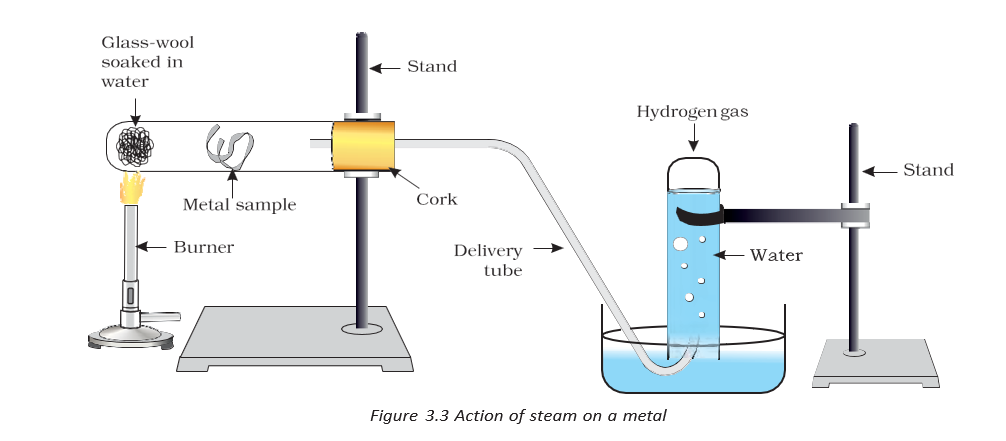
| Steam | Aluminium, iron and zinc react to form oxides and hydrogen. |
| No reaction with water | Lead, copper, silver and gold do not react. |
Key observations
- Potassium and sodium: Their reactions with cold water are violent and exothermic; the hydrogen produced may catch fire.
- Calcium: Reacts less violently; its heat is insufficient to ignite hydrogen. It floats as hydrogen bubbles stick to its surface.
- Magnesium: Does not react with cold water but reacts with hot water; it may float as hydrogen bubbles cling to it.
- Aluminium, iron and zinc: Do not react with cold or hot water, but react with steam.
Metals Reacting with Acids
Reaction with dilute acids — Many metals react with dilute acids to form a salt and hydrogen gas.
Reactivity with dilute hydrochloric acid
- Evidence of reaction: Faster hydrogen bubbling and a greater temperature rise indicate a more vigorous reaction.
- Order: Reactivity decreases as ; magnesium reacts fastest and most exothermically.
- Copper: Does not react with dilute hydrochloric acid; no bubbles form and the temperature remains unchanged.
Nitric acid exception
- Usual behaviour: Hydrogen gas is generally not evolved because nitric acid is a strong oxidising agent; it oxidises the hydrogen produced to water and is reduced to nitrogen oxides such as , or .
- Exception: Magnesium and manganese react with very dilute nitric acid to evolve hydrogen.
Aqua regia
- Composition: A freshly prepared mixture of concentrated hydrochloric acid and concentrated nitric acid in the ratio .
- Use: Dissolves gold and platinum, even though neither acid alone can dissolve gold.
- Nature: A highly corrosive, fuming liquid.
Why are sodium and potassium stored under kerosene?
What is an amphoteric oxide? Give two examples.
Why does nitric acid usually not produce hydrogen when reacting with metals?
Quick recap
- Most metals react with oxygen to form oxides; sodium is the most reactive sampled metal with oxygen, while magnesium is less reactive than sodium.
- Most metal oxides are insoluble in water; some dissolve to form alkalis, and aluminium oxide and zinc oxide are amphoteric.
- Potassium and sodium react violently with cold water; magnesium reacts with hot water, while aluminium, iron and zinc react with steam.
- Lead, copper, silver and gold do not react with water.
- With dilute hydrochloric acid, the reactivity order is ; copper does not react.
- Nitric acid usually oxidises hydrogen to water; very dilute nitric acid with magnesium or manganese is an exception.
- Aqua regia is a fresh mixture of concentrated hydrochloric and nitric acids and can dissolve gold and platinum.
How Do Metals React with Solutions of Other Metal Salts?
Displacement Reactions Between Metals
- Displacement: A more reactive metal displaces a less reactive metal from its salt solution.
- Example: Iron displaces copper from copper sulphate solution, but copper cannot displace iron from iron sulphate.
The Reactivity Series
- Reactivity series: Metals are arranged in decreasing order of their chemical activity.
- Use: The series helps compare metals and predict whether one metal can displace another from its compounds.
Why Metals and Non-metals React
- Stable configuration: Atoms tend to attain a completely filled outermost shell, like noble gases.
- Electron transfer: Metals generally lose electrons, while non-metals generally gain electrons to achieve a stable configuration.
Formation of Ionic Compounds
Properties of Ionic Compounds
Why does iron displace copper from copper sulphate?
What ions are present in magnesium chloride?
Why does solid sodium chloride not conduct electricity, while molten sodium chloride does?
Quick recap
- A more reactive metal displaces a less reactive metal from its salt.
- The reactivity series runs from potassium at the top to gold at the bottom, with hydrogen as a reference.
- Metals tend to lose electrons; non-metals tend to gain them to reach stable outer shells.
- Electron transfer forms oppositely charged ions that attract to make ionic compounds.
- Ionic compounds are generally hard, brittle, and have high melting and boiling points.
- Ionic compounds conduct electricity when molten or dissolved in water, but not when solid.
Occurrence of Metals
Minerals, Ores and Gangue
- Minerals: Naturally occurring elements or compounds found in the Earth’s crust.
- Ores: Minerals containing enough of a metal for its extraction to be economically worthwhile.
- Gangue: Unwanted impurities such as soil and sand mixed with ores; these are removed before metal extraction.
Occurrence and Reactivity of Metals
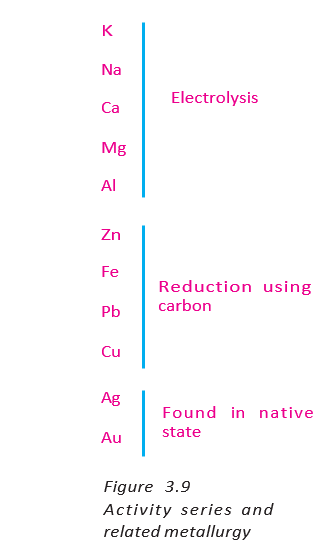
| Reactivity group | Examples | Typical occurrence |
|---|---|---|
| Low | Gold, silver, platinum, copper | Often found in the free state |
| Medium | Zinc, iron, lead | Usually found as oxides, sulphides or carbonates |
| High | Potassium, sodium, calcium, magnesium, aluminium | Not found as free elements in nature |
Preparing Ores for Extraction
Extraction Based on Reactivity
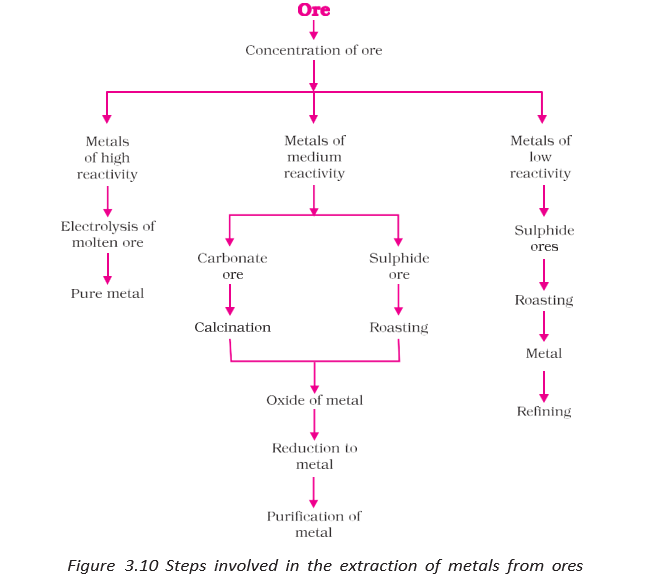
Converting Medium-Reactivity Ores into Oxides
| Point | Roasting | Calcination |
|---|---|---|
| Ore heated | Sulphide | Carbonate |
| Air supply | Excess air | Limited air |
| Main result | Metal oxide forms; sulphur dioxide is released | Metal oxide forms; carbon dioxide is released |
Reduction by Displacement and the Thermit Reaction
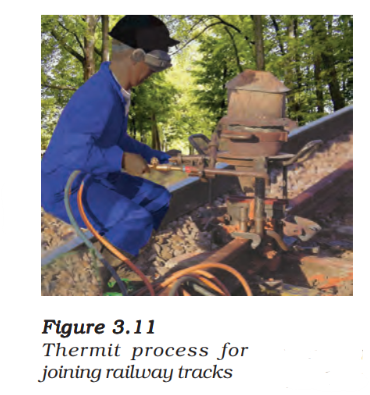
Thermit reaction — The highly exothermic reaction between iron(III) oxide and aluminium, used to join railway tracks and repair cracked machine parts.
Why are many metal ores found as oxides?
Distinguish roasting from calcination.
What is the thermit reaction used for?
Quick recap
- Minerals occur naturally; ores are minerals from which metals can be extracted profitably, and gangue is removed before extraction.
- Low-reactivity metals may occur free; highly reactive metals do not occur naturally as free elements.
- Low-reactivity metal oxides can be reduced by heating; copper and mercury extraction examples show the process.
- Roasting converts sulphide ores into oxides in excess air; calcination converts carbonate ores into oxides in limited air.
- Metal oxides can be reduced using carbon or a more reactive metal.
- The thermit reaction is highly exothermic and produces molten iron used for joining or repair.
Extracting Metals Towards the Top of the Activity Series
Extraction of Highly Reactive Metals
Refining of Metals
Corrosion
Prevention of Corrosion
- Methods: Rusting can be prevented by painting, oiling, greasing, galvanising, chrome plating or anodising.
- Galvanisation: Coating iron or steel with zinc protects it from rusting, even if the coating is scratched or broken.
Alloys
| Alloy | Composition | Property or use |
|---|---|---|
| Brass | Copper and zinc | Not a good electrical conductor |
| Bronze | Copper and tin | Not a good electrical conductor |
| Solder | Lead and tin | Low melting point; used to join electrical wires |
| 22-carat gold | 22 parts pure gold alloyed with 2 parts copper or silver | Harder than pure gold; commonly used for ornaments |
Amalgam — An alloy in which one of the metals is mercury.
Gold Alloys
- 24-carat gold: Pure gold is very soft and unsuitable for making jewellery.
- 22-carat gold: Commonly used for ornaments; it contains 22 parts pure gold alloyed with 2 parts of copper or silver.
Why are highly reactive metals extracted by electrolysis rather than by reduction with carbon?
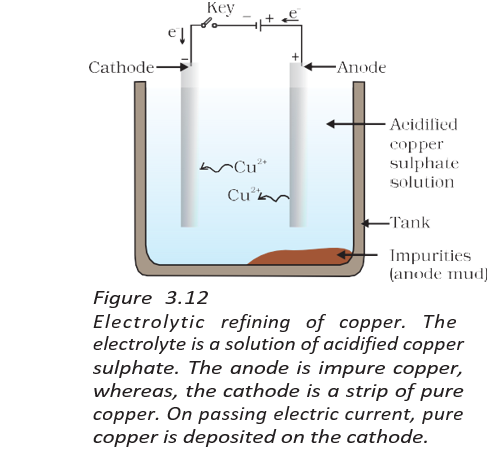
What happens to the metal and impurities during electrolytic refining?
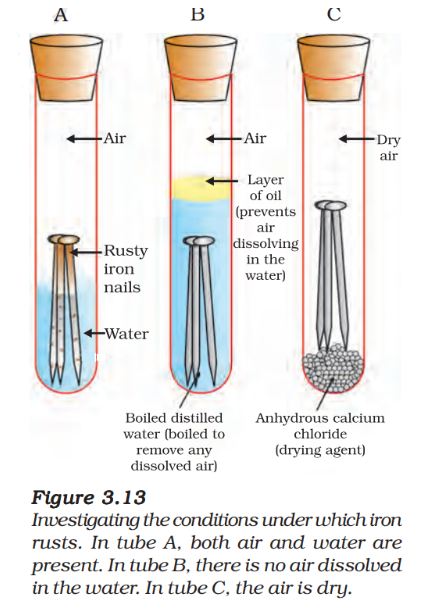
What conditions are needed for iron to rust, and how can rusting be prevented?
Quick recap
- Highly reactive metals are extracted by electrolytic reduction because carbon cannot reduce their oxides.
- In molten metal chlorides, metal forms at the cathode and chlorine forms at the anode.
- Electrolytic refining purifies metals; insoluble impurities settle as anode mud.
- Iron rusts only when both air and water are present.
- Corrosion can be prevented by coatings, surface treatments and alloying.
- Pure 24-carat gold is soft; alloying it makes it suitable for jewellery.
Science — ALL CHAPTERS
1
CHEMICAL REACTIONS AND EQUATIONS
2
ACIDS, BASES AND SALTS
3
METALS AND NON-METALS
4
CARBON AND ITS COMPOUNDS
5
LIFE PROCESSES
6
CONTROL AND COORDINATION
7
HOW DO ORGANISMS REPRODUCE?
8
HEREDITY
9
LIGHT – REFLECTION AND REFRACTION
10
THE HUMAN EYE AND THE COLOURFUL WORLD
11
ELECTRICITY
12
MAGNETIC EFFECTS OF ELECTRIC CURRENT
13
OUR ENVIRONMENT