Class 10 . Science . Science . Control and Coordination
Chapter 6: CONTROL AND COORDINATION
Ch 6
Science
Class 10
Introduction & Animals – Nervous System
Living Organisms: Control and Coordination in Movement
Control and coordination — Processes that help organisms detect environmental changes and produce appropriate, organised responses.
- Movement and life: Some movement results from growth, such as a seedling pushing through soil; other movements, such as running or chewing, are not growth-related.
- Response: Organisms detect environmental changes and respond in ways that can protect them or help meet their needs.
- Coordination: The appropriate response depends on recognising the event—for example, whispering to a nearby friend rather than shouting.
- Specialised tissues: In multicellular organisms, specialised tissues carry out control and coordination.
Nervous System and Neurons
Nervous tissue — An organised network of neurons specialised to carry information from one part of the body to another through electrical impulses.
- Control in animals: Nervous tissue detects and carries information; muscular tissue helps produce the response.
- Receptors: Specialised tips of some nerve cells detect information from the environment; they are usually located in sense organs such as the inner ear, nose and tongue.
- Receptor types: Gustatory receptors detect taste; olfactory receptors detect smell.
- Combined senses: Smell contributes to the flavour of food, so food may taste less flavourful when the nose is blocked, as during a cold.
- Brain: Dense networks of neurons in the brain receive signals from the body, process them, and send instructions to muscles; this complex processing can take time.
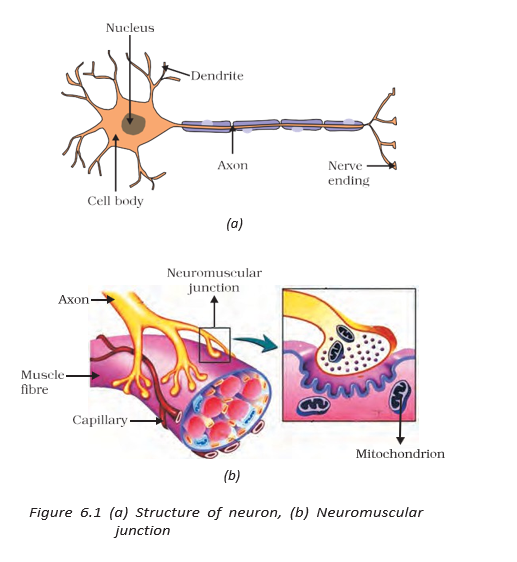
How a Nervous Impulse Travels
- Detection: Information is received at a receptor; a chemical reaction at the dendritic tip creates an electrical impulse.
- Within a neuron: The impulse travels from the dendrite to the cell body, then along the axon to its end.
- Across a synapse: Chemicals released at the axon end cross the gap and trigger an electrical impulse in the next neuron's dendrite.
- To an effector: A similar junction carries the signal from a neuron to a muscle cell or gland.
- Input: Information is acquired at the dendritic tip.
- Conduction: The impulse passes through the cell body and along the axon.
- Transmission onward: At the axon end, the electrical signal leads to chemical release across a synapse.
Reflex Actions
Reflex action — A rapid, automatic response to a stimulus that occurs without conscious control of the immediate action.
- Why reflexes matter: Thinking through a dangerous stimulus, such as touching a flame, could take too long and allow injury.
- Reflex arc: A simpler connection between the input nerve and output nerve enables a quick response.
- Location: Reflex arcs are formed in the spinal cord, where nerves travelling between the body and brain meet.
- Brain involvement: Information also travels to the brain, even though the immediate reflex response is coordinated through the spinal cord.
- Efficiency: Reflex arcs enable fast responses and remain useful even in animals with complex brains.
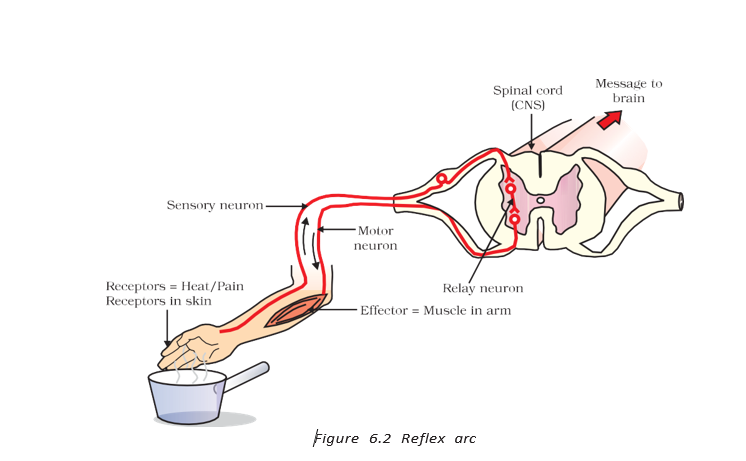
Reflex Response to a Harmful Stimulus
- Stimulus: A receptor detects a harmful change, such as heat.
- Input: A sensory nerve carries the impulse to the spinal cord.
- Relay: The spinal cord connects the input pathway to the output pathway.
- Response: A motor nerve carries the impulse to a muscle, which acts quickly; information also travels to the brain.
What happens when bright light is focussed on the eyes?
Why are reflex arcs useful?
Quick recap
- Organisms detect environmental changes and make appropriate responses; specialised tissues coordinate these responses.
- Receptors detect information; gustatory receptors sense taste and olfactory receptors sense smell.
- A neuron carries an electrical impulse along its dendrite, cell body and axon; chemicals transmit the signal across a synapse.
- Nervous tissue carries information; muscular tissue helps produce responses.
- A reflex is a rapid, automatic response; its reflex arc is formed in the spinal cord, while information also reaches the brain.
Human Brain
The Brain and Nervous System
Brain regions
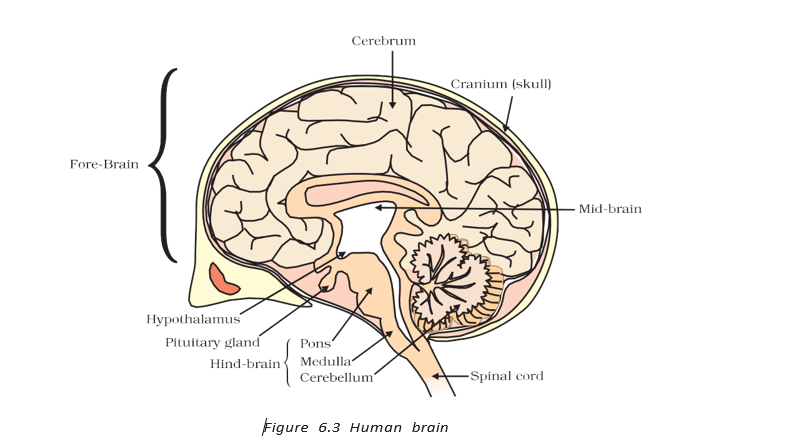
- Major regions: Forebrain, midbrain and hindbrain perform different coordinating functions.
- Voluntary actions: The brain sends messages through the nervous system to muscles; examples include writing, talking and moving a chair.
Functions of Brain Regions
| Point | Voluntary actions | Involuntary actions |
|---|---|---|
| Control | Done with conscious thought or decision | Occur without conscious thinking or control |
| Examples | Writing, talking, moving a chair | Heartbeat, salivation, blood pressure and vomiting |
| Brain control | Forebrain motor areas control voluntary muscles | Many are controlled by the midbrain and hindbrain; the medulla controls several involuntary actions |
Midbrain and Hindbrain
- Midbrain and hindbrain: Control many involuntary actions that do not require conscious thought.
- Medulla: Part of the hindbrain; controls involuntary actions such as blood pressure, salivation and vomiting.
- Cerebellum: Part of the hindbrain; coordinates precision of voluntary movements and maintains posture and balance.
- Examples: Walking in a straight line, riding a bicycle and picking up a pencil depend on cerebellar coordination.
Protection of Nervous Tissue
- Brain: Protected by the bony skull and cushioned by fluid.
- Spinal cord: Protected by the vertebral column (backbone).
How Nervous Tissue Causes Action
From Nerve Impulse to Movement
- Nerve impulse reaches muscle fibre
- Muscle proteins change shape and arrangement
- Muscle cell shortens
- Movement occurs
How does the cerebellum help in movement?
Name the structures that protect the brain and spinal cord.
Quick recap
- The brain and spinal cord form the CNS; cranial and spinal nerves connect it to the body.
- The forebrain processes sensory information, supports thinking and controls voluntary responses.
- The medulla controls involuntary actions including blood pressure, salivation and vomiting.
- The cerebellum coordinates precise voluntary movement, posture and balance.
- The skull, surrounding fluid and vertebral column protect the CNS.
- Nerve impulses trigger protein changes that shorten muscle fibres and produce movement.
Coordination in Plants
Types of Movement in Plants
- Plant movements: Plants respond to stimuli even though they have no nervous system or muscles.
- Two types: Their movements may occur with growth or independently of growth.
Immediate Response to Touch
Do not confuse the sensitive plant’s quick leaf-folding response with growth movement: it occurs without growth.
How do the leaves of a sensitive plant move after touch?
Quick recap
- Plants coordinate responses despite having no nervous system or muscles.
- Plant movements may be growth-dependent or growth-independent.
- Sensitive-plant leaf folding is a rapid response that does not involve growth.
- Electrical-chemical signals carry information from cell to cell without specialised conducting tissue.
- Changes in cell water content alter cell shape and produce movement.
Movement Due to Growth
Directional Growth in Plants
Tropism — A tropism is a directional growth response of a plant to a stimulus.
How growth causes movement
- Directional growth makes a plant appear to move towards or away from a stimulus.
- Tendrils respond to touch: the side touching a support grows more slowly than the opposite side, so the tendril curls around the support.
| Type | Stimulus | Example / direction |
|---|---|---|
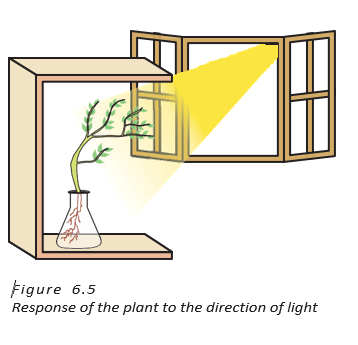
| Phototropism | Light | Shoots grow towards light; roots generally grow away from it. |
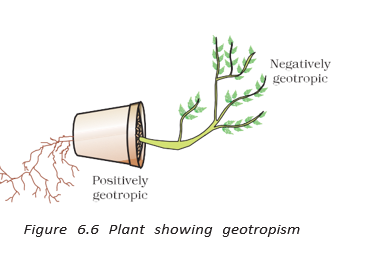
| Geotropism | Gravity | Roots grow downwards (positive response); shoots grow upwards (negative response). |
| Hydrotropism | Water | Directional growth in response to water. |
| Chemotropism | Chemicals | Pollen tubes grow towards ovules. |
Communication and Control
Fast and slow responses
- Response speed varies: sensitive-plant movement is quick, sunflower responses to day or night are slower, and growth-related plant movements are slower still.
- Controlled growth also occurs in animals; for example, arms and fingers grow in specific directions rather than randomly.
| Point | Electrical impulses | Chemical communication |
|---|---|---|
| Speed | Very rapid; useful for fast responses. | Slower because chemicals diffuse between cells. |
| Reach | Only cells connected by nervous tissue receive them. | Can potentially reach cells throughout the body, whether or not they have nervous connections. |
| Duration / repetition | A cell needs time to reset before generating another impulse. | Can provide steady, persistent communication. |
Chemical Signalling
- A stimulated cell releases a chemical compound.
- The compound diffuses around the cell.
- Nearby cells detect it using special surface molecules and receive the information.
Plant hormones — Plant hormones are chemical compounds that coordinate growth, development and responses to the environment.
How plant hormones act
- Production and action may occur in different places: hormones are made away from their target and diffuse to the area where they act.
- Variety of plant hormones enables different effects, including promoting or inhibiting growth.
Auxin and Bending Towards Light
- The shoot tip produces auxin as the growing plant detects light.
- Light from one side causes auxin to collect on the shady side of the shoot.
- Cells on the shady side elongate more.
- Unequal growth bends the shoot towards the light.
| Hormone | Main effect |
|---|---|
| Auxin | Promotes cell elongation; contributes to stem growth and bending towards light. |
| Gibberellin | Promotes stem growth. |
| Cytokinin | Promotes cell division; found in greater concentration in rapidly dividing regions such as fruits and seeds. |
| Abscisic acid | Inhibits growth; its effects include wilting of leaves. |
Explain how auxin causes a shoot to bend towards light.
What is geotropism? Give the responses of roots and shoots.
Quick recap
- Tropisms are directional growth responses to stimuli; tendrils curl around supports through unequal growth.
- Shoots usually grow towards light; roots grow downwards in response to gravity while shoots grow upwards.
- Pollen tubes growing towards ovules are an example of chemotropism.
- Electrical impulses are rapid but limited to nervous connections and require time for cells to reset.
- Chemical signals diffuse, can reach widely, and can act steadily, but more slowly.
- Auxin, gibberellins and cytokinins promote growth in different ways; abscisic acid inhibits growth.
Hormones in Animals
Hormones and the Endocrine System
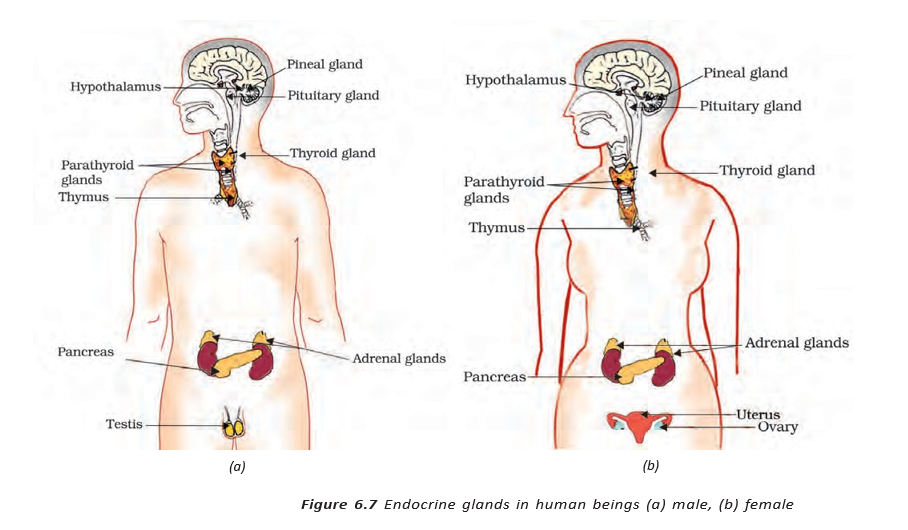
Hormone — A chemical messenger released by an endocrine gland into the blood to act on target organs or tissues.
How hormonal control works
- Endocrine system: Provides chemical control and coordination throughout the body.
- Wide reach: Blood carries hormones to many body parts, allowing coordinated changes across tissues.
- Nerve signals: Electrical impulses travel through nerve cells and have a more limited reach than hormones.
| Point | Nerve signals | Hormonal signals |
|---|---|---|
| Signal | Electrical impulses through nerve cells | Chemical messengers carried in blood |
| Reach | Limited to connected nerve pathways | Can reach many body tissues |
Adrenaline: Preparing for Urgent Action
Adrenaline — A hormone secreted by the adrenal glands that prepares the body for an emergency, such as fighting or running away.
Effects of adrenaline
- Transport: It is released directly into the blood and carried to target organs and tissues.
- Heart: The heartbeat becomes faster, increasing oxygen supply to muscles.
- Blood flow: Small arteries to the digestive system and skin contract, reducing blood flow there and diverting more blood to skeletal muscles.
- Breathing: Contractions of the diaphragm and rib muscles increase the breathing rate.
Hormones and Controlled Growth
Hormonal control of growth — Hormones help regulate growth in appropriate parts of the body, maintaining its organised design as it develops.
Thyroxin and iodine
- Thyroxin: The thyroid gland needs iodine to synthesise this hormone, which regulates carbohydrate, protein and fat metabolism to support growth.
- Iodine deficiency: Too little iodine can cause goitre; a common symptom is a swollen neck.
Growth, Puberty and Blood Sugar
Growth hormone and puberty hormones
- Growth hormone: Secreted by the pituitary gland; regulates growth and development of the body.
- Deficiency: Too little growth hormone during childhood can cause dwarfism.
- Puberty: Testosterone in males and oestrogen in females are associated with the changes that occur during puberty.
Insulin — A hormone produced by the pancreas that helps regulate the level of sugar in the blood.
Insulin and blood-sugar feedback
- Feedback regulation: Feedback mechanisms regulate the timing and amount of hormone release.
- High blood sugar: Pancreatic cells detect a rise and produce more insulin.
- Falling blood sugar: As the blood sugar level falls, insulin secretion is reduced.
- Insufficient insulin: Blood sugar can rise and cause harmful effects; diabetes may be treated with insulin injections.
Hypothalamus and Pituitary
- Hypothalamus: Plays an important role in the release of many hormones.
- Example: When growth-hormone levels are low, the hypothalamus releases growth hormone-releasing factor, which stimulates the pituitary gland to release growth hormone.
Important Hormones and Their Functions
| Hormone | Endocrine gland | Main function |
|---|---|---|
| Growth hormone | Pituitary gland | Stimulates growth in all organs |
| Thyroxin | Thyroid gland | Regulates metabolism for body growth |
| Insulin | Pancreas | Regulates blood sugar level |
| Testosterone | Testes | Associated with changes at male puberty |
| Oestrogen | Ovaries | Development of female sex organs; regulates the menstrual cycle |
| Adrenaline | Adrenal glands | Prepares the body for urgent action |
| Releasing hormones | Hypothalamus | Stimulate the pituitary gland to release hormones |
Quick recap
- Hormones are chemical messengers carried in the blood to target organs and tissues.
- Adrenaline prepares the body for urgent action by increasing heartbeat and breathing and redirecting blood to skeletal muscles.
- Iodine is needed to make thyroxin; deficiency can cause goitre.
- Pituitary growth hormone supports growth; deficiency during childhood can cause dwarfism.
- Testosterone and oestrogen are associated with puberty changes in males and females.
- Feedback mechanisms regulate hormone release; insulin secretion rises when blood sugar rises and falls as blood sugar falls.
Science — ALL CHAPTERS
1
CHEMICAL REACTIONS AND EQUATIONS
2
ACIDS, BASES AND SALTS
3
METALS AND NON-METALS
4
CARBON AND ITS COMPOUNDS
5
LIFE PROCESSES
6
CONTROL AND COORDINATION
7
HOW DO ORGANISMS REPRODUCE?
8
HEREDITY
9
LIGHT – REFLECTION AND REFRACTION
10
THE HUMAN EYE AND THE COLOURFUL WORLD
11
ELECTRICITY
12
MAGNETIC EFFECTS OF ELECTRIC CURRENT
13
OUR ENVIRONMENT