Class 10 . Science . Science . Chemical Reactions and Equations
Chapter 1: CHEMICAL REACTIONS AND EQUATIONS
Ch 1
Science
Class 10
Introduction & Chemical Equations
Chemical Changes and Reactions
- Chemical change: A chemical reaction occurs when the nature and identity of the starting substances change, forming new substances.
- Evidence: Changes in state or colour, gas evolution, and temperature change can indicate that a chemical reaction has taken place.
Chemical Equations
What observations can indicate that a chemical reaction has taken place?
Identify the reactants and product in the magnesium word equation.
Quick recap
- A chemical reaction is a chemical change that forms a substance with a changed identity.
- Common reaction clues include changes in state, colour or temperature, and gas evolution.
- Burning magnesium in oxygen forms magnesium oxide.
- Word equations represent reactants changing into products.
- Reactants go on the LHS; products go on the RHS, separated by an arrow.
Writing a Chemical Equation
Chemical Equations and Skeletal Equations
Chemical equation — A chemical equation represents a chemical reaction using the chemical formulae of reactants and products.
Parts of an equation
- Reactants are written on the left-hand side (LHS); products are written on the right-hand side (RHS).
- Arrow means “forms” or “yields” and separates reactants from products.
- Skeletal equation shows the correct formulae but may have unequal numbers of atoms on the two sides.
Balanced Chemical Equations
Balanced chemical equation — An equation in which each element has the same number of atoms on the LHS and RHS.
Why equations must be balanced
- Law of conservation of mass: mass can neither be created nor destroyed in a chemical reaction.
- Consequence: total mass, and therefore the number of atoms of each element, is the same before and after a reaction.
- Balancing rule: change coefficients in front of formulae; never change the formulae themselves.
| Element | LHS atoms | RHS atoms |
|---|---|---|
| Zn | 1 | 1 |
| H | 2 | 2 |
| S | 1 | 1 |
| O | 4 | 4 |
Balancing by the Hit-and-Trial Method
| Element | LHS atoms | RHS atoms |
|---|---|---|
| Fe | 1 | 3 |
| H | 2 | 2 |
| O | 1 | 4 |
Hit-and-trial balancing
- Write the correct formulae and count atoms of each element on both sides.
- Start with a compound containing many atoms; here, balance oxygen in Fe3O4 by placing 4 before H2O.
- Balance hydrogen by placing 4 before H2.
- Balance iron by placing 3 before Fe.
- Recount every element on both sides and use the smallest whole-number coefficients.
Balancing rules
- Coefficients multiply an entire formula: 4H2O represents four water molecules, containing 8 H atoms and 4 O atoms.
- Never alter subscripts or write H2O4 to balance oxygen; changing a formula changes the substance.
- Hit-and-trial method balances an equation by testing coefficients until all atom counts match.
Physical States and Reaction Conditions
| Symbol | State | Meaning |
|---|---|---|
| (s) | Solid | Substance is solid |
| (l) | Liquid | Substance is liquid |
| (g) | Gas | Substance is gaseous |
| (aq) | Aqueous | Substance is dissolved in water |
Adding states and conditions
- State symbols are written after the formulae; they make equations more informative but are included when needed.
- Reaction conditions such as temperature, pressure or a catalyst may be written above or below the arrow.
- Water as steam is written as H2O(g), distinguishing it from liquid water, H2O(l).
State the law used to balance chemical equations.
Why must formulae not be changed while balancing an equation?
Quick recap
- Chemical equations use formulae to represent reactants and products; an unbalanced one is skeletal.
- A balanced equation has equal numbers of atoms of every element on both sides.
- Balancing follows the law of conservation of mass.
- Use coefficients—not changed subscripts—and finish with the smallest whole-number coefficients.
- State symbols are (s), (l), (g) and (aq); conditions may be written around the arrow.
Types of Chemical Reactions
What Happens in a Chemical Reaction?
- Atoms: Chemical reactions do not create, destroy, or change atoms of one element into atoms of another.
- Bond changes: Reactions involve breaking and making bonds between atoms, producing new substances.
Combination Reactions
Combination reaction — A reaction in which two or more reactants combine to form a single product.
- Quicklime and water: Calcium oxide reacts vigorously with water to form slaked lime and release much heat.
- Whitewashing: Slaked lime reacts slowly with carbon dioxide in air, forming a thin, shiny calcium carbonate layer on walls after two to three days. Marble is also calcium carbonate.
Other combination examples
- Coal burning: Carbon combines with oxygen to form carbon dioxide.
- Water formation: Hydrogen and oxygen combine to form water.
Exothermic Reactions
Exothermic reaction — A reaction that releases heat along with the formation of products.
Important examples
- Burning natural gas: Methane burns in oxygen to form carbon dioxide and water vapour.
- Respiration: Glucose combines with oxygen in body cells, producing carbon dioxide, water, and energy.
- Composting: Decomposition of vegetable matter into compost also releases heat.
- Respiration and energy: Carbohydrates in foods such as rice, potatoes, and bread are broken down into glucose; glucose reacts with oxygen in cells and releases energy.
Decomposition Reactions
Decomposition reaction — A reaction in which one reactant breaks down into two or more simpler products.
Thermal decomposition
- Definition: Decomposition caused by heating is called thermal decomposition.
- Ferrous sulphate crystals: The crystals are ferrous sulphate heptahydrate, . They lose water on heating and then decompose; ferric oxide is a solid, while sulphur dioxide and sulphur trioxide are gases.
- Limestone: Heating calcium carbonate gives calcium oxide (quicklime) and carbon dioxide. Quicklime is used in cement manufacture.
- Lead nitrate observation: Heating lead nitrate releases brown fumes of nitrogen dioxide.
Electrolytic Decomposition
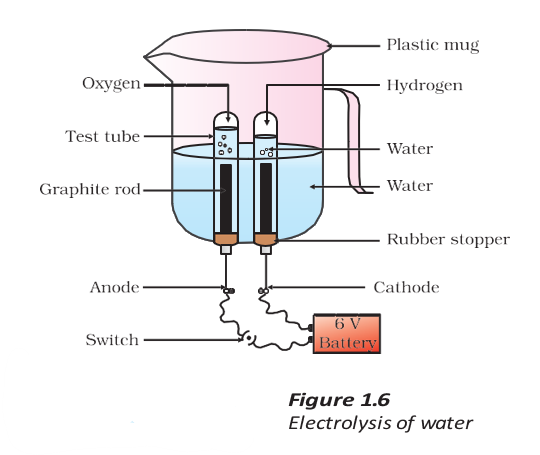
- Electrolysis of water: Passing electricity through acidified water decomposes it into hydrogen and oxygen.
- Gas volumes: Hydrogen is produced in twice the volume of oxygen.
Photolytic Decomposition
- Silver chloride: White silver chloride decomposes in sunlight, turning grey as silver forms.
- Silver bromide: It also decomposes in sunlight. These reactions are used in black-and-white photography.
Energy in Chemical Reactions
Endothermic reaction — A reaction that absorbs energy from its surroundings.
| Reaction type | Energy involved | Example |
|---|---|---|
| Thermal decomposition | Heat supplied | Heating calcium carbonate |
| Electrolytic decomposition | Electricity supplied | Electrolysis of water |
| Photolytic decomposition | Light supplied | Silver chloride decomposes in sunlight |
| Exothermic reaction | Heat released | Respiration or burning natural gas |
| Endothermic reaction | Energy absorbed | Decomposition reactions; barium hydroxide mixed with ammonium chloride |
Combination and energy classifications describe different features: a reaction can be both combination and exothermic, as when quicklime reacts with water.
How can a reaction be identified as a decomposition reaction?
What happens when silver chloride is exposed to sunlight?
Quick recap
- Combination: Two or more reactants form one product.
- Exothermic: Heat is released; examples include quicklime reacting with water, combustion, and respiration.
- Decomposition: One reactant breaks into simpler products.
- Energy-driven decomposition: Heat, electricity, or light can cause decomposition.
- Photolysis: Silver chloride and silver bromide decompose in sunlight and are used in black-and-white photography.
- Endothermic: Energy is absorbed from the surroundings.
Displacement Reaction
Displacement Reaction
Displacement reaction — A reaction in which a more reactive element replaces a less reactive element from its compound.
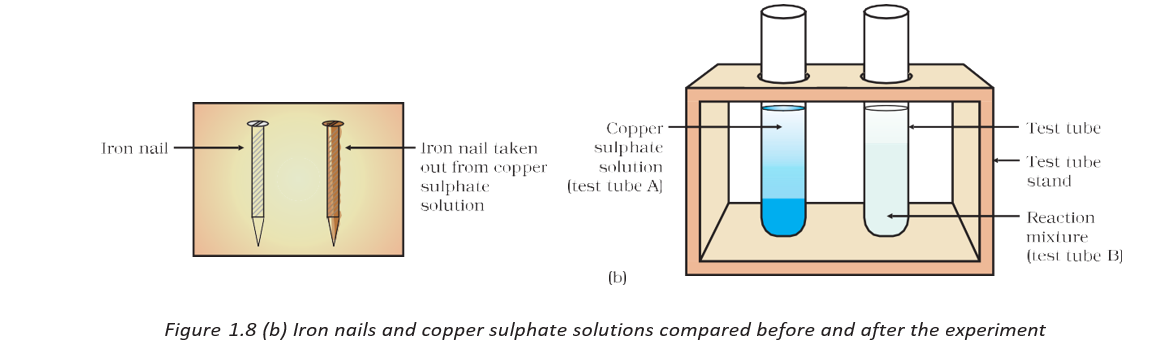
- Iron and copper sulphate: Iron displaces copper; the blue solution fades and the iron nail gets a brown copper coating.
- Reactivity: Zinc and lead are more reactive than copper, so they displace copper from its compounds.
Double Displacement Reaction
Double displacement reaction — A reaction in which ions are exchanged between reactants to form new compounds.
Precipitate — An insoluble solid formed in a solution during a reaction; a reaction that forms one is a precipitation reaction.
- Barium sulphate: Sulphate ions and barium ions combine to form white, insoluble barium sulphate; sodium chloride remains dissolved.
- Lead(II) nitrate and potassium iodide: This ion-exchange reaction is also a double displacement reaction.
Oxidation and Reduction
| Point | Oxidation | Reduction |
|---|---|---|
| Oxygen | Gain of oxygen | Loss of oxygen |
| Hydrogen | Loss of hydrogen | Gain of hydrogen |
Redox reaction — A reaction in which oxidation and reduction occur together: one reactant is oxidised while another is reduced.
Key examples
- Copper oxide and hydrogen: Black copper(II) oxide loses oxygen and becomes brown copper; hydrogen gains oxygen to form water.
- Zinc oxide and carbon: Zinc oxide is reduced to zinc, while carbon is oxidised to carbon monoxide.
- Manganese dioxide and hydrochloric acid: Manganese dioxide is reduced to manganese chloride, while hydrochloric acid is oxidised to chlorine.
- Magnesium: When magnesium burns in oxygen to form magnesium oxide, magnesium is oxidised.
Effects of Oxidation in Everyday Life
- Everyday effects: Oxidation reactions can cause changes in metals and in fat- or oil-containing foods.
- Prevention: Protective measures can slow oxidation and reduce damage to materials and food.
Corrosion
Corrosion — The damage to a metal caused by substances in its surroundings, such as moisture and acids.
- Rusting: Iron forms a reddish-brown coating when left exposed for some time.
- Other examples: Silver develops a black coating; copper develops a green coating.
- Effects: Corrosion damages cars, bridges, railings, ships and other metal objects; iron corrosion causes substantial replacement costs.
Rancidity
Rancidity — The oxidation of fats and oils, which changes the smell and taste of food.
Preventing rancidity
- Antioxidants: Added to foods containing fats and oils to prevent or slow oxidation.
- Airtight storage: Reduces contact with air and slows oxidation.
- Nitrogen flushing: Chips packets are flushed with nitrogen to help prevent oxidation.
How are oxidation and reduction identified in the reaction of copper(II) oxide with hydrogen?
Quick recap
- Displacement: A more reactive element replaces a less reactive element from its compound.
- Double displacement: Reactant ions exchange; an insoluble solid formed is a precipitate.
- Redox: Oxidation and reduction occur together; oxygen gain/loss and hydrogen loss/gain identify them.
- Corrosion: Metals are damaged by substances in their surroundings; rusting is corrosion of iron.
- Rancidity: Oxidation of fats and oils changes food smell and taste; antioxidants, airtight storage and nitrogen help prevent it.
Science — ALL CHAPTERS
1
CHEMICAL REACTIONS AND EQUATIONS
2
ACIDS, BASES AND SALTS
3
METALS AND NON-METALS
4
CARBON AND ITS COMPOUNDS
5
LIFE PROCESSES
6
CONTROL AND COORDINATION
7
HOW DO ORGANISMS REPRODUCE?
8
HEREDITY
9
LIGHT – REFLECTION AND REFRACTION
10
THE HUMAN EYE AND THE COLOURFUL WORLD
11
ELECTRICITY
12
MAGNETIC EFFECTS OF ELECTRIC CURRENT
13
OUR ENVIRONMENT