Class 10 . Science . Science . Our Environment
Chapter 13: OUR ENVIRONMENT
Ch 13
Science
Class 10
Introduction & Eco-system — What Are Its Components?
Environment and Ecosystem
Ecosystem — An ecosystem consists of all interacting organisms in an area and the non-living constituents of their environment.
| Component | Meaning | Examples |
|---|---|---|
| Biotic | Living components | Plants, animals, microorganisms and humans |
| Abiotic | Physical, non-living factors | Temperature, rainfall, wind, soil and minerals |
Ecosystem Examples
- Garden: Plants and animals interact with each other and with abiotic factors; therefore, a garden is an ecosystem.
- Natural ecosystems: Forests, ponds and lakes.
- Human-made ecosystems: Gardens and crop-fields; an aquarium is also a human-made ecosystem.
- Aquarium needs: Fish need swimming space, water, oxygen and food; an aerator can supply oxygen.
- Self-sustaining system: Aquatic plants and animals can interact to support the system, while decomposers recycle waste and dead matter.
| Group | How it obtains food | Examples |
|---|---|---|
| Producers | Make organic compounds such as sugar and starch from inorganic substances using the Sun’s radiant energy and chlorophyll. | Green plants and certain food-producing bacteria |
| Consumers | Obtain food directly from producers or indirectly by eating other consumers. | Herbivores, carnivores, omnivores and parasites |
| Decomposers | Break down dead organisms and waste into simple inorganic substances. | Bacteria and fungi |
| Type | Food source | Example |
|---|---|---|
| Herbivores | Plants | Deer |
| Carnivores | Other animals | Lion |
| Omnivores | Both plants and animals | Human |
| Parasites | Obtain food from a host, usually harming it | Tapeworm |
Food Dependence in an Ecosystem
- Producers make food using energy from the Sun.
- Consumers obtain this food directly or through other consumers.
- Decomposers break down dead organisms and waste into simple inorganic substances.
- These substances enter the soil and can be used again by plants.
Interdependence
- Food chain example: Algae → zooplankton → small fish → large fish.
- Interdependence: Producers, consumers and decomposers depend on one another; no group can be considered unimportant.
- Without decomposers: Dead organisms and waste would accumulate, and nutrients would not be naturally returned to the soil for plant use.
Why are decomposers essential in an ecosystem?
Quick recap
- An ecosystem includes interacting organisms and the non-living components of their surroundings.
- Biotic components are living; abiotic factors include temperature, rainfall, wind, soil and minerals.
- Forests, ponds and lakes are natural ecosystems; gardens, crop-fields and aquariums are human-made.
- Producers make food from inorganic substances using the Sun’s energy; consumers depend on producers directly or indirectly.
- Consumers include herbivores, carnivores, omnivores and parasites.
- Bacteria and fungi decompose dead matter and waste, recycling nutrients for plants.
Food Chains and Webs
Food Chains and Trophic Levels
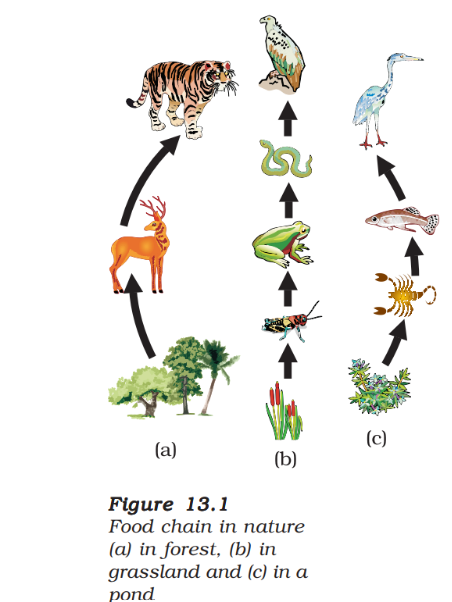
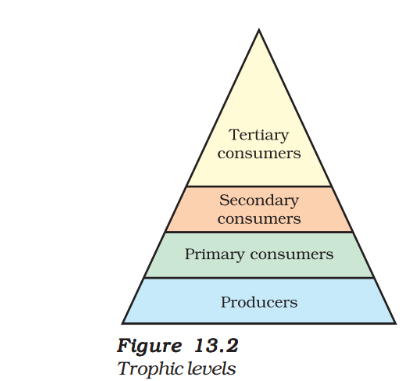
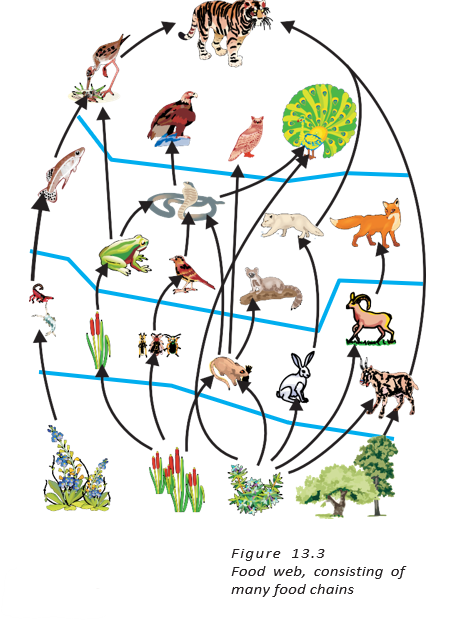
Energy Flow and Food Webs
| Point | Food chain | Food web |
|---|---|---|
| Structure | A single feeding pathway | Interconnected, branching feeding pathways |
| Relationships | Shows one route of energy transfer | Shows that organisms may feed on, or be eaten by, several kinds of organisms |
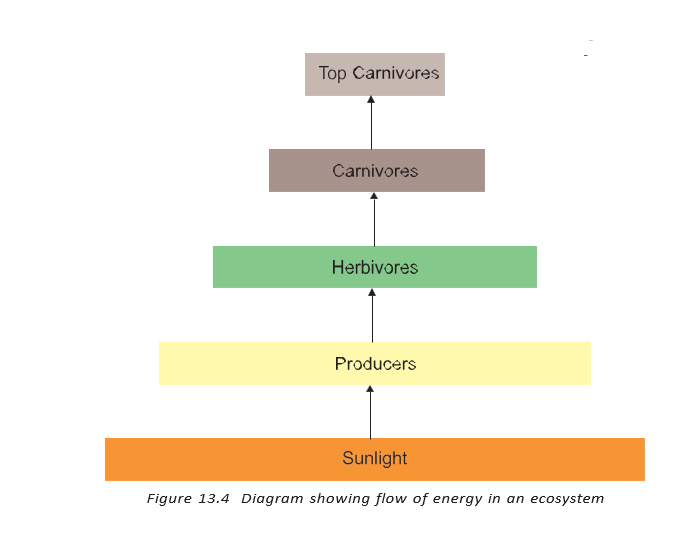
- Unidirectional flow: energy does not return from consumers to producers or from producers to the Sun.
- Progressive decrease: less usable energy is available at each successive trophic level.
Biological Magnification
How Pesticides Enter Food Chains
- Pesticides used on crops wash into soil or water.
- Plants or aquatic organisms absorb the chemicals.
- Consumers eat contaminated organisms.
- Non-degradable chemicals accumulate at higher trophic levels.
Washing food does not always remove pesticide residues; residues can also reach people through other foods, including meat.
Ozone Layer and Its Depletion
Ozone Depletion and Action
- Ozone levels in the atmosphere began dropping sharply in the 1980s.
- The decline was linked to synthetic chemicals such as chlorofluorocarbons (CFCs), used as refrigerants and in fire extinguishers.
- In 1987, the United Nations Environment Programme (UNEP) secured an agreement to freeze CFC production at 1986 levels.
- Manufacturers worldwide are required to make CFC-free refrigerators.
Why are food chains usually limited to three or four trophic levels?
What is biological magnification, and why can humans be affected by it?
How does ozone form, and what is its role in the upper atmosphere?
Quick recap
- A food chain shows a feeding pathway; each feeding step is a trophic level.
- Producers capture sunlight, but only about of food energy passes to the next level on average.
- Food webs are branching networks of interconnected food chains.
- Energy flows one way through an ecosystem and decreases at each trophic level.
- Non-degradable chemicals can accumulate through food chains by biological magnification.
- Ozone is poisonous, yet ozone high in the atmosphere protects Earth from UV radiation; CFCs are linked to ozone depletion.
Managing the Garbage We Produce
Biodegradable and Non-Biodegradable Waste
Biodegradable substances — Substances that can be broken down by biological processes, such as the action of bacteria and other saprophytes.
Non-biodegradable substances — Substances that are not broken down by biological processes under ordinary environmental conditions.
How breakdown occurs
- Enzyme specificity: Enzymes act on particular substances; one enzyme cannot break down every material.
- Persistent materials: Many human-made materials, such as plastics, resist breakdown by bacteria and other saprophytes.
- Environmental conditions: Heat and pressure may affect some non-biodegradable materials, but they persist for a long time in ordinary surroundings.
- Possible effects: Persistent substances may remain inert or harm organisms and other parts of the ecosystem.
| Point | Biodegradable | Non-biodegradable |
|---|---|---|
| Breakdown | Broken down by biological processes | Not broken down biologically under ordinary conditions |
| Examples | Spoiled food, vegetable peels and used tea leaves | Many plastics |
| Environmental fate | Can change form and structure over time | May persist for a long time and cause harm |
Managing the Waste We Generate
Waste sources and treatment
- Household waste: Includes kitchen scraps, paper, packaging, medicine containers, old clothes and broken footwear.
- Segregation: Separate biodegradable and non-biodegradable waste so each type can be treated appropriately.
- Local responsibility: Panchayats, municipal corporations and resident groups may organise waste collection and treatment.
- Sewage and industrial waste: Treat these wastes before release to help prevent pollution of local water bodies and soil.
Lifestyle Changes and Environmental Impact
- Lifestyle improvements and increased use of disposable products
- More waste is generated, often with additional packaging
- A larger share of waste is non-biodegradable
- Persistent waste can accumulate and harm the environment
Special Waste Concerns
- Electronic waste: Discarded electronic items can involve hazardous materials that need to be considered during disposal.
- Plastic waste: The recycling process for plastics may also affect the environment.
- Key principle: Waste collection and treatment should prevent harmful materials from polluting soil and water.
Why do many plastics remain in the environment for a long time?
How can poor treatment of sewage and industrial waste affect the environment?
Quick recap
- Biodegradable waste is broken down by biological processes; non-biodegradable waste is not.
- Enzymes and saprophytes act on specific materials, so not all waste decomposes.
- Many plastics persist in the environment and may harm ecosystem members.
- Separating waste helps ensure biodegradable and non-biodegradable materials receive suitable treatment.
- Sewage and industrial waste should be treated to protect soil and water.
- Disposable products and packaging increase waste, including persistent non-biodegradable waste.
Science — ALL CHAPTERS
1
CHEMICAL REACTIONS AND EQUATIONS
2
ACIDS, BASES AND SALTS
3
METALS AND NON-METALS
4
CARBON AND ITS COMPOUNDS
5
LIFE PROCESSES
6
CONTROL AND COORDINATION
7
HOW DO ORGANISMS REPRODUCE?
8
HEREDITY
9
LIGHT – REFLECTION AND REFRACTION
10
THE HUMAN EYE AND THE COLOURFUL WORLD
11
ELECTRICITY
12
MAGNETIC EFFECTS OF ELECTRIC CURRENT
13
OUR ENVIRONMENT