Introduction & Accumulation of Variation During Reproduction
Introduction: Similarity and Variation
- Reproduction: Produces new individuals that share the basic body design of their parents.
- Variation: Small differences among individuals help explain how traits are inherited and how populations change.
Accumulation of Variation During Reproduction
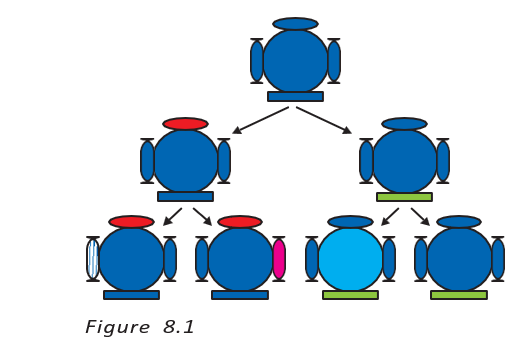
Variation and Survival
How Variation Can Affect Survival
- Variation arises among individuals.
- Environmental conditions favour some variations over others.
- Individuals with advantageous variations survive better.
- Selection of variants contributes to evolution.
Why do bacteria produced by repeated asexual reproduction show only small differences?
How can environmental conditions influence the survival of variations?
Quick recap
- Reproduction produces similar offspring, but variation may occur.
- Small DNA-copying inaccuracies can create variation in asexual reproduction.
- Sexual reproduction generally creates greater diversity.
- Offspring inherit parental differences and may acquire new variations.
- Environmental conditions favour some variations, affecting survival.
- Selection of variants by the environment forms the basis of evolution.
Heredity
Inherited Traits
Heredity — The passing of traits from parents to offspring through genetic material.
Variation and inheritance
- Inherited traits are features passed from parents; offspring resemble their parents but are not identical to them.
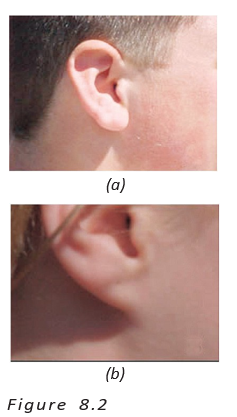
- Variation means differences between individuals of the same species, such as free or attached earlobes.
- Parental contribution: In sexual reproduction, both parents contribute practically equal amounts of genetic material.
- Two versions: Each trait can be influenced by a version of a gene from each parent.
Mendel’s Rules for Inheritance
Mendel’s pea-plant experiments
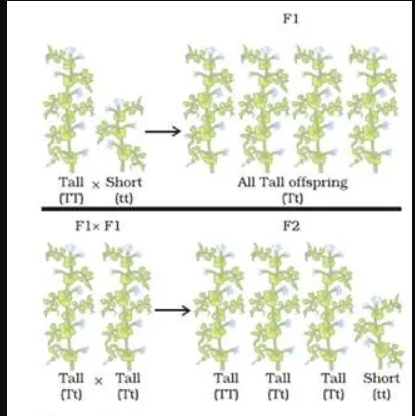
- Approach: Gregor Mendel crossed pea plants with contrasting traits, such as tall and short plants, and observed their offspring.
- F₁ generation: Crossing a tall plant with a short plant produced all tall offspring—no intermediate-height plants appeared.
- F₂ generation: Self-pollinating the F₁ plants produced mostly tall offspring, but about one-quarter were short.
- Conclusion: The F₁ plants carried both tallness and shortness factors, although only tallness was expressed.
Gene — A unit of inheritance; Mendel described the inherited versions controlling traits as factors.
Alleles and the monohybrid cross
- Two copies: For each trait, a sexually reproducing organism has two gene versions, one inherited from each parent; they may be identical or different.
- Cross: A pure tall plant and a pure short plant can be represented as ; all F₁ offspring are and tall.
- F₂ cross: Self-pollinating the F₁ plants gives , producing genotypes in the ratio .
- Phenotypes: Since and are tall while is short, the F₂ phenotype ratio is tall : short.
| Point | Dominant | Recessive |
|---|---|---|
| Expression | Expressed when at least one copy is present. | Expressed only when both copies are recessive. |
| Pea-plant example | Tallness: | Shortness: |
| Genotype examples | or |
A dominant trait does not erase the recessive version: in , tallness is visible, but the plant still carries the shortness allele.
Inheritance of Two Traits
Independent inheritance
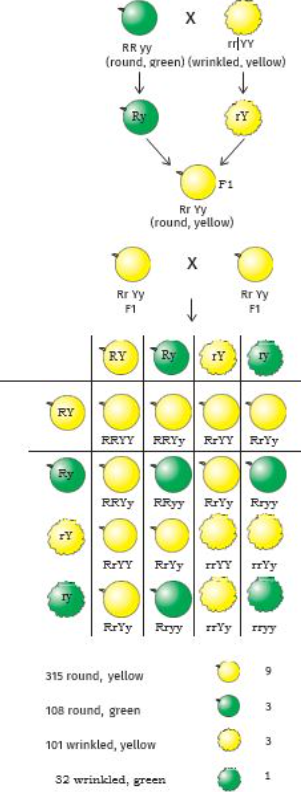
- Dihybrid cross: Tracks two contrasting traits together, such as plant height and seed shape.
- F₁ result: Crossing tall, round-seeded plants with short, wrinkled-seeded plants gives offspring that are all tall with round seeds.
- F₂ result: Self-pollination produces parental combinations and new combinations—tall with wrinkled seeds and short with round seeds.
- Principle: The factors for different traits can be inherited independently and recombine into new combinations in offspring.
Why are all F₁ offspring tall when a tall pea plant is crossed with a short pea plant?
Give the genotypic and phenotypic ratios in the F₂ generation of a tall–short monohybrid cross.
What does the appearance of new combinations in a dihybrid F₂ generation demonstrate?
Quick recap
- Offspring inherit genetic material from both parents and resemble them while showing variation.
- Each sexually reproducing organism has two gene versions for a trait, one from each parent.
- A dominant allele is expressed with one copy; a recessive trait appears only when both copies are recessive.
- A tall–short monohybrid F₂ cross gives a genotype ratio and a phenotype ratio.
- Independent inheritance of two traits can produce new combinations in F₂ offspring.
How Do These Traits Get Expressed?
Genes, Proteins and Traits
- Genes: Sections of DNA that carry information for making proteins.
- Traits: Genes influence characteristics by directing the production of proteins.
Example: Inheritance of Plant Height
How a Gene Can Affect Height
- Gene information affects the enzyme
- Enzyme efficiency affects hormone production
- Hormone amount affects plant growth and height
Chromosomes and Inheritance
- Chromosomes: Separate DNA structures that carry genes.
- Pairs: Body cells contain two copies of each chromosome, one inherited from each parent.
Germ Cells and Fertilisation
Chromosome Inheritance in Sexual Reproduction
- Body cells contain chromosome pairs
- Each germ cell receives one chromosome from every pair
- Male and female germ cells combine
- The offspring has the usual two chromosome sets
Asexual Reproduction
- Inheritance: Asexual reproduction also follows rules of inheritance, though this lecture does not explain its mechanism in detail.
How do genes influence a characteristic such as plant height?
How are chromosome sets passed on during sexual reproduction?
Quick recap
- A gene is a section of DNA that provides information for making a protein.
- Proteins can affect processes that produce an organism’s traits.
- An enzyme’s efficiency can change hormone production and plant height.
- Each chromosome carries genes; genes are not each on separate chromosomes.
- Body cells have two copies of each chromosome, one inherited from each parent.
- Germ cells receive one chromosome from each pair; fertilisation restores two sets.
Sex Determination
Different Ways Sex Is Determined
Sex determination — The process by which an individual's sex is decided; the factors involved vary among species.
| Mode | Factor | Example |
|---|---|---|
| Environmental | Temperature at which fertilised eggs develop | Some reptiles |
| Sex change | An individual can change sex | Snails |
| Genetic | Inherited sex chromosomes largely determine sex | Humans |
Human Sex Chromosomes
Chromosome Pairs
- Autosomes: Humans have 22 pairs of chromosomes with maternal and paternal copies.
- Sex chromosomes: The remaining pair determines sex and is not always a matching pair.
- Women: Have a matching pair of sex chromosomes, .
- Men: Have a mismatched pair, : a normal-sized chromosome and a shorter chromosome.
Inheritance of Sex Chromosomes
How a Child's Sex Is Determined
- Mother's contribution: Every child inherits an chromosome from the mother.
- Father's contribution: The father contributes either an or a chromosome.
- combination: An egg receiving an from the father develops into a girl.
- combination: An egg receiving a from the father develops into a boy.
- Expected outcome: The two possibilities are equally likely, giving an expected half girls and half boys.
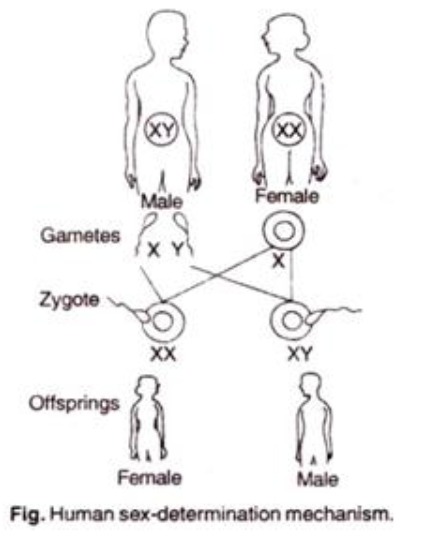
Why does the father's chromosome determine a child's sex in humans?
Quick recap
- Sex determination can depend on environmental conditions, sex change, or inherited genes, depending on the species.
- Humans have 22 pairs of autosomes and one pair of sex chromosomes.
- Women have matching sex chromosomes; men have mismatched chromosomes, with the shorter than the .
- Every child receives an chromosome from the mother.
- A paternal results in offspring (girl); a paternal results in offspring (boy).
- The expected proportion is half girls and half boys.
Science — ALL CHAPTERS
1
CHEMICAL REACTIONS AND EQUATIONS
2
ACIDS, BASES AND SALTS
3
METALS AND NON-METALS
4
CARBON AND ITS COMPOUNDS
5
LIFE PROCESSES
6
CONTROL AND COORDINATION
7
HOW DO ORGANISMS REPRODUCE?
8
HEREDITY
9
LIGHT – REFLECTION AND REFRACTION
10
THE HUMAN EYE AND THE COLOURFUL WORLD
11
ELECTRICITY
12
MAGNETIC EFFECTS OF ELECTRIC CURRENT
13
OUR ENVIRONMENT