Class 10 . Science . Science . The Human Eye and the Colourful World
Chapter 10: THE HUMAN EYE AND THE COLOURFUL WORLD
Ch 10
Science
Class 10
Introduction & the Human Eye
The Eye and the Study of Light
- Vision: The eye uses light to let us see objects and colours around us.
- Chapter focus: Ideas about lenses and refraction help explain vision and optical phenomena such as rainbows and the blue sky.
Structure and Working of the Human Eye
Main parts and their functions
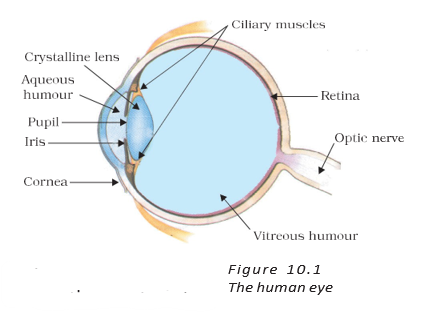
- Eyeball: Approximately spherical, with a diameter of about .
- Cornea: Transparent bulge at the front of the eye; most refraction of incoming light occurs at its outer surface.
- Eye lens: Crystalline lens that makes finer focal-length adjustments to focus objects at different distances.
- Iris and pupil: The dark, muscular iris changes the pupil's size; the pupil controls how much light enters the eye.
- Retina: Delicate, light-sensitive screen where the eye lens forms an inverted, real image.
- Optic nerve and brain: Retinal cells convert light into electrical signals, which travel to the brain for interpretation.
How vision occurs
- Light enters through the cornea and is refracted.
- The eye lens focuses light to form an inverted, real image on the retina.
- Light-sensitive retinal cells generate electrical signals.
- The optic nerve carries the signals to the brain, which interprets them.
Power of Accommodation
Accommodation — The ability of the eye lens to adjust its focal length so that objects at different distances are focused clearly on the retina.
| Point | Distant objects | Nearby objects |
|---|---|---|
| Ciliary muscles | Relax | Contract |
| Eye lens | Becomes thinner; curvature decreases | Becomes thicker; curvature increases |
| Focal length | Increases | Decreases |
| Result | Distant objects are focused on the retina | Nearby objects are focused on the retina |
Near point and far point
- Least distance of distinct vision (near point): The closest distance at which an object can be seen distinctly and comfortably without strain.
- Normal near point: About for a young adult.
- Far point: The farthest point seen clearly; it is infinity for a normal eye.
- Normal vision range: A normal eye sees clearly from about to infinity.
Cataract — A condition in which the eye lens becomes milky and cloudy, causing partial or complete loss of vision; vision can be restored by cataract surgery.
Defects of Vision and Their Correction
- Refractive defects: These occur when light is not focused correctly on the retina, causing blurred vision.
- Correction: Suitable spherical lenses can correct common vision defects.
Myopia (Near-sightedness)
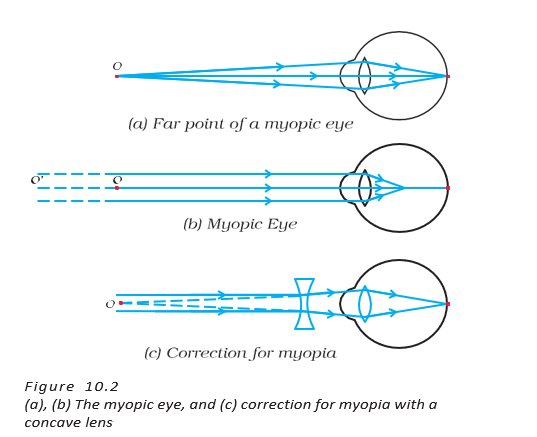
Myopia — A vision defect in which nearby objects are seen clearly but distant objects are not.
Cause and correction
- Far point: It is closer than infinity; the person can see clearly only up to a limited distance.
- Image position: Light from a distant object is focused in front of the retina.
- Causes: The eye lens has excessive curvature, or the eyeball is elongated.
- Correction: A suitable concave (diverging) lens brings the image back onto the retina.
Hypermetropia (Far-sightedness)
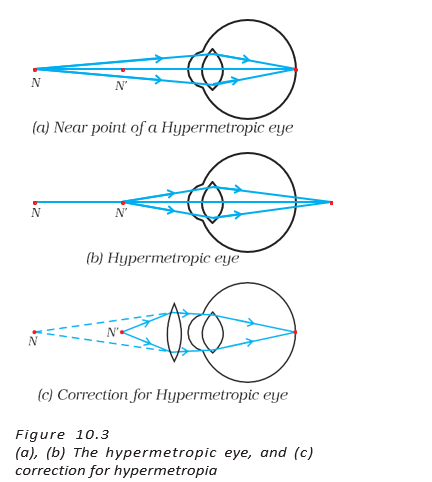
Hypermetropia — A vision defect in which distant objects are seen clearly but nearby objects are not.
Cause and correction
- Near point: It lies farther from the eye than the normal near point of about ; reading material must be held farther away.
- Image position: Light from a nearby object is focused behind the retina.
- Causes: The eye lens has too long a focal length, or the eyeball is too small.
- Correction: A suitable convex (converging) lens supplies extra focusing power and forms the image on the retina.
Presbyopia and Bifocal Lenses
Presbyopia — An age-related defect in which the eye's accommodation decreases and the near point gradually moves farther away.
Causes and correction
- Causes: Ciliary muscles gradually weaken and the eye lens loses flexibility.
- Effect: Nearby objects become difficult to see distinctly and comfortably.
- Bifocal lenses: Used when a person has both myopia and hypermetropia; the upper concave part helps distant vision, while the lower convex part helps near vision.
- Other options: Refractive defects may also be corrected with contact lenses or surgical interventions.
| Defect | What is unclear? | Image position / main cause | Correction |
|---|---|---|---|
| Myopia | Distant objects | Image forms in front of retina; excessive lens curvature or elongated eyeball | Concave lens |
| Hypermetropia | Nearby objects | Image forms behind retina; long focal length or small eyeball | Convex lens |
| Presbyopia | Usually nearby objects as accommodation declines | Age-related weakening of ciliary muscles and reduced lens flexibility | May require suitable corrective lenses; bifocals if combined with myopia |
Do not mix up the lenses: Myopia is corrected with a concave lens; hypermetropia is corrected with a convex lens.
What is accommodation, and how does the eye focus on a nearby object?
State the cause and correction of myopia.
What is presbyopia, and when are bifocal lenses used?
Quick recap
- The cornea causes most refraction; the eye lens makes fine focusing adjustments.
- The retina receives an inverted, real image and sends electrical signals to the brain through the optic nerve.
- A normal young adult eye has a near point of about and a far point at infinity.
- Accommodation changes the eye lens's focal length through the action of ciliary muscles.
- Myopia: distant vision unclear; corrected with a concave lens.
- Hypermetropia: near vision unclear; corrected with a convex lens.
- Presbyopia is age-related loss of accommodation; bifocals can help when myopia and hypermetropia coexist.
Refraction of Light Through a Prism
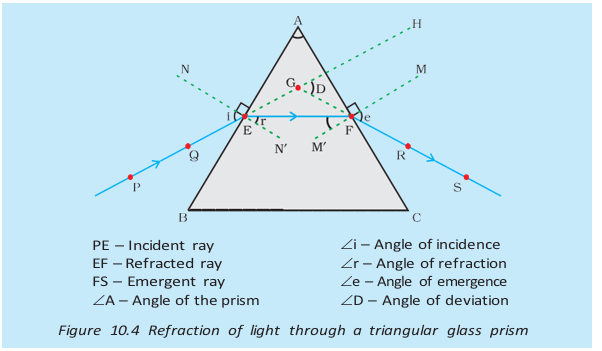
Refraction Through a Triangular Prism
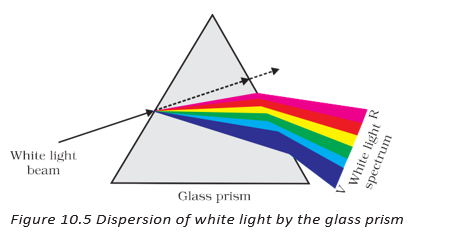
Dispersion of White Light
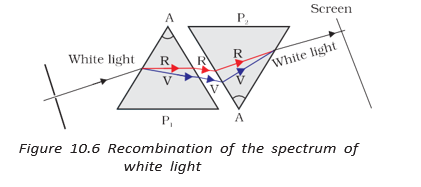
Recombination of Colours
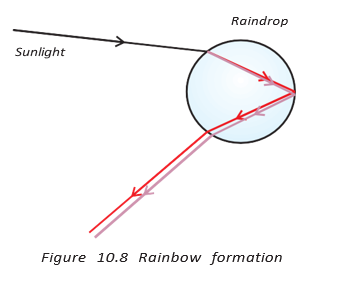
Rainbow Formation
How a Rainbow Forms
- Sunlight enters a water droplet and is refracted and dispersed.
- The light is internally reflected inside the droplet.
- As it exits, the light is refracted again.
- The separated colours reach the observer’s eye, producing a rainbow.
VIBGYOR
Remember the spectrum’s colour order: Violet, Indigo, Blue, Green, Yellow, Orange, Red.
What is dispersion, and why do the colours of white light separate in a prism?
How is a rainbow formed?
Quick recap
- At a prism’s first face, light bends towards the normal; at its second face, it bends away.
- A prism deviates the emergent ray from the incident direction.
- Dispersion splits white light into a spectrum of seven colours in VIBGYOR order.
- Red bends least and violet bends most in a prism.
- Two oppositely placed prisms can recombine the spectrum into white light.
- Rainbows form through dispersion, internal reflection and refraction in water droplets.
Atmospheric Refraction
Atmospheric Refraction
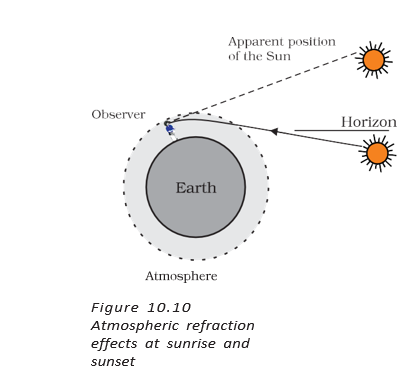
Atmospheric refraction — The bending of light as it passes through layers of Earth’s atmosphere with different refractive indices.
Wavering through hot air
- Hot air above a fire is less dense and has a slightly lower refractive index than the cooler air above it.
- Changing air layers continually alter the path of light, so an object seen through hot air appears to waver.
Twinkling of Stars
Why stars twinkle
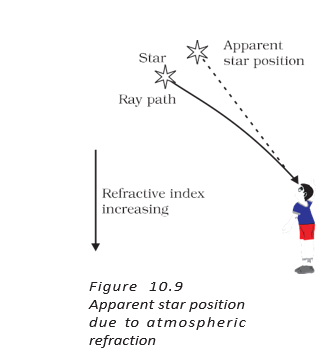
- Refraction: Starlight bends continuously through atmospheric layers whose refractive index changes with height.
- Apparent position: The bending makes a star appear slightly higher than its actual position, especially near the horizon.
- Fluctuation: Changing atmospheric conditions shift the star’s apparent position and vary the starlight entering the eye.
- Point source: A star is very distant and appears point-sized; changing light intensity makes it seem brighter or fainter.
| Point | Stars | Planets |
|---|---|---|
| Appearance | Very distant; seen as point-sized sources. | Closer; seen as extended sources. |
| Twinkling | Atmospheric changes cause noticeable fluctuations in their apparent brightness. | Light from many point-like parts averages out the fluctuations, so planets generally do not twinkle. |
Advance Sunrise and Delayed Sunset
Effect of atmospheric refraction
- Advance sunrise: The Sun becomes visible about 2 minutes before it actually crosses the horizon.
- Delayed sunset: The Sun remains visible about 2 minutes after it has actually crossed below the horizon.
- Sun’s shape: Atmospheric refraction also causes the Sun’s disc to appear flattened at sunrise and sunset.
Scattering of Light
Scattering of light — The redirection of light in different directions when it interacts with particles in a medium.
Scattering in the atmosphere
- Atmosphere: Contains smoke, tiny water droplets, dust and air molecules.
- Visible beam: Light scattered by these particles reaches the eye from different directions, making the beam’s path visible.
- True solution vs colloid: A beam’s path is not visible through a true solution, but can be visible through a colloidal solution because its particles are larger.
Tyndall Effect
Tyndall effect — The scattering of light by colloidal particles, which makes the path of a light beam visible.
Examples and particle-size effect
- Examples: A sunlight beam through a smoke-filled room or through mist under a dense forest canopy is visible because particles scatter light.
- Very fine particles scatter mainly blue light; larger particles scatter longer wavelengths.
- Very large particles can scatter light of many wavelengths, making the scattered light appear white.
Why the Clear Sky Is Blue
Scattering by air molecules
- Particle size: Air molecules and other fine particles are smaller than the wavelengths of visible light.
- Wavelength dependence: These fine particles scatter shorter blue wavelengths much more strongly than longer red wavelengths.
- Result: Scattered blue light reaches our eyes, so the clear sky appears blue.
- Wavelength comparison: Red light has a wavelength about 1.8 times that of blue light.
- No atmosphere: Without atmospheric particles to scatter sunlight, the sky would appear dark; it also appears dark to passengers at very high altitudes where scattering is weak.
Why danger signals are red
- Red light is scattered least by fog and smoke, so it remains visible from a greater distance.
Why do stars twinkle but planets generally do not?
What causes advance sunrise and delayed sunset?
Why does the sky appear blue, and why are danger signals red?
Quick recap
- Atmospheric refraction through changing air layers can make objects appear to waver.
- Stars twinkle because changing refraction alters their apparent position and the starlight reaching the eye.
- Planets generally do not twinkle because their extended light sources average out fluctuations.
- Refraction gives about 2 minutes of advance sunrise and delayed sunset, and flattens the Sun’s disc near the horizon.
- The Tyndall effect is scattering by colloidal particles that makes a beam’s path visible.
- Fine atmospheric particles scatter blue light more strongly; red light is scattered least by fog and smoke.
Science — ALL CHAPTERS
1
CHEMICAL REACTIONS AND EQUATIONS
2
ACIDS, BASES AND SALTS
3
METALS AND NON-METALS
4
CARBON AND ITS COMPOUNDS
5
LIFE PROCESSES
6
CONTROL AND COORDINATION
7
HOW DO ORGANISMS REPRODUCE?
8
HEREDITY
9
LIGHT – REFLECTION AND REFRACTION
10
THE HUMAN EYE AND THE COLOURFUL WORLD
11
ELECTRICITY
12
MAGNETIC EFFECTS OF ELECTRIC CURRENT
13
OUR ENVIRONMENT