Class 12 Humanities . Geography . Fundamentals Of Human Geography . Human Development
Chapter 3: Human Development
Ch 3
Geography
Class 12 Humanities
Growth And Development
Growth and Development
Growth without Development
- Example: A city’s population may rise from one lakh to two lakhs, while housing and basic services remain unchanged.
- Result: The city has grown, but residents’ quality of life has not necessarily improved.
- Negative growth: A city’s size or population can also decline; the Banda Aceh images show a city affected by the December 2004 tsunami.
Human Development
What Makes a Life Meaningful?
- More than longevity: A meaningful life is not simply a long life; it also has purpose.
- Key aspects: People should be healthy, develop their talents, participate in society and be free to pursue their goals.
- Examples: Education, achievement and work that contributes positively to others can be part of a meaningful life.
Key Thinkers and the Human Development Approach
- Mahbub-ul-Haq: Introduced the concept of human development and created the HDI in 1990.
- Amartya Sen: Viewed increased freedom, or reduced unfreedom, as the main objective of development.
- Freedom and development: Sen emphasised that expanding freedoms is both a goal of development and an effective way to bring it about.
- Institutions: Social and political institutions and processes can help expand people’s freedoms.
Development of the Human Development Approach
- Late 1980s and early 1990sThe importance of quality of life, opportunities and freedoms was clearly articulated in development thinking.
- 1990Mahbub-ul-Haq created the Human Development Index.
- Since 1990The United Nations Development Programme has published the Human Development Report annually, using Haq’s human development concept.
Capabilities, Choices and Human Development
How Capabilities Expand Choices
- Improve access to health, education and resources
- Build people’s capabilities
- Enable wider choices and greater freedom
- Support healthier, more informed and more decent lives
Example: Beti Bachao Beti Padhao
- Purpose stated in the text: The Government of India introduced the programme to address the decline in the child sex ratio.
- Human development link: Supporting girls’ survival and education can strengthen their capabilities and expand their future choices.
Distinguish between growth and development.
What is the main aim of human development?
How can lack of capability limit a person’s choices?
Quick recap
- Growth is quantitative and value-neutral; development is qualitative and value-positive.
- Growth can occur without development when quality of life does not improve.
- Human development places people, their choices, opportunities and freedoms at the centre.
- A meaningful life includes health, purpose, talent development, participation and freedom.
- Mahbub-ul-Haq introduced the human development concept and created the HDI in 1990; Amartya Sen stressed freedom.
- Health, education and access to resources build capabilities and widen people’s choices.
Four Pillars Of Human Development
The Four Pillars
- Human development rests on four pillars: equity, sustainability, productivity and empowerment.
Equity
Equity — Ensuring that everyone has equal access to opportunities, regardless of gender, race, income or caste.
- Unequal access is common in societies and can restrict people’s choices.
- Education example: Many women and people from socially and economically disadvantaged groups in India leave school.
- Effect: Limited access to education and knowledge can narrow future choices and opportunities.
Sustainability
Sustainability — Maintaining the continuity of opportunities so that future generations have opportunities comparable to those available today.
- Resource use: Manage environmental, financial and human resources with future generations in mind.
- Misuse of resources reduces the opportunities available to people in the future.
- Example: If girls are not encouraged to attend school, their later career choices and other life opportunities may be restricted.
Productivity
Productivity — The productivity of human labour, strengthened by building people’s capabilities.
- People are the real wealth of nations.
- Building capabilities: Better knowledge and health facilities help people work more efficiently.
- Result: Developing people’s abilities can raise human work productivity.
Empowerment
Empowerment — Giving people the power to make choices by increasing their freedom and capabilities.
- Enabling conditions: Good governance and people-oriented policies support empowerment.
- Priority: Empowering socially and economically disadvantaged groups is especially important.
- Outcome: Greater freedom and capability allow people to make meaningful choices.
Name the four pillars of human development.
How does education support equity and sustainability?
How can productivity and empowerment be strengthened?
Quick recap
- Equity means fair access to opportunities, regardless of social or economic background.
- Sustainability protects opportunities for future generations through responsible resource use.
- Productivity grows when people’s capabilities, knowledge and health improve.
- Empowerment enables people to make choices through greater freedom and capability.
- Good governance and people-oriented policies help empower disadvantaged groups.
Approaches To Human Development
Four Approaches to Human Development
| Approach | Main idea | Key points |
|---|---|---|
| Income | Human development is linked to income. | Income is seen as reflecting the freedom a person enjoys; higher income is associated with higher human development. |
| Welfare | People are beneficiaries of development activities. | Calls for greater government expenditure on education, health, social security and amenities. People are passive recipients, not participants. |
| Basic needs | Development focuses on providing essential needs. | Initially proposed by the International Labour Organisation (ILO). Identifies health, education, food, water supply, sanitation and housing; human choices are ignored. |
| Capability | Development depends on building people’s capabilities. | Associated with Professor Amartya Sen. Emphasises capabilities in health, education and access to resources. |
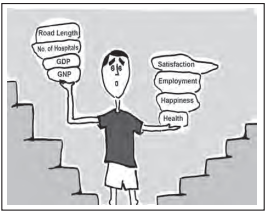
Measuring Human Development
Human Development Index (HDI) — An index that ranks countries by their achievements in health, education and access to resources.
| Dimension | Indicator | What it reflects |
|---|---|---|
| Health | Life expectancy at birth | The chance of living longer and healthier lives. |
| Education | Adult literacy rate and gross enrolment ratio | Adults’ ability to read and write, and children’s access to schooling. |
| Access to resources | Purchasing power, measured in U.S. dollars | People’s access to economic resources. |
Interpreting HDI
- Equal weighting: Each of the three dimensions receives a weight of .
- Scale: Country scores range from to ; a score closer to indicates higher human development.
- Examples: A score of indicates a very high level, while indicates a very low level.
- Limitation: HDI shows achievements in key areas but does not show how those achievements or resources are distributed within a country.
Human Poverty Index (HPI) — A non-income measure of shortfalls in human development.
What the HPI considers
- Survival: Probability of not surviving until age .
- Education: Adult illiteracy rate.
- Living conditions: People without access to clean water.
- Nutrition: Number of small children who are underweight.
- Use: HPI can reveal deprivation more clearly than HDI; considering both gives a fuller picture of a country’s human development.
| Point | HDI | HPI |
|---|---|---|
| Measures | Achievements in health, education and access to resources. | Shortfalls in human development. |
| Focus | A country’s overall attainment in key dimensions. | Non-income deprivation, including survival, literacy, clean water and child nutrition. |
| Using both | Combining HDI and HPI gives a more complete picture of a country’s human development. | Combining HPI and HDI gives a more complete picture of a country’s human development. |
UNDP reporting
- Since 1990The United Nations Development Programme (UNDP) has published the Human Development Report annually, ranking member countries by human development.
Beyond HDI and HPI
- Ongoing research: Measures are continually refined to capture more aspects of human development.
- Other possible links: Researchers examine how human development relates to corruption and political freedom; political-freedom measures and corruption rankings have also been discussed.
Gross National Happiness
Bhutan’s approach
- Gross National Happiness (GNH): Bhutan is the only country to officially use GNH as a measure of national progress.
- Core idea: Material progress should not come at the cost of happiness, the environment, or cultural and spiritual life.
- Emphasis: GNH includes spiritual, non-material and qualitative aspects of development.
Name the three HDI dimensions and their indicators.
Why is HPI often more revealing than HDI?
Quick recap
- Human development is viewed through income, welfare, basic-needs and capability approaches.
- HDI assesses health, education and access to resources, with each dimension assigned equal weight.
- An HDI score nearer signals higher human development, but HDI does not show distribution.
- HPI measures non-income shortfalls, including survival, literacy, clean water and child nutrition.
- UNDP has published its annual Human Development Report since 1990; HDI and HPI are key measures.
- Bhutan’s GNH approach includes happiness and the environmental, cultural and spiritual dimensions of progress.
International Comparisons
Comparing Human Development
International comparison — Comparing human development across countries helps reveal differences in outcomes and the factors linked to them.
Why size and income are not enough
- Territory and income: Neither a country’s size nor its per capita income is directly related to its human development level.
- International examples: Sri Lanka and Trinidad and Tobago rank above India in HDI despite having smaller economies.
- Within India: Kerala performs better in human development than Punjab and Gujarat despite having lower per capita income.
Human Development Categories
| Development level | HDI score | Number of countries |
|---|---|---|
| Very high | Above | 69 |
| High | to | 49 |
| Medium | to | 42 |
| Low | Below | 33 |
The lecture gives different category counts in its table and descriptive text. It explicitly links the figure of 66 very-high-HDI countries to the 2021–22 report; it does not explain the differences in the high- and medium-category counts, so do not assume their cause.
Features of the Development Groups
| Level | Key characteristics |
|---|---|
| Very high | Score above . The lecture says the 2021–22 report included 66 countries in this group. |
| High | The descriptive text states 50 countries. Education and healthcare are government priorities; investment in people and good governance help distinguish this group. Many are industrialised western countries, often in Europe, and former imperial powers. Social diversity is often comparatively low, though non-European countries are also included. |
| Medium | The descriptive text states 53 countries and calls this the largest group. Many emerged after the Second World War; some were former colonies, while others emerged after the Soviet Union broke up. People-oriented policies and reduced social discrimination have helped some improve. Social diversity is often higher, and some have experienced political instability or uprisings. |
| Low | The descriptive text states 33 countries. Many are small countries affected by political turmoil and social instability, including civil war, famine or a high incidence of disease. Well-planned policies are urgently needed. |
Top-Ranked Very High HDI Countries
| Rank | Country |
|---|---|
| 1 | Switzerland |
| 2 | Norway |
| 3 | Iceland |
| 4 | Hong Kong, China (SAR) |
| 5 (tie) | Denmark; Sweden |
| 7 (tie) | Germany; Ireland |
| 9 | Singapore |
| 10 (tie) | Australia; Netherlands |
India and Uneven Global Progress
- India’s HDI: After a drop in 2021, its value rose from to in 2022, placing India in the medium category; India ranked 134th out of 193 countries.
- Gender inequality: India’s 2022 Gender Inequality Index value was , below the global average of and the South Asian average of .
- Global pattern: Global HDI was projected to reach a record high in 2023, but progress was uneven: rich countries reached record levels while half of the poorest countries remained below pre-crisis levels.
- Consequences: Uneven progress leaves the poorest behind, worsens inequality and contributes to political polarisation and global gridlock; collective action is urgently needed.
Dates in the lecture
- After the Second World WarMany countries in the medium human development group emerged during the post-war period.
- 1991The Soviet Union broke up; some countries that emerged after its dissolution are described as part of the medium group.
- 2021India’s HDI dropped before its subsequent rise.
- 2022India’s HDI rose to and its Gender Inequality Index value was .
- 2023Global HDI was projected to reach a record high, despite uneven progress.
- March 14, 2024The report described India’s HDI progress and its rank of 134 out of 193 countries.
Why Human Development Levels Differ
Avoid cultural stereotypes
- Misleading explanation: Blaming low human development on people’s religion or community is not a sound explanation.
- Relevant factors: Examine government spending on the social sector, the political environment, people’s freedom and how equitably resources are distributed.
Factors linked to higher human development
- Government prioritises education, healthcare and other social sectors
- Greater investment in people and good governance
- Resources are distributed more equitably and people have greater freedom
- Political turmoil and instability are generally limited
- Human development outcomes tend to be higher
| Factor | Higher human development | Lower human development |
|---|---|---|
| Public spending | Greater investment in social sectors | More spending on defence than on social sectors |
| Political conditions | Generally free from political turmoil and instability | Political instability and turmoil are more common |
| Resource distribution | More equitable | Less equitable distribution can hinder development |
| Economic development | Investment in people supports development | Countries may not have initiated accelerated economic development |
- Human Development Index (HDI)
- An index used to compare countries’ levels of human development.
- Social sector
- Public services such as education and healthcare that support people’s well-being.
- Gender Inequality Index
- An index reporting gender inequality; India’s value in 2022 was .
Why are country size and per capita income insufficient to explain human development?
What factors help explain differences in human development levels?
Quick recap
- Country size and per capita income do not directly determine human development.
- HDI categories are very high, high, medium and low, based on score ranges.
- Category counts differ between the table and descriptive text; only the 66-country very-high count is explicitly linked to the 2021–22 report.
- Education, healthcare, good governance and investment in people support higher human development.
- Political instability, low social-sector spending and unequal resource distribution can hinder development.
- India’s HDI rose to in 2022, placing it in the medium category.
Geography — ALL CHAPTERS
1
Human Geography Nature And Scope
2
The World Population Distribution, Density And Growth
3
Human Development
4
Primary Activities
5
Secondary Activities
6
Tertiary And Quaternary Activities
7
Transport And Communication
8
International Trade
1
UNIT -I POPULATION DISTRIBUTION ,DENSITY, GROWTH AND COMPOSITION
2
UNIT -II HUMAN SETTLEMENTS
3
UNIT- III LAND RESOURCES AND AGRICULTURE
4
UNIT -III WATER RESOURCES
5
UNIT - III MINERAL AND ENERGY RESOURCES
6
UNIT -III PLANNING AND SUSTAINABLE DEVELOPMENT IN INDIAN CONTEXT
7
UNIT -IV TRANSPORT AND COMMUNICATION
8
UNIT -IV INTERNATIONAL TRADE
9
UNIT - V GEOGRAPHICAL PERSPECTIVE ON SELECTED ISSUES AND PROBLEMS