Class 12 Humanities . Geography . Fundamentals Of Human Geography . International Trade
Chapter 8: International Trade
Ch 8
Geography
Class 12 Humanities
History Of International Trade
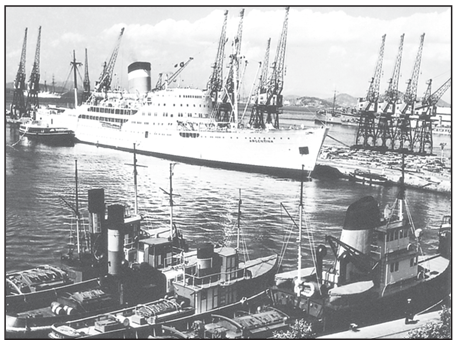
Trade and Its Early Forms
Trade — The voluntary exchange of goods and services between parties; it is mutually beneficial to both the seller and the purchaser.
International trade — The exchange of goods and services between countries across national boundaries.
Why countries trade
- Need: Countries trade for goods and services they cannot produce themselves.
- Lower cost: They may buy from another country when it can supply a commodity more cheaply.
- Levels: Trade takes place nationally as well as internationally.
Barter system — A direct exchange of goods or services without using money.
Barter and the use of money
- Barter example: A potter needing plumbing services had to find a plumber who wanted pots.
- Limitation: Exchange depended on both parties wanting what the other offered.
- Money: Money overcame barter's difficulties. Before coins and paper currency, scarce or valuable objects served as money.
- Examples of early money: Flintstones, obsidian, cowrie shells, animal teeth and paws, skins, furs, cattle, rice, peppercorns, salt, tools, copper, silver and gold.
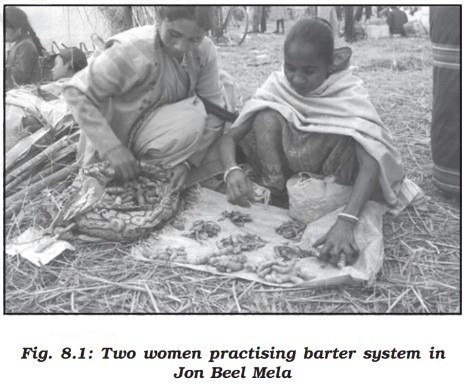
Jon Beel Mela
- Location: Jagiroad, about 35 km from Guwahati.
- Significance: Held each January after harvest, it is possibly India's only fair where barter remains in use; people from different tribes and communities exchange products.
Development of International Trade
Major stages in trade history
- Ancient timesRisky long-distance transport kept most trade local; wealthy people traded luxury goods such as jewellery and costly clothing.
- Early long-distance tradeThe Silk Route linked Rome and China over about 6,000 km, carrying silk, wool, precious metals and other valuable goods through India, Persia and Central Asia.
- Twelfth and thirteenth centuriesEuropean commerce grew after the Roman Empire's disintegration; ocean-going warships expanded trade between Europe and Asia, and the Americas were discovered.
- Fifteenth century onwardsEuropean colonialism expanded trade in exotic goods and introduced slave trading.
- 1792Denmark abolished the slave trade.
- 1807Great Britain abolished the slave trade.
- 1808The United States abolished the slave trade.
- After the Industrial RevolutionDemand for raw materials such as grains, meat and wool increased, although their monetary value declined relative to manufactured goods. Industrial nations imported primary products and exported finished goods.
- Later half of the nineteenth centuryRegions producing primary goods became less important in trade, while industrial nations became one another's main customers.
- World Wars I and IICountries imposed trade taxes and quantitative restrictions.
- Post-war periodThe General Agreement for Tariffs and Trade (GATT), later the World Trade Organisation (WTO), helped reduce tariffs.
Colonialism and the slave trade
- European colonial expansion from the fifteenth century
- Portuguese, Dutch, Spanish and British traders captured African people
- Enslaved people were forcibly transported to the Americas
- Their labour was used on plantations; the trade remained lucrative for over 200 years
- The slave trade was abolished in Denmark (1792), Great Britain (1807) and the United States (1808)
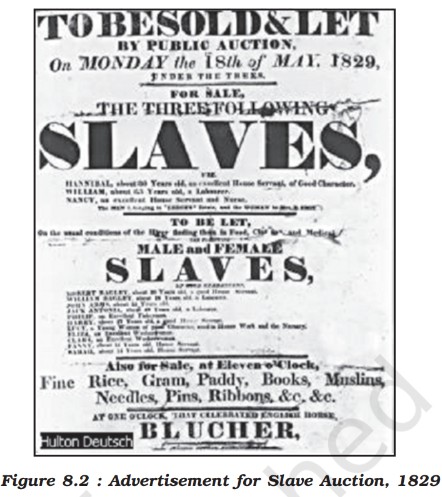
Slave auctions
- Price example: Buyers could pay as much as US2,000 for a skilled, healthy enslaved person.
- Human cost: Auctions often separated family members, who might never see one another again.
| Point | Primary goods | Manufactured goods |
|---|---|---|
| Examples and demand | Grains, meat and wool; demand expanded after the Industrial Revolution | Finished, value-added products |
| Trade role | Exported by non-industrialised regions as raw materials | Produced by industrialised nations and exported as finished products |
| Relative value | Monetary value declined relative to manufactured goods | Greater value was added through processing and manufacture |
| Later nineteenth century | Producing regions became less important in trade | Industrial nations increasingly became each other's main customers |
Trade restrictions and tariff reduction
- World Wars I and II: Governments introduced trade taxes and quantitative restrictions.
- Post-war cooperation: GATT worked to reduce tariffs and later became the WTO.
Why International Trade Exists
Specialisation — Concentrating production on particular goods or services, which creates a basis for exchange between countries.
Basis and benefits of international trade
- Specialisation and division of labour: Countries focus on particular production or services, supporting a more efficient world economy.
- Comparative advantage: Trade is based on countries specialising where they have an advantage.
- Complementarity: Countries trade when their needs and outputs fit together.
- Transferability: Goods and services must be capable of being moved or supplied between trading partners.
- Mutual benefit: In principle, international trade benefits both partners.
- Modern importance: Trade is a basis of the world's economic organisation and is connected with nations' foreign policies. Developed transport and communication systems make participation in international trade important.
- Barter
- Direct exchange of goods or services without money.
- Primary goods
- Raw materials and basic products, such as grains, meat and wool.
- Tariff
- A tax imposed on traded goods.
- Quantitative restriction
- A limit on the quantity of goods that may be traded.
- Comparative advantage
- An advantage that supports a country's specialisation and trade in particular goods or services.
How did trade change after the Industrial Revolution?
What are the main principles underlying international trade?
Why is international trade important in modern times?
Quick recap
- Trade is the mutually beneficial voluntary exchange of goods and services; international trade crosses national boundaries.
- Barter was an early trade system, while money helped overcome the need for each party to want the other's goods; Jon Beel Mela preserves barter in India.
- The Silk Route connected Rome and China; ocean trade and European colonial expansion later widened trade networks.
- The slave trade forcibly transported Africans to plantations in the Americas and was abolished in Denmark (1792), Great Britain (1807) and the United States (1808).
- After the Industrial Revolution, demand for primary goods rose, but their value declined relative to manufactured goods; industrial nations imported raw materials and exported finished goods.
- GATT, later the WTO, helped reduce tariffs; trade is based on specialisation, comparative advantage, complementarity and transferability.
- Modern international trade supports world economic organisation and is linked to nations' foreign policies.
Basis Of International Trade
Differences in National Resources
Differences in national resources — Unevenly distributed geology, relief, soils and climate give countries different resources and production opportunities.
How physical resources shape trade
- Geological structure: Determines a region’s mineral-resource base; differences in relief produce varied landscapes.
- Relief: Topographical differences support diversity in the crops and animals raised. Lowlands generally have greater agricultural potential, while mountains can attract tourists.
- Minerals: Their uneven distribution provides a basis for industrial development.
- Climate: Influences which flora and fauna can survive and the products that can be produced. Cold regions can produce wool; tropical regions can grow bananas, rubber and cocoa.
Population Factors
Population factors — The size, distribution and diversity of a country’s population influence the types and volumes of goods it trades.
Culture, population size and demand
- Culture: Distinctive arts and crafts can become valued exports—for example, Chinese porcelain and brocades, Iranian carpets, North African leatherwork and Indonesian batik.
- Population size: Densely populated countries often have substantial internal trade but less external trade, as much agricultural and industrial production is consumed in local markets.
- Standard of living: It shapes demand for better-quality imported goods. With a low standard of living, fewer people can afford costly imports.
Stage of Economic Development
Stage of economic development — A country’s level of economic development influences the kinds of goods it exports and imports.
| Country type | Typical exports | Typical imports |
|---|---|---|
| Agriculturally important | Agricultural products | Manufactured goods |
| Industrialised | Machinery and finished products | Food grains and other raw materials |
Extent of Foreign Investment
Foreign investment — Investment from another country can provide developing countries with capital to establish industries and expand trade.
Investment and trade
- Capital-intensive industries: Mining, oil drilling, heavy engineering, lumbering and plantation agriculture require substantial investment.
- Investing countries’ interests: Industrial nations can secure imports of foodstuffs and minerals and create markets for their finished products.
How Foreign Investment Expands Trade
- Foreign capital enters a developing country → capital-intensive industries are developed.
- Industrial production and extraction grow → foodstuffs and minerals become available to investing countries.
- Investing countries sell finished products in the developing country → markets and trade between nations expand.
Transport
Transport — Transport and preservation methods affect the distance over which goods can be traded and the volume of trade.
| Point | Earlier conditions | Later developments |
|---|---|---|
| Transport and trade | Inadequate transport restricted trade mainly to local areas; long-distance trade focused on high-value goods such as gems, silk and spices. | Rail, ocean and air transport expanded the distance over which goods could be traded. |
| Preservation | Limited refrigeration and preservation restricted the movement of goods. | Improved refrigeration and preservation helped expand trade spatially. |
- Internal trade
- Trade in goods within a country.
- Foreign investment
- Capital invested across national borders, which can support industrial development and trade.
- Capital-intensive industries
- Industries that require substantial investment, such as mining and heavy engineering.
Quick recap
- Differences in geology, relief, minerals and climate shape a country’s resources and production.
- Topographical differences support diversity in crops and animals; lowlands favour agriculture and mountains can promote tourism.
- Population size, culture and living standards affect traded goods and demand for imports.
- Agricultural countries often exchange farm products for manufactured goods; industrialised countries export machinery and finished products.
- Foreign investment can develop capital-intensive industries, secure resources and create markets, increasing trade.
- Improved transport and preservation have expanded trade beyond local areas.
Balance Trade And Types Of International Trade
Balance of Trade and Balance of Trade Position
Balance of trade — The balance of trade records the value of a country's goods and services imported and exported.
| Point | Favourable / Positive | Unfavourable / Negative |
|---|---|---|
| Value comparison | Exports exceed imports | Imports exceed exports |
| Economic implication | The country earns more from exports than it spends on imports. | The country spends more buying goods than it earns from selling them; continued deficits may exhaust financial reserves. |
Types of International Trade
| Point | Bilateral Trade | Multilateral Trade |
|---|---|---|
| Trading partners | Trade between two countries. | Trade involving many countries; one country can trade with several partners. |
| Arrangement | The two countries may agree to exchange specified commodities. | A country may grant some trading partners Most Favoured Nation (MFN) status. |
| Example | Country A exchanges specified raw materials with country B for another agreed item. | One country trades with a number of other countries. |
Free Trade and Trade Liberalisation
Free trade / trade liberalisation — Opening an economy to international trade by reducing barriers such as tariffs.
Benefits and Concerns
- Competition: Liberalisation allows goods and services from different countries to compete with domestic products and services.
- Faster trade: Improved transport and communication enable goods and services to travel farther and faster.
- Unequal conditions: Globalisation and free trade can disadvantage developing economies when trading conditions are unfavourable.
- Unequal market access: Rich countries may gain access to other markets while keeping their own markets protected, leaving developing countries without an equal playing field.
Dumping and Anti-Dumping Concerns
Dumping — Selling a commodity in two countries at different prices for reasons unrelated to its costs.
Why Dumping Matters
- Risk to producers: Cheaper dumped goods can harm domestic producers, so countries need to monitor them even under free trade.
- Example: The United States imposed anti-dumping duties on shrimp imports from India, Thailand, China, Brazil, Ecuador and Vietnam in July 2004.
- Trade dispute: India and Thailand challenged US anti-dumping duties and customs bond requirements on shrimp imports; the WTO established a panel to examine the dispute.
- Impact on India: The US was the second-largest importer of Indian marine products, so the measures seriously affected India's exports to that market.
- Tariff
- A trade barrier or duty that can be reduced to liberalise trade.
- Most Favoured Nation (MFN)
- A status that a country may grant to some of its multilateral trading partners.
- Anti-dumping duty
- A duty imposed to address harmful dumping of imported goods.
How can a negative balance of trade affect a country's economy?
What is dumping, and why can it concern trading nations?
Quick recap
- The balance of trade records the value of imports and exports of goods and services.
- Imports exceeding exports create an unfavourable balance; continued deficits can exhaust financial reserves.
- Bilateral trade is between two countries; multilateral trade involves several countries and may include MFN status for some partners.
- Free trade lowers barriers such as tariffs and allows imported goods and services to compete with domestic products.
- Unequal trading conditions, including rich countries protecting their markets while entering others, can disadvantage developing economies.
- Dumping means selling the same commodity in different countries at prices that differ for reasons unrelated to costs; cheaper dumped goods may harm domestic producers.
World Trade Organization And Regional Trade Blocs, Concerns Related
World Trade Organization (WTO)
Purpose and functions
- Purpose: GATT was formed to liberalise world trade by reducing high customs tariffs and other restrictions.
- Functions: The WTO sets rules for the global trading system and resolves disputes between member nations.
- Scope: It also covers services such as telecommunications and banking, and issues such as intellectual property rights.
- Headquarters: The WTO is based in Geneva, Switzerland; India was one of its founding members.
- Membership: The WTO had 164 member countries as of December 2024.
From GATT to WTO
- 1948Some countries formed the General Agreement for Tariffs and Trade (GATT) to liberalise world trade.
- 1994Member countries decided to establish a permanent institution to promote free and fair trade.
- 1 January 1995GATT was transformed into the World Trade Organization.
- December 2024The WTO had 164 member countries.
Criticism of the WTO
Concerns about free trade and globalisation
- Unequal gains: Critics argue free trade may not improve ordinary people’s lives and can widen the gap between rich and poor.
- Influence: Powerful nations may use the WTO to prioritise their own commercial interests.
- Market access: Many developed countries have not fully opened their markets to products from developing countries.
- Social concerns: Critics say health, workers’ rights, child labour and environmental issues are often ignored.
Regional Trade Blocs
Purpose and trade-offs
- Formation: Blocs encourage trade among geographically close countries with similar or complementary trading items.
- Aim: They promote intra-regional trade and help curb restrictions on trade affecting the developing world.
- Scale: About 120 regional trade blocs generate 52% of world trade.
- Why they grew: They developed partly because global organisations failed to speed up trade within regions.
- Trade-off: Blocs remove tariffs among members, but trade between different blocs may become more difficult.
Benefits and Risks of International Trade
| Point | Potential benefits | Potential harms |
|---|---|---|
| Economic effects | Regional specialisation and higher production | Dependence on other countries and uneven development |
| People and markets | Better living standards; worldwide availability of goods and services; equalisation of prices and wages | Exploitation and commercial rivalry that may lead to wars |
| Knowledge and culture | Diffusion of knowledge and culture | — |
Environmental and Health Concerns
How expanding trade can harm the environment
- Countries compete to increase trade and production.
- Natural-resource use rises, sometimes faster than resources can be replenished.
- Marine life declines, forests are cut down, and river basins may be sold to private drinking-water companies.
- Multinational corporations in oil, gas, mining, pharmaceuticals and agribusiness expand operations, often increasing pollution.
- If profit is prioritised and environmental and health concerns are ignored, serious future impacts may result.
Sustainability concern
- Impact: Global trade can affect the environment, health and people’s well-being worldwide.
- Risk: Some multinational corporations expand operations without following sustainable-development norms.
- Key concern: Trade and production that focus only on profit can cause serious long-term harm if environmental and health issues are not addressed.
What are the main functions of the WTO?
Why have regional trade blocs developed, and what is one possible drawback?
State two benefits and two risks of international trade.
Quick recap
- WTO: GATT began in 1948; it became the WTO on 1 January 1995.
- WTO role: It is the only international organisation dealing with global rules of trade; it sets rules and resolves disputes.
- WTO criticism: Critics cite unequal gains, limited market access for developing countries and neglected social and environmental concerns.
- Trade blocs: About 120 blocs generate 52% of world trade; they boost intra-regional trade but may hinder trade between blocs.
- Trade benefits: Specialisation can increase production, improve living standards and spread goods, knowledge and culture.
- Trade risks: Dependence, uneven development, exploitation, rivalry and unsustainable resource use can cause serious harm.
Gateways Of International Trade Port
Ports: Gateways of International Trade
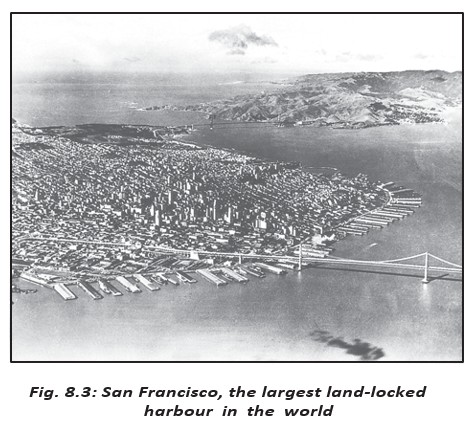
Types of Ports by Cargo Handled
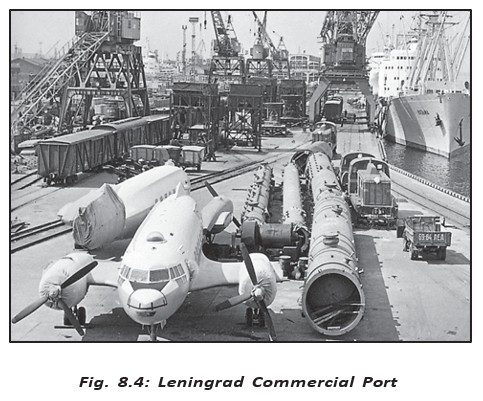
Types of Ports by Location
- Inland ports: Located away from the coast and connected to the sea by a river or canal; they are accessible to flat-bottomed ships or barges.
- Out ports: Deep-water ports built away from the main port to serve large ships that cannot approach it.
Types of Ports by Specialised Functions
- Oil ports: Specialise in processing and shipping oil; they include tanker ports and refinery ports.
- Ports of call: Developed as stops on sea routes for refuelling, water and food supplies; examples include Aden, Honolulu and Singapore.
- Packet stations: Ferry ports that carry passengers and mail over short distances, usually in pairs across a water body.
- Entrepot ports: Collection centres where goods from different countries are assembled for export; examples include Singapore and Rotterdam.
- Naval ports: Serve warships and provide repair facilities; Kochi and Karwar are examples in India.
Quick recap
- Ports are gateways for international cargo and passenger movement, providing docking, cargo handling and storage.
- Port importance depends on cargo volume and ships handled; cargo volume also indicates hinterland development.
- Cargo types: Industrial ports handle bulk goods, commercial ports handle general cargo and passengers, and comprehensive ports handle both at scale.
- Location types: Inland ports connect to the sea by river or canal; out ports serve parent ports by receiving large ships.
- Specialised ports include oil ports, ports of call, packet stations, entrepot ports and naval ports.
Geography — ALL CHAPTERS
1
Human Geography Nature And Scope
2
The World Population Distribution, Density And Growth
3
Human Development
4
Primary Activities
5
Secondary Activities
6
Tertiary And Quaternary Activities
7
Transport And Communication
8
International Trade
1
UNIT -I POPULATION DISTRIBUTION ,DENSITY, GROWTH AND COMPOSITION
2
UNIT -II HUMAN SETTLEMENTS
3
UNIT- III LAND RESOURCES AND AGRICULTURE
4
UNIT -III WATER RESOURCES
5
UNIT - III MINERAL AND ENERGY RESOURCES
6
UNIT -III PLANNING AND SUSTAINABLE DEVELOPMENT IN INDIAN CONTEXT
7
UNIT -IV TRANSPORT AND COMMUNICATION
8
UNIT -IV INTERNATIONAL TRADE
9
UNIT - V GEOGRAPHICAL PERSPECTIVE ON SELECTED ISSUES AND PROBLEMS