Class 12 Humanities . Geography . India People And Economy . Unit V Geographical Perspective on Selected Issues and Problems
Chapter 9: UNIT - V GEOGRAPHICAL PERSPECTIVE ON SELECTED ISSUES AND PROBLEMS
Ch 9
Geography
Class 12 Humanities
Introduction ,types and Sources of Pollution
Environmental Pollution
- Environmental pollution: The release of substances and energy from human activities that contaminate the environment.
- Types: Pollution is classified by the medium through which pollutants are transported and diffused: air, water, land and noise.
Water Pollution
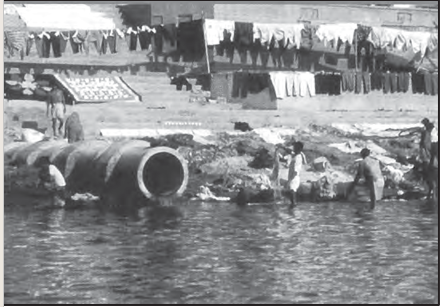
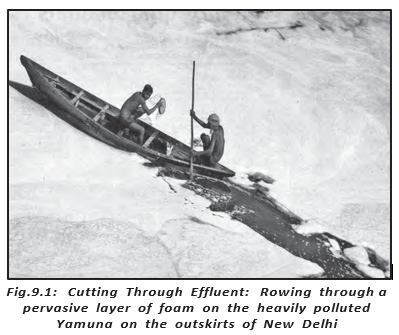
Sources and Effects of Water Pollution
| River and states | Polluted stretches | Nature of pollution | Main polluters |
|---|---|---|---|
| Ganga — Uttar Pradesh, Bihar and West Bengal | Downstream of Kanpur; downstream of Varanasi; Farrakka Barrage. | Industrial pollution from towns such as Kanpur; domestic waste from urban centres; carcasses dumped in the river. | Kanpur, Prayagraj, Varanasi, Patna and Kolkata release domestic waste into the river. |
| Yamuna — Delhi and Uttar Pradesh | Delhi to its confluence with the Chambal; Mathura and Agra. | Water extraction by Haryana and Uttar Pradesh for irrigation; agricultural runoff with high levels of micro-pollutants; domestic and industrial waste from Delhi. | Delhi dumps domestic waste into the river. |
Health Effects and River-Cleaning Efforts
- Pollutant
- A substance or form of energy released into the environment that contributes to pollution.
- Self-purification
- The limited natural capacity of water to reduce pollution.
- Water-borne disease
- A disease spread through contaminated water.
- Micro-pollutant
- A pollutant present in water in very small amounts.
What are the main human sources of water pollution?
How do agricultural chemicals pollute water?
Quick recap
- Pollution is classified by its medium: air, water, land or noise.
- Water becomes polluted when pollutant levels exceed its limited self-purifying capacity.
- Industry, agriculture and cultural activities are human sources of water pollution; industry is the leading contributor.
- Industrial, agricultural and domestic wastes pollute rivers, including the Ganga and Yamuna.
- Water pollution can cause diarrhoea, intestinal worms and hepatitis; about one-fourth of communicable diseases in India are water-borne.
- The National Mission for Clean Ganga and Namami Gange Programme aim to improve the Ganga's condition.
Air Pollution and Noise Pollution
Air Pollution
Air pollution — The addition of contaminants to the air in substantial amounts and for long enough to harm living things or property.
Sources, pollutants and effects
- Main sources: Burning fossil fuels, mining and industrial activities; increased fuel use has raised toxic emissions.
- Pollutants: Sulphur and nitrogen oxides, hydrocarbons, carbon dioxide, carbon monoxide, lead and asbestos.
- Health effects: Air pollution can cause diseases of the respiratory, nervous and circulatory systems.
- Urban smog: Smoky fog over cities caused by atmospheric pollution; it is harmful to human health.
- Acid rain: Air pollution can make rain acidic. The first rain after summer has a lower pH than later rains.
Air pollution: sources to impacts
- Fossil-fuel combustion, mining and industry release contaminants into the air.
- These contaminants pollute the atmosphere.
- Exposure can cause disease and urban smog; air pollution can also contribute to acid rain.
Namami Gange Programme
Namami Gange Programme — A Union Government programme to clean the nationally important Ganga by controlling pollution in its water.
Programme objectives
- Sewage: Develop treatment systems in towns.
- Industrial pollution: Monitor industrial effluents.
- Riverfront and banks: Develop the riverfront and plant trees along the banks to increase biodiversity.
- River surface: Clean the river surface.
- Ganga Grams: Develop them in Uttarakhand, Uttar Pradesh, Bihar, Jharkhand and West Bengal.
- Public awareness: Discourage adding pollutants to the river, including through rituals.
Noise Pollution
Noise pollution — Unbearable or uncomfortable noise that affects people; technological innovations have made it a serious concern.
Sources and measurement
- Main sources: Factories, mechanised construction and demolition, automobiles and aircraft.
- Periodic sources: Sirens and loudspeakers used at festivals, programmes and community events.
- Measurement: The level of steady noise is expressed in decibels (dB).
| Factor | Effect or pattern |
|---|---|
| Traffic | The biggest noise nuisance; noise depends on the type of aircraft, vehicle or train, and on road and vehicle conditions. |
| Sea traffic | Noise is mainly confined to harbours, especially during loading and unloading. |
| Industry | Noise intensity varies according to the type of industry. |
| Distance from source | Noise is location-specific and generally becomes less intense farther from its source. |
| Urban areas | Noise pollution is hazardous in many metropolitan and large Indian cities. |
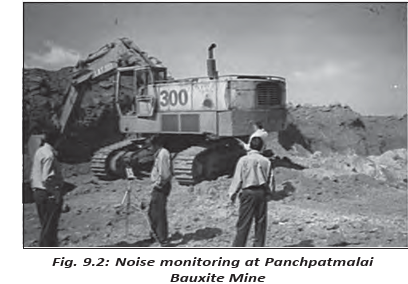
Noise pollution: location and intensity
- Noise is produced by sources such as traffic, industry or an airport.
- Its intensity and nature depend on the source and its conditions, such as the type and condition of vehicles and roads.
- Noise generally declines in intensity as distance from its source increases.
- Urban smog
- Smoky fog over cities caused by atmospheric pollution.
- Acid rain
- Rain made more acidic by atmospheric pollutants.
- Industrial effluents
- Waste substances discharged by industries.
- Decibel (dB)
- Unit used to express sound level.
State the main objectives of the Namami Gange Programme.
Why is traffic considered the biggest noise nuisance?
Quick recap
- Air pollution is the harmful addition of contaminants to the atmosphere.
- Fossil-fuel burning, mining and industry release pollutants that can cause disease, urban smog and acid rain.
- The first rain after summer has a lower pH than subsequent rains.
- Namami Gange aims to reduce river pollution through sewage treatment, effluent monitoring, river cleaning and public awareness.
- Noise comes from transport, industry, construction and periodic community sources; steady noise is measured in decibels.
- Traffic is a major noise nuisance, and noise generally diminishes with distance from its source.
Urban Waste Disposal
Urban Waste: Meaning and Sources
- Solid waste: Discarded items such as metals, broken glass, plastics, polythene, ash and electronic waste; it is also called refuse, garbage or rubbish.
- Sources: Waste comes from household or domestic establishments and industrial or commercial establishments.
Impacts of Poor Waste Disposal
Industrial Waste and Water Pollution
- Industrial units concentrated in and around cities generate industrial waste.
- Waste dumped into rivers, together with untreated sewage, pollutes the water.
- Pollution creates serious health problems for communities downstream.
Waste Collection and Disposal in India
- Collection in major cities: About 90 per cent of solid waste is collected and disposed of in metropolitan cities such as Mumbai, Kolkata, Chennai and Bengaluru.
- Uncollected waste: In many other cities and towns, about 30–50 per cent of generated waste is left uncollected.
Case Study: Ecological Restoration in Daurala
Daurala: Key Date
- 2003The village’s poor conditions drew the attention of civil society.
- Landfill
- A low-lying area used for dumping waste.
- Potable water
- Water that is safe to drink.
- Aquifer
- An underground layer that stores and transmits groundwater.
- Rainwater harvesting
- Collecting and storing rainwater to support water supply and groundwater recharge.
Why is uncollected urban waste a serious problem?
What measures helped restore Daurala’s ecology and protect residents’ health?
Quick recap
- Urban solid waste comes mainly from domestic and industrial or commercial sources.
- Poor disposal creates health hazards, foul smells and environmental pollution.
- Industrial waste and untreated sewage can pollute rivers and harm downstream communities.
- Many Indian towns leave 30–50% of their waste uncollected; waste can instead be used for energy and compost.
- Daurala’s restoration used the polluter-pays principle and combined safer water supply, pond restoration, rainwater harvesting and tree planting.
Rural- Urban Migration and Problems of Slums
Rural–Urban Migration
Urban Population Growth
- World: About 55 per cent of the population lives in cities; the proportion is projected to reach 68 per cent by 2050, increasing pressure to provide adequate urban infrastructure and quality of life.
- India: Since 1961, around 60 per cent of urban growth has been attributed to natural increase and about 29 per cent to rural–urban migration.
Key Dates and Periods
- Since 1961In India, around 60 per cent of urban growth is attributed to natural increase and about 29 per cent to rural–urban migration.
- 1988Ramesh worked in a woollen factory in Ludhiana for six months at Rs. 20 per day.
- 2011Approximately 69 per cent of India's population lived in rural areas.
- 2050The global urban population share is estimated to reach 68 per cent.
Migration: Ramesh's Case
How Migration Changed Ramesh’s Family
- Rural hardship: Ramesh’s family struggled with debt; three brothers and their families depended on three acres of land. He left school after ninth standard and faced added financial pressure after marriage.
- First move: Influenced by successful migrants from his village and the expectation of work, he went to Ludhiana with a friend and worked for six months in a woollen factory in 1988.
- Work challenges: His wage was only Rs. 20 per day, and he struggled with personal expenses and adapting to a new culture and environment.
- Skills and mobility: With a friend’s guidance, he moved to Surat, learned welding and later travelled to different places with a contractor for temporary construction work.
- Remittances: He sends Rs. 20,000 a year to his father. The money supports daily needs, healthcare and children’s schooling, and also contributes to farming, land purchase and house-building.
- Outcome and cost: His family’s living standard improved, but temporary, transferable work keeps him separated from his family, whom he cannot relocate with him.
Migrant Work and Family Separation
- Rural poverty and limited job options → migration to cities for work.
- Low-paid, temporary and transferable informal-sector jobs → wages are often insufficient to support the whole family at the destination.
- Spouse remains in the village to care for children and elderly relatives → the rural–urban migration stream is dominated by males.
Problems of Slums
Rural and Urban Settlements
- Urban centre: Its definition varies among countries; settlement geography uses the term to distinguish urban from rural settlements.
- Relationship: Rural and urban settlements have different functions that may complement one another, but they have also developed into distinct cultural, social, political, economic and technological spheres.
- India’s rural context: In 2011, about 69 per cent of the population was rural. Many villages depend mainly on primary activities and function as part of the hinterland of urban centres.
- Urban inequality: Indian cities are internally diverse, ranging from high-income areas with developed infrastructure and privacy to slums and shanty colonies with severe housing and service shortages.
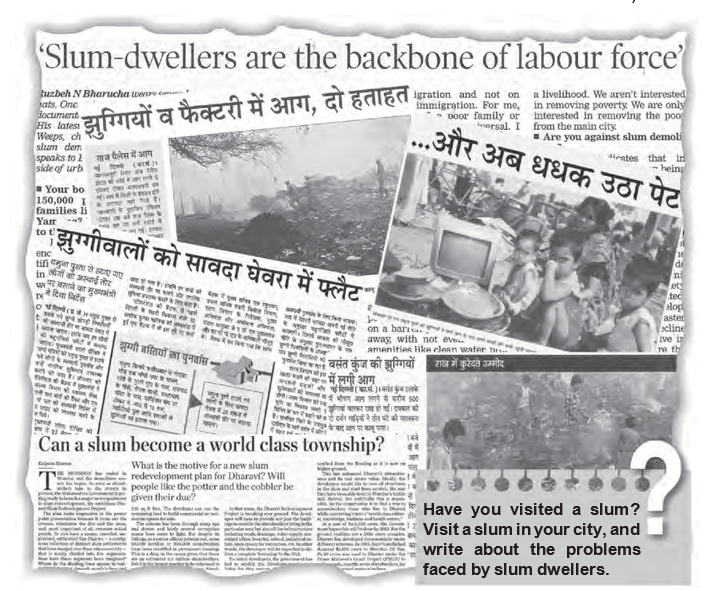
Slum — A residential area of last choice, typically marked by dilapidated housing, poor hygiene, inadequate ventilation and a lack of basic amenities.
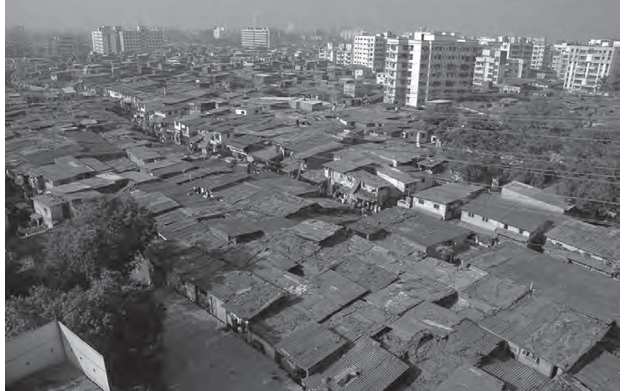
Dharavi: Asia’s Largest Slum
Living Conditions and Economic Role
- Access and housing: Buses run around its periphery, auto-rickshaws are prohibited, and one main road is narrowed for much of its length. Some lanes are too narrow for bicycles.
- Overcrowding: Temporary, often two- or three-storey buildings have cramped rooms sometimes shared by families of twelve or more.
- Poor environment: The area has uncollected garbage, stagnant polluted water and few trees; some structures are used for hide processing and tanning.
- Productive work: Despite harsh conditions, Dharavi produces ceramics and pottery, embroidery and zari work, leather goods, garments, metalwork, jewellery, wood carvings and furniture.
- Urban contradiction: Dharavi’s industries create valuable goods for wealthy consumers, even as residents face poor housing and sanitation.
Government Response
- Swachh Bharat Mission (SBM): Part of the urban renewal mission launched by the Government of India to improve quality of life in urban slums.
Why are children of slum-dwellers often deprived of school education?
- Natural increase
- Population growth when births exceed deaths.
- Net in-migration
- The balance of people moving into an area over those moving out.
- Hinterland
- The surrounding rural area linked to and served by an urban centre.
- Informal sector
- Economic work that is generally unorganised and often low-paid or insecure.
Quick recap
- Rural–urban migration is driven by rural job scarcity, urban labour demand and uneven development.
- Urban growth comes from natural increase, in-migration and reclassification; India’s migration stream is dominated by men.
- Ramesh’s case shows how remittances can improve rural family livelihoods while temporary work causes family separation.
- Slums are overcrowded, poorly serviced settlements often occupied by migrants unable to afford formal housing.
- Dharavi combines hazardous living conditions with productive small-scale industries.
- Slum poverty can limit nutrition, health and children’s education; the Swachh Bharat Mission aims to improve quality of life.
Land Degradation
Meaning and effects of land degradation
How land degradation develops
- Land is used repeatedly without managing its fertility
- Soil quality and productive capacity decline
- Agricultural productivity falls
- If degradation remains unchecked, land may be converted into wasteland
Processes and types of wasteland
| Main process | Examples | Note |
|---|---|---|
| Primarily natural | Gullied/ravinous land; desertic or coastal sands; barren rocky areas; steep sloping land; glacial areas | Primarily caused by natural agents |
| Natural and human factors | Waterlogged and marshy areas; land affected by salinity or alkalinity; land with or without scrub | Both natural and human factors contribute |
| Human action | Degraded shifting-cultivation areas; degraded land under plantation crops; degraded forests and pastures; mining and industrial wastelands | Caused by human action |
Case study: Watershed management in Jhabua
- Jhabua: This backward district in Madhya Pradesh’s westernmost agro-climatic zone has a large tribal population, mostly Bhils, and faces poverty alongside forest and land degradation.
- Watershed programmes: Programmes funded by the Union Ministries of Rural Development and Agriculture linked land, water and vegetation management with improved livelihoods and community participation.
- Results: In the five years described, the Rural Development Ministry’s programme treated 20 per cent of Jhabua district’s total area, helping prevent land degradation and improve soil quality.
Petlawad: community management of common land
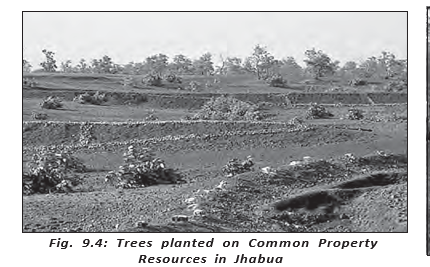
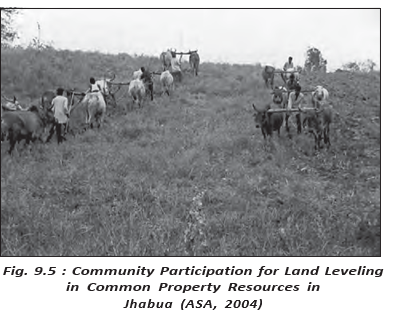
- Watershed management
- Coordinated management of land, water and vegetation to improve natural resources and local livelihoods.
- Common property resources (CPRs)
- Resources held or used collectively by a community, such as common land and pastures.
- Social fencing
- Community agreement and cooperation to protect land from grazing or other harmful use.
What are the main causes of land degradation, and what may unchecked degradation lead to?
How did the Petlawad community restore and protect its common pastures?
Quick recap
- Land degradation is a temporary or permanent decline in land’s productive capacity.
- Soil erosion, waterlogging, salinisation and alkalinisation lead to land degradation.
- NRSC classifies wastelands by the processes that created them; human-made processes are especially important.
- Watershed programmes in Jhabua linked land, water and vegetation management with community participation.
- Petlawad villagers restored common pastures through tree planting, fodder planting, social fencing and agreed grazing rules.
Geography — ALL CHAPTERS
1
Human Geography Nature And Scope
2
The World Population Distribution, Density And Growth
3
Human Development
4
Primary Activities
5
Secondary Activities
6
Tertiary And Quaternary Activities
7
Transport And Communication
8
International Trade
1
UNIT -I POPULATION DISTRIBUTION ,DENSITY, GROWTH AND COMPOSITION
2
UNIT -II HUMAN SETTLEMENTS
3
UNIT- III LAND RESOURCES AND AGRICULTURE
4
UNIT -III WATER RESOURCES
5
UNIT - III MINERAL AND ENERGY RESOURCES
6
UNIT -III PLANNING AND SUSTAINABLE DEVELOPMENT IN INDIAN CONTEXT
7
UNIT -IV TRANSPORT AND COMMUNICATION
8
UNIT -IV INTERNATIONAL TRADE
9
UNIT - V GEOGRAPHICAL PERSPECTIVE ON SELECTED ISSUES AND PROBLEMS