QUESTION PAPER
2022 BOARD EXAM
CBSE Class 12 Humanities History Board Paper 2022 — Set 5
2022
History
Class 12 Humanities
CBSE EXAMINATION PAPER-2022
HISTORY
(Solved)
General Instructions :
Read the following instructions carefully and follow them :
- This question paper contains 13 questions. All questions are compulsory.
- This question paper is divided into 3 sections.
- Section A – questions number 1 to 3 are case based questions
- Section B – questions number 4 to 8 are short answer
- Section C – questions number 9 to 13 are long answer
- There is no overall choice given in the question paper. However, an internal choice has been provided in few questions.
- Use of calculator is NOT allowed.
Section A
Read the source given below and answer the questions that follow :
Darbar-i Akbari
Abu'l Fazl gives a vivid account of Akbar's darbar: Whenever His Majesty (Akbar) holds court (darbar) a large drum is beaten, the sounds of which are accompanied by Divine praise. In this manner, people of all classes receive notice. His Majesty's sons and grandchildren, the grandees of the Court, and all other men who have admittance, attend to make the kornish, and remain standing in their proper places. Learned men of renown and skillful mechanics pay their respects; and the officers of justice present their reports. His Majesty, with his usual insights, gives orders, and settles everything in a satisfactory manner. During the whole time, skillful gladiators and wrestlers from all countries hold themselves in readiness, and singers, male and female, are in waiting. Clever jugglers and funny tumblers also are anxious to exhibit their dexterity and agility.
(1) How were the people informed about the conduct of the court?
[1 Mark](2) How was the social control exercised in the court?
[1 Mark](3) How did Akbar dispose of the appeals or cases in the court?
[2 Marks]Read the source given below and answer the questions that follow :
"We are not going just to copy"
This is what Jawahar Lal Nehru said in his famous speech of 13 December, 1946: We say that it is our firm and solemn resolve to have an independent sovereign republic. India is bound to be sovereign, it is bound to be independent and it is bound to be a republic... Now, some friends have raised the question: 'Why have you not put in the word ‘democratic’ here?' Well, I told them that it is conceivable, of course, that a republic may not be democratic but the whole of our past is witness to this fact that we stand for democratic institutions. Obviously we are aiming at democracy and nothing less than a democracy. What form of democracy, what shape it might take is another matter... We are not going just to copy, I hope, a certain democratic procedure or an institution of a so-called democratic country. We may improve upon it. In any event whatever system of government we may establish here must fit in with the temper of our people and be acceptable to them..."
(1) Define the term sovereignty.
[1 Mark](2) Which constitutions of the countries were referred by the Constitution Assembly?
[1 Mark](3) How is democracy explained in this source?
[2 Marks]On the given political outline map of India mark and label any one of the follow with appropriate symbols :
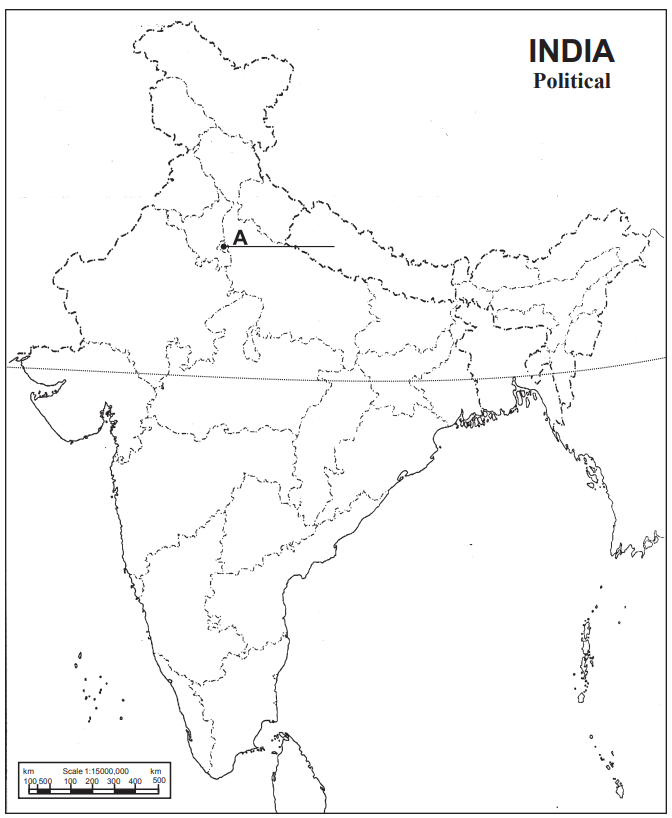
(1) The place where Jallianwala Bagh Massacre happened.
(2) The place where Salt Law was broken by Gandhiji.
(3) Mention the place where Jallianwala Bagh Massacre took place.
(4) On the same map, a capital of the Mughal Empire is marked as 'A'. Identify it and name it on the line drawn near it.
(5) Name any one capital of the Mughal Empire.
(6) Name the place where Gandhiji broke the Salt Law.
Section B
"The jotedars were more effective than that of zamindars in the villages." Examine the statement in the context of Permanent Settlement.
Explain the provisions of Irwin-Gandhi pact. Why was it criticised by the radical nationalists ?
Section C
Paper Details
CBSE Board Exam 2022
Class
Class 12 Humanities
Subject
History
Year
2022
Set
Set 5
Other Years — History