QUESTION PAPER
2024 BOARD EXAM
CBSE Class 12 Humanities History Board Paper 2024 — Set 2
2024
History
Class 12 Humanities
CBSE EXAMINATION PAPER-2024
HISTORY
(Solved)
General Instructions :
Read the following instructions carefully and follow them :
- This question paper contains 41 questions. All questions are compulsory.
- This question paper is divided into 4 sections.
- Section A – questions number 1 to 5 are case based questions
- Section B – questions number 6 to 27 are multiple choice questions
- Section C – questions number 28 to 35 are short answer
- Section D – questions number 36 to 41 are long answer
- There is no overall choice given in the question paper. However, an internal choice has been provided in few questions.
- Use of calculator is NOT allowed.
Section A
Read the given source and answer the questions that follow:
A Tiger-like Husband
This is a summary of a story from the Adi Parvan of the Mahabharata: The Pandavas had fled into the forest. They were tired and fell asleep; only Bhima, the second Pandava, renowned for his prowess, was keeping watch. A man-eating rakshasa caught the scent of the Pandavas and sent his sister Hidimba to capture them. She fell in love with Bhima, transformed herself into a lovely maiden and proposed to him. He refused. Meanwhile, the rakshasa arrived and challenged Bhima to a wrestling match. Bhima accepted the challenge and killed him. The others woke up hearing the noise. Hidimba introduced herself, and declared her love for Bhima. She told Kuntil have forsaken my friends, my dharma and my kin; and good lady, chosen your tiger-like son for my man... whether you think me a fool, or your devoted servant, let me join you, great lady, with your son as my husband." Ultimately, Yudhisthira agreed to the marriage on condition that they would spend the day together but that Bhima would return every night. The couple roamed all over the world during the day. In due course Hidimba gave birth to a rakshasa boy named Ghatotkacha. Then the mother and son left the Pandavas Ghatotkacha promised to return to the Pandavas whenever they needed him.
(1) How was Hidimba's culture different from Pandavas?
[1 Mark](2) How did this incident prove Kunti's far-sightedness?
[2 Marks](3) Why did Kunti approve Hidimba's plea for Bhima?
[1 Mark]A language with an enormous range
Al-Biruni described Sanskrit as follows:
If you want to conquer this difficulty (i.e. to learn Sanskrit), you will not find it easy, because the language is of an enormous range, both in words and inflections, something like the Arabic, calling one and the same thing by various names, both original and derivative, and using one and the same word for a variety of subjects, which, in order to be properly understood, must be distinguished from each other by various qualifying epithets.
(1) How did Al-Biruni compare Sanskrit with Arabic?
[1 Mark](2) Give an example of Al-Biruni's translated work.
[1 Mark](3) Why is Sanskrit considered a language with an 'enormous range'?
[2 Marks]Read the following source and answer the questions that follow:
From the Fifth Report
Referring to the condition of zamindars and the auction of lands, the Fifth Report stated:
The revenue was not realised with punctuality, and lands to a considerable extent were periodically exposed to sale by auction. In the native year 1203, corresponding with 1796-97, the land advertised for sale comprehended a jumma or assessment of sicca rupees 28,70,061, the extent of land actually sold bore a jumma or assessment of rupees 14,18,756 and the amount of purchase money sicca rupees 17,90,416. In 1204, corresponding with 1797-98, the land advertised was for sicca rupees 26,66,191, the quantity sold was for sicca rupees 22,74,076, and the purchase money sicca rupees 21,47,580. Among the defaulters were some of the oldest families of the country. Such were the rajahs of Nuddea, Rajeshaye, Bishenpore (all districts of Bengal)..... and others, the dismemberment of whose estates at the end of each succeeding year, threatened them with poverty and ruin, and in some instances presented difficulties to the revenue officers, in their efforts to preserve undiminished the amount of public assessment.
(1) Why is it called the *Fifth Report*?
[1 Mark](2) Why were the Company’s activities debated in England?
[1 Mark](3) Analyze two limitations of the *Fifth Report*.
[2 Marks]On the given Political outline map of India, locate and label the following with appropriate symbols :
(1) Ujjaiyini — A Mahajanpada
On the given Political outline map of India, locate and label the following with appropriate symbols :
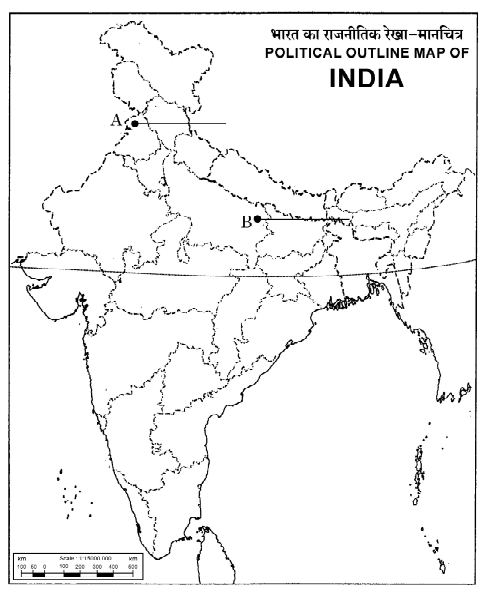
(1) Ujjaiyini — A Mahajanpada
(2) Kalibangan was a major Mature Harappan site of the Indus Valley Civilization. It is located in present-day Kalibangan, in Rajasthan, on the banks of the (now dry) Ghaggar River. On the given political outline map of India, Kalibangan is marked at Point A (in north-western India, Rajasthan region).
(3) Panipat is located in present-day Haryana, near Delhi in northern India. On the given map, this corresponds to Point A (the north-western marked location). So, the correct answer is: A.
(4) Thanjavur — An empire of the Medieval Period.
(5) On the same outline map, two places regarding the centre of the Indian National Movement have been marked as ‘A’ and ‘B’. Identify them and write their correct names on the lines drawn near them.
(6) Name any two Budhhist sites of the matured Harappan period.
(7) Name any one territory under Mughal Empire.
(8) Name the capital of Vijayanagar Empire.
(9) Name any two centres related with Indian Nationalist Movement.
Section B
Which of the following dynasties queen Prabhavati belonged to?
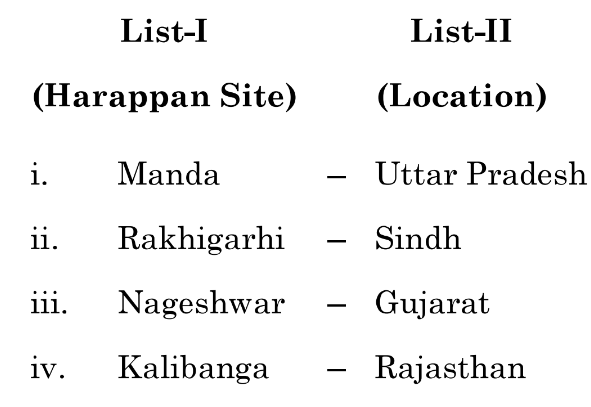
Which of the following pairs is correctly matched?
Which of the following is the correct chronological sequence of the ruling dynasties of India?
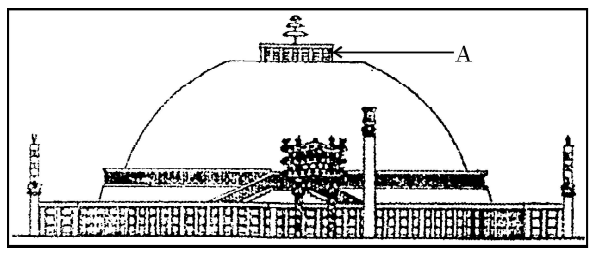
look at figure given below and identify the structual feature marked as 'A' sachi stupa from the following option.
In which of the following places buddha gave his first sermon
which of the following countries ' durate barbosa ' belonged to?
Which of the following statements regarding 'Nath' sect of medieval india is not correct?
Why was vijayanagar named as hampi?select the appropriate option from the following:
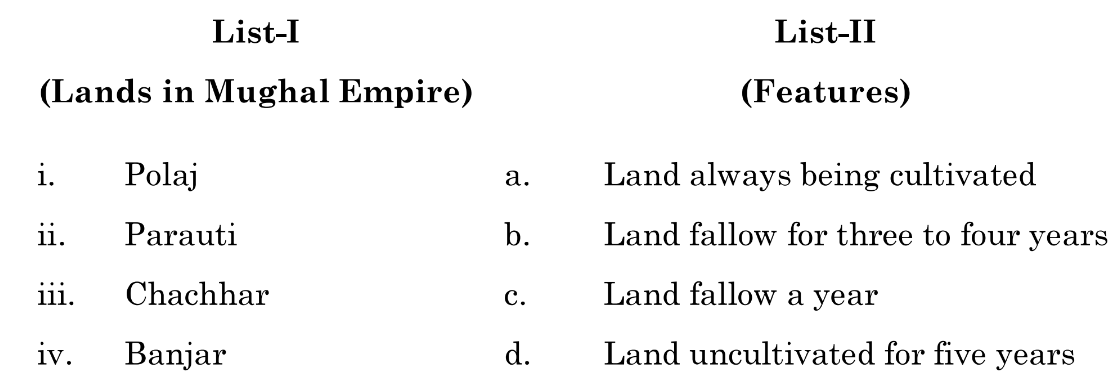
Match the following:
Arrange the following in chronological orders and select the correct order from the given options:
(I) Santhal Rebelion
(II) Riots in Deccan villages
(III) Permanent settlement in Bengal
(IV) First revenue settlement in bombay deccan
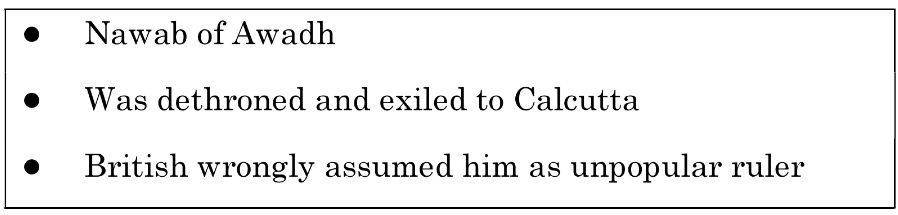
Read the given information and identify the leader of 1857 revolt from the following option:
who among the following demanded justice for women, not reserved seats or seprate electorates in the constituent assembly?
Given below are the two statements ,one labelled as assertion(A) and other labelled as reason(R):
Assertion(A): lahore session of congress in 1929 is significant
Reason(R): Proclamation of commitment to ' poorna sawaraj ' or complete independence was passed .
Which of the following is correctly matched
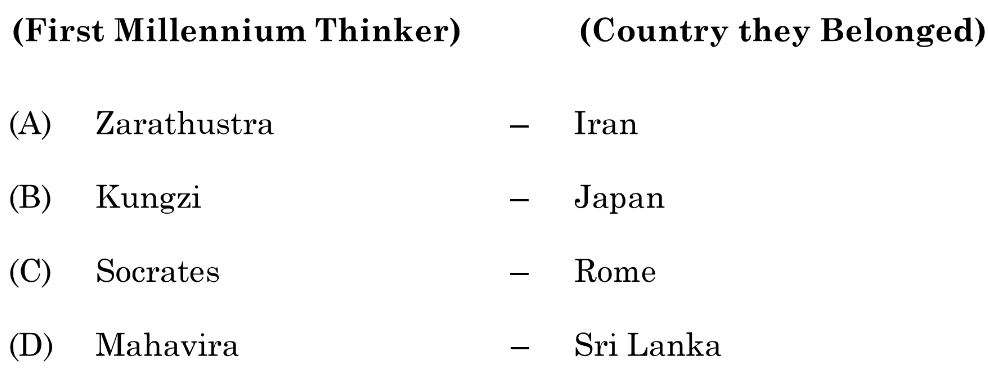
Which of the following regions of harappa was called as ' Ganeshwar jodhpur culture'?
Which one of the following statements regarding the vedic tradition is incorrect?
Match the following :
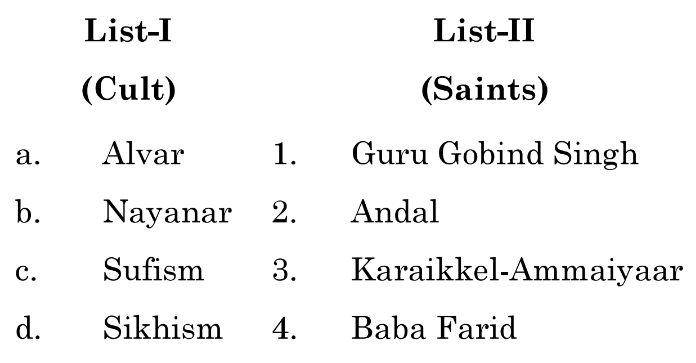
Which of the following pair is correctly matched?
Which of the following informations are correct about ain-i- akbar?
(I) Written by Abdul Razi in arabic language
(II) Manzil- abadi, concern the imperial households
(III) Sipah-abadi , covers the military and civil administrative
(IV) Mulk- abadi, deals with the fiscal side of the fiscal side of the empire.
Who among the following in the constituent assembly proposed ' horizontal tricolour national flag of saffron , white and green in equal proportion?
Who among the following travellers was from portugal ?
Section C
Section D
Paper Details
CBSE Board Exam 2024
Class
Class 12 Humanities
Subject
History
Year
2024
Set
Set 2
Other Years — History