QUESTION PAPER
2024 BOARD EXAM
CBSE Class 12 Humanities History Board Paper 2024 — Set 3
2024
History
Class 12 Humanities
CBSE EXAMINATION PAPER-2024
HISTORY
(Solved)
General Instructions :
Read the following instructions carefully and follow them :
- This question paper contains 40 questions. All questions are compulsory.
- This question paper is divided into 4 sections.
- Section A – questions number 1 to 4 are case based questions
- Section B – questions number 5 to 26 are multiple choice questions
- Section C – questions number 27 to 34 are short answer
- Section D – questions number 35 to 40 are long answer
- There is no overall choice given in the question paper. However, an internal choice has been provided in few questions.
- Use of calculator is NOT allowed.
Section A
Read the given source carefully and answer the questions that follow:
What the silk weavers did.
Here is an excerpt from the inscription, which is in Sanskrit:
Some are intensely attached to music (so) pleasing to the ear; others, being proud of (the authorship of) a hundred excellent biographies, are conversant with wonderful tales; (others), filled with humility, are absorbed in excellent religious discourses; ... some excel in their own religious rites; likewise by others, who were self-possessed, the science of (Vedic) astronomy was mastered.
(1) How was love for music expressed in the inscription?
[1 Mark](2) In what ways did the various talents mentioned in the inscription contribute to the overall fabric of society?
[2 Marks](3) How did individuals demonstrate their mastery in the science of Vedic astronomy?
[1 Mark]Read the given source carefully and answer the questions that follow:
How tanks were built ?
How tanks were built? About a tank constructed by Krishnadeva Raya, Paes wrote:
The king made a tank ... at the mouth of two hills so that all the water which comes from either one side or the other collects there; and, besides this, water comes to it from more than three leagues (approximately 15 kilometres) by pipes which run along the lower parts of the range outside. This water is brought from a lake which itself overflows into a little river. The tank has three large pillars handsomely carved with figures; these connect above with certain pipes by which they get water when they have to irrigate their gardens and rice-fields. In order to make this tank the said king broke down a hill ... In the tank I saw so many people at work that there must have been fifteen or twenty thousand men, looking like ants ...
(1) Why did Krishnadeva Raya construct a tank?
[1 Mark](2) In what ways was the water from the tanks used?
[2 Marks](3) Why did Krishnadeva Raya choose the location at the mouth of two hills for building the tank?
[1 Mark]Read the given source carefully and answer the questions that follow:
The Nawab has left
Another song mourned the plight of the ruler who had to leave his motherland: Noble and peasant all wept together and all the world wept and wailed Alas! The chief has bidden adieu to his country and gone abroad.
(1) What was the immediate impact of the removal of the Nawab?
[1 Mark](2) Why was there emotional upheaval at the dethroning and departure of the Nawab?
[1 Mark](3) How did the annexation of Awadh fit into the British colonial strategy? Explain.
[2 Marks]On the given political outline map of India (on page 23), locate and label the following with appropriate symbols :
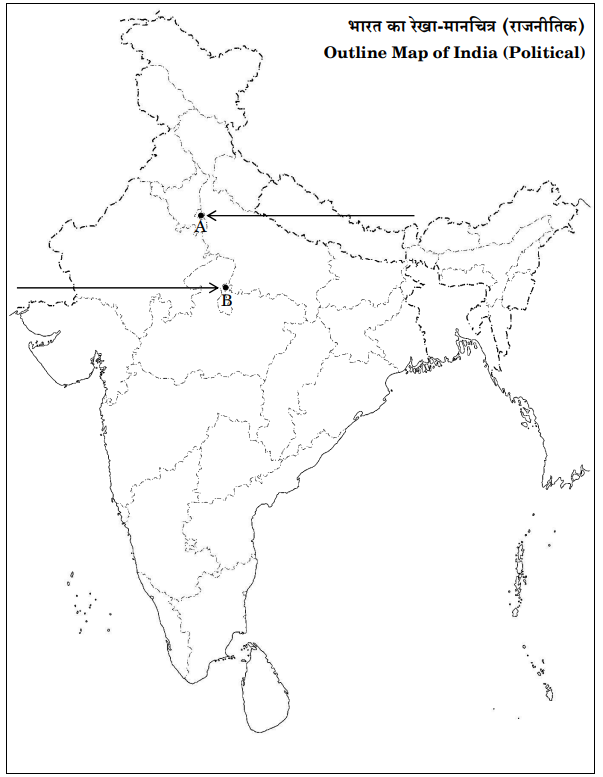
(1) Dholavira – a Harappan site
(2) Meerut Pillar – a site of Asokan inscription
(3) Vijayanagara
(4) Bijapur
(5) On the same political outline map of India, two places related to British control in 1857 are marked as A and B. Identify them and write their correct names on the lines drawn near them.
(6) Name the capital city of Vijayanagara Empire.
(7) Name any one Harappan site.
(8) Mention any two cities which were under the British control during 1857.
(9) Mention any one Buddhist site.
(10) Mention any one neighbouring state of the Vijayanagara Empire.
Section B
Which of the following options are correct regarding Magadha ?
I. Magadha was the most powerful Mahajanapada.
II. Rajgaha was the capital of Magadha.
III. Magadha was in a semi-arid area.
IV. Magadha was rich in natural resources.
Arrange the following in chronological order and choose the correct option :
I. Rule of Asoka
II. Rule of Mahapadma Nanda
III. Rule of Harshavardhana
IV. Rule of Samudragupta
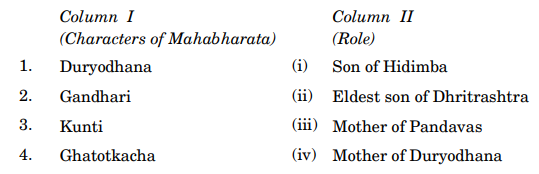
Match Column I with Column II and choose the correct option :
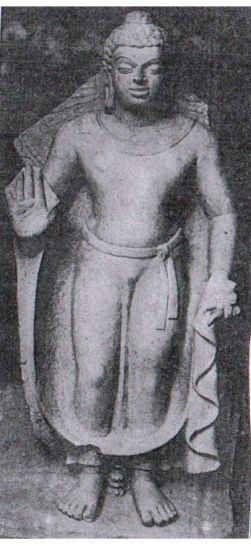
Which of the following schools of art is depicted in the given sculpture image of Buddha ?
In which of the following texts were Buddha’s teachings compiled ?
Fill in the blank with the appropriate word from the given options :
The Harappan site of ________ is located in present day Rajasthan.
Read the following statements regarding Cunningham and choose the correct option :
I. Cunningham was the first Director-General of ASI.
II. He began archaeological excavations in mid 19th century.
III. He brought a military precision to the practice of archaeology.
IV. He used the accounts left by Chinese Buddhist pilgrims.
Assertion (A) : Ibn Battuta found Indian agriculture very productive.
Reason (R) : The soils were fertile which allowed the farmers to produce two crops a year.
Identify the person with the help of following information :
· He was a famous engineer, surveyor and cartographer.
· He was appointed the first Surveyor General of India in 1815.
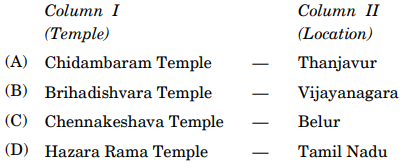
Which one of the following pairs is correctly matched ?
Which one of the following tribes was engaged in overland trade between India and Afghanistan and in the villages and towns in Punjab during the Mughal era ?
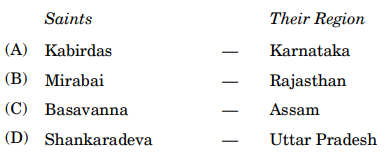
Which one of the following pairs is correctly matched ?
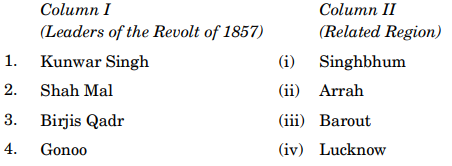
Match Column I with Column II and choose the correct option from the following :
Who among the following initiated the task of preparing the critical edition of Mahabharata ?
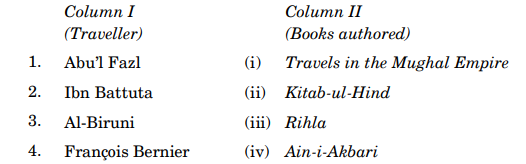
Match Column I with Column II and choose the correct option :
Fill in the blank with the appropriate word from the given options : The land which was annually cultivated for each crop in succession was called __________ in the Mughal Empire.
In which of the following districts did the ryots revolt against sahukars of the Ryotwari system ?
Who among the following belonged to a Moderate group of Indian National Congress ?
Which of the following statements is not correct regarding ‘Quit India Movement’ ?
‘‘Khoob ladi mardani, woh to Jhansi wali rani thi.’’
Who among the following has written these lines and portrayed Laxmi Bai as a symbol to resist injustice ?
Who among the following introduced the ‘Objectives Resolution’ in the Constituent Assembly on 13th December, 1946 ?
Which of the following were discussed in the Constituent Assembly for making a strong government at the Centre ?
Choose the correct option from the following.
I. Planning for the well-being of the country.
II. To establish strong administration at the state level.
III. To mobilise available economic resources.
IV. To defend the country against foreign aggression.
Section C
Section D
Paper Details
CBSE Board Exam 2024
Class
Class 12 Humanities
Subject
History
Year
2024
Set
Set 3
Other Years — History