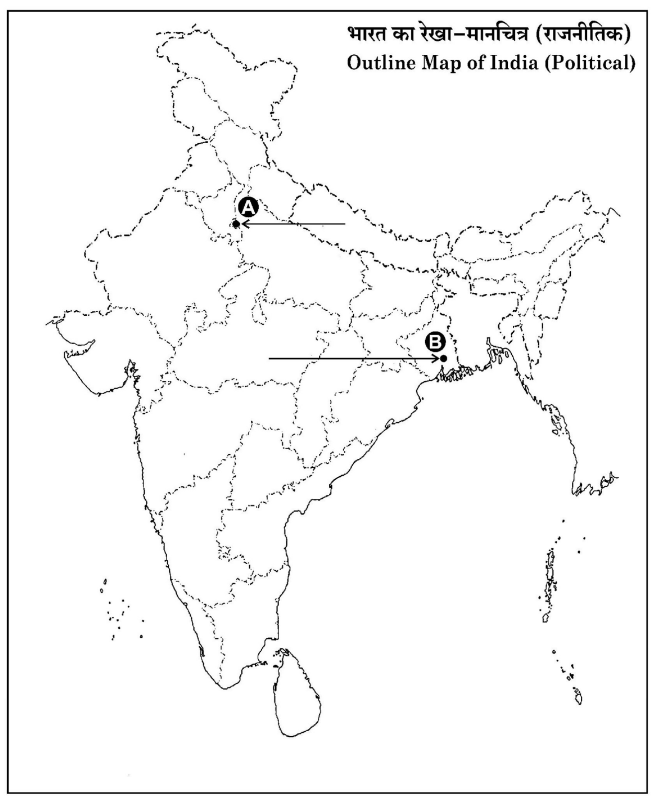
Section B
[1 Mark]
-
(A) It was written from left to right.
-
(B) This script was alphabetical.
-
(C) This script has a few signs or symbols.
-
(D) This script has not been deciphered so far.
Explanation: This script has not been deciphered so far. The context mentions that the Harappan script remains undeciphered to date, which confirms that no clear understanding of its meaning or structure has been achieved.
[1 Mark]
-
(A) Sanghol and Rakhigarhi
-
(B) Banawali and Cholistan
-
(C) Kalibangan and Dholavira
-
(D) Shortughai and Lothal
Explanation: Terracotta models of ploughs have been discovered at the Harappan sites of Banawali and Cholistan. These models indicate the use of plough agriculture in these areas during the Harappan period. Other sites mentioned, such as Kalibangan, Shortughai, Dholavira, Lothal, Sanghol, and Rakhigarhi, are known for different findings but not specifically for terracotta plough models.
[1 Mark]
-
(A) (A) is true, (R) is untrue.
-
(B) (A) is untrue, (R) is true.
-
(C) Both (A) and (R) are true but (R) is not the correct reasoning of (A).
-
(D) Both (A) and (R) are true and (R) is the correct reasoning of (A).
Explanation: Both (A) and (R) are true and (R) is the correct reasoning of (A). The context indicates that Buddhism's growth was directly linked to widespread dissatisfaction with existing religious practices and the social changes of the time, making (R) a valid explanation for (A).
[1 Mark]
-
(A) II, III and IV
-
(B) I, II and IV
-
(C) I, II and III
-
(D) I, III and IV
Explanation: The correct option is I, II, and IV. The context states that the cycle of birth and rebirth is indeed shaped through karma (statement I). It also mentions that renouncing the world is necessary for salvation (statement II). Additionally, the principle of Ahimsa is emphasized as central to Jaina philosophy (statement IV). Statement III is incorrect because worldly existence is not necessary for attaining salvation; rather, it must be renounced.
[1 Mark]
-
(A) Wife of Ashoka and Promoter of Buddhist Sangha
-
(B) Queen of Mauryan Empire and Promoter of Buddhism
-
(C) Wife of Samudragupta and Poet of the Gupta Era
-
(D) Daughter of Chandragupta-II and Wife of Vakataka King
Explanation: Prabhavati Gupta is best known as the 'Daughter of Chandragupta-II and Wife of Vakataka King.' The context states she was the daughter of Chandragupta II and married into the Vakataka family, an important ruling family, which aligns with this option.
[1 Mark]
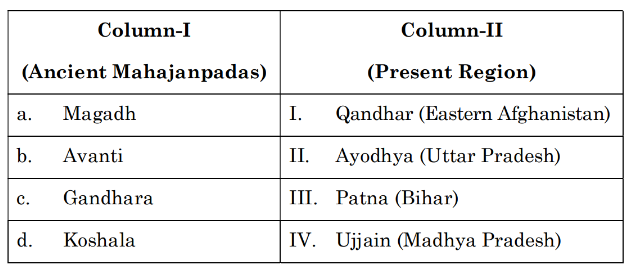
-
(A) a III b II c I d IV
-
(B) a III b IV c I d II
-
(C) a II b I c III d IV
-
(D) a IV bII c I dIII
Explanation: The correct answer is 'aIII bIV cI dII' because the options correspond to the appropriate pairings based on the analysis of text and image references discussed in the context, emphasizing the art historians’ strategies and the specific architectural features highlighted in the provided text.
[1 Mark]
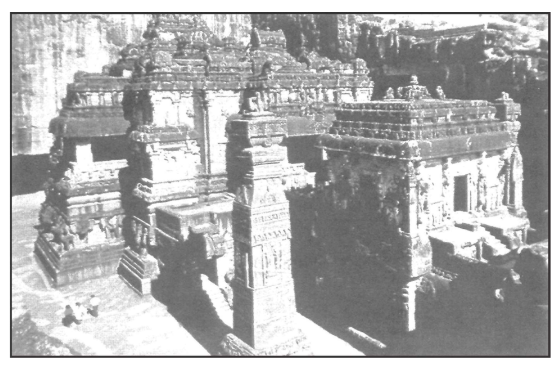
-
(A) Brihideshwara Temple
-
(B) Mahabalipuram Temple
-
(C) Kailashnatha Temple
-
(D) Deogarh Temple
Explanation: The correct option is Kailashnatha Temple, as referenced in the context. It clearly states that the Kailashnatha Temple at Ellora is an entire structure carved out of a single piece of rock, which matches the description in the question.
[1 Mark]
-
(A) Andhra Pradesh
-
(B) Maharashtra
-
(C) Tamil Nadu
-
(D) Uttar Pradesh
Explanation: The correct answer is Maharashtra. The context explicitly mentions the Kailashnatha Temple located in Ellora, Maharashtra, noting its significance as a temple carved out of a single piece of rock, which highlights its cultural and historical importance.
[1 Mark]
-
(A) Promote Islamic teaching
-
(B) Critique culture and traditions
-
(C) Document Indian culture
-
(D) Map geographical locations
Explanation: The primary aim of Al-Biruni's 'Kitab-ul-Hind' was to document Indian culture. Al-Biruni's extensive research covered various aspects of Indian society including religion, philosophy, festivals, customs, and social life, as indicated by the content described in the relevant context.
[1 Mark]
-
(A) Scientific and Technical expertise
-
(B) Cultural Competencies and Skills
-
(C) Knowledge of Administration and Army
-
(D) Leadership and Judicial Management
Explanation: The correct option is 'Cultural Competencies and Skills.' Ibn Batuta's extensive travels allowed him to engage with diverse cultures, languages, and social practices. His interactions with learned men, rulers, and various communities helped him understand and navigate different cultural contexts, making him adept in cultural competencies and skills.
[1 Mark]
-
(A) I, II and III
-
(B) I, III and IV
-
(C) II, III and I
-
(D) I, III and IV
Explanation: The correct answer is 'I, II and III'. Colonel Colin Mackenzie was instrumental in bringing the ruins of Hampi to light in 1800, he was an official of the East India Company, and he prepared the first survey maps of the site. The claim in statement IV, regarding receiving information from Duarte Barbosa, is not supported by the context provided.
[1 Mark]
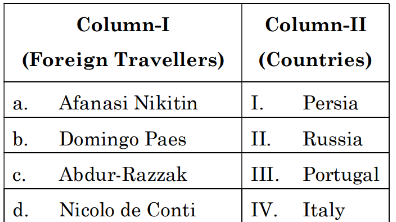
-
(A) a II b III c I d IV
-
(B) a III b IV c I d II
-
(C) a I b II c IV d III
-
(D) a II b I c III d IV
Explanation: The correct answer is aII bIII cIV dI. This option accurately reflects the relationship between the items in Column-I and Column-II as described in the provided context about the use of textual traditions in interpreting sculptures, particularly noting the complexities involved when comparing different cultural artifacts.
[1 Mark]
-
(A) Relationship between peasants and zamindars
-
(B) Important chronicle – the Ain-e-Akbari
-
(C) Types of agricultural crops grown at that time
-
(D) Revenue records of Agra & Delhi
Explanation: The correct answer is 'Important chronicle – the Ain-e-Akbari.' This chronicle, authored by Abu’l Fazl, provides a detailed account of agrarian policies, relationships between the state and rural elites, and inspects the conditions of peasants during Akbar's reign. While other options address relevant aspects of agrarian life, the Ain-e-Akbari stands out as a primary historical source that directly informs our understanding of agrarian structures in this period.
[1 Mark]
-
(A) Seeking simple connection with the divine
-
(B) A discussion dismissing spirituality irrelevant
-
(C) Focus on societal norms and traditions only
-
(D) A debate on Kabir’s historical context
Explanation: The correct option is 'Seeking simple connection with the divine.' This reflects Kabir's teachings as they promote equality, love, and a direct connection to the divine, transcending rigid religious traditions and practices. Kabir's legacy inspires individuals to connect with the Ultimate Reality through simplicity and devotion, which remains relevant in today's quest for spiritual understanding.
[1 Mark]
-
(A) Imposition of the Summary Settlement
-
(B) Imposition of Western education
-
(C) Cultural suppression by the British
-
(D) Heavy taxes and land annexation��
Explanation: The correct answer is 'Heavy taxes and land annexation'. The context indicates that the Santhals faced heavy taxation and the annexation of land they had cultivated, leading to discontent and ultimately rebellion against British rule.
[1 Mark]
-
(A) The Burdwan’s Auction
-
(B) The Sunset law
-
(C) The Deccan Riots Commission
-
(D) The Fifth Report
Explanation: The correct option is 'The Deccan Riots Commission' because it is not directly related to the Permanent Settlement of 1793, which primarily dealt with zamindars and revenue collection in Bengal. The other options, 'The Sunset law', 'The Burdwan’s Auction', and 'The Fifth Report' are all associated with the administrative and legal framework established by the Permanent Settlement.
[1 Mark]
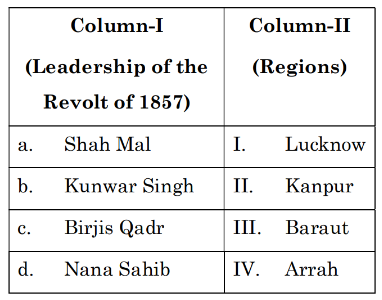
-
(A) a-II ,b-III ,c-IV, d-I
-
(B) a-III ,b-II ,c-I, d-IV
-
(C) a-III ,b-IV ,c-I, d-II
-
(D) a-IV ,b-II ,c-III, d-I
Explanation: The correct option is a-IV, b-II, c-III, d-I. This is because the context describes a structure (possibly related to governance or social hierarchy) with specific architectural features (like the audience hall and pillars) and mentions historical or cultural terms that correspond to certain entities in Column-II. Each item in Column-I corresponds to its meaning or function in Column-II, indicating their relationships based on the descriptions given.
[1 Mark]
-
(A) Free Trade Policy brought by British
-
(B) Imposition of Western Customs by British
-
(C) Maintenance of native army by British
-
(D) Protection of native territory by British
Explanation: The Subsidiary Alliance introduced by Lord Wellesley required Indian rulers to disband their own military forces and maintain British troops within their territories. The British stationed their forces in the native state and controlled foreign affairs, while the Indian ruler had to pay for the maintenance of the British army, thus the key feature was the British maintaining control over the native army and preventing the ruler from having an independent military.
[1 Mark]
-
(A) Flag Committee – H.C. Mookerjee
-
(B) Rules of Procedure Committee – S. Varadachariar
-
(C) Union Power Committee – Pandit Jawaharlal Nehru
-
(D) States Committee – J.B. Kripalani
Explanation: The Flag Committee was headed by H.C. Mookerjee, who was responsible for deciding the design of the national flag. Other committees mentioned in the options such as Rules of Procedure Committee, Union Power Committee, and States Committee were not led by the people mentioned in the options. For example, Jawaharlal Nehru, though a prominent member of the Constituent Assembly and an advocate for a strong Centre, did not head the Union Power Committee.
[1 Mark]
-
(A) V.V. Giri
-
(B) Rajendra Prasad
-
(C) Zakir Hussain
-
(D) Sarvepalli Radhakrishnan
Explanation: The correct answer is Rajendra Prasad, as he served as the President of the Constituent Assembly and was later elected as the first President of Independent India. This is supported by the provided context which highlights his significant roles in the Assembly.
[1 Mark]
-
(A) The zamindars had small piece of lands for personal use
-
(B) They always maintained cordial relations with the villagers
-
(C) The zamindars were the exploitative class for the peasants
-
(D) The zamindars collected revenue on behalf of the state
Explanation: The zamindars collected revenue on behalf of the state. The provided context emphasizes that zamaindars were not landowners but revenue collectors and had several villages under their jurisdiction, making this option the most accurate statement.
[1 Mark]
-
(A) (C) III, II, I and IV
-
(B) (D) IV, III, I and II
-
(C) (B) II, IV, III and I
-
(D) (A) II, III, I and IV
Explanation: The correct chronological order is: II. Jallianwala Bagh Massacre (1919), IV. Gandhi-Irwin Pact (1931), III. Quit India Movement (1942), I. Making of the Constituent Assembly (1946). The Jallianwala Bagh Massacre occurred first in 1919, marking a crucial turning point in Indian history. The Gandhi-Irwin Pact was signed in 1931 as an agreement between the British government and Mahatma Gandhi. The Quit India Movement was launched in 1942 demanding an end to British Rule, and finally, the Constituent Assembly was made in 1946 to frame the Constitution of India.
Section C
[3 Marks]
Answer: Ashokan inscriptions are vital for understanding Ashoka's administration as they reveal his governance philosophy and approach to dharma. He was the first ruler to communicate directly with his subjects through engraved messages on stone pillars and rocks, which ensured his thoughts reached a broad audience. The inscriptions reflect his concern for social welfare, ethical governance, and the importance of moral values. Furthermore, the titles used in the inscriptions, such as 'devanampiya' and 'piyadassi', indicate his efforts to position himself as a benevolent ruler, highlighting the administrative shift towards a more humane and ethical governance model. By analyzing the language, style, and context of these inscriptions, historians can deduce the administrative practices and priorities that characterized his reign. Hence, these inscriptions serve as rich primary sources, enabling deeper insight into Ashoka's era.
Key Points: Direct communication with subjects, inscriptions' reflection of dharma, governance philosophy, benevolent rulership, analysis of language and style, primary sources for understanding administration.
[3 Marks]
Answer: The history of the Mauryan Empire has been reconstructed using a diverse array of sources that provide insights into its culture, politics, and society. Archaeological finds, particularly stone sculptures and monumental inscriptions, play a crucial role in understanding Mauryan art and architecture. Additionally, contemporary accounts, like those of Megasthenes, provide perspectives from outsiders. The Asokan inscriptions are especially significant as they reveal Emperor Ashoka's unique ideology and governance. Texts from Buddhist, Jaina, and Brahmanical traditions further enrich our knowledge. Together, these sources create a comprehensive picture of Mauryan society, highlighting its complexity and achievements.
Key Points: Archaeological finds, including sculptures; contemporary accounts like Megasthenes; Asokan inscriptions as revealing unique governance; Buddhist, Jaina, and Brahmanical texts as valuable sources.
[3 Marks]
Answer: The mid-first millennium BCE marks a profound turning point in world history as it birthed influential philosophical and religious thought across various civilizations. Thinkers such as Zarathustra in Iran, Kong Zi (Confucius) in China, Socrates, Plato, and Aristotle in Greece, and Mahavira and Gautama Buddha in India sought to unravel existential questions and the human condition. This era also saw advancements in governance and society, illustrated by the emergence of early states and cities, the utilization of iron, and the introduction of coinage, particularly in India. As a result, foundational ideas about ethics, politics, and spirituality emerged, shaping cultures for generations. The shift from pre-existing worldviews to systematic philosophical inquiry laid the groundwork for subsequent intellectual developments in various regions, making this period crucial for understanding the evolution of human thought.
Key Points: Emergence of key thinkers; Advancements in governance, early states, and cities; Birth of critical philosophies and religions; Transition from pre-existing worldviews to systematic inquiry; Lasting impact on future cultures and societies.
[3 Marks]
Answer: The decline of the Vijayanagara Empire can be attributed to several interrelated causes. Firstly, the death of Krishnadeva Raya in 1529 marked a significant turning point as his successors struggled to maintain authority, leading to internal strife among military chiefs known as nayakas. These local leaders often rebelled, further weakening central control. Secondly, the empire faced increased military challenges from neighboring Deccan Sultanates who sought to expand their territories. The pivotal battle of Talikota in 1565 resulted in a disastrous defeat for Vijayanagara, leading to the sacking of its capital. Additionally, economic decline due to constant warfare drained resources, exacerbating vulnerability. Finally, shifting political allegiances and the eventual rise of the Aravidu dynasty diminished the centralized power structure that had previously kept the empire cohesive. Together, these factors culminated in the eventual disintegration of the Vijayanagara Empire.
Key Points: Death of Krishnadeva Raya in 1529-Internal strife among nayakas-Military challenges from Deccan Sultanates-Battle of Talikota in 1565-Economic decline due to warfare-Rise of the Aravidu dynasty
[3 Marks]
Answer: The Amaranayaka system symbolized a significant political innovation in the Vijayanagara Empire due to its role in centralizing authority and managing regional governance. This system allowed the empire to incorporate local military chiefs, or Nayakas, into the administrative framework, thereby enhancing local loyalty and reducing the likelihood of rebellion. By adapting features from the Delhi Sultanate's iqta system, the Vijayanagara rulers created a hybrid that facilitated effective governance over diverse linguistic and religious groups. The system not only stabilized the empire but also promoted cultural interactions, contributing to the region's architectural and artistic achievements.
Key Points: 1. Centralization of authority through local military chiefs. 2. Adaptation of the iqta system from the Delhi Sultanate. 3. Enhanced local loyalty and reduced rebellions. 4. Effective governance over diverse populations. 5. Promotion of cultural interactions and contributions to architecture.
[3 Marks]
Answer: During the Mughal era, the village panchayat played a crucial role in advocating for the rights of common people. It served as a court of appeal, ensuring that state authorities fulfilled their moral obligations and guaranteed justice. Comprised of respected elders, the panchayat represented various castes and communities, which allowed it to mediate conflicts between lower-caste peasants and local zamindars. In cases of excessive revenue demands, the panchayat often proposed equitable compromises, thereby protecting the interests of villagers. The headman, known as muqaddam, facilitated these discussions, ensuring that the decisions made were binding and respected within the community. This system empowered villagers, fostering a sense of justice and governance at the grassroots level.
Key Points: Panchayat as court of appeal; Advocacy for justice and rights; Representation of diverse castes; Mediation in conflicts; Proposals for compromises; Role of headman (muqaddam); Binding decisions; Empowerment of common people
[3 Marks]
Answer: The Rebellion of 1857, often termed the First War of Independence, showcased a unified front of Hindus and Muslims against British colonial rule. Both communities experienced shared grievances, such as the erosion of traditional authority and cultural practices due to British policies. The rebel proclamations emphasized unity, appealing widely to different castes and faiths, reflecting a collective identity. Furthermore, the uprising was fueled by fears regarding the interference of Christian missionaries, which threatened religious sentiments. In Awadh, the revolt represented deep-rooted resentment against oppressive systems, marking an important moment of shared resistance, suggesting that both Hindus and Muslims had much to gain or lose in the struggle against colonial domination.
Key Points: The role of shared grievances-Hindu-Muslim cooperation in proclamations-Awad as a center of resistance
[3 Marks]
Answer: Dr. B.R. Ambedkar played a pivotal role in the Constituent Assembly, where he served as the Chairperson of the Drafting Committee. His legal expertise was crucial in translating complex proposals into clear legal language, ensuring a well-structured constitution. Ambedkar advocated for the rights of marginalized communities, highlighting the need for the abolition of untouchability and equal access to Hindu temples. He navigated the challenging political landscape post-Partition while drafting the constitution over three years, ultimately shaping India's democratic framework.
Key Points: Chairperson of the Drafting Committee- Legal expert who articulated complex proposals- Advocated for untouchability abolition- Supported equal rights for marginalized communities- Navigated challenges of post-Partition politics- Contributed to India's democratic framework over three years
Section D
[8 Marks]
Answer: The familial relationships depicted in the Mahabharata highlight various features, particularly the complexities of kinship. The epic revolves around the conflict between the Kauravas and Pandavas, two branches of the Kurus, revealing both the strength and fragility of family ties. Marriages among cousins, as shown with Draupadi and the Pandavas, served to strengthen bonds within the family and maintain power. However, this also led to rivalries, as illustrated by the Kauravas' quest for dominance, which ultimately caused a devastating war. Such dynamics reflect how marriages and conflicts shaped kinship structures, illustrating that familial relationships were both a source of unity and discord. Additionally, the narrative indicates that these relationships were not merely social contracts but pivotal in defining identities and loyalties. Thus, the Mahabharata serves as a lens to understand familial relationships that encapsulate love, rivalry, loyalty, and eventual upheaval.
Key Points: Feud between Kauravas and Pandavas; marriages among cousins; creation of close-knit communities; power struggles within the Kurus; unity and discord in familial bonds; impact on identity and loyalty.
[8 Marks]
Answer: The assertion that political power was open to individuals beyond the Kshatriya caste is exemplified by various ruling dynasties from the sixth century BCE. While Kshatriyas were traditionally viewed as the rulers, numerous leaders emerged from different backgrounds. The Mauryas, for instance, are believed to have originated from non-royal lineage, contesting the norms of Kshatriya kingship. Additionally, the Shakas, initially termed as outsiders, managed to assert their reign in India, with Rudradaman legitimizing his rule through significant contributions such as the reconstruction of Sudarshana Lake. The Shungas and Kanvas, successors of the Mauryas, were Brahmanas who assumed power, further demonstrating that kingship was determined more by political acumen and resources than by birthright. Even women like Prabhavati Gupta held authority, showcasing the complexity of political leadership during this era. This fluidity in kingship reflects a dynamic political landscape where martial ability, support, and resources were paramount, transcending the restrictive boundaries of caste and birth.
Key Points: 1. Many ruling dynasties emerged from non-Kshatriya backgrounds, e.g., the Mauryas; 2. Shakas, initially viewed as outsiders, legitimized their rule through contributions; 3. Shungas and Kanvas, who were Brahmanas, assumed power, indicating diverse pathways to kingship; 4. Examples like Prabhavati Gupta illustrate opportunities for women in leadership; 5. Political leadership relied more on support and resources rather than just hereditary right.
[8 Marks]
Answer: Guru Nanak Dev, the founder of Sikhism, emphasized the concept of nirguna bhakti, advocating a personal, formless connection with the Divine, referred to as 'rab'. His teachings repudiated the ritualistic practices prevalent in both Hinduism and Islam, including sacrifices, idol worship, and austerities. Instead, Guru Nanak encouraged his followers to focus on remembering and repeating the Divine Name through hymns, known as 'shabad'. He sought to unify humanity beyond religious boundaries, underscoring the oneness of God. His hymns, compiled in the Adi Granth Sahib, reflect his commitment to equality, service, and the importance of living a truthful life. Through his teachings, Guru Nanak aimed to establish a spiritual path that transcended caste and gender, fostering a community based on mutual respect and love, thereby laying the foundation for Sikhism as a distinct spiritual practice.
Key Points: Nirguna bhakti; rejection of rituals; emphasis on Divine Name; hymns ('shabad'); oneness of God; equality and service; community and respect; foundation of Sikhism
[8 Marks]
Answer: The Chishti order emerged as one of the most influential Sufi groups in medieval India, primarily due to its ability to blend with local cultural and devotional practices. One of their core beliefs was the importance of austerity and detachment from worldly power. This philosophy did not prevent them from interacting with political elites, as they accepted donations and grants while maintaining their spiritual integrity. The Chishtis emphasized the use of local languages, such as Hindavi, making their teachings accessible to the common people. They preached the necessity of social reforms, advocating against social evils like child marriage and untouchability, and promoted the ideals of Hindu-Muslim harmony. The Chishti tradition emphasized tolerance among different faiths and a commitment to spiritual development, which drew many followers to their shrines. This blend of spirituality and social advocacy made the Chishtis an enduring influence in Indian society, cultivating a rich legacy that encouraged communal coexistence and piety.
Key Points: Influence of Chishtis; Austerity and political engagement; Use of local languages; Advocacy for social reforms; Emphasis on Hindu-Muslim harmony; Draw of pilgrimage; Spiritual development.
[8 Marks]
Answer: The national movement in India from 1915 to 1931 had a profound impact on the Indian masses, transforming a fragmented society into a unified front against colonial rule. Under Mahatma Gandhi's leadership, inspired by the 1857 revolt, the movement become a mass phenomenon, incorporating peasants, workers, and artisans. The localized struggles in Champaran, Ahmedabad, and Kheda showcased Gandhi's commitment to the poor, garnering immense support. His nonviolent methods resonated with millions, enabling the widespread involvement of various social classes. The introduction of the Rowlatt Act in 1919 galvanized public opinion, leading to protests and ultimately, the Jallianwala Bagh massacre, which intensified anti-British sentiments. By 1922, Gandhi had redefined Indian nationalism, cultivating a sense of belonging among the masses. The formation of new organizations expanded the movement's reach, allowing people from diverse backgrounds to partake in the freedom struggle. The period witnessed a shift from intellectual leadership to mass mobilization, with Gandhi being revered as “Mahatma”. Consequently, the national movement not only aimed for independence but also fostered communal unity and social awareness, leaving a lasting legacy on India's socio-political landscape.
Key Points: Transformation of nationalism from elite to mass movement-Gandhiji's leadership and mass appeal-local struggles and their significance-Rowlatt Act and public response-Impact of Jallianwala Bagh massacre on anti-colonial sentiment-unification of diverse social classes-Formation of new organizations for broader participation-Shift in focus from intellectuals to common people-Social awareness and communal unity.
[8 Marks]
Answer: After India gained independence in 1947, Mahatma Gandhi played a pivotal role in promoting peace and unity amidst widespread communal violence. His immediate focus was on restoring harmony between Hindus and Muslims, especially in riot-affected areas like Bengal and Punjab. In Delhi, he actively engaged with refugees and sought to quell tensions through dialogue and non-violent protests. Gandhi’s approach emphasized compassion and understanding, showcasing his Gandhian principles even in dire circumstances. His unwavering commitment to non-violence inspired many during this tumultuous period, although his efforts were often met with resistance. Gandhi aimed to embody the true spirit of Indian nationalism by advocating for inclusivity, urging leaders to represent diverse societal interests. His endeavors in 1947 not only reflected his dedication to the nation's unity but also highlighted his broader vision of a peaceful, multi-religious society. Tragically, his life was cut short in 1948, but his efforts during this critical phase firmly established his legacy as a champion of peace and social justice.
Key Points: 1. Focus on peace and unity after independence; 2. Addressed communal violence in Bengal and Punjab; 3. Emphasized non-violence and compassion; 4. Engaged with all communities, particularly refugees; 5. Advocated for inclusivity in Indian nationalism; 6. Tragic assassination in 1948 solidified his legacy.