QUESTION PAPER
2023 BOARD EXAM
CBSE Class 12 Humanities History Board Paper 2023 — Set 4
2023
History
Class 12 Humanities
CBSE EXAMINATION PAPER-2023
HISTORY
(Solved)
General Instructions :
Read the following instructions carefully and follow them :
- This question paper contains 39 questions. All questions are compulsory.
- This question paper is divided into 4 sections.
- Section A – questions number 1 to 4 are case based questions
- Section B – questions number 5 to 25 are multiple choice questions
- Section C – questions number 26 to 33 are short answer
- Section D – questions number 34 to 39 are long answer
- There is no overall choice given in the question paper. However, an internal choice has been provided in few questions.
- Use of calculator is NOT allowed.
Section A
Read the given source carefully and answer the questions that follow :
What the king's official's kid
Here is an excerpt from the account of Megasthenes:
Of the great officers of state, some . . . superintend the rivers, measure the land, as is done in Egypt, and inspect the sluices by which water is let out from the main canals into their branches, so that every one may have an equal supply of it. The same persons have charge also of the huntsmen, and are entrusted with the powers of rewarding or punishing them according to their deserts. They collect the taxes, and superintend the occupations connected with land; as those of the woodcutters, the carpenters, the blacksmiths, and the miners.
(1) Who was Megasthenes?
[1 Mark](2) How does this description help understand the king's administrative role?
[2 Marks](3) How were the roles of supervisory officers important?
[1 Mark]Read the given source carefully and answer the questions that follow :
Peasants on the move
This was a feature of agrarian society which struck a keen observer like Babur, the first Mughal emperor, forcefully enough for him to write about it in the Babur Nama, his memoirs: In Hindustan hamlets and villages, towns indeed, are depopulated and set up in a moment! If the people of a large town, one inhabited for years even, flee from it, they do it in such a way that not a sign or trace of them remains in a day and a half. On the other hand, if they fix their eyes on a place to settle, they need not dig water courses because their crops are all raingrown, and as the population of Hindustan is unlimited it swarms in. They make a tank or a well; they need not build houses or set up walls . . . khas-grass abounds, wood is unlimited, huts are made, and straightaway there is a village or a town!
(1) What is Babur Nama?
[1 Mark](2) How did the peasants meet the needs of water ?
(3) Explain the distinctive features of agrarian society.
Read the given source carefully and answer the questions that follow :
" We are not going just to copy"
This is what Jawaharlal Nehru said in his famous speech of 13 December, 1946 : My mind goes back to the various Constituent Assemblies that have gone before and of what took place at the making of the great American nation when the fathers of that nation met and fashioned out a Constitution which has stood the test of so many years, more than a century and a half, and of the great nation which has resulted, which has been built up on the basis of that Constitution. My mind goes back to that mighty revolution which took place also over 150 years ago and to that Constituent Assembly that met in that gracious and lovely city of Paris which has fought so many battles for freedom, to the difficulties that the Constituent Assembly had and to how the King and other authorities came in its way, and still it continued. The House will remember that when these difficulties came and even the room for a meeting was denied to the then Constituent Assembly, they betook themselves to an open tennis court and met there and took the oath, which is called the Oath of the Tennis Court, that they continued meeting in spite of Kings, in spite of the others, and did not disperse till they had finished the task they had undertaken. Well, I trust that it is in the solemn spirit that we too are meeting here and that we, too, whether we meet in this chamber or other chambers, or in the fields or in the market-place, will go on meeting and continue our work till we have finished it
(1) Which was the revolution discussed by Nehru in the passage ?
(2) Which qualities of the American Constitution are highlighted by Nehru ?
(3) What was the 'Oath of the Tennis Court'?
On the given political outline map of India (on page 23), locate and label the following with appropriate symbols :
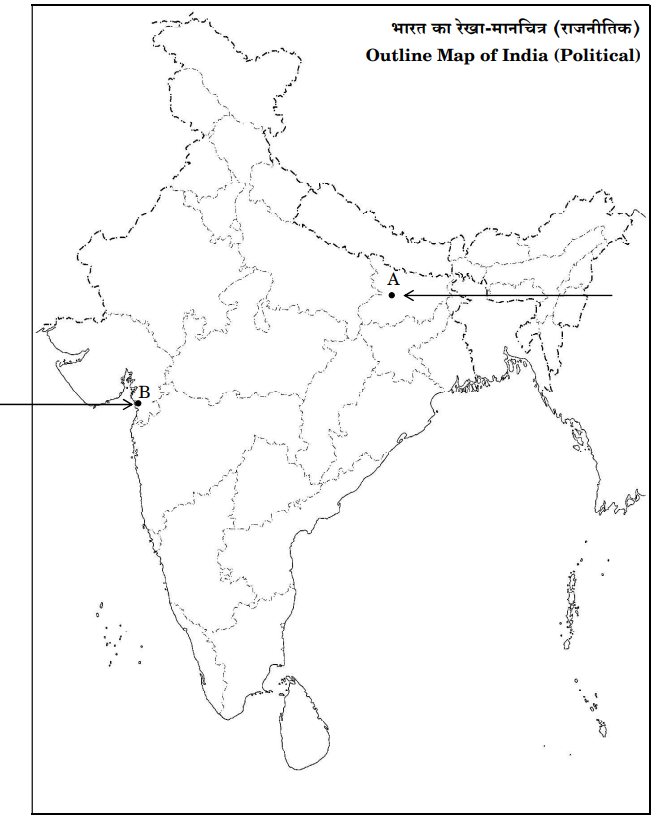
(1) Kalibangan a mature Harrapan site
(2) Ajmer a territory under Akbar
(3) Bharhut an important Buddhist site
(4) Name any mature Harappan site in Rajasthan.
(5) Mention any two places which were under the control of the British in 1857.
(6) Vijayanagara Capital of Krishanadeva Raya's empire
(7) Mention any one Buddhist site in Southern India.
(8) On the same political outline map of India two places related to British control in 1857 are marked as A and B. Identify them and write their names on the lines drawn near them.
(9) Name any one capital city of the Mughal Empire.
(10) Name the capital of Vijayanagara Empire.
Section B
Identify the character of the Mahabharata for the following information:
Was a nishad;
Considered Dronacharya as his Guru;
Gave his right thumb to Dronacharya as Guru dakshina.
Who among the following is believed to have spoken these words? "Be lamps unto yourselves as all of you must work out your own liberation."
Which of the following statements is correct about Prabhavati Gupta?
Which of the following statements are true regarding Buddha?
(i) Buddha was the son of a chief of Sakya clan.
(ii) He had a sheltered upbringing within the Sangha.
(iii) He was informed of the harsh realities of life.
(iv) He was deeply anguished when he saw an old man and a sick man.
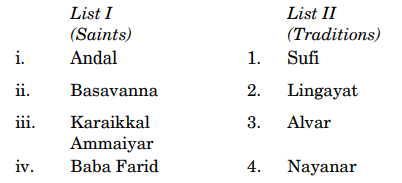
Match List I with List II:
Which of the following statements regarding Francois Bernier are correct?
(i) He was a doctor, philosopher, and historian.
(ii) He came to the Mughal Empire in search of opportunities.
(iii) He became physician to Prince Dara Shikoh.
(iv) Bernier traveled during Aurangzeb's reign.
Rearrange the following in chronological order:
(i) Saluva commanders replaced by Tuluvas,
(ii) Orissa subdued by Krishnadeva Raya,
(iii) Battle of Talikota,
(iv) Harihara and Bukka founded Vijayanagara.
Assertion (A) : Our major source to know agrarian history of 16th and 17th centuries is the chronicle known as Ain-i-Akbari.
Reason (R) : This text meticulously recorded the arrangements made by the state to ensure cultivation, collect revenue and relations between state and zamindars
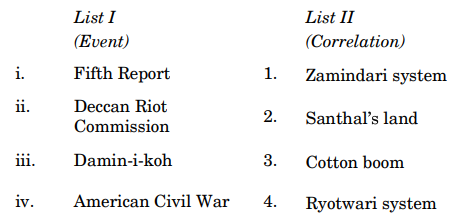
Match the events:
Arrange the following in sequence:
(i) Gandhiji's call for Non-Cooperation
(ii) Gandhiji's Kheda Satyagraha
(iii) Gandhiji's Champaran Satyagraha
(iv) Gandhiji's speech in Banaras Hindu University
Section C
The vey choice of the site of Vijayanagar was inspired by the existence of the shirnes of impressive shrines of Virupaksa and Pampadevi. Justify the statement.
Section D
"According to Brahmanical theory, only Kshatriyas could be kings in the early states, however several other ruling lineages probably had different origins in the statement with examples from ancient India.
"Given the diversity of the sub-continent , there have been populations in early states, whose social practices were not influenced by the Brahmanical ideas ." Explains the statement .
Paper Details
CBSE Board Exam 2023
Class
Class 12 Humanities
Subject
History
Year
2023
Set
Set 4
Other Years — History