QUESTION PAPER
2024 BOARD EXAM
CBSE Class 12 Humanities History Board Paper 2024 — Set 5
2024
History
Class 12 Humanities
CBSE EXAMINATION PAPER-2024
HISTORY
(Solved)
General Instructions :
Read the following instructions carefully and follow them :
- This question paper contains 40 questions. All questions are compulsory.
- This question paper is divided into 4 sections.
- Section A – questions number 1 to 4 are case based questions
- Section B – questions number 5 to 26 are multiple choice questions
- Section C – questions number 27 to 34 are short answer
- Section D – questions number 35 to 40 are long answer
- There is no overall choice given in the question paper. However, an internal choice has been provided in few questions.
- Use of calculator is NOT allowed.
Section A
Read the following source carefully and answer the questions that follow:
Buddhism in practice
This is an excerpt from the Sutta Pitaka, and contains the advice given by the Buddha to a wealthy house holder named Sigala:
In five ways should a master look after his serva ntsand employees.... by assigning them work according to their strength, by supplying them with food and wages,by tending them in sickness; by sharing delicacies with the man dby granting leave at times...
In five ways should the clansmen look after the needs of samanas (those who have renounced the world)andBrahmanas:byaffectioninact and speech and mind, by keeping open house to them and supplying their worldly needs.
There are similar instructions to Sigala about how to behave with his parents,teacher and wife.
(1) Explain the significance of Sutta Pitaka in Buddhism.
[1 Mark](2) What was the advice given by Buddha to Sigala on how to behave with his parents and teachers ?
(3) How did Buddha advise the wealthy householders to be humane and ethical?
[1 Mark]Read the source given below and answer the questions that follow:
A language with an enormous range
Al-Biruni described Sanskrit as follows :
If you want to conquer this difficulty (i.e.to learnSanskrit),you will not find it easy,because the language is of an enormous range,both in words and inflections ,something liketheArabic,calling one and the same thing by various names, both original and derivative, and using one and the same word for a variety of subjects, which, in order to be properly understood,must be distinguished from each other by various qualifying epithets.
(1) How did Al-Biruni’s observations about Sanskrit contribute to cross-cultural understanding?
[1 Mark](2) In what ways did Al-Biruni compare Sanskrit to Arabic?
[2 Marks](3) What motivated Al-Biruni to study Sanskrit?
[1 Mark]Read the source given below and answer the questions that follow:
A ryot petition
This is an example of a petition from a ryot of the village of Mirajgaon, Taluka Karjat, to the Collector, Ahmednagar, Deccan Riots Commission:
The sowkars (sahukars)....have of late begun to oppress us.As we cannot earn enough todefray our household expenses,we are actually forced to beg of the to provide us with money ,clothes and grain, which we obtain from them not with out great difficulty, nor with out their compelling us to enter into hard conditions in the bond. Moreover the necessary clothes andgrain are notsold tous at cash rates. Theprices asked from us are generally twenty-five or fifty per cent more than demanded from customer smaking readymoney payments... The produce of our fields is also taken by the sowkars, who at the time of removing it assure us that it will be credited to our account ,but they do not actually make any mention of it in the accounts. They also refuse to pass us any receipts for the
(1) Explain any two features of the Ryotwari system.
[2 Marks](2) Why was the harvest taken away by the money-lenders?
[1 Mark](3) In what ways did the money-lenders oppress the ryots?
[1 Mark]On the given political outline map of India, locate and label the following with appropriate signs :
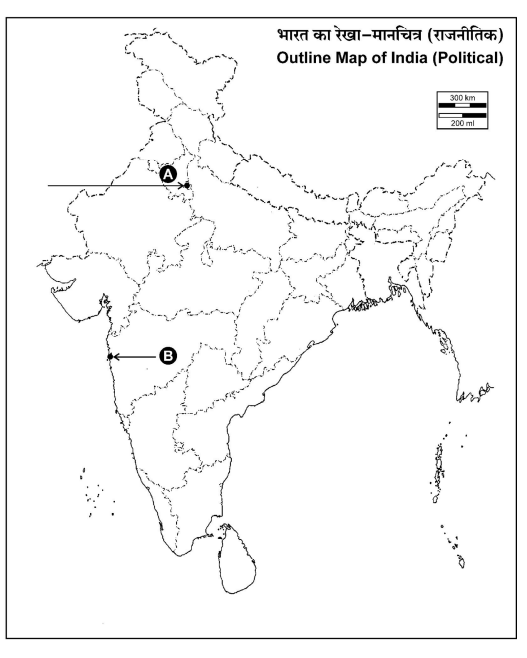
(1) Banawali - A matured Harappan Site
(2) Bharhut - A Buddhist Site
(3) On the same map two places have been marked as A and B, which are the centres of Indian National Movement. Identify them and write their correct names on the lines drawn near them.
(4) Delhi – Territory under Mughal’s control
(5) Agra – Territory under Mughal’s control
(6) Mention any two Harappan Site.
(7) Mention any one territory under Mughal’s control.
(8) Mention the name of the Capital of Vijay nagar Empire.
(9) Name any two centres of Indian National Movement.
Section B
Which one of the following is the correct statement regarding Harappan Culture?
Who among the following was an ex-army official and worked as Director General of Archaeological Survey of India (ASI)?
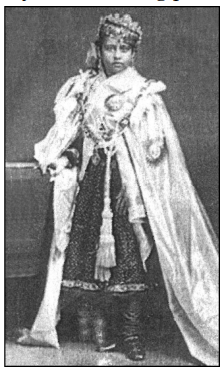
Identify the following picture from the given options:
Arrange the following in chronological order:
I. Rule of Ashoka,
II. Invasion of Alexander,
III. Rule of Gupta dynasty,
IV. Rise of Chalukyas in Karnataka.
Assertion (A) : In the Eighth Century, the Kailashnath Temple was carved out of mountain.
Reason (R) : King Ashoka had given the directive to create artificial caves by cutting into the mountains to resemble temples.
Identify the medieval globe-trotter with the help of the following information :
Before he set-off for India he made pilgrimage trips to Mecca before1332-33 C.E.
The Delhi Sultan Muhammad Bin Tughlaq made him Qazi or the judge of Delhi.
Read the following information carefully and choose the correct location for this dargah from the given options.
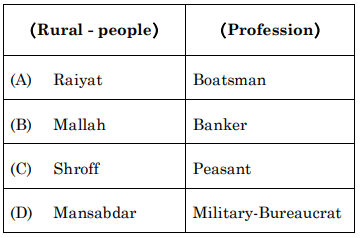
Which Mughal rural society term is correctly matched?
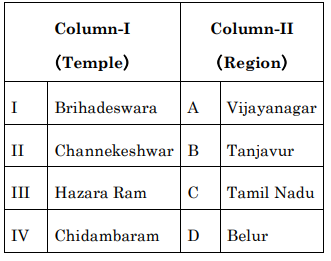
Match column-I with column-II and choose the correct option:
Identify the forest tribe during sixteenth and seventeenth century with the help of following information :
In Assam these Tribal Chiefs became kings.
They rendered military service in exchange of land.
They declared their monopoly on catching wild elephants.
Identify the primary purpose of Britishers to implement Permanent Settlement in Bengal. Choose the best suitable option from the following:
Who among the following described the following line for Kingdom of Awadh ? “A cherry that will fall into our mouth one day.”
Who among the following moved the resolution in the Constituent Assembly that the Indian National Flag be horizontal tricolour of saffron, white and dark green in equal proportions with a wheel in navy blue in the centre?
Identify the member of Constituent Assembly with the help of information given below :
(i) He was a member of drafting committee of constitution.
(ii) He was a lawyer.
(iii) He gave crucial inputs in drafting of constitution.
(iv) He belonged to Madras(Chennai).
Which of the following movements was broadened by ‘Lal-Bal-Pal’ and conveyeditastheall-India character of their struggle from1905-1907? 1
Section C
Section D
Paper Details
CBSE Board Exam 2024
Class
Class 12 Humanities
Subject
History
Year
2024
Set
Set 5
Other Years — History