QUESTION PAPER
2024 BOARD EXAM
CBSE Class 12 Humanities History Board Paper 2024 — Set 1
2024
History
Class 12 Humanities
CBSE EXAMINATION PAPER-2024
HISTORY
(Solved)
General Instructions :
Read the following instructions carefully and follow them :
- This question paper contains 42 questions. All questions are compulsory.
- This question paper is divided into 4 sections.
- Section A – questions number 1 to 6 are case based questions
- Section B – questions number 7 to 28 are multiple choice questions
- Section C – questions number 29 to 36 are short answer
- Section D – questions number 37 to 42 are long answer
- There is no overall choice given in the question paper. However, an internal choice has been provided in few questions.
- Use of calculator is NOT allowed.
Section A
Read the given source carefully and answer the questions that follow: Buddhism in practice.
This is an excerpt from the Sutta Pitaka, and contains the advice given by the Buddha to a wealthy householder named Sigala...
In five ways should a master look after his servants and employees … by assigning them work according to their strength, by supplying them with food and wages, by tending them in sickness; by sharing delicacies with them and by granting leave at times… In five ways should the clansmen look after the needs of samanas (those who have renounced the world) and Brahmanas : by affection in act and speech and mind, by keeping open house to them and supplying their worldly needs. There are similar instructions to Sigala about how to behave with his parents, teacher and wife.
(1) How did Buddha highlight the significance of compassion in social hierarchy?
[1 Mark](2) Explain any two tenets of Karma according to Buddha.
[2 Marks](3) Why did Buddha emphasise righteous action?
[1 Mark]Read the given source carefully and answer the questions that follow:
A strange nation?
The travelogue of Abdur Razzaq written in the 1440s is an interesting mixture of emotions and perceptions. On the one hand, he did not appreciate what he saw in the port of Calicut (present-day Kozhikode) in Kerala, which was populated by “a people the likes of whom I had never imagined”, describing them as “a strange nation”. Later in his visit to India, he arrived in Mangalore, and crossed the Western Chats. Here he saw a temple that filled him with admiration : Within three leagues (about nine miles) of Mangalore, I saw an idol-house the likes of which is not to be found in all the world. It was a square, approximately ten yards a side, five yards in height, all covered with cast bronze, with four porticos. In the entrance portico was a statue in the likeness of a human being, full stature, made of gold. It had two red rubies for eyes, so cunningly made that you would say it could see. What craft and artisanship!
(1) Why did Abdur Razzaq call India a ‘strange nation’?
[1 Mark](2) How do emotions and perceptions reflect in this source?
[1 Mark](3) How did Abdur Razzaq describe the temples of the Western Ghats in Mangalore?
[2 Marks]Read the given source carefully and answer the questions that follow: “There cannot be any divided loyalty” Govind Ballabh Pant emphasised to become loyal citizens.
For the success of democracy one must train himself in the art of self-discipline. In democracies one should care less for himself and more for others. All loyalties must exclusively be centred round the State. If in a democracy, you create rival loyalties, or you create a system in which any individual or group, instead of suppressing his extravagance, cares nought for larger or other interests, then democracy is doomed.
(1) How has Pant described the key to the success of democracy?
[1 Mark](2) How has Pant defined the art of self-discipline in democracy?
[1 Mark](3) Explain Pant’s views on the relationship between democracy and equality.
[2 Marks]Map-Based Questions
On the given political outline map of India (on page 23), locate and label the following with appropriate symbols :
(i) Banawali, a Harappan site
(ii) Amravati stupa
(iii) (a) Agra (Territory under the Mughals)
OR
(iii) (b) Ajmer (Territory under the Mughals)
On the same outline map, two centres related to the Indian National Movement are marked as A and B. Identify them and write their correct names on the lines drawn near them. 2
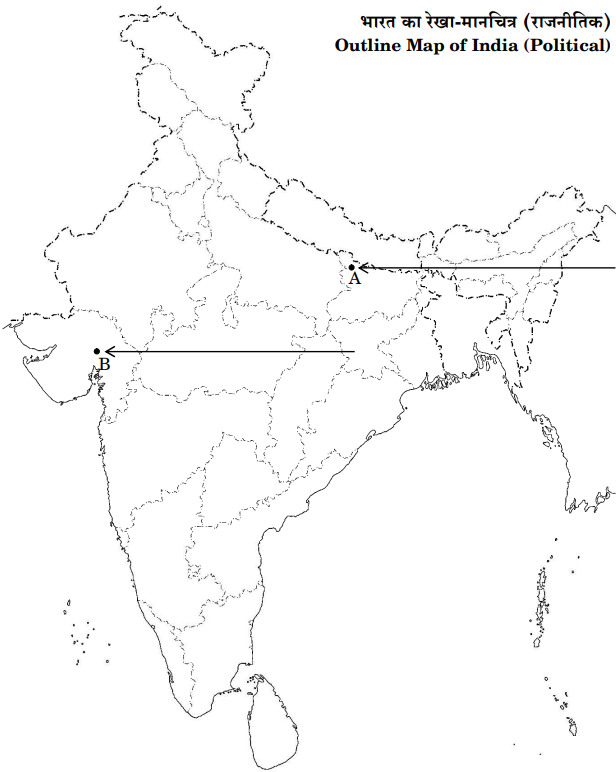
On the given political outline map of India (on page 23), locate and label the following with appropriate symbols :
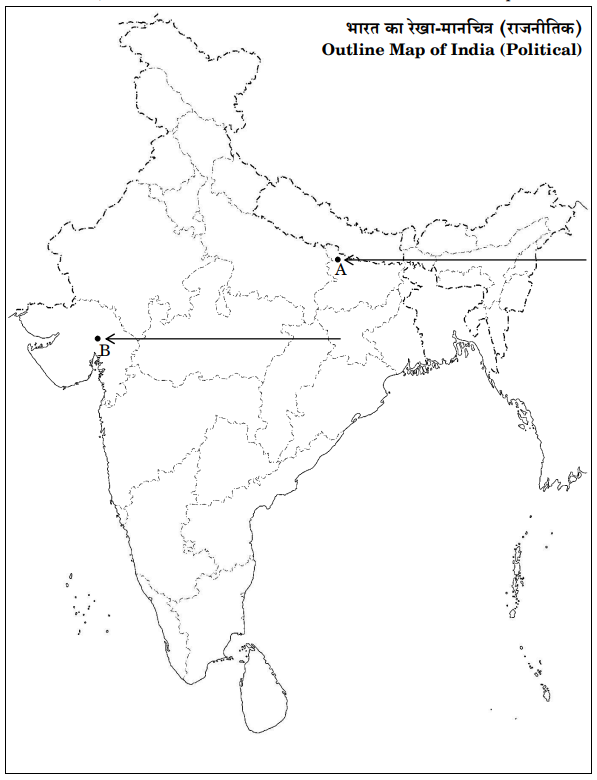
(1) Banawali, a Harappan site
(2) Ajmer (Territory under the Mughals)
(3) Amravati stupa
(4) Agra (Territory under the Mughals)
(5) On the same outline map, two centres related to the Indian National Movement are marked as A and B. Identify them and write their correct names on the lines drawn near them.
(6) Mention any two Buddhist sites in India.
(7) Mention the capital city of Vijayanagara empire.
(8) Mention any one territory under the Mughal empire.
(9) Mention any two centres of the Indian National Movement.
Section B
Which of the following was the best source of lapis lazuli in the Harappan sites ?
Consider the following statements about Prabhavati Gupta and choose the correct option :
(i) She was the daughter of Chandragupta Maurya.
(ii) She was married to a Vakataka ruler.
(iii) She had independent access to resources.
(iv) She gave land grants to people.
Identify the ruler of ancient India with the help of the given information and choose the correct option :

Sushruta’s book ‘Sushruta Samhita’ is based on which of the following theme ?
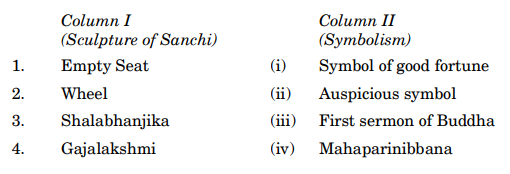
Match Column I with Column II and choose the correct option :
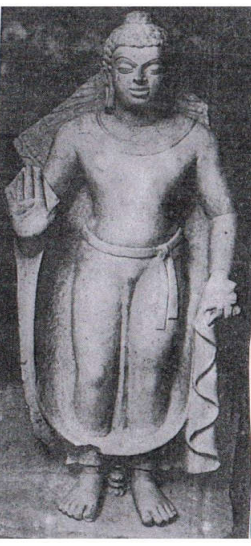
Identify the school of art with the help of the given image of Buddha.
Which of the following clans did Buddha belong to ?
In which of the following languages has Al-Biruni translated Sanskrit, Pali and Prakrit texts in India ?
Who among the following was the mentor of Amir Khusrau ?
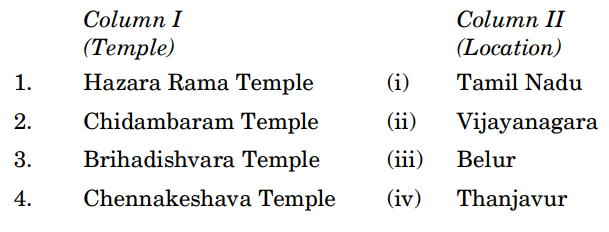
Match Column I with Column II and choose the correct option :
Among the following, whose description of ‘degenerated East’ inspired Western theorists to develop the idea of ‘oriental despotism’ ?
Which one of the following was the main factor that led to the decline of the Vijayanagara empire ?
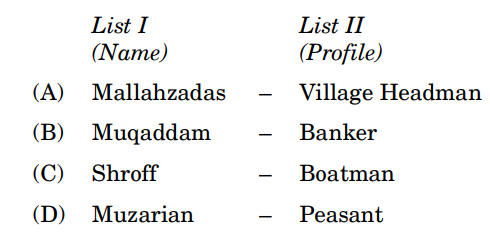
Choose the correct pair regarding the profile of rural people during the Mughal period :
Arrange the following in chronological order and choose the correct option :
(i) Limitation Law
(ii) Sunset Law
(iii) Santhal Rebellion
(iv) Bombay-Deccan Riots
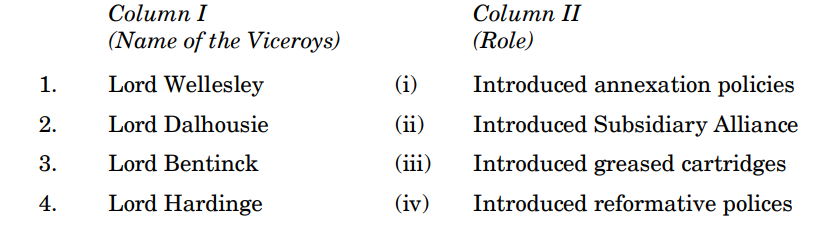
Match Column I with Column II and choose the correct option :
Assertion (A) : To broaden the Non-Cooperation Movement, Gandhiji had joined hands with the Khilafat Movement.
Reason (R) : Gandhiji hoped that coupling Non-Cooperation and Khilafat could collectively bring an end to the Colonial rule.
Who among the following members of the Constituent Assembly made a strong plea for Hindi to be used as the language of constitution-making ?
Which one of the following was a significant criticism of the Permanent Settlement ?
Fill in the blank with the appropriate word from the given options : The legislature elected under the Government of India Act, 1935 operated within the framework of _________.
Who among the following rebels took over the bungalow of a British official and turned it into a ‘hall of justice’ to settle disputes during 1857 in Uttar Pradesh ?
Fill in the blank with the appropriate word from the given options : The legislature elected under the Government of India Act, 1935 operated within the framework of _________.
Section C
Section D
Paper Details
CBSE Board Exam 2024
Class
Class 12 Humanities
Subject
History
Year
2024
Set
Set 1
Other Years — History