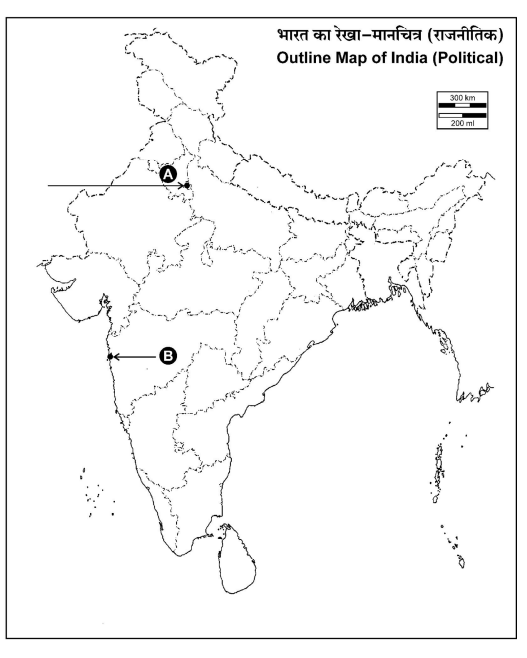
Section B
[1 Mark]
-
(A) Most of the Harappan sites were located in semi-arid lands.
-
(B) Irrigation was probably not required for agriculture at the Harappan sites.
-
(C) No trace of canals have been found at the Harappan sites.
-
(D) The Iron-tipped Ploughshare was used at the Harappan sites.
Explanation: Most of the Harappan sites were located in semi-arid lands, where irrigation was probably required for agriculture. The context indicates that while traces of canals have been found at the site of Shortughai, this is not true for all Harappan sites, and suggests that methods such as using wells and water reservoirs were employed for irrigation. Thus, the statement regarding the location of Harappan sites being in semi-arid lands is correct.
[1 Mark]
-
(A) John Marshall
-
(B) Alexander Cunningham
-
(C) R.E.M. Wheeler
-
(D) R.D. Banerjee
Explanation: The correct answer is R.E.M. Wheeler. He served as the Director General of the Archaeological Survey of India (ASI) starting in 1944 and his background as an ex-army official helped him implement important changes in archaeological practices in India.
[1 Mark]
-
(A) This script remains undeciphered till date.
-
(B) This script was written from left to right.
-
(C) It was not alphabetic.
-
(D) It has too many signs between 375 and 400.
Explanation: The correct answer is 'This script was written from left to right.' This statement is not true because the context indicates that the Harappan script was written from right to left, as evidenced by the spacing noted in seals. All other statements about the script being undeciphered, not being alphabetic, and having between 375 and 400 signs are accurate.
[1 Mark]
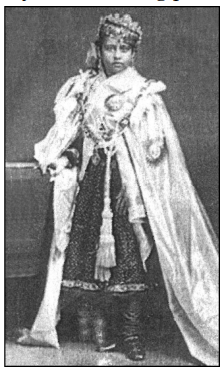
-
(A) Jahanara Begum
-
(B) Shahjahan Begum
-
(C) Sultan Jahan Begum
-
(D) Ruksar Begum
Explanation: The correct option is Jahanara Begum. The context refers to Jahanara as a Mughal princess accompanying her father, Emperor Shah Jahan, on a pilgrimage, which suggests she is a prominent figure in Mughal history. The other options, while also notable individuals, do not have the same relevant connections described in the context.
[1 Mark]
-
(A) Uttar Pradesh
-
(B) Madhya Pradesh
-
(C) Arunachal Pradesh
-
(D) Andhra Pradesh
Explanation: The Sanchi Stupa is located in Madhya Pradesh. The context mentions traveling from Delhi to Bhopal and refers explicitly to the Sanchi site as being significant for early Buddhism, confirming its location in Madhya Pradesh.
[1 Mark]
-
(A) Exogamy
-
(B) Polygyny
-
(C) Polyandry
-
(D) Endogamy
Explanation: The correct answer is 'Polygyny.' This term specifically refers to a man having multiple wives, which aligns with the definition provided in the question. The context discusses various marriage practices, including endogamy and exogamy, but makes no mention of a man having several wives, confirming that polygyny is the appropriate term.
[1 Mark]
-
(A) II, I, III, IV
-
(B) IV, II, I, III
-
(C) III, IV, II, I
-
(D) I, III, II, IV
Explanation: The correct chronological order is II, I, III, IV. The invasion of Alexander the Great occurred around 327 BCE, followed by the establishment of the Mauryan Empire and the rule of Ashoka around 268-232 BCE. The Gupta dynasty emerged much later, around 320 CE, and the rise of the Chalukyas occurred in Karnataka around the 6th century CE.
[1 Mark]
-
(A) Both (A) and (R) are true and (R) is the correct explanation of (A).
-
(B) (A) is not true but (R) is true.
-
(C) Both (A) and (R) are true but (R) is not the correct explanation of (A).
-
(D) (A) is true but (R) is untrue.
Explanation: Assertion (A) is true:
The Kailashnath (Kailasa) Temple at Ellora was carved out of a single mountain rock in the 8th century CE during the Rashtrakuta period.
Reason (R) is false:
Although Ashoka (3rd century BCE) did patronize rock-cut caves (like the Barabar caves), he did not order the creation of the Kailashnath Temple. The Kailasa Temple was built many centuries later and not under Ashoka’s directive.
[1 Mark]
-
(A) Ibn Batuta
-
(B) Seydi Ali Reis
-
(C) Abd-al-Razzak
-
(D) Al-Biruni
Explanation: The correct option is Ibn Battuta. He made pilgrimage trips to Mecca before 1332-33 C.E. and was appointed as the qazi or judge of Delhi by Sultan Muhammad Bin Tughlaq, as noted in the context.
[1 Mark]
-
(A) Guru Nanak Dev Ji
-
(B) Guru Arjun Dev Ji
-
(C) Guru Hargobind Sahib Ji
-
(D) Guru Gobind Singh Ji
Explanation: The correct answer is Guru Arjun Dev Ji. He was the fifth Guru of the Sikhs and compiled the hymns of Baba Guru Nanak, his four successors, and other saints into the Adi Granth Sahib, the holy scripture of Sikhism.
[1 Mark]
-
(A) This tradition emerged in Karnataka.
-
(B) They are the followers of Vishnu.
-
(C) They believed in the theory of rebirth.
-
(D) They practice funerary rites.
Explanation: The correct option is 'This tradition emerged in Karnataka.' The relevant context states that the Virashaiva tradition originated in Karnataka during the twelfth century and was led by Basavanna. This directly supports the assertion that the tradition emerged in this region.
[1 Mark]
-
(A) Ajmer
-
(B) Agra
-
(C) Fatehpur Sikri
-
(D) Delhi
Explanation: The correct answer is Ajmer, as the context specifies that the shrine became very popular by the sixteenth century and that Akbar visited the tomb in Ajmer multiple times. The shrine is also mentioned in relation to the trade route linking Delhi and Gujarat, which further highlights the significance of Ajmer as a pilgrimage site.
[1 Mark]
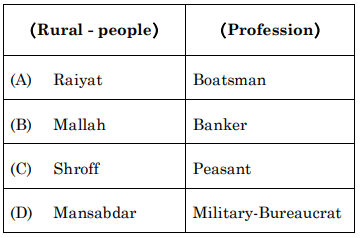
-
(A) Mallah - Banker
-
(B) Mansabdar - Military-Bureaucrat
-
(C) Raiyat - Boatsman
-
(D) Shroff - Peasant
Explanation: The correct answer is Mansabdar - Military-Bureaucrat. The term 'Mansabdar' refers to a military officer or bureaucrat in the Mughal administration, who was responsible for maintaining troops and overseeing their operations. In contrast, 'raiayat' refers specifically to peasants, while 'Mallah' (boatsman) and 'Shroff' (moneylender) do not correctly describe these roles in the rural society of the Mughals.
[1 Mark]
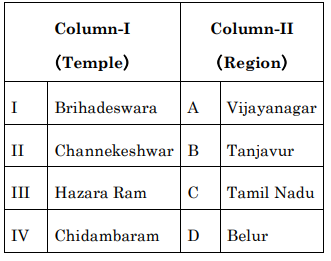
-
(A) I-A, II-C, III-D, IV-B
-
(B) I-B, II-C, III-D, IV-A
-
(C) I-C, II-B, III-D, IV-A
-
(D) I-B, II-D, III-C, IV-A
Explanation: The correct option is I-B, II-D, III-C, IV-A. This option is correct as it aligns the items in column-I with their respective explanations or counterparts in column-II, indicating a proper understanding of the historical and cultural contexts discussed in the provided text.
[1 Mark]
-
(A) Lohani tribe
-
(B) Santhal tribe
-
(C) Ahom tribe
-
(D) Munda tribe
Explanation: The correct answer is the Ahom tribe as they are specifically mentioned in the context as having their paiks who rendered military service in exchange for land. Additionally, it is noted that capturing wild elephants was declared a royal monopoly by the Ahom kings, linking them directly to the details provided.
[1 Mark]
-
(A) To empower peasants of the region.
-
(B) To abolish land ownership in the region.
-
(C) To provide financial stability to British govt.
-
(D) To increase agricultural productivity of Jotedars.
Explanation: The correct answer is 'To provide financial stability to British govt.' The Permanent Settlement was implemented to ensure a fixed revenue collection from zamindars, which aimed to stabilize the British government's financial income in Bengal, especially during a time when the rural economy was in crisis.
[1 Mark]
-
(A) Shahmal
-
(B) Kunwar Singh
-
(C) Gonoo
-
(D) Nana Saheb
Explanation: Kunwar Singh, a local zamindar in Arrah, Bihar, emerged as a prominent leader in the 1857 revolt. The context specifically mentions him taking on leadership during the uprising in Bihar, making him the correct answer.
[1 Mark]
-
(A) Lord Dalhousie
-
(B) Lord Canning
-
(C) Lord Cornwallis
-
(D) Lord Wellesley
Explanation: The correct answer is Lord Dalhousie. He described the kingdom of Awadh as 'a cherry that will drop into our mouth one day' in 1851, indicating his intention to annex the kingdom, which was carried out five years later in 1856.
[1 Mark]
-
(A) Barrackpore
-
(B) Delhi
-
(C) Meerut Cantt
-
(D) Lucknow
Explanation: The 1857 mutiny began in Meerut Cantt, as the sepoys in the cantonment broke out in mutiny late in the afternoon of 10 May 1857. This event marked the start of a larger uprising that spread rapidly to other areas.
[1 Mark]
-
(A) Rajendra Prasad
-
(B) Jawaharlal Nehru
-
(C) B.R. Ambedkar
-
(D) Vallabhbhai Patel
Explanation: The correct answer is Jawaharlal Nehru. According to the provided context, it was Nehru who moved the resolution proposing the design of the National Flag, which included a horizontal tricolour of saffron, white, and dark green with a navy blue wheel at the center.
[1 Mark]
-
(A) Alladi Krishnaswami Ayyar
-
(B) S.N. Mukherjee
-
(C) B.N. Rau
-
(D) K.M. Munshi
Explanation: The correct answer is Alladi Krishnaswami Ayyar, as he was a lawyer from Madras and was a member of the drafting committee of the Constitution, providing crucial inputs in its formulation.
[1 Mark]
-
(A) Gadar Movement
-
(B) Swadeshi Movement
-
(C) Satyagraha Movement
-
(D) Peasant Movement
Explanation: The correct answer is 'Swadeshi Movement'. The Lal-Bal-Pal trio, consisting of leaders like Bal Gangadhar Tilak, Bipin Chandra Pal, and Lala Lajpat Rai, were instrumental in expanding the Swadeshi Movement across India from 1905 to 1907, thereby establishing its all-India character.
Section C
[3 Marks]
Answer: The Harappans employed various strategies to procure raw materials for their craft production. Firstly, they established settlements in regions rich in specific resources, such as Nageshwar and Balakot for shell collection. They also utilized trade routes to access materials not found locally, such as metals from Rajasthan and stones from distant sources. Evidence of expeditions suggests organized efforts to obtain essential items like copper from the Khetri region. Additionally, transport mechanisms, including terracotta models of bullock carts, indicate complex logistics for moving goods across land. Overall, their diverse sourcing methods showcased sophisticated understanding and management of resources.
Key Points: Settlement in resource-rich areas-trade routes for materials-expeditions for copper-organized procurement systems-transport mechanisms like bullock carts
[3 Marks]
Answer: Archaeologists have reconstructed the dietary practices of the Harappans through various types of archaeological evidence, particularly through the analysis of charred grains, seeds, and animal remains found at excavation sites. Archaeo-botanists specialize in studying ancient plant remains, revealing that the Harappans cultivated a diversity of crops such as wheat, barley, lentil, chickpea, sesame, and millets, with rice being comparatively rare. Additionally, the discovery of animal bones—including those of cattle, goats, sheep, buffalo, and pigs—provides insight into the animal husbandry practices of the time. Identifying tools such as grinding stones, which were necessary for food processing, further informs our understanding of their culinary practices. Overall, the combination of plant and animal remains, alongside tools used for food preparation, allows archaeologists to piece together a comprehensive picture of the Harappan diet.
Key Points: analysis of charred grains and seeds; archaeo-botanists study ancient plant remains; cultivated crops include wheat, barley, lentil, chickpea; animal bones reveal dietary sources; grinding tools indicate food processing practices
[3 Marks]
Answer: The patriliny system was crucial among elite families from the sixth century BCE, as it ensured the continuity of wealth and power within male lineage. Sons inherited the resources and positions of authority from their fathers, such as kingship and property, thus reinforcing their status. For example, royal dynasties often emphasized patriliny by ensuring that the throne was passed down to sons. This system also influenced social norms where daughters married into other families, thereby strengthening alliances. While exceptions existed, such as women like Prabhavati Gupta, patriliny predominantly shaped elite family dynamics.
Key Points: Continuity of wealth and power; Sons inherit resources; Royal dynasties emphasized patriliny; Daughters married out to form alliances; Exceptions like Prabhavati Gupta.
[3 Marks]
Answer: Baba Guru Nanak Dev ji, the founder of Sikhism, emphasized a form of ‘Nirguna Bhakti’, which is the worship of an abstract, formless God rather than deities with specific forms. His teachings, expressed through hymns known as ‘shabad’, rejected external rituals and practices prevalent in both Hinduism and Islam, such as sacrifices, idol worship, and ritual baths. For him, the true connection to the Divine was through remembering the Divine Name, promoting a personal and direct relationship with God. By advocating Nirguna Bhakti, Baba Guru Nanak promoted an inclusive approach to spirituality that transcended religious boundaries. He aimed to connect seekers to the formless Absolute or ‘Rab’, encouraging a universal devotion that sought to unify rather than divide humanity.
Key Points: Advocated formless God-Nirguna Bhakti-Rejected rituals of Hinduism and Islam-Emphasized hymns and personal connection to Divine
[3 Marks]
Answer: The Ain-i-Akbari, authored by Abu'l Fazl, is a crucial chronicle that offers insights into the agrarian structure of the Mughal Empire during the sixteenth and seventeenth centuries. This text systematically documented the state’s efforts in agriculture, revenue collection, and regulations governing the relationship between the state and zamindars. Despite its authoritative perspective, where information about peasants is viewed from the top, it serves as a key source for understanding rural dynamics, customs, and administrative practices of the time. The Ain highlights the state’s organizing frameworks, showcasing how they managed agricultural productivity while also reflecting Akbar’s vision of social harmony under a powerful ruling class, though it is essential to recognize it lacks the voice of the common peasant.
Key Points: Importance of Ain-i-Akbari as a primary source-Documented state’s agricultural and revenue strategies-Sheds light on relationship between state and zamindars-Provides insights into rural customs despite its top-down perspective-Reflects Akbar’s vision of social harmony
[3 Marks]
Answer: Bahadur Shah Zafar initially reacted with horror to the rebellion of 1857, expressing rejection rather than support for the sepoys' uprising. However, as the situation escalated and rebels entered the Mughal court, he realized he had limited options and agreed to be a nominal leader of the revolt. This decision came after the sepoys from Meerut urged him to assume leadership, as they sought legitimacy for their cause. His blessing gave a symbolic endorsement to the rebellion, allowing it to gain traction and unite disparate groups under a common leadership, transcending religious divides.
Key Points: Bahadur Shah's initial horror and rejection - The entry of sepoys into the court - Limited options leading to his acceptance of leadership - Blessing the rebellion provided legitimacy - Unification of Hindus and Muslims under a common cause
[3 Marks]
Answer: To understand the Revolt of 1857, we can refer to several key sources. Firstly, official British records provide insight into the perspectives and actions of British officials during the revolt. However, these records are limited in reflecting the desires of the rebels. Secondly, rebel proclamations and letters from leaders convey the motivations and sentiments behind the uprising, offering a glimpse into the thoughts and aims of the insurgents. Lastly, art and literature from the period, including poems and narratives, have immortalized the events and portrayed the heroes of the revolt, shaping public memory and historical interpretation. These sources combined help paint a comprehensive picture of this significant event in Indian history.
Key Points: British official records - offer perspectives on British actions; Rebel proclamations - reveal insights on rebel motivations; Art and literature - illustrate and preserve the memory of the revolt
[3 Marks]
Answer: The draft constitution of India established a federal structure through three distinct lists of subjects: Union, State, and Concurrent. The Union List includes subjects exclusively under the jurisdiction of the Central Government, like defense, foreign affairs, and atomic energy, ensuring a unified national policy. The State List contains subjects such as police, public health, and agriculture, allowing states to govern local matters. The Concurrent List comprises subjects like education and marriage, where both levels of government can legislate. This framework was designed to maintain a strong central authority while ensuring state rights, balancing autonomy with national interests.
Key Points: Three lists: Union, State, Concurrent - Union List: exclusive powers to Central Government (defense, foreign affairs) - State List: powers to state governments (police, agriculture) - Concurrent List: shared powers (education, marriage) - Ensures strong central authority while allowing state autonomy
Section D
[8 Marks]
Answer: The sixth century BCE marked a pivotal transformation in early Indian history, characterized by the rise of early states and empires. This era witnessed the inception of the mahajanapadas, the foremost among which included Vajji, Magadha, Koshala, and others. The agrarian society evolved alongside the growth of urban centers facilitated by iron technology and coinage, contributing to economic sophistication. Additionally, this period fostered significant philosophical development, with the emergence of Buddhism and Jainism, driven by thinkers like Gautama Buddha and Mahavira, who sought to address existential questions. Collectively, these developments reflect the socio-political and intellectual dynamism of the sixth century BCE, establishing it as a cornerstone in the tapestry of Indian history.
Key Points: emergence of mahajanapadas; rise of early states and urban centers; technological advancements in iron and coinage; philosophical diversity with Buddhism and Jainism; influence of key thinkers like Gautama Buddha and Mahavira; transformation of social norms
[8 Marks]
Answer: Inscriptions are crucial for understanding historical contexts, yet they come with significant limitations. Firstly, the physical condition of inscriptions can impede their legibility; many inscriptions are faded, eroded, or otherwise damaged, making accurate reconstruction difficult. In some cases, letters may be missing, leading to ambiguities in meaning. Additionally, the interpretive challenges arise due to the specific language or terminology that may have varied across regions and periods. Historians often grapple with distinguishing truth from exaggeration in these texts, which can reflect bias. Furthermore, despite numerous discoveries, many inscriptions remain undeciphered or undocumented, and countless more may have been lost to time. Thus, while inscriptions are invaluable, their limitations necessitate cautious and nuanced interpretations in historical reconstruction.
Key Points: 1. Physical condition affects legibility of inscriptions. 2. Missing letters can create ambiguity. 3. Interpretive challenges due to language and regional specificity. 4. Potential bias in historical claims made in inscriptions. 5. Many inscriptions remain undeciphered; many more lost to time.
[8 Marks]
Answer: The rise of the Vijayanagara Empire can be attributed to several key factors. Founded by Harihara and Bukka in 1336, it capitalized on the political fragmentation in South India after the fall of the Delhi Sultanate. The Empire expanded rapidly under capable rulers like Krishnadeva Raya, who employed military prowess and strategic alliances, effectively unifying diverse linguistic and religious groups under a single rule. The agrarian economy flourished, supported by irrigation projects and temple maintenance that fostered local loyalty. However, the decline began after Krishnadeva Raya's death in 1529, as succession issues led to power struggles. The increased independence of military chiefs, the Nayakas, and conflicts with the Deccan Sultanates weakened central authority. The catastrophic defeat at the Battle of Talikota in 1565 marked a significant turning point, leading to the sacking of the empire’s capital and the eventual fragmentation of its territories. By the end of the 17th century, the once-mighty Vijayanagara Empire had lost its prominence, succumbing to internal strife and external pressures. The complexities of identity among the empire’s diverse population also played a role in its decline, as factionalism undermined unified governance.
Key Points: 1. Founded in 1336 by Harihara and Bukka amidst political fragmentation. 2. Expansion under Krishnadeva Raya through military strength and alliances. 3. Economic prosperity from agrarian reforms and irrigation. 4. Decline post-1529 due to succession crises and Nayakas' independence. 5. Defeat at the Battle of Talikota in 1565 led to the capital's sacking. 6. Internal strife and diverse identities hindered unified governance.
[8 Marks]
Answer: The fortifications of the Vijayanagara Empire represent a meticulous blend of defense and urban planning, reflecting its rulers' strategic foresight. Unlike conventional practices of merely creating fortress structures, the Vijayanagara rulers adopted a comprehensive approach to fortification. They fortified not just the royal center but also the expansive agricultural regions, indicating an innovative strategy to protect their economic base. The empire featured a multi-tiered defense system, with three concentric walls surrounding urban complexes, establishing robust barriers against invasions. Architectural elements, such as grand gateways and aqueducts, showcased engineering prowess alongside defensive functionalities. The prominent gopurams, or temple towers, exemplified the cultural richness intertwined with military architecture. These fortifications not only safeguarded the empire against external threats but also symbolized the rulers' power and wealth, solidifying their imperial culture. The urban layout designed by the empire reflected careful planning, with significant monuments and temple complexes integrated into the defensive network, highlighting the interdependence of security, economy, and culture in the Vijayanagara Empire. Thus, the fortifications of Vijayanagara were not only military installations but also vital components of its identity, blending aesthetics, religion, and strength effectively.
Key Points: Multi-tiered defense system; protection of agricultural belts; architectural features like gopurams and gateways; integration of defense with urban planning; representation of imperial power and wealth.
[8 Marks]
Answer: Gandhiji’s decision to initiate the Salt Satyagraha was rooted in multiple strategic and symbolic reasons. Primarily, the British salt monopoly imposed restrictions on the production and sale of salt, a commodity essential for every Indian household, thus making it an apt symbol of protest. By targeting this law, Gandhiji aimed to unite the Indian populace against the oppressive British rule, as the salt issue affected everyone. He announced the march with a clear intent to challenge the authority of the British government publicly. Additionally, the march from Sabarmati to the sea highlighted the nonviolent spirit of the movement, attracting widespread participation and media attention. The Salt Satyagraha not only showcased Gandhiji's strategy of peaceful resistance but was also pivotal because it marked a significant turning point in the Indian independence struggle, galvanizing national consciousness and inspiring collective action. The simple act of making salt became a powerful statement against colonial oppression, making the Salt Satyagraha one of the most significant events in the history of the Indian freedom movement.
Key Points: British monopoly on salt; everyday importance of salt; mobilization of mass discontent; nonviolent resistance; galvanizing national consciousness; significant turning point in independence movement
[8 Marks]
Answer: The ‘Quit India Movement’, launched by Mahatma Gandhi in August 1942, is considered a mass movement due to its broad participation across different sections of Indian society. Following the failure of the Cripps Mission, Gandhi called for immediate independence, which resonated with the aspirations of millions of Indians. Despite Gandhi’s arrest, the movement gained momentum as students, workers, and peasants mobilized on a large scale. Ordinary citizens participated in strikes, demonstrations, and acts of civil disobedience, indicating widespread discontent with British rule. The movement particularly engaged the youth, with many abandoning their studies to join protests. This unprecedented surge in popular action created a sense of national unity among diverse communities, including Hindus and Muslims, who collectively sought to end colonial dominance. Thus, the Quit India Movement was not merely an elite-driven campaign but a grassroots mobilization involving hundreds of thousands of Indians united in their demand for freedom.
Key Points: Mass participation across different sections of society; Gandhi's leadership and call for independence; Widespread civil disobedience and strikes; Significant involvement of the youth; Unity among Hindus and Muslims against colonial rule; Unprecedented surge in popular action.