QUESTION PAPER
2023 BOARD EXAM
CBSE Class 12 Humanities History Board Paper 2023 — Set 3
2023
History
Class 12 Humanities
CBSE EXAMINATION PAPER-2023
HISTORY
(Solved)
General Instructions :
Read the following instructions carefully and follow them :
- This question paper contains 40 questions. All questions are compulsory.
- This question paper is divided into 4 sections.
- Section A – questions number 1 to 4 are case based questions
- Section B – questions number 5 to 26 are multiple choice questions
- Section C – questions number 27 to 34 are short answer
- Section D – questions number 35 to 40 are long answer
- There is no overall choice given in the question paper. However, an internal choice has been provided in few questions.
- Use of calculator is NOT allowed.
Section A
Read the given source and answer the questions that follow :
How artefacts are identified
Processing of food required grinding equipment as well as vessels for mixing, blending and cooking. These were made of stone, metal and terracotta. This is an excerpt from one of the earliest reports on excavations at Mohenjodaro, the best-known Harappan site : Saddle querns ... are found in considerable numbers ... and they seem to have been the only means in use for grinding cereals. As a rule, they were roughly made of hard, gritty, igneous rock or sandstone and mostly show signs of hard usage. As their bases are usually convex, they must have been set in the earth or in mud to prevent their rocking. Two main types have been found: those on which another smaller stone was pushed or rolled to and fro, and others with which a second stone was used as a pounder, eventually making a large cavity in the nether stone. Querns of the former type were probably used solely for grain; the second type possibly only for pounding herbs and spices for making curries. In fact stones of this latter type are dubbed "curry stones" by our workman and our cook asked for the loan of one from the museum for use in the kitchen.
(From Ernest Mackay, Further Excavations at Mohenjodaro)
(1) How do archaeologists classify their finds?
[1 Mark](2) How has Ernest Mackay described 'Saddle quern' in his book?
(3) How do archaeologists use present day analogies to understand ancient artefacts?
[1 Mark]Read the given source and answer the questions that follow :
Irrigating trees and fields
This is an excerpt from the Babur Nama that describes the irrigation devices the emperor observed in northern India :
The greater part of Hindustan country is situated on level land. Many though its towns and cultivated lands are, it nowhere has running waters ... For ... water is not at all a necessity in cultivating crops and orchards. Autumn crops grow by the downpour of the rains themselves; and strange it is that spring crops grow even when no rains fall. (However) to young trees water is made to flow by means of buckets or wheels ...
In Lahore, Dipalpur (both in present-day Pakistan) and those other parts, people water by means of a wheel. They make two circles of rope long enough to suit the depths of the well, fix strips of wood between them, and on these fasten pitchers. The ropes with the wood and attached pitchers are put over the wheelwell. At one end of the wheel-axle a second wheel is fixed, and close to it another on an upright axle. The last wheel the bullock turns; its teeth catch in the teeth of the second (wheel), and thus the wheel with the pitchers is turned. A trough is set where the water empties from the pitchers and from this the water is conveyed everywhere.
In Agra, Chandwar, Bayana (all in present-day Uttar Pradesh) and those parts again, people water with a bucket ... At the well-edge they set up a fork of wood, having a roller adjusted between the forks, tie a rope to a large bucket, put the rope over a roller, and tie its other end to the bullock. One person must drive the bullock, another empty the bucket.
(1) How did the expansion of irrigation facilities increase the participation of farmers?
[1 Mark](2) Examine the factor that accounted for the expansion of agriculture in Mughal Period.
[1 Mark](3) Examine the irrigation devices used in agrarian culture.
[2 Marks]Read the given source and answer the questions that follow :
The jotedars of Dinajpur
Buchanan described the ways in which the jotedars of Dinajpur in North Bengal resisted being disciplined by the zamindar and undermined his power : Landlords do not like this class of men, but it is evident that they are absolutely necessary, unless the landlords themselves would advance money to their necessitous tenantry ...
The jotedars who cultivate large portions of lands are very refractory, and know that the zamindars have no power over them. They pay only a few rupees on account of their revenue and then fall in balance almost every kist (instalment), they hold more lands than they are entitled to by their pottahs (deeds of contract). should be zamindar's officers in consequence, summon them to the cutcherry, and detain them for one or two hours with a view to reprimand them, they immediately go and complain at the Fouzdarry Thanna (police station) for imprisonment and at the munsiff's (a judicial officers at the lower court) cutcherry for being dishonoured and whilst the causes continue unsettled, they instigate the petty ryots not to pay their revenue consequently ...
(1) Why did jotedars resist the Zamindars of Dinajpur?
[1 Mark](2) How did Jotedars instigate the ryots?
[1 Mark](3) How did jotedars gain power in the village?
[2 Marks]On the given political outline map of India (on page 27), locate and label the following with appropriate symbols :
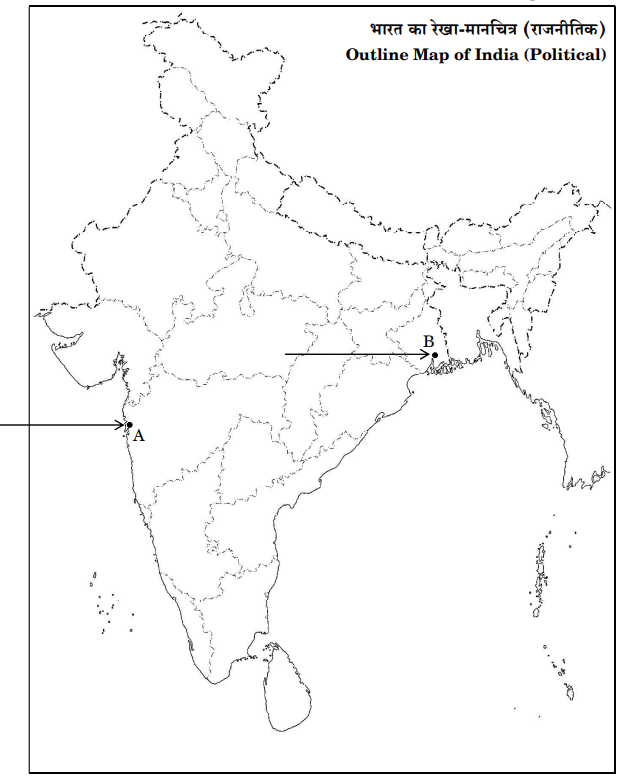
(1) Kannauj Ashokan Inscription
(2) Rakhigarhi Mature Harappan site
(3) Ajmer Territory under control of Mughals
(4) Mysore An empire
(5) On the same political outline map of India, two places related to British control in 1857 are marked as A and B. Identify them and write their names on the lines drawn near them.
(6) Name any two Buddhist sites in India.
(7) Name any one capital city of the Mughal Empire.
(8) Name any one territory under Mughal empire.
(9) Name any two centres of the Revolt of 1857.
Section B
Read the following statements about the Indus Valley Civilization:
(i) Early and mature Harappan culture shared subsistence strategies.
(ii) Millets have been found from one of the Indus Valley Civilization sites.
(iii) Archaeologists have found evidences of a ploughed field at Kalibangan.
(iv) Archaeo-zoologists reconstructed dietary practices from charred grains. Choose the correct option:
Which of the following statements are correct about the Bhakti saint, Karaikkal Ammaiyar?
(i) She was a woman devotee from Karnataka.
(ii) She was a woman Nayanar.
(iii) She was a devotee of Shiva.
(iv) She composed Nalayira Divyaprabandham.
Which of the following are correct about Mughal Land Revenue Collection?
(i) Kankut: Estimation of crops as good, middle and inferior.
(ii) Batai: Crops were reaped, sacked and divided by agreement.
(iii) Khet Batai: Division of fields before they were sown.
(iv) Lang Batai: Division of crops among Kings and Zamindars.
Which of the following options is correct about the water resources of the Vijayanagara Empire ?
Identify the leader of the Revolt of 1857 with the help of the following information:

Assertion (A): The Jallianwala Bagh massacre marked a turning point in India's struggle for independence.
Reason (R): The massacre spoiled the relations with the British and was the opening of Gandhiji's commitment to Indian nationalism.
Which of the following is the correct chronology of the rulers of ancient India?
(i) Chandragupta Maurya
(ii) Ajatashatru
(iii) Mahapadma Nanda
(iv) Ashoka
Fill in the blank: In the __________, the executives were made entirely responsible to the Provincial Legislature.
Read the following statements:
(i) Bernier's description influenced Western theorists from the fifteenth century onwards.
(ii) Montesquieu used this account to develop the idea of oriental despotism.
(iii) Bernier's idea was developed as the Asiatic mode of production by Karl Marx.
(iv) According to Bernier, the Mughal Imperial Court presided over village communities.
Choose the correct options:
Two statements as Assertion (A) and Reason (R) are given below. Read them carefully and select the correct option :
Assertion (A) : Harappan Civilization had developed a precise system of weights and measures.
Reason (R) : Metal scale-pans have been found.
Which of the following statements are correct about the central purpose of the Ain-i-Akbari?
(i) Ain-i-Akbari was authored by Abu'l Fazal.
(ii) Ain-i-Akbari presented the vision of Akbar's empire.
(iii) Ain-i-Akbari highlighted the strength of the Mughal Army.
(iv) Ain-i-Akbari mentions the Iqta system of Mughals.
Choose the correct option:
With which of the following aspect was the ' Ricardian theory ' related?
Identify the theme of "Sushruta Samhita" from the following options:
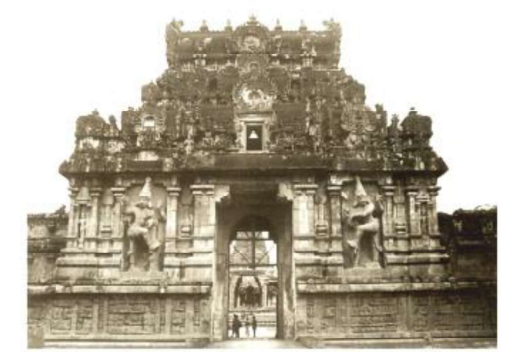
Identify the given image of a temple from the following options :
Section C
Several urban centres emerged in the sub-continent from the sixth century BCE. Explain the staement with examples.
Between the sixth and fourth centuries BCE, Magadha became the most powerful Mahajan pada .Explain the statement with examples.
Virupaksa Temple was significant in Vijayanagar Empire substantiate the statement .
The architecture of Vitthal temple was unique . substantiate the statement .
How did the British control the powers of Talukdars in the 1850's? Explain .
Section D
By 1922 Gandhi had transformed Indian nationalism .Examine the statement
Paper Details
CBSE Board Exam 2023
Class
Class 12 Humanities
Subject
History
Year
2023
Set
Set 3
Other Years — History