QUESTION PAPER
2023 BOARD EXAM
CBSE Class 12 Humanities History Board Paper 2023 — Set 5
2023
History
Class 12 Humanities
CBSE EXAMINATION PAPER-2023
HISTORY
(Solved)
General Instructions :
Read the following instructions carefully and follow them :
- This question paper contains 44 questions. All questions are compulsory.
- This question paper is divided into 4 sections.
- Section A – questions number 1 to 7 are case based questions
- Section B – questions number 8 to 30 are multiple choice questions
- Section C – questions number 31 to 38 are short answer
- Section D – questions number 39 to 44 are long answer
- There is no overall choice given in the question paper. However, an internal choice has been provided in few questions.
- Use of calculator is NOT allowed.
Section A
Read the following source and answer the questions that follow:
The Therigatha
This unique Buddhist text, part of the Sutta Pitaka, is a collection of verses composed by bhikkhunis. It provides an insight into women's social and spiritual experiences. Punna, a dasi or slave woman, went to the river each morning to fetch water for her master's household. There she would daily see a Brahmana performing bathing rituals. One morning she spoke to him. The following are verses composed by Punna, recording her conversation with the Brahmana:
I am a water carrier:
Even in the cold
I have always gone down to the water
frightened of punishment
Or the angry words of high class women.
So what are you afraid of Brahmana,
That makes you go down to the water
(Though) your limbs shake with the bitter cold?
The Brahmana replied:
I am doing good to prevent evil;
anyone young or old
who has done something bad
is freed by washing in water.
Punna said:
Whoever told you
You are freed from evil by washing in the water?....
In that case all the frogs and turtles
Would go to heaven, and so would the water snakes
and crocodiles!
(Instead) Don't do that thing.
the fear of which leads you to the water.
Stop now Brahmana!
Save your skin from the cold....
Read the following source and answer the questions that follow:
The Therigatha
This unique Buddhist text, part of the Sutta Pitaka, is a collection of verses composed by bhikkhunis. It provides an insight into women's social and spiritual experiences. Punna, a dasi or slave woman, went to the river each morning to fetch water for her master's household. There she would daily see a Brahmana performing bathing rituals. One morning she spoke to him. The following are verses composed by Punna, recording her conversation with the Brahmana:
I am a water carrier:
Even in the cold
I have always gone down to the water frightened of punishment
Or the angry words of high class women.
So what are you afraid of Brahmana,
That makes you go down to the water (Though)
your limbs shake with the bitter cold?
The Brahmana replied: I am doing good to prevent evil;
anyone young or old who has done
something bad is freed by washing in water.
Punna said: Whoever told you You are freed from evil by washing in the water?....
In that case all the frogs and turtles
Would go to heaven, and so would the water snakes
and crocodiles!
(Instead) Don't do that thing.
the fear of which leads you to the water.
Stop now Brahmana! Save your skin from the cold....
Read the following source and answer the questions that follow:
The Therigatha
This unique Buddhist text, part of the Sutta Pitaka, is a collection of verses composed by bhikkhunis. It provides an insight into women’s social and spiritual experiences. Punna, a dasi or slave woman, went to the river each morning to fetch water for her master’s household. There she would daily see a Brahmana performing bathing rituals. One morning she spoke to him. The following are verses composed by Punna, recording her conversation with the Brahmana :
I am a water carrier :
Even in the cold
I have always gone down to the water
frightened of punishment
Or the angry words of high class women.
So what are you afraid of Brahmana,
That makes you go down to the water
(Though) your limbs shake with the bitter cold ?
The Brahmana replied:
I am doing good to prevent evil;
anyone young or old who has done something bad
is freed by washing in water. Punna said : Whoever told you You are freed from evil by washing in the water ? ....
In that case all the frogs and turtles
Would go to heaven, and so would the water snakes and crocodiles!
(nstead) Don’t do that thing,
the fear of which
leads you to the water.
Stop now Brahmana!
Save your skin from the cold ...
(1) How does the text provide an insight into Punna’s spiritual experience?
(2) How is Punna reflected as an awakened soul ?
(3) Which of the teachings to Buddha are evident in the composition ?
Read the following source and answer the questions that follow:
Education and Entertainment
This is what Ibn Juzayy, who was deputed to write what Ibn Battuta dictated, said in his introduction :
A gracious direction was transmitted (by the ruler) that he (Ibn Battuta) should dictate an account of the cities which he had seen in his travel, and of the interesting events which had clung to his memory, and that he should speak of those whom he had met of the rulers of countries, of their-distinguished men of learning, and their pious saints. Accordingly, he dictated upon these subjects a narrative which gave entertainment to the mind and delight to the ears and eyes, with a variety of curious particulars by the exposition of which he gave edification and of marvellous things, by referring to which he aroused interest.
(1) Why did the Sultan of Morocco insist Ibn Battuta to dictate the story of his travel to Ibn Juzayy ?
(2) Highlight the places Ibn Battuta explored during his travel.
(3) What do Ibn Battuta’s travel account reveal about the things he noted in India ?
Read the following source and answer the questions that follows:
A newspaper report
The following report, titled “The ryot and the moneylender’, appeared in the Native Opinion (6 June, 1876), and was quoted in Report of the Native Newspapers of Bombay :
They (the ryots) first place spies on the boundaries of their villages to see if any Government officers come, and to give timely intimation of their arrival to the offenders. They then assemble in a body and go to the houses of their creditors, and demand from them a surrender of their bonds and other documents, and threaten them in case of refusal with assault and plunder. If any Government officer happens to approach the villages where the above is taking place, the spies give intimation to the offenders and the latter disperse in time.
(1) What does the given report of newspaper show about the Deccan Countryside ?
(2) Examine the causes of revolt by the ryots against moneylender.
(3) Examine the ways through which ryots spied the British.
On the given political outline map of India, locate and label the following with appropriate symbols :
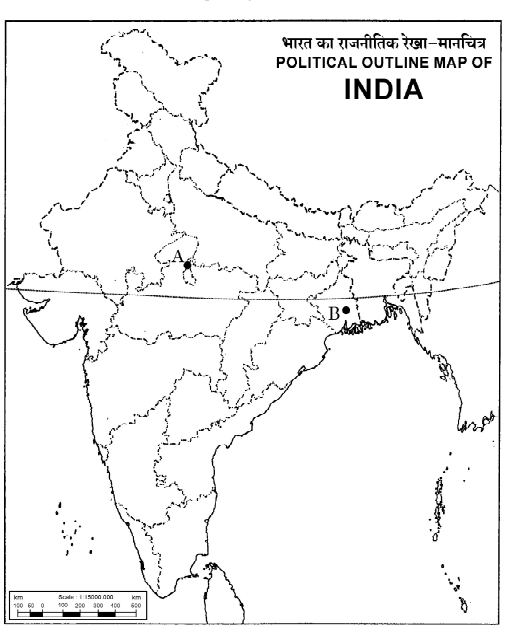
(1) Sanchi—A Stupa
(2) Dholavira —A matured Harappan Site
(3) Shahjahanabad (Delhi) — Territory under the control of Mughals.
(4) Name the capital of Vijayanagara empire.
(5) Golconda — An empire of 14‘ to 18» century.
(6) Name any two centres of the Revolt of 1857.
(7) Name any two sites of the matured Harrapan period.
(8) Name any one territory under the control of Mughal empire.
(9) On the same outline map, two places related with the centres of the Revolt of 1857 have been marked as ‘A’ and ‘B’. Identify them and write their correct names on the lines drawn near them.
Section B
Who among the following was the author of 'ashtadhyayi' , work on the Sanskrit grammer?
Arrange the following dynasties in chronological order:
(I) Nanda
(II) Shungas
(III) Mauryas
(IV) Guptas
Which one of the following statement is correct?
Which one of the following countries did 'Afanasi Nikitins' belong to?
Consider the following statements regarding the early traditions of Bhakti and select the correct ones:
I. Historians draw on hagiographies of saints for knowing traditions.
II. Many beliefs and practices were shaped through 'great' and 'little' Sanskritic Puranic traditions.
III. Bhakti tradition was classified into two broad categories Saguna and Nirguna.
IV. God was worshipped with attributes in the Nirguna bhakti.
Which of the following crops were considered ' Jins -i -Kamil ' in the mughal empire ?
Which of the following statements regarding Krishnadeva Roy is incorrect?
(A) He belonged to the Tuluva dynasty.
(B) His rule was characterised by expansion and consolidation.
(C) He founded a suburban township called Krishnapuram.
(D) He composed a work on statecraft known as 'Amuktamalyada'.
Which of the following statements regarding Krishnadeva roy is incomplete ?
Identify the british official with the help of the following information and select the correct option:
He was a Physician,came to india during 1994 to 1815
he served as surgeon to the lord wellesley.
He served in the begal medical services.
He organised ' Culcutta alipore zoo'.
Identify the given image of a temple from the following option:
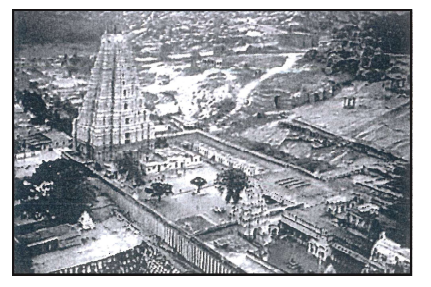
Which one of the following dynasties was the first dynasty of vijanagara empire?
Find out the chronological order of the events of the Revolt of 1857:
(I) Subsidiary alliance introduced by wellesley in awadh.
(II) Nawab wajid ali shah deposed.
(III) Summary revenue settlement introduced in awadh by the british.
(IV) Mutiny stared in meerut.
Find out the chronological order of the events of the Revolt of 1857:
(I) Subsidiary alliance introduced by wellesley in awadh.
(II) Nawab wajid ali shah deposed.
(III) Summary revenue settlement introduced in awadh by the british.
(IV) Mutiny stared in meerut.
Assertion(A): Gandhiji called for a countrywide agitation against the Rowlatt act.
Reason(R) : British authorized the government to imprison people withot trial.
Who among the following rulers worked onthe preservation of Sanchi stupa
In which of the following regions satvahanas ruled during second century BCE to second century CE?
Who among the following rulers rebuilt 'Sudarshan lake'?
Consider the given statements regarding constituent assembly and select the correct from the following options:
Which one of the following regions was called as the " Nursery of the bengal army " by the british during 1850's ?
Assertion(A) : The book "Sipah abadi' was the important book on the military and civil administration of mughals.
Reason(R): Book includes short biographical sketches of imperial officials like Mansabdars , poet etc.
Match the following :
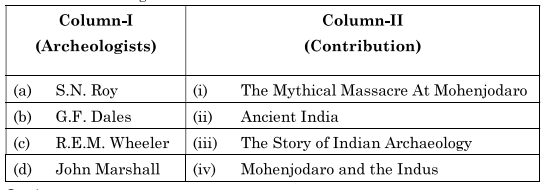
Which of the following are correctly matched ?
I. Cholas in Tamil Nadu
II. Hoysala in Warangal
III. Sultans of the Deccan
IV. Gajapati of Orissa
Identify the character of Mahabharata with the help of the following information :
Was the husband of Gandhari.
Became the King of Hastinapur.
Section C
Analyse the elements examined by historians on Mahabharata as a text.
Describe any three feature of ancient numismatics.
Why was persian ambassador abdur razzaq greatly impressed by the fortification of vijayanagara empire?Explain
Why was the 'Mahanavami Dibba' a centre of main vijayanagara rituals? Explain.
Examine the position of zamindars in the Mughal village society.
" One of the topics most vigorously debate in the constituent assembly was the respective rights of the central and the state governments." Analyse the statement with supporting arguments.
" The rebel proclamations of 1857 appealed to all the sections of the population for unity'. Explain the statement with examples.
"Art and literature as much as the writing of history have helped in keeping alive the memory of 1857." Explain the statement in reference to Rani lakshmibai.
Section D
Describe the town planning of Harappa.
Describe the contribution of varoius archeologists from 1857 till 1950 in discovering the Harappa civilization.
'Kabir Das is one of the most outstanding examples of a poet-saint who has given extensive views on social situation , institution and on ultimate reality.'Explain the statement.
'The Chistis became the most influential sufi devotional tradition in the late twelfth century.' Explain the staement.
Describe the causes and events of the quit India movement .
Describe the role of Gandhiji in the indian freedom struggle from 1922 till 1931
Paper Details
CBSE Board Exam 2023
Class
Class 12 Humanities
Subject
History
Year
2023
Set
Set 5
Other Years — History