SOLUTIONS

2022 BOARD EXAM

CBSE Class 12 Humanities History Board Paper 2022 — Set 5 Solutions

2022

History

Class 12 Humanities

CBSE EXAMINATION PAPER-2022

HISTORY

(Solved)

Time allowed : 3 hours

Maximum Marks : 45

General Instructions :

Read the following instructions carefully and follow them :

  1. This question paper contains 13 questions. All questions are compulsory.
  2. This question paper is divided into 3 sections.
  3. Section A – questions number 1 to 3 are case based questions
  4. Section B – questions number 4 to 8 are short answer
  5. Section C – questions number 9 to 13 are long answer
  6. There is no overall choice given in the question paper. However, an internal choice has been provided in few questions.
  7. Use of calculator is NOT allowed.

Section A

Question 1.

Read the source given below and answer the questions that follow :

Darbar-i Akbari

Abu'l Fazl gives a vivid account of Akbar's darbar: Whenever His Majesty (Akbar) holds court (darbar) a large drum is beaten, the sounds of which are accompanied by Divine praise. In this manner, people of all classes receive notice. His Majesty's sons and grandchildren, the grandees of the Court, and all other men who have admittance, attend to make the kornish, and remain standing in their proper places. Learned men of renown and skillful mechanics pay their respects; and the officers of justice present their reports. His Majesty, with his usual insights, gives orders, and settles everything in a satisfactory manner. During the whole time, skillful gladiators and wrestlers from all countries hold themselves in readiness, and singers, male and female, are in waiting. Clever jugglers and funny tumblers also are anxious to exhibit their dexterity and agility.

(1) How were the people informed about the conduct of the court?

[1 Mark]
Answer: The people in Akbar's empire were informed about the conduct of the court through the beating of a large drum, which heralded the start of the darbar. This sound, accompanied by divine praise, served as an announcement for individuals of all social classes to attend. The presence of Akbar's family members, court dignitaries, and officials further emphasized the importance of the event, and it was an essential aspect of the court's organization as chronicled in the Ain-i Akbari. The elaborate arrangements for the court ensured that everyone, including learned men, mechanics, and performers, were present and ready, further underlining the communal and formal aspect of these royal gatherings.
Key Points: Large drum beaten for announcements-divine praise signifies importance-attendance by all classes of society-Members of the court and officials present-readiness of performers and skilled craftsmen.

(2) How was the social control exercised in the court?

[1 Mark]
Answer: Social control in Akbar's court was exercised through various formal and informal mechanisms. The presence of a large drum to announce court activities signifies a structured approach to governance, ensuring that all social classes were aware of the proceedings. The court was attended by his sons, grandchildren, and grandees, emphasizing the hierarchical nature of societal interactions. Furthermore, learned men and skilled mechanics submitted their respects, showcasing the inclusion of intellect and craftsmanship, which reinforced the importance of knowledge and skill in governance. Officers of justice reported directly to Akbar, allowing for accountability and oversight in law enforcement, while the entertainment provided by wrestlers and jugglers served not only as a distraction but also as a display of cultural values, unity, and social cohesion within the empire. The Ain-i Akbari documented these elements meticulously, illustrating how Akbar's governance was systematic and reinforced social order through a blend of authority and cultural representation.
Key Points: Reinforcement of hierarchy in court; role of justice officers; incorporation of intellectuals and artisans; entertainment as a means of social cohesion; documentation by Ain-i Akbari.

(3) How did Akbar dispose of the appeals or cases in the court?

[2 Marks]
Answer: In his court, Akbar meticulously handled appeals and cases with a structured approach that showcased his insights and administrative skills. When the darbar was held, officers of justice presented their reports to the Emperor, who would then give orders and settle matters accordingly. This process ensured that all classes of people received fair attention, allowing even the learned and skilled mechanics to make their voices heard. The presence of renowned men and distinguished officials reflected the importance of justice in Akbar’s rule, as he aimed for satisfaction and resolution of cases based on structured reports and insights into each situation.
Key Points: Akbar held a court (darbar) for case disposal - Officers of justice presented reports - Akbar made orders to settle cases - Structured resolution ensured fairness - Presence of all classes in the court.
Question 2.

Read the source given below and answer the questions that follow :

"We are not going just to copy"

This is what Jawahar Lal Nehru said in his famous speech of 13 December, 1946: We say that it is our firm and solemn resolve to have an independent sovereign republic. India is bound to be sovereign, it is bound to be independent and it is bound to be a republic... Now, some friends have raised the question: 'Why have you not put in the word ‘democratic’ here?' Well, I told them that it is conceivable, of course, that a republic may not be democratic but the whole of our past is witness to this fact that we stand for democratic institutions. Obviously we are aiming at democracy and nothing less than a democracy. What form of democracy, what shape it might take is another matter... We are not going just to copy, I hope, a certain democratic procedure or an institution of a so-called democratic country. We may improve upon it. In any event whatever system of government we may establish here must fit in with the temper of our people and be acceptable to them..."

(1) Define the term sovereignty.

[1 Mark]
Answer: Sovereignty refers to the absolute authority and independence of a state to govern itself without interference from external forces. It signifies the power of the state to make decisions regarding its governance, laws, and policies. In the context of Jawaharlal Nehru's speech, sovereignty is highlighted as an essential characteristic of India as it becomes a republic, indicating that India has the right to self-determination and must establish a political system that is reflective of its own people's values and aspirations.
Key Points: Definition of sovereignty - authority of a state; Independence from external control; Importance in the context of a republic; Relation to democracy and governance; Reflects the people's values

(2) Which constitutions of the countries were referred by the Constitution Assembly?

[1 Mark]
Answer: In his address on 13 December 1946, Jawaharlal Nehru indicated that the Constitution Assembly of India was aware of various international models and inspirations for crafting India's own constitution. Primarily, they looked to the American Constitution, which had been fundamental in establishing a republic. The assembly also took into consideration the British parliamentary system, which provided a framework for democratic governance. Furthermore, the constitutional frameworks from countries such as Ireland and South Africa helped in shaping the ideals and principles embedded in the Indian Constitution. However, Nehru emphasized that India would not merely copy these constitutions but rather adapt and improve upon them to suit its unique context and the aspirations of its people.
Key Points: American Constitution-British parliamentary system-Irish Constitution-South African Constitution

(3) How is democracy explained in this source?

[2 Marks]
Answer: In Jawaharlal Nehru's speech on December 13, 1946, democracy is explained as a fundamental goal of the newly independent India. Nehru emphasizes that while the term 'democratic' isn't explicitly included in their declaration of a republic, the intent is clear: India must operate as a sovereign and independent entity that embraces democratic values. He acknowledges that a republic can exist without being democratic, but firmly states that Indian history and culture support the establishment of democratic institutions. Nehru insists that any democratic system formed must be tailored to fit the unique character of the Indian people rather than simply copying Western models. This approach indicates a desire for a distinctly Indian form of democracy that reflects the preferences and realities of its constituents, ensuring it is not just a replica of systems used in other nations.
Key Points: Importance of democracy; Republic vs democracy; Tailoring democracy to Indian context; Learning from Western nations; Not merely copying foreign systems
Question 3.

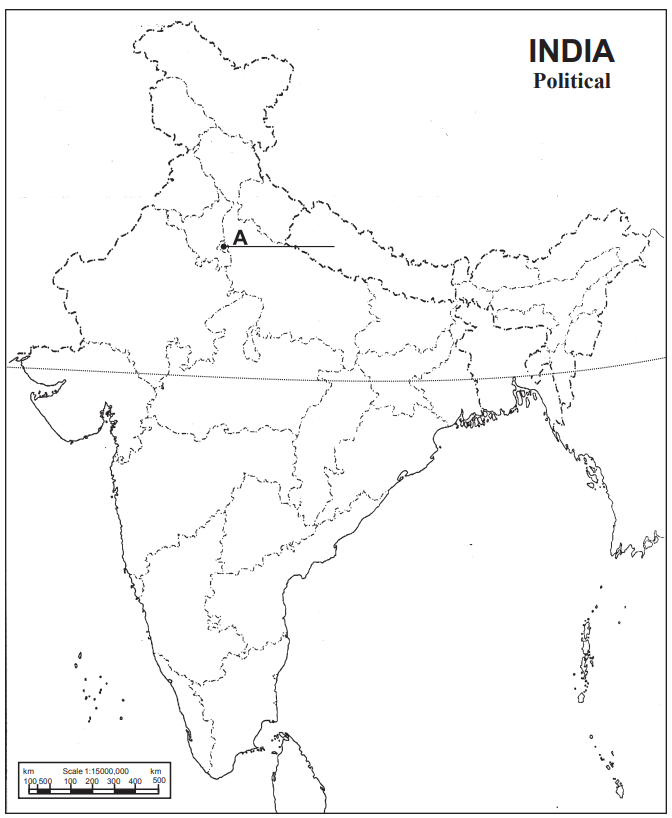
On the given political outline map of India mark and label any one of the follow with appropriate symbols :

Diagram 1 – CBSE Class 12 Humanities History 2022 Set 5 Solutions

(1)

The place where Jallianwala Bagh Massacre happened.

[1 Mark]
Answer: The Jallianwala Bagh Massacre took place in Amritsar, Punjab, on April 13, 1919. To mark this event on the political outline map of India, you should locate Amritsar in the state of Punjab and label it with a symbol such as a red dot or a cross, along with an annotation that reads 'Jallianwala Bagh Massacre 1919'. This massacre symbolizes a pivotal moment in India’s struggle for independence, highlighting the repression faced by Indians under British rule.
Key Points: Massacre took place in Amritsar; Date: April 13, 1919; Use a symbol like a red dot or cross; Significance in India's independence struggle.

(2)

The place where Salt Law was broken by Gandhiji.

[1 Mark]
Answer: The Salt Law was broken by Mahatma Gandhi at Dandi on April 6, 1930. During the Salt Satyagraha, Gandhi and his followers marched approximately 240 miles from Sabarmati Ashram to the coastal village of Dandi, where he famously picked up natural salt from the sea, thereby defying British law. This act symbolized the struggle against British oppression and the demand for Indian independence. Dandi is significant as it marked a pivotal moment in the Indian independence movement.
Key Points: Dandi - location of the Salt Satyagraha; Date - April 6, 1930; Act of defiance against British Salt Law; Symbol of Indian independence movement; Gandhi's leadership.

(3)

Mention the place where Jallianwala Bagh Massacre took place.

[1 Mark]
Answer: The Jallianwala Bagh Massacre took place in Amritsar, Punjab. It occurred on April 13, 1919, when British troops opened fire on a large gathering of Indians protesting against repressive measures imposed by the British government. This tragic incident led to the loss of hundreds of lives and is remembered as a pivotal moment in the Indian struggle for independence.
Key Points: Location: Amritsar, Punjab; Date: April 13, 1919; Event: British troops opened fire on protesters; Significance: Over 400 deaths, pivotal moment in the independence struggle.

(4)

On the same map, a capital of the Mughal Empire is marked as 'A'. Identify it and name it on the line drawn near it.

[1 Mark]
Answer: The capital of the Mughal Empire marked as 'A' on the map is 'Delhi'. This city served as the primary seat of power for the Mughal emperors, particularly during the reign of Shah Jahan, who is famous for commissioning the Taj Mahal. Delhi's significance as a political and cultural center during the Mughal era is evident from its historical monuments and architectural heritage, reflecting the grandeur of the empire.
Key Points: Delhi- Capital of Mughal Empire- Seat of power- Shah Jahan- Taj Mahal

(5)

Name any one capital of the Mughal Empire.

[1 Mark]
Answer: One of the capitals of the Mughal Empire was Fatehpur Sikri. Built during the reign of Emperor Akbar in the late 16th century, it served as the capital for a short period and is known for its stunning architecture and vibrant history.
Key Points: Fatehpur Sikri-Emperor Akbar-16th century architecture-cultural significance

(6)

Name the place where Gandhiji broke the Salt Law.

[1 Mark]
Answer: The place where Gandhiji broke the Salt Law is Dandi. On April 5, 1930, Mahatma Gandhi led a march to the coastal town of Dandi to protest against the British salt monopoly, which was a symbol of oppression for the Indian people. The act of picking up salt at Dandi marked a significant moment in the Indian independence movement and highlighted the importance of civil disobedience against unjust laws.
Key Points: Dandi - location of the Salt March - April 5, 1930 - protest against British salt monopoly - symbol of Indian resistance

Section B

Question 4. Describe the three lists of Federalism provided by the Drafting Committee in the Constituent Assembly.
[3 Marks]
Answer: The Drafting Committee of the Constituent Assembly established three lists to clarify the distribution of powers between the central government and the states in India. The first list, known as the Union List, contains subjects exclusively reserved for the Central Government, which ensures a cohesive national approach to critical issues. The State List, the second list, comprises subjects that fall solely under the jurisdiction of individual states, allowing them to govern local matters effectively. Lastly, the Concurrent List includes subjects where both the Centre and states can legislate; however, in case of a conflict, Union laws prevail. This arrangement reflects the necessity for a strong central authority while recognizing the importance of state rights, addressing India's diverse needs and the importance of cooperation.
Key Points: Union List for central government control-State List for state jurisdiction-Concurrent List for shared responsibilities
Question 5.

"The jotedars were more effective than that of zamindars in the villages." Examine the statement in the context of Permanent Settlement.

[3 Marks]
Answer: The statement that jotedars were more effective than zamindars can be examined through the dynamics of land control under the Permanent Settlement. Unlike zamindars who resided in urban areas and distanced themselves from village affairs, jotedars were entrenched in local governance. They exerted direct control over the agrarian economy by managing sharecroppers who labored their lands. The jotedars maintained a firm grip on poorer cultivators, thus ensuring the agricultural productivity of the village, which zamindars sometimes overlooked. Furthermore, when zamindars defaulted on their revenue payments, their estates frequently went to auction, with jotedars often becoming the new landowners. This trend signified their increasing influence as they were rising figures capable of mobilizing agricultural resources effectively. Overall, jotedars’ central role in village life positioned them as more effective local authorities compared to the often disconnected zamindars.
Key Points: Jotedars lived in villages; direct control over poor villagers; sharecropping system; zamindars living in urban areas; jotedars purchasing zamindars' estates; rise of jotedars in North Bengal; consolidation of power by rich peasants.
Question 6. Examine how the lives of Paharias in the hills of Raj Mahal were intimately connected to the forests.
[3 Marks]
Answer: The Paharias, who inhabit the Rajmahal hills, lived in close harmony with the forests that surrounded them. Their existence was deeply tied to the natural resources offered by these forests, as they engaged in practices like shifting cultivation, hunting, and gathering food. The clearing of forests allowed them to grow rice and cotton. They resided in hutments within tamarind groves and led lives characterized by their identity as forest dwellers. This connection fostered a culture that valued nature, evidenced by their resistance against external settlers and their reliance on forests for sustenance and livelihood. Thus, the forests were not merely a backdrop; they were integral to the Paharias' way of life and identity.
Key Points: Paharias as forest dwellers; reliance on forest resources; practices like shifting cultivation and hunting; cultural identity tied to forests; resistance against external intrusion; living conditions in tamarind groves;
Question 7. Explain the main provisions of Subsidiary Alliance as devised by Lord Wellesley in 1798.
[3 Marks]
Answer: The Subsidiary Alliance, devised by Lord Wellesley in 1798, aimed to expand British control in India through strategic alliances with Indian princely states. Under this system, the Indian rulers were required to disband their armies and accept British troops stationed within their territories for protection. They must also defer to the advice of a British Resident at their courts. This arrangement effectively reduced the military autonomy of Indian states while ensuring British influence over their governance. The first state to implement this alliance was Awadh in 1801. This policy facilitated the gradual annexation of territories, with Awadh itself being formally annexed in 1856. By inserting British military and administrative influence into local governance, the Subsidiary Alliance brought Indian states under British control, creating a framework for colonial dominance that diminished local power and sovereignty.
Key Points: Imposition of Subsidiary Alliance in Awadh, disbanding of military forces by Nawabs, British troops stationed in Indian states, advice from British Resident, gradual annexation of territories, reduction of local autonomy.
Question 8.

Explain the provisions of Irwin-Gandhi pact. Why was it criticised by the radical nationalists ?

[3 Marks]
Answer: The Gandhi-Irwin Pact was signed in March 1931, marking a significant moment in the Indian independence movement. The major provisions included the suspension of the Civil Disobedience Movement, the release of political prisoners, and the authorization for salt manufacture along the coast. However, radical nationalists criticized this pact primarily because it did not secure any concrete commitment towards India's political independence from the British government. Instead, it only ensured dialogues about future possibilities, leaving many nationalist leaders like Nehru feeling that a meaningful path to sovereignty was not achieved. Furthermore, critics like Lahiri felt that the pact reinforced British control by necessitating cooperation between the Indian leaders and a British-created Constituent Assembly that did not genuinely reflect Indian aspirations. They believed that genuine independence could only be attained through continued non-cooperation and resistance against British rule.
Key Points: Provisions of the pact; Suspension of Civil Disobedience; Release of political prisoners; Authorization for salt manufacture; Criticism from radical nationalists; Lack of commitment to political independence; Views of Nehru and Lahiri; Concept of British-created Constituent Assembly

Section C

Question 9. The British used military power on gigantic scale and passed number of Acts to suppress the Revolt of 1857. Elucidate the statement with suitable examples.
[6 Marks]
Answer: The Revolt of 1857, also termed as the Sepoy Mutiny, posed a substantial threat to British colonial rule in India. In response, the British implemented military strategies on a colossal scale, deploying significant troop reinforcements from Britain and introducing martial law throughout North India. Key legislative Acts passed in May and June 1857 granted military officers expanded jurisdiction to punish suspected rebels, showcasing their resolve to restore order. Notably, the British recognized the strategic importance of Delhi and launched a coordinated assault from multiple fronts, ultimately leading to its capture. In regions like Awadh, where the local populace united against British rule, the British attempted to sow discord among rebels by promising rewards to landowners. Their multifaceted approach of military might combined with socio-political manipulation was pivotal to ultimately suppressing the revolt by March 1858, despite facing fierce resistance.
Key Points: Military reinforcements from Britain; Acts passed for martial law; Delhi's strategic importance; Use of divide and rule in Awadh; Prolonged conflict until March 1858
Question 10. Describe the circumstances that led to the initiation of Non-Cooperation Movement by Gandhiji. Explain the significance of this movement.
[6 Marks]
Answer: The Non-Cooperation Movement was initiated by Mahatma Gandhi as a response to several socio-political injustices faced by Indians under British rule. It was fueled by the Rowlatt Act of 1919, which imposed repressive measures on Indians, and the Jallianwala Bagh massacre, which ignited widespread outrage. Gandhi called for a peaceful non-cooperation campaign, encouraging Indians to withdraw from British institutions, boycotting schools, courts, and paying taxes. Significantly, this movement was transformative, fostering a sense of unity among Indians across different regions and communities. It was a tool for self-discipline and self-rule and marked a decisive turn towards an organized mass movement in India's struggle for independence. By joining forces with the Khilafat Movement, Gandhi expanded the movement's scope, appealing to a broader section of Indian society. The movement ultimately shook the British Raj, demonstrating the power of nonviolent resistance and laying the groundwork for further advancements in the freedom struggle, although it also highlighted the challenges of managing a diverse and vast population in coordinated action.
Key Points: Rowlatt Act of 1919, Jallianwala Bagh massacre, call for non-cooperation, boycotting British institutions, significance of unity, self-discipline and self-rule, cooperation with Khilafat Movement, impact on British Raj, power of nonviolent resistance
Question 11. Describe the role of Gandhiji as a social reformer and as a Political leader.
[6 Marks]
Answer: Mahatma Gandhi played a dual role in India's freedom struggle, acting as both a social reformer and a political leader. As a social reformer, he championed the abolition of untouchability, working tirelessly to uplift the marginalized sections of society. His promotion of khadi not only aimed at economic self-reliance but also sought to instill national pride among Indians. Politically, he transformed the Indian national movement by involving the masses—peasants, workers, and artisans—who revered him as 'Mahatma,' or 'great soul.' Gandhi's unique ability to empathize with the common people, owing to his simple lifestyle, made him an effective leader. His emphasis on non-violent resistance drew international attention and support for India’s struggle for independence. His campaigns against the British, such as the Salt March in 1930, galvanized the nation and helped to unify various segments of Indian society under a common cause. Gandhi’s approach fused social reform with political activism, making significant contributions to both spheres and leaving an indelible mark on India’s quest for freedom.
Key Points: Social reformer; Abolition of untouchability; Promotion of khadi; Involved masses in independence movement; Empathy with common people; Non-violent resistance; Salt March; Unified various segments of Indian society;
Question 12. The paintings in the Mughal Chronicles possess special powers to communicate ideas about the power of king and kingdom. Give arguments to support the statement.
[6 Marks]
Answer: The paintings in the Mughal Chronicles serve as powerful visual narratives that articulate the grandeur and authority of the Mughal emperors. These artworks often depict emperors in majestic poses, surrounded by symbols of power such as thrones, magnificent architecture, and elaborate garments. For instance, portraits of Akbar and his successors not only celebrate their royal lineage but also emphasize their role as divine sovereigns who bring stability and harmony to their realms. The Ain, authored by Abu’l Fazl, reinforces this idea by highlighting that Akbar’s empire was characterized by social order maintained by a strong ruling class. The emphasis on crown ownership of land is pivotal, for it indicates that the ruler had a divine right to governance, discouraging rebellion and portraying any dissent as futile. This imagery creates a perception of the king as a protector, whose authority is pivotal for agricultural and economic prosperity. Furthermore, chronicles like the Badshah Nama contains depictions of hunting scenes that symbolize nobility and valor, reflecting the emperor's capability to conquer both nature and realms. Thus, these paintings communicate not just artistic talent but also embody the political ideology and social structure of the empire.
Key Points: Depictions of emperors symbolize authority and divinity - Ain presents vision of social order by ruling class - Crown ownership of land reinforces sovereign power - Imagery communicates strength against rebellion - Hunting scenes reflect nobility and prowess
Question 13. Few women of the imperial household played a significant role in the Mughal empire. Justify the statement.
[6 Marks]
Answer: The role of women in the Mughal Empire, particularly those from the imperial household, was more significant than often acknowledged. Women like Empress Noor Jahan wielded considerable influence, participating in governance and court decisions. Noor Jahan, the wife of Jahangir, not only managed the imperial court but also issued royal decrees under her name, demonstrating her power. Similarly, women from royal families were often involved in diplomatic marriages, extending political alliances and securing peace. They could own property, and their economic contributions were essential in managing their estates and providing for their families. Moreover, the writings of women from this era reveal their aspirations for economic power and education in a male-dominated society. This involvement, while constrained by societal norms, showcases that women were more than just caretakers; they were pivotal in shaping the socio-political landscape of the Mughal Empire.
Key Points: Influential women like Noor Jahan participated in governance - royal decrees issued by women - involvement in diplomatic marriages to secure alliances - women managing estates and having property rights - women's writings reflecting aspirations for economic power and education - women's roles in shaping Mughal society.
Paper Details

CBSE Board Exam 2022

Class

Class 12 Humanities

Subject

History

Year

2022

Set

Set 5

Other Years — History

2022 Set-1

2022 Set-2

2022 Set-3

2022 Set-4

2022 Set-5

2023 Set-1

2023 Set-3

2023 Set-4

2023 Set-5

2024 Set-1

2024 Set-2

2024 Set-3

2024 Set-4

2024 Set-5

2025 Set-1

2025 Set-2

2025 Set-3

2025 Set-4

2025 Set-5

2025 Set-6

CBSE Class 12 History 2022 Set 5 Solutions | Prepzy