Class 12 PCB . Biology . Biology . Biodiversity and Conservation
Chapter 13: Biodiversity And Conservation
Ch 13
Biology
Class 12 PCB
Biodiversity
Meaning and Levels of Biodiversity
- Biodiversity: The combined diversity of life across all levels of biological organisation.
- Scope: It ranges from genetic variation within species to the diversity of ecosystems.
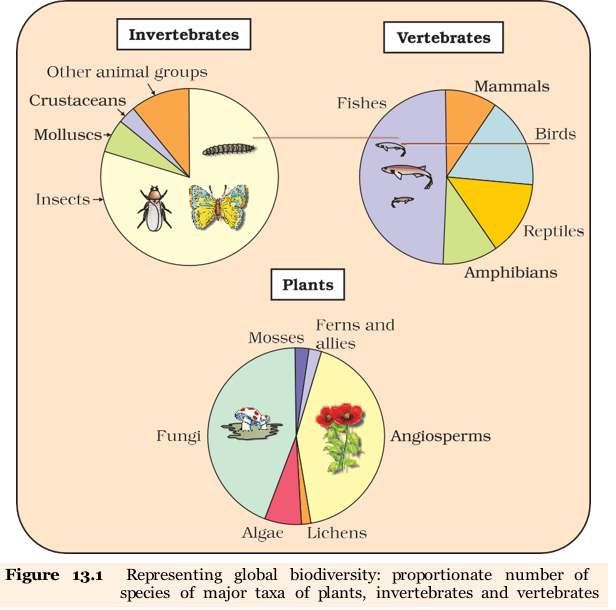
Global Species Diversity
Biodiversity in India
Name the three main levels of biodiversity and give one example of each.
What are the global estimates for total species diversity, and why are they uncertain?
Quick recap
- Biodiversity covers genetic, species and ecological diversity.
- Edward Wilson popularised the term biodiversity.
- IUCN (2004) listed slightly more than 1.5 million described plant and animal species; Robert May estimated about 7 million globally.
- Extreme global estimates range from 20 to 50 million; prokaryotic diversity is especially difficult to estimate.
- Insects make up more than 70 per cent of recorded animal species.
- India has 8.1 per cent of recorded global species diversity on 2.4 per cent of the world’s land area.
- Many species may disappear before they are discovered and described.
Patterns of Biodiversity
Latitudinal Gradients in Biodiversity
Latitudinal gradient — Species diversity generally decreases from the equator towards the poles.
Tropical diversity
- Tropics extend from 23.5° N to 23.5° S and generally contain more species than temperate and polar regions.
- Bird examples: Colombia near the equator has nearly 1,400 bird species; New York at 41° N has 105; Greenland at 71° N has 56. India has over 1,200.
- Plant example: An equal-area tropical forest in Ecuador may have up to 10 times as many vascular plant species as a temperate forest in the US Midwest.
- Amazon rainforest has over 40,000 plant, 3,000 fish, 1,300 bird, 427 mammal, 427 amphibian and 378 reptile species, plus over 125,000 invertebrate species. At least two million insect species may remain undiscovered.
| Hypothesis | Reason |
|---|---|
| Long evolutionary time | Tropics have remained relatively undisturbed for millions of years, allowing more time for speciation and species diversification. |
| Stable environment | Less seasonal, more constant and predictable conditions promote niche specialisation. |
| Greater solar energy | More solar energy supports higher productivity, which may indirectly increase diversity. |
Species–Area Relationship
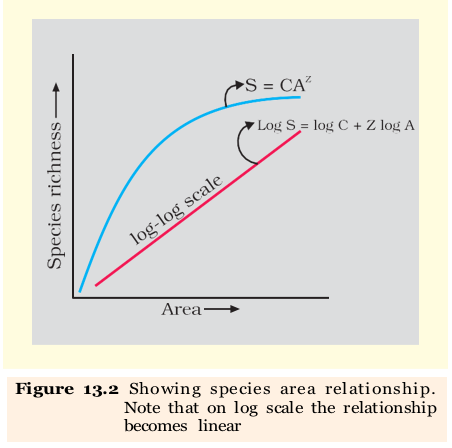
Species–area relationship — Within a region, species richness increases as the explored area increases, but only up to a limit.
- Pattern: The relationship for many taxa, including plants, birds, bats and freshwater fishes, forms a rectangular hyperbola.
- Logarithmic scale: The relationship becomes a straight line; its slope is the regression coefficient .
- Typical slope: For many taxa and regions, is usually between 0.1 and 0.2.
- Very large areas: Across entire continents, the slope is steeper, with between 0.6 and 1.2. For fruit-eating birds and mammals in tropical forests on different continents, .
- Meaning of a steeper slope: Species richness increases more rapidly with area at the continental scale than within a region.
Use for the straight-line relationship on a logarithmic scale.
Symbols
- = species richness; = area.
- = slope of the line (regression coefficient); = y-intercept constant.
Importance of Species Diversity to the Ecosystem
Ecosystem stability — A stable community has low year-to-year variation in productivity, resists or recovers from disturbances, and resists invasion by alien species.
Species diversity and ecosystem function
- Evidence from David Tilman: Long-term outdoor-plot experiments found that more diverse plots had less year-to-year variation in total biomass and higher productivity.
- Conclusion: The exact links between species richness and all aspects of ecosystem stability are not fully understood, but biodiversity is essential for ecosystem health and human survival.
- Biodiversity loss can reduce plant production, lower resistance to disturbances such as drought, and increase variation in plant productivity, water use, and pest and disease cycles.
Rivet Popper Hypothesis
- Paul Ehrlich's analogy: An airplane represents an ecosystem, and its rivets represent species.
- Gradual loss: Removing a few rivets may not immediately affect flight, just as some species losses may not immediately disrupt ecosystem functioning.
- Cumulative danger: Continued rivet removal weakens the plane; continued species loss can make ecosystems dangerously unstable.
- Key species: Losing a rivet from a wing is more serious than losing one from a seat or window; similarly, loss of species that drive major ecosystem functions can have especially severe effects.
Loss of Biodiversity
Extent and rate of loss
- Human impact: Biodiversity is declining rapidly, largely because of human activities. Human colonisation of tropical Pacific islands is estimated to have caused over 2,000 native bird extinctions.
- IUCN Red List (2004) recorded 784 extinctions in the previous 500 years: 338 vertebrates, 359 invertebrates and 87 plants.
- Examples: Dodo (Mauritius), quagga (Africa), thylacine (Australia), Steller's sea cow (Russia), and Bali, Javan and Caspian tiger subspecies.
- Recent loss: 27 species disappeared in the 20 years preceding the source's account. Extinctions are not random; amphibians are particularly vulnerable.
- Species at risk: Over 15,500 species worldwide face extinction. Threatened proportions include 12% of birds, 23% of mammals, 32% of amphibians and 31% of gymnosperms.
- Sixth extinction: Fossil evidence shows five previous mass extinctions over more than 3 billion years of life. The current, human-driven extinction rate is estimated to be 100–1,000 times the pre-human rate.
- Warning: If current trends continue, nearly half of Earth's species could disappear within the next 100 years.
Causes of Biodiversity Loss: The Evil Quartet
| Cause | How it causes loss | Examples / key facts |
|---|---|---|
| Habitat loss and fragmentation | Destruction or degradation removes habitat; splitting large habitats into fragments isolates populations and disrupts species needing large territories or migration routes. | Tropical rain forests have declined from over 14% to no more than 6% of Earth's land surface. Amazon forest is cleared for soya cultivation and cattle pasture; pollution also degrades habitats. |
| Over-exploitation | Taking organisms or resources faster than populations can recover drives declines and extinction. | Steller's sea cow and passenger pigeon were lost through human over-exploitation; many marine fish populations are overharvested. |
| Alien species invasions | Introduced species may become invasive and reduce or eliminate native species. | Nile perch in Lake Victoria contributed to the extinction of over 200 native cichlid species. Invasive weeds include carrot grass (Parthenium), Lantana and water hyacinth (Eichhornia). African catfish (Clarias gariepinus), introduced illegally for aquaculture, threatens native catfishes. |
| Co-extinctions | Extinction of one species can cause the loss of species obligatorily associated with it. | Extinction of a host fish can eliminate its specific parasites; loss of a species in a coevolved plant–pollinator mutualism can lead to loss of its partner. |
State the three main hypotheses explaining greater tropical biodiversity.
What does a steeper slope in a species–area relationship indicate?
Name and explain the four major causes of biodiversity loss.
Quick recap
- Species diversity generally declines from the tropics towards the poles; tropical regions are species-rich.
- Tropical diversity is linked to long evolutionary time, stable conditions and greater solar energy.
- Species richness rises with area; the species–area relationship is linear on a log–log scale.
- Tilman's experiments linked greater diversity with higher productivity and lower biomass variation.
- The rivet popper hypothesis warns that cumulative species loss can weaken ecosystem functioning.
- The current human-driven extinction rate is estimated at 100–1,000 times the pre-human rate.
- The Evil Quartet is habitat loss and fragmentation, over-exploitation, alien invasions and co-extinctions.
Biodiversity Conservation
Why Conserve Biodiversity?
Three reasons for conservation
- Narrowly utilitarian: Biodiversity provides direct goods and economic benefits used by people.
- Broadly utilitarian: Biodiversity supports ecosystem services that sustain life and human well-being.
- Ethical: Every species has intrinsic value; humans have a moral duty to protect species and pass on biological heritage.
| Category | Examples and key facts |
|---|---|
| Narrowly utilitarian | Food, firewood, fibre, construction materials, industrial products and medicines. More than 25% of drugs sold worldwide are plant-derived; about 25,000 plant species are used in traditional medicines. |
| Bioprospecting | Exploring molecular, genetic and species diversity for products with economic value; biodiversity-rich nations may gain substantial benefits. |
| Broadly utilitarian | Ecosystem services include oxygen production, pollination, pest control, climate moderation and flood control. |
| Ecosystem examples | The Amazon forest is estimated to produce about 20% of atmospheric oxygen. Bees, bumblebees, birds and bats pollinate plants, enabling fruit and seed production. |
| Intangible benefits | Nature provides aesthetic and emotional benefits, such as enjoying forests, flowers and birdsong. |
| Ethical | Species deserve care even if they have no current economic use; people should preserve biodiversity for future generations. |
Methods of Biodiversity Conservation
In situ conservation — Protecting species within their natural habitats by conserving the ecosystem in which they live.
Ex situ conservation — Protecting threatened species outside their natural habitats in specially managed settings.
| Point | In situ | Ex situ |
|---|---|---|
| Location | Natural habitat | Outside the natural habitat |
| Main approach | Protect the species and its whole ecosystem | Give threatened species special protection and care |
| Examples | Biosphere reserves, national parks, wildlife sanctuaries and sacred groves | Zoos, botanical gardens, safari parks, seed banks and laboratory methods |
| Best suited to | Conserving biodiversity at ecosystem, species and genetic levels | Species at very high risk of extinction in the wild that need urgent support |
Endangered or threatened species — A species facing a very high risk of extinction in the wild in the near future.
In situ Conservation
Biodiversity hotspot — A region with exceptionally high species richness and endemism, often also experiencing rapid habitat loss.
Hotspots and protected regions
- Endemism: Species are endemic when they are confined to a particular region and occur nowhere else.
- Hotspot total: 25 hotspots were first identified; nine more were later added, making 34 worldwide.
- Conservation value: Together, hotspots cover less than 2% of Earth's land area but contain exceptionally many species; strict protection could reduce ongoing mass extinctions by nearly 30%.
- Indian hotspots: Western Ghats–Sri Lanka, Indo-Burma and the Himalaya include India's exceptionally biodiverse regions.
- India's protected areas: The lecture lists 14 biosphere reserves, 90 national parks and 448 wildlife sanctuaries.
Sacred groves
- Meaning: Forest patches protected by religious and cultural traditions, with their trees and wildlife left undisturbed.
- Locations: Khasi and Jaintia Hills in Meghalaya; Aravalli Hills in Rajasthan; Western Ghats in Karnataka and Maharashtra; Sarguja, Chanda and Bastar regions of Madhya Pradesh.
- Importance: Meghalaya's sacred groves are refuges for many rare and threatened plants.
Ex situ Conservation
| Method | How it helps |
|---|---|
| Zoos and wildlife safari parks | Maintain and care for threatened animals; some species extinct in the wild survive in zoological parks. |
| Botanical gardens | Maintain and protect plant species outside their natural habitats. |
| Cryopreservation | Preserves gametes of threatened species in viable, fertile condition for long periods. |
| In vitro fertilisation | Enables eggs to be fertilised outside the organism. |
| Tissue culture | Propagates plants under controlled conditions. |
| Seed banks | Store seeds of different genetic strains of commercially important plants for long periods. |
International Cooperation
Global commitments
- Shared responsibility: Biodiversity crosses political boundaries, so its conservation requires cooperation among nations.
- Convention on Biological Diversity: The 1992 Earth Summit in Rio de Janeiro called on nations to conserve biodiversity and use its benefits sustainably.
- World Summit on Sustainable Development: In 2002, 190 countries at Johannesburg pledged to achieve a significant reduction in the rate of biodiversity loss by 2010, at global, regional and local levels.
Key International Milestones
- 1992The Earth Summit in Rio de Janeiro promoted biodiversity conservation and sustainable use through the Convention on Biological Diversity.
- 2002At the Johannesburg summit, 190 countries pledged to significantly reduce biodiversity loss by 2010.
- 2010Target year set for a significant reduction in biodiversity loss at global, regional and local levels.
Explain the three main arguments for conserving biodiversity.
Differentiate between in situ and ex situ conservation, giving examples.
Quick recap
- Biodiversity conservation is justified by direct economic benefits, ecosystem services and the intrinsic value of species.
- In situ conservation protects species in their natural habitats; ex situ conservation provides protection away from those habitats.
- Biodiversity hotspots combine high species richness and endemism, and are often threatened by rapid habitat loss.
- India's in situ measures include hotspots, protected areas and culturally protected sacred groves.
- Ex situ methods include captive care, cryopreservation, in vitro fertilisation, tissue culture and seed banks.
- International agreements promote shared responsibility for conservation and sustainable use of biodiversity.
Biology — ALL CHAPTERS
1
Sexual Reproduction In Flowering Plants
2
Human Reproduction
3
Reproductive Health
4
Principles Of Inheritance And Variation
5
Molecular Basis Of Inheritance
6
Evolution
7
Human Health And Disease
8
Microbes In Human Welfare
9
Biotechnology : Principles And Processes
10
Biotechnology And Its Applications
11
Organisms And Populations
12
Ecosystem
13
Biodiversity And Conservation