Class 12 PCB . Biology . Biology . Reproductive Health
Chapter 3: Reproductive Health
Ch 3
Biology
Class 12 PCB
Reproductive Health – Problems And Strategies
Meaning of Reproductive Health
- Reproductive health: A state of total well-being in all aspects of reproduction.
- Dimensions: It includes physical, emotional, behavioural and social well-being.
National Programmes and Awareness
Development of Reproductive Health Programmes
- 1951India initiated national family-planning programmes to make reproductive health a social goal.
- Later decadesThe programmes were periodically assessed and expanded into Reproductive and Child Health Care (RCH) programmes.
Reproductive and Child Health Care (RCH) programmes — Expanded national programmes that promote reproductive health through awareness, facilities and support.
Awareness and Education
- Communication: Governmental and non-governmental agencies use audio-visual and print media; parents, relatives, teachers and friends also help share information.
- Sex education: Schools should provide accurate information to prevent myths and misconceptions, especially among young people.
- Topics covered: Reproductive organs, adolescent changes, safe and hygienic sexual practices, sexually transmitted diseases (STDs) and AIDS.
- Family health: Fertile couples and people of marriageable age need information on birth-control options, pregnancy care, post-natal care, breastfeeding and equal opportunities for male and female children.
- Social awareness: People should understand the harms of uncontrolled population growth, sex abuse and sex-related crimes, and take steps to prevent them.
Facilities, Support and Strategies
Requirements for Effective Reproductive Care
- Support systems: Successful programmes need strong infrastructure, professional expertise and material resources.
- Medical care: These resources help provide care for pregnancy, delivery, STDs, abortions, contraception, menstrual problems and infertility.
- Improvement: Better techniques and new strategies are needed over time to make care more efficient.
- Other programmes: Examples include massive child immunisation and a statutory ban on using amniocentesis for sex determination to prevent female foeticide.
- Research: Governmental and non-governmental agencies support research to develop new reproductive-health methods and improve existing ones.
Amniocentesis — A procedure in which amniotic fluid is sampled to analyse foetal cells and dissolved substances.
Amniocentesis: Uses and Legal Restriction
- Medical use: It can help detect genetic disorders such as Down syndrome, haemophilia and sickle-cell anaemia, and assess foetal survivability.
- Restriction: Its use for sex determination is legally banned to help prevent female foeticide.
Saheli and Signs of Progress
- Saheli: An oral contraceptive for females developed by scientists at the Central Drug Research Institute (CDRI) in Lucknow, India.
- Indicators of improvement: Better awareness, more medically assisted deliveries, improved post-natal care, and lower maternal and infant mortality.
- Further indicators: More couples choosing small families, better detection and treatment of STDs, and increased medical facilities for reproductive-health problems.
Quick recap
- Reproductive health includes physical, emotional, behavioural and social well-being.
- India began national family-planning programmes in 1951; these developed into Reproductive and Child Health Care (RCH) programmes.
- Education and awareness help prevent myths and support informed reproductive choices.
- Effective care requires infrastructure, expertise, resources, improved strategies and research.
- Amniocentesis can detect some genetic disorders, but its use for sex determination is legally banned.
- Saheli is an oral contraceptive developed by CDRI scientists in Lucknow.
- Lower maternal and infant mortality and better reproductive care are indicators of improved reproductive health.
Population Stabilisation And Birth Control
Population Growth and Stabilisation
| Population | Earlier figure | Later figure |
|---|---|---|
| World | About 2 billion in 1900 | About 6 billion by 2000; 7.2 billion in 2011 |
| India | About 350 million at independence | Nearly 1 billion by 2000; over 1.2 billion in May 2011 |
Why Population Grew Rapidly
- Improved living conditions and healthcare reduced death rates, maternal mortality rate (MMR) and infant mortality rate (IMR).
- More people of reproductive age also contributed to rapid population growth.
- India's growth rate was below 2 per cent in the 2011 Census, or about —still high enough for rapid population increase.
- Pressure on resources: uncontrolled growth can cause shortages of food, shelter and clothing.
Population-Control Measures
- Family planning: Reproductive and Child Health (RCH) programmes promote smaller families and contraceptive use.
- Public message: “Hum Do Hamare Do” encourages a two-parent, two-child family; some couples adopt a one-child norm.
- Marriageable age: Legally raised to 18 years for females and 21 years for males.
- Incentives: Couples with small families may receive incentives.
Ideal contraceptive — A contraceptive that is user-friendly, easily available, effective, reversible, has few or no side-effects, and does not interfere with sexual drive, desire or the sexual act.
| Category | Examples |
|---|---|
| Natural / traditional | Periodic abstinence, withdrawal, lactational amenorrhea |
| Barrier | Condoms, diaphragms, cervical caps, vaults |
| Intrauterine devices (IUDs) | Non-medicated, copper-releasing, hormone-releasing |
| Hormonal methods | Oral pills, injections, implants |
| Surgical methods | Vasectomy, tubectomy |
Natural and Barrier Methods
| Method | How it works | Important point |
|---|---|---|
| Periodic abstinence | Avoid coitus during the fertile period, when ovulation is expected. | Usually abstain on days 10–17 of the menstrual cycle; fertilisation chances are high then. |
| Withdrawal (coitus interruptus) | The male withdraws the penis from the vagina before ejaculation, preventing insemination. | Failure chances are relatively high. |
| Lactational amenorrhea | During intense, full breastfeeding after childbirth, ovulation and menstrual cycles may not occur. | Conception chances are almost nil, but this is effective only up to a maximum of six months after childbirth. |
Natural Methods: Overall
- Principle: Reduce the chance of sperm and ovum meeting.
- Advantage: No medicines or devices are used, so side-effects are almost nil.
- Limitation: Failure chances are relatively high.
Barrier methods — Methods that physically prevent sperm from meeting the ovum, usually by blocking sperm entry into the female reproductive tract.
Barrier Methods
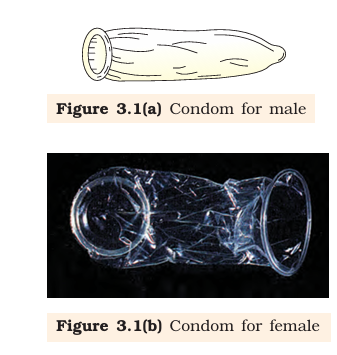
- Condoms: Thin rubber or latex sheaths cover the penis, or the vagina and cervix, before coitus; they prevent semen entering the female reproductive tract.
- Male condom: Nirodh is a popular brand. Male and female condoms are disposable and can be self-inserted, offering privacy.
- Additional protection: Condoms reduce the risk of sexually transmitted infections (STIs), including AIDS.
- Female barriers: Diaphragms, cervical caps and vaults cover the cervix and block sperm entry; they are reusable.
- Spermicides: Creams, jellies or foams are often used with female barriers to increase contraceptive efficiency.
Intrauterine Devices
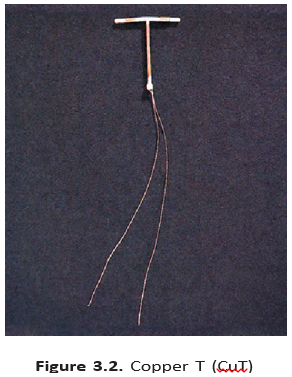
Intrauterine device (IUD) — A contraceptive device inserted into the uterus through the vagina by a doctor or trained nurse.
| Type | Examples | Action |
|---|---|---|
| Non-medicated | Lippes loop | IUDs increase phagocytosis of sperm within the uterus. |
| Copper-releasing | CuT, Cu7, Multiload 375 | Released copper ions suppress sperm motility and fertilising capacity. |
| Hormone-releasing | Progestasert, LNG-20 | Also make the uterus unsuitable for implantation and the cervix hostile to sperm. |
Use of IUDs
- Suitable for: Females seeking to delay pregnancy or space children.
- Use in India: IUDs are among the most widely accepted contraceptive methods.
Hormonal Methods and Emergency Contraception
Oral Contraceptive Pills
- Composition: Small doses of progestogens alone or progestogen–estrogen combinations.
- Schedule: Take one tablet daily for 21 days, preferably starting within the first five days of the menstrual cycle; pause for seven days, then repeat while contraception is desired.
- Actions: Inhibit ovulation and implantation, and alter cervical mucus to prevent or retard sperm entry.
- Effectiveness: Pills are very effective, have fewer side-effects and are generally well accepted.
- Saheli: A non-steroidal oral contraceptive taken once a week; it has few side-effects and high contraceptive value.
Injections and Implants
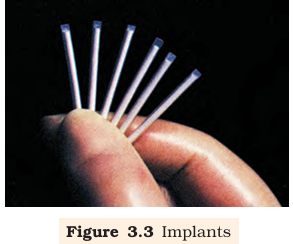
- Hormones used: Progestogens alone or combined with estrogen can be given by injection or implanted under the skin.
- Action: Similar to oral pills, with a much longer effective period.
Emergency contraception — Use of certain hormones or IUDs soon after intercourse to reduce the chance of pregnancy.
Emergency Contraception
- Options: Progestogens, progestogen–estrogen combinations or IUDs can be used within 72 hours of coitus.
- Use: May help prevent pregnancy after rape or casual unprotected intercourse.
Surgical Methods and Responsible Use
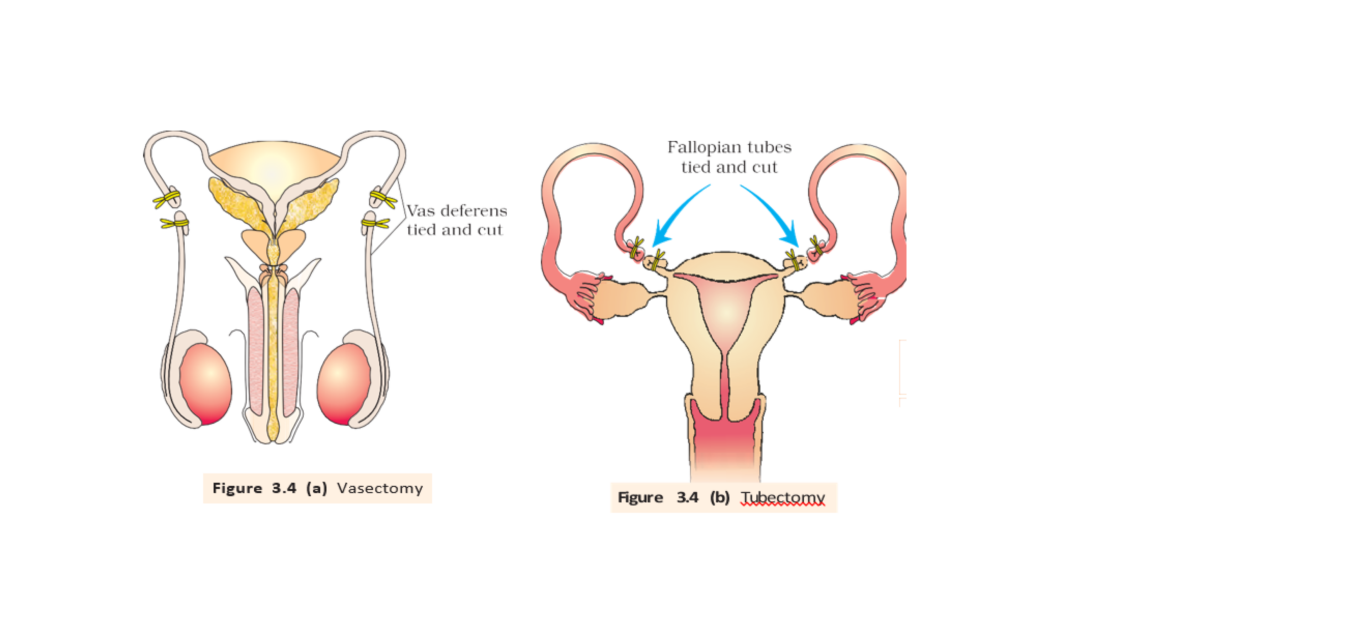
Sterilisation — A surgical, generally permanent contraceptive method that blocks gamete transport and prevents conception.
| Point | Vasectomy | Tubectomy |
|---|---|---|
| Partner | Male | Female |
| Procedure | A small part of each vas deferens is cut or tied. | A small part of each fallopian tube is cut or tied. |
| Access | Small incision in the scrotum. | Small incision in the abdomen or access through the vagina. |
| Reversibility | Very poor | Very poor |
Safe and Informed Use
- Medical advice: Choose and use a contraceptive in consultation with qualified medical professionals.
- Purpose: Contraceptives are used to prevent, delay or space pregnancies for personal reasons; they are not routine requirements for maintaining reproductive health.
- Population impact: Widespread contraceptive use helps check uncontrolled population growth.
- Possible side-effects: Nausea, abdominal pain, breakthrough bleeding and irregular menstrual bleeding may occur; possible ill-effects should not be ignored.
How do copper-releasing IUDs prevent conception?
State the schedule and actions of oral contraceptive pills.
Distinguish vasectomy from tubectomy.
Quick recap
- Rapid population growth followed falling death, MMR and IMR rates and an increase in people of reproductive age.
- Small-family promotion, legal marriageable ages and contraceptive methods help stabilise population.
- Natural methods avoid sperm–ovum contact but have higher failure chances; barrier methods physically block sperm.
- IUDs, pills, injections and implants work through sperm suppression or hormonal effects on ovulation, implantation or sperm entry.
- Emergency contraception may use hormones or IUDs within 72 hours of intercourse.
- Vasectomy and tubectomy block gamete transport; both are highly effective but poorly reversible.
Infertility
Meaning and Causes of Infertility
- Infertility: The inability to have children despite unprotected sexual cohabitation.
- Causes: Physical, congenital, disease-related, drug-related, immunological or psychological factors may cause infertility.
Assisted Reproductive Technologies (ART)
| Method | Procedure | Transfer site / use |
|---|---|---|
| ZIFT | Zygote intra-fallopian transfer | A zygote or early embryo with up to 8 blastomeres is transferred to the fallopian tube. |
| IUT | Intra-uterine transfer | An embryo with more than 8 blastomeres is transferred to the uterus. |
| GIFT | Gamete intra-fallopian transfer; a donor ovum is transferred into another female’s fallopian tube. | Used when the recipient cannot produce ova but can support fertilisation and further development. |
| ICSI | A sperm is directly injected into an ovum in the laboratory to form an embryo. | A specialised procedure for laboratory fertilisation. |
| AI / IUI | Semen from the husband or a healthy donor is artificially introduced into the vagina (AI) or uterus (IUI). | Can help when the male cannot inseminate the female or has a very low sperm count. |
Access and Adoption
- Availability: ART requires specialised professionals, precise handling and expensive equipment, so it is offered at only a few centres.
- Limitations: The high cost makes ART unaffordable for many couples; emotional, religious and social factors can also deter its use.
- Adoption: Legal adoption is an important option for couples seeking parenthood and can provide care to orphaned and destitute children.
Quick recap
- Infertility is inability to conceive or produce children after 2 years of unprotected sexual cohabitation.
- Causes include physical, congenital, disease-related, drug-related, immunological and psychological factors; either partner may be affected, and the problem often lies with the male partner.
- IVF forms a zygote outside the body; IVF followed by embryo transfer is called the test-tube baby programme.
- ZIFT transfers a zygote or embryo up to 8 blastomeres to the fallopian tube; IUT transfers embryos with more than 8 blastomeres to the uterus.
- GIFT transfers a donor ovum to a recipient’s fallopian tube; ICSI injects sperm directly into an ovum.
- AI introduces semen into the vagina or uterus (IUI); it can help when insemination is not possible or sperm count is very low.
- ART is costly and requires specialist facilities; legal adoption is another route to parenthood.
Biology — ALL CHAPTERS
1
Sexual Reproduction In Flowering Plants
2
Human Reproduction
3
Reproductive Health
4
Principles Of Inheritance And Variation
5
Molecular Basis Of Inheritance
6
Evolution
7
Human Health And Disease
8
Microbes In Human Welfare
9
Biotechnology : Principles And Processes
10
Biotechnology And Its Applications
11
Organisms And Populations
12
Ecosystem
13
Biodiversity And Conservation