Class 12 PCB . Biology . Biology . Organisms and Populations
Chapter 11: Organisms And Populations
Ch 11
Biology
Class 12 PCB
Populations
Ecology and Levels of Organisation
- Ecology: Studies interactions among organisms and between organisms and their physical (abiotic) environment.
- Levels of organisation: Ecology focuses on organisms, populations, communities and biomes.
Population and Population Ecology
- Population: A group of individuals of the same species living in a defined area, sharing resources and potentially interbreeding.
- Population ecology: Studies populations and links ecology with population genetics and evolution; natural selection operates at the population level.
Population Attributes
Calculate each rate by dividing the number of births or deaths by the population size at the start of the interval.
Rate examples
- Lotus birth rate: 8 new plants from an initial 20 gives offspring per lotus per year.
- Fruitfly death rate: 4 deaths in a population of 40 in one week gives deaths per fruitfly per week.
Age Distribution and Age Pyramids
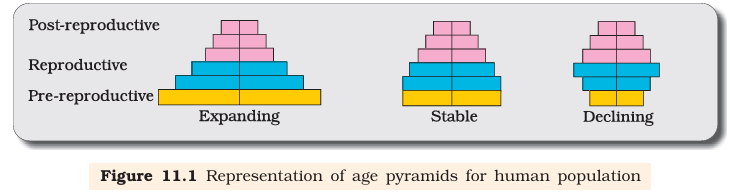
Population Size and Density
| Measure | Useful when | Example or note |
|---|---|---|
| Total number | Individuals can be counted and this reflects population size | Usually the most appropriate measure |
| Biomass or percentage cover | Number alone understates the organism’s ecological role | One large banyan may matter more than many carrot grass plants |
| Relative density | Absolute numbers are unnecessary or impractical | Fish caught per trap can indicate relative fish abundance in a lake |
| Indirect signs | Individuals are difficult to see or count directly | Tiger censuses use pug marks and faecal pellets |
Why may total number be a poor measure of population density?
Quick recap
- Ecology studies organism–organism and organism–environment interactions at several levels.
- A population is a same-species group in a defined area; ecological populations may reproduce sexually or asexually.
- Population attributes include per-capita birth and death rates, sex ratio and age distribution.
- Age-pyramid shape indicates whether a population is growing, stable or declining.
- Population density, , can be measured by number, biomass, percentage cover, relative density or indirect evidence.
Population Growth
Changes in Population Density
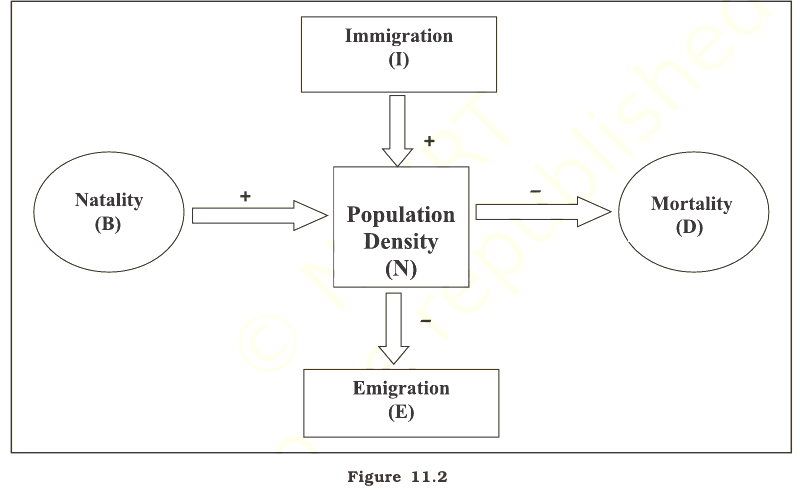
The density at the next time step equals the initial density plus additions minus losses.
When population density increases
- Increase: Density rises when ; it falls when .
- Usual conditions: Births and deaths are generally the main influences; immigration and emigration become especially important in particular situations.
- Colonisation: When a species begins occupying a new habitat, immigration may contribute more to growth than births.
Population Growth Models
- Population growth: Population size changes over time in response to factors such as resource availability, predation and weather.
- Growth patterns: Growth may be exponential when resources are unlimited or logistic when resources are limited by the habitat’s carrying capacity.
Exponential Growth
The change in population size per unit time depends on the per-capita birth–death difference and current population size.
is population density after time ; is initial density; is the natural-logarithm base, approximately .
| Population | value |
|---|---|
| Norway rat | |
| Flour beetle | |
| Human population in India (1981) |
Exponential growth examples
- Paramecium: Starting from one individual, daily doubling by binary fission can produce an enormous population in 64 days if food and space remain unlimited.
- Elephants: Darwin illustrated that even a slow-growing animal could reach enormous numbers if growth had no checks.
Logistic Growth
is population density at time , is intrinsic rate of natural increase, and is carrying capacity.
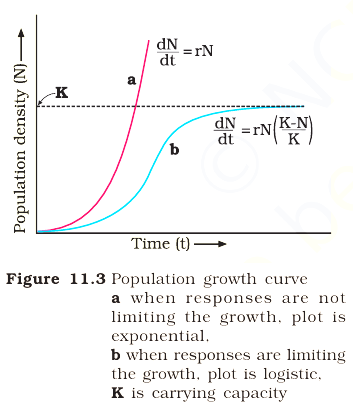
| Point | Exponential growth | Logistic growth |
|---|---|---|
| Resources | Unlimited | Limited |
| Curve | J-shaped | Sigmoid (S-shaped) |
| Population outcome | Can rise enormously without checks | Levels off at carrying capacity |
| Typical relevance | Idealised conditions | More realistic for most animal populations |
Life History Variation
| Trait | Strategy | Examples |
|---|---|---|
| Breeding frequency | Breed once in a lifetime | Pacific salmon, bamboo |
| Breeding frequency | Breed many times in a lifetime | Most birds and mammals |
| Offspring | Many small offspring | Oysters, pelagic fishes |
| Offspring | Few large offspring | Birds, mammals |
Quick recap
- Population density increases through natality and immigration, and decreases through mortality and emigration.
- Density change is determined by additions minus losses: .
- Unlimited resources produce exponential, J-shaped growth: .
- With finite resources, logistic growth approaches carrying capacity and forms a sigmoid curve.
- Life history strategies vary in breeding frequency and offspring number and size, reflecting habitat constraints.
Population Interactions
Interspecific Interactions
Interspecific interaction — An interaction between populations of two different species that may benefit, harm or leave either species unaffected.
- Signs: means beneficial, means detrimental, and means neutral.
- Community: Organisms do not live in isolation; plants, for example, depend on soil microbes for nutrient recycling and animals for pollination.
- Close association: Predation, parasitism and commensalism involve interacting species living closely together.
| Interaction | Effect on Species A | Effect on Species B | Meaning |
|---|---|---|---|
| Mutualism | Both species benefit. | ||
| Competition | Both species are adversely affected. | ||
| Predation | The predator benefits; the prey is harmed. | ||
| Parasitism | The parasite benefits; the host is harmed. | ||
| Commensalism | One species benefits; the other is unaffected. | ||
| Amensalism | One species is harmed; the other is unaffected. |
Predation
Predation — An interaction in which a predator benefits by feeding on another organism, the prey, which is harmed.
- Energy transfer: Predation transfers energy fixed by plants to higher trophic levels; seed-eating birds are predators in this broad ecological sense.
- Herbivory: Herbivores are categorized separately, but ecologically they act as predators on plants. Nearly of all insects are phytophagous, feeding on plant sap or other plant parts.
- Population control: Predators limit prey numbers, helping prevent excessive growth and ecosystem instability.
- Invasive species: Prickly pear cactus spread rapidly across Australian rangeland after introduction in the early 1920s; a cactus-feeding moth from its natural habitat later brought it under control.
- Biological control: Agricultural pest control can use predators to regulate pest populations.
- Species diversity: Predators can reduce competition among prey species. Removing the starfish *Pisaster* from a Pacific rocky intertidal area led to more than 10 invertebrate species becoming extinct within a year.
- Prudent predation: If predators overexploit prey, the prey may become extinct, followed by the predator due to lack of food.
| Defence | Example or means | Effect |
|---|---|---|
| Animal camouflage | Cryptically coloured insects and frogs | Makes prey harder for predators to detect. |
| Animal chemical defence | Poisonous or distasteful prey; Monarch butterfly | Discourages predators. Monarch caterpillars acquire a defensive chemical by feeding on a poisonous weed. |
| Plant morphological defence | Thorns in *Acacia* and cactus | Discourages herbivores from feeding. |
| Plant chemical defence | *Calotropis* cardiac glycosides; nicotine, caffeine, quinine, strychnine and opium | May cause illness, inhibit feeding or digestion, disrupt reproduction, or kill herbivores. |
Competition
Competition — A process in which the fitness of one species is significantly lower in the presence of another species.
- Fitness measure: In this context, fitness is measured by the intrinsic rate of increase, .
- Competitors: Competition can occur between closely related or unrelated species using the same resource. Flamingoes and resident fish in some South American lakes both feed on zooplankton.
- Resources: Resources do not have to be limited for competition to occur.
- Interference competition: One species may reduce another's feeding efficiency through interference or inhibition, even when food and space are abundant.
- Evolution: Darwin regarded interspecific competition as a potent force in the struggle for existence and organic evolution.
| Concept | Meaning | Example or evidence |
|---|---|---|
| Competitive exclusion | Gause's principle: two closely related species competing for the same resources cannot coexist indefinitely; the competitively inferior species is eventually eliminated. | Laboratory experiments demonstrate exclusion when resources are limited. |
| Limits of exclusion | The principle is most applicable when resources are limiting; exclusion is not conclusively established in every natural case. | Species may evolve mechanisms that promote coexistence. |
| Competitive release | A species expands its distribution when a competitively superior species is removed. | Removal of the competing species can reveal the restricted species' potential range. |
| Resource partitioning | Competing species use a shared resource differently, such as at different times or through different foraging patterns. | Five related warbler species coexisted on the same tree through differences in foraging behaviour. |
Evidence for Competition in Nature
- Abingdon tortoise: It became extinct within a decade after goats were introduced to the Galápagos Islands, apparently because goats browsed more efficiently.
- Barnacles: Connell's field experiments showed that the larger, competitively superior *Balanus* dominates the rocky intertidal area and excludes the smaller *Chathamalus* from that zone.
- General pattern: Plants and herbivores appear more adversely affected by competition than carnivores.
Do not assume competitive exclusion is inevitable in all natural settings. Competition may promote coexistence through resource partitioning, and exclusion is especially expected when resources are limiting.
State Gause's Competitive Exclusion Principle.
What is resource partitioning? Give an example.
Quick recap
- Interspecific interactions can benefit, harm or leave species unaffected.
- Predation transfers energy, regulates prey populations and can help maintain species diversity.
- Herbivores act as predators on plants in a broad ecological context; about of insects are phytophagous.
- Animals and plants use camouflage, thorns and chemical defences to reduce predation or herbivory.
- Competition can occur between related or unrelated species, even when resources are not limited.
- Competitive exclusion is especially expected with limited resources, while resource partitioning can support coexistence.
Parasitism , Commensalism & Mutualism
Parasitism
- Parasitism: One species, the parasite, benefits by living on or in another species, the host, which is harmed.
- Host–parasite relationship: Parasites are often host-specific and may co-evolve with their hosts as hosts develop resistance and parasites counter it.
- Effects on hosts: Parasites can reduce host survival, growth and reproduction, and may make hosts more vulnerable to predators.
Types of Parasites
A female mosquito takes a blood meal for reproduction, but is not treated here as a parasite: it visits briefly to feed rather than living on or inside the host as its way of life.
Commensalism
- Commensalism: One species benefits while the other is neither benefited nor harmed.
- Examples: Orchids growing on mango branches, barnacles on whales, cattle egrets foraging near grazing cattle, and clownfish living among sea anemones.
Mutualism
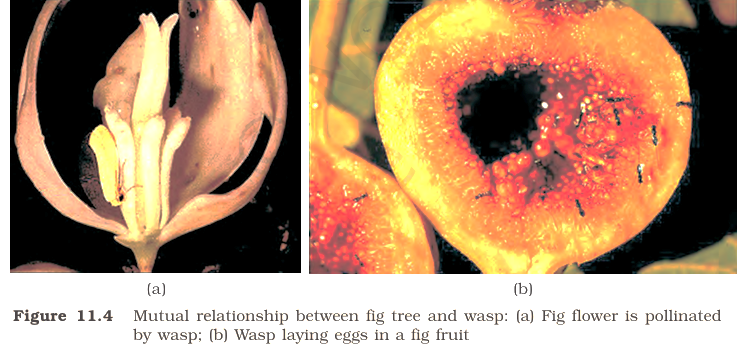
Fig and Wasp Mutualism
- Partner-specific pollination: In many fig species, only a particular partner wasp species can pollinate the fig.
- Wasp’s benefit: The female wasp lays eggs in the fig fruit; developing seeds provide food for its larvae.
- Fig’s benefit: As the wasp searches for egg-laying sites, it pollinates the fig inflorescence.
Orchid Pollination and Co-evolution
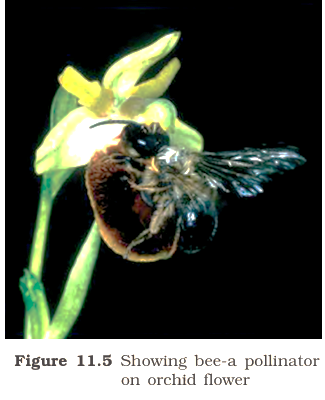
How does brood parasitism improve the chances that a parasitic bird’s eggs will be incubated?
Distinguish between commensalism and mutualism.
Describe the mutualism between a mycorrhizal fungus and a plant.
Quick recap
- Parasitism benefits the parasite and harms the host; many parasites are host-specific and co-evolve with their hosts.
- Parasites may be ectoparasites, endoparasites or brood parasites, each using a different host resource or site.
- Commensalism benefits one species while leaving the other unaffected.
- Mutualism benefits both species, as in lichens, mycorrhizae and plant–animal partnerships.
- Fig wasps pollinate figs and use fig fruits as egg-laying sites and food sources for their larvae.
- Ophrys orchids can mimic female bees to attract males and achieve pollination.
Biology — ALL CHAPTERS
1
Sexual Reproduction In Flowering Plants
2
Human Reproduction
3
Reproductive Health
4
Principles Of Inheritance And Variation
5
Molecular Basis Of Inheritance
6
Evolution
7
Human Health And Disease
8
Microbes In Human Welfare
9
Biotechnology : Principles And Processes
10
Biotechnology And Its Applications
11
Organisms And Populations
12
Ecosystem
13
Biodiversity And Conservation