Class 12 PCB . Biology . Biology . Ecosystem
Chapter 12: Ecosystem
Ch 12
Biology
Class 12 PCB
Ecosystem – Structure And Function
Ecosystem: Meaning and Types
- Ecosystem: A functional unit of nature in which living organisms interact with one another and with their physical environment.
- Types: Ecosystems may be terrestrial, such as forests, grasslands and deserts, or aquatic, such as ponds, lakes, rivers and estuaries. Crop fields and aquariums are man-made examples.
Ecosystem Structure
- Components: Interactions between biotic and abiotic components give each ecosystem its characteristic physical structure.
- Species composition: The plant and animal species present in an ecosystem.
- Stratification: The vertical distribution of species into layers, such as trees, shrubs, herbs and grasses in a forest.
Ecosystem Functions and Relationships
- Functions: Ecosystems operate through productivity, decomposition, energy flow and nutrient cycling.
- Relationships: Energy transfer and repeated nutrient use connect organisms and the physical environment in an ecosystem.
Pond Ecosystem: Structure and Function
Matter and Energy in a Pond
- Solar energy enables autotrophs to convert inorganic material into organic matter.
- Heterotrophs consume autotrophs, transferring organic matter and energy.
- Decomposers break down dead matter and mineralise it, releasing materials for reuse.
- Autotrophs reuse the released nutrients, continuing the cycle of matter.
- Energy moves towards higher trophic levels and is eventually lost as heat.
| Feature | Energy flow | Nutrient cycling |
|---|---|---|
| Direction | One-way towards higher trophic levels | Nutrients are reused within the ecosystem |
| Outcome | Energy is ultimately dissipated as heat | Decomposition releases nutrients for reuse by autotrophs |
Name the four major functional aspects of an ecosystem.
Why is energy flow in an ecosystem described as unidirectional?
Quick recap
- An ecosystem is a functional unit formed by interactions between organisms and their physical environment.
- The biosphere is a composite of local ecosystems and can be viewed as the global ecosystem.
- Abiotic-biotic interactions create a structure characteristic of each ecosystem; species composition and stratification describe its organisation.
- Ecosystems function through productivity, decomposition, energy flow and nutrient cycling.
- A pond contains abiotic components, autotrophs, consumers and decomposers.
- Nutrients are recycled, while energy flows one way through trophic levels and is ultimately lost as heat.
Productivity
Primary Production and Productivity
Energy and Measurement
- Solar energy: A constant input of solar energy is essential for an ecosystem to function and sustain itself.
- Primary production: The amount of biomass or organic matter produced by plants through photosynthesis per unit area over a period of time.
- Measurement: Primary production is expressed as mass, such as , or energy, such as .
- Productivity: The rate of biomass production, expressed per unit area per year, such as or ; these units allow ecosystem comparisons.
| Type | Meaning | Importance |
|---|---|---|
| Gross primary productivity (GPP) | Rate of organic matter production during photosynthesis. | Some of the production is used by plants in respiration. |
| Net primary productivity (NPP) | GPP remaining after plant respiration losses. | Biomass available to heterotrophs, including herbivores and decomposers. |
| Secondary productivity | Rate at which consumers form new organic matter. | Describes organic matter production by consumers. |
Net primary productivity equals gross primary productivity minus respiration losses.
Factors and Global Productivity
- Factors: Primary productivity depends on plant species, environmental conditions, nutrient availability and the photosynthetic capacity of plants.
- Variation: These factors cause primary productivity to differ among ecosystem types.
- Biosphere: Annual NPP is about 170 billion tonnes of dry organic matter. Oceans contribute about 55 billion tonnes despite covering roughly 70% of Earth's surface.
- Land contribution: The remaining annual NPP is about 115 billion tonnes on land, calculated as 170 minus 55 billion tonnes.
Decomposition
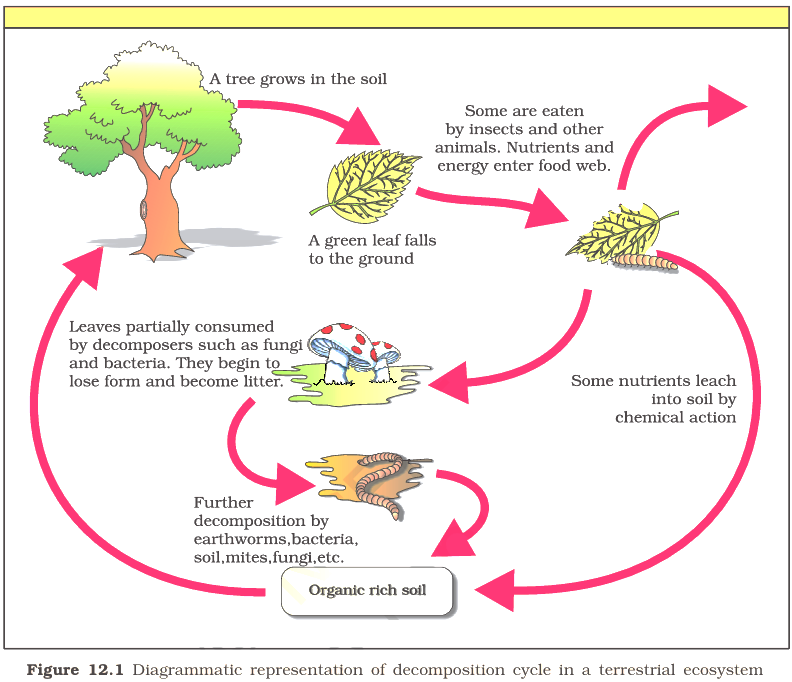
Decomposition — The breakdown of complex organic matter by decomposers into inorganic substances such as carbon dioxide, water and nutrients.
Detritus and Decomposers
- Detritus: Dead plant material, dead animal remains and faecal matter; it is the raw material for decomposition.
- Decomposers: Bacteria and fungi use enzymes to break down detritus.
- Earthworms: As detritivores, they break down organic matter and help loosen the soil.
- Oxygen: Decomposition is largely an oxygen-requiring process.
| Step | What happens |
|---|---|
| Fragmentation | Detritivores such as earthworms break detritus into smaller particles. |
| Leaching | Water-soluble inorganic nutrients move down into the soil and may precipitate as unavailable salts. |
| Catabolism | Bacterial and fungal enzymes degrade detritus into simpler inorganic substances. |
| Humification | Dark, amorphous humus forms; it resists microbial action and decomposes very slowly. |
| Mineralisation | Microbes further degrade humus, releasing inorganic nutrients. |
Humus and Overlapping Processes
- Humus: Its colloidal nature makes it a nutrient reservoir; it is highly resistant to microbial action and breaks down very slowly.
- Overlap: All decomposition steps operate simultaneously on detritus; humification and mineralisation occur in the soil.
| Factor or detritus quality | Effect on decomposition |
|---|---|
| Lignin- and chitin-rich detritus | Slows decomposition. |
| Nitrogen-rich detritus or detritus rich in water-soluble substances such as sugars | Speeds decomposition. |
| Warm, moist conditions | Favour decomposition by supporting soil-microbe activity. |
| Low temperature or anaerobiosis | Inhibit decomposition and can cause organic matter to build up. |
| Temperature and soil moisture | Important climatic controls because they affect soil-microbe activity. |
Quick recap
- Solar energy: A constant input is essential for ecosystem function and sustainability.
- Primary productivity: GPP is total photosynthetic production; NPP is GPP minus respiration losses.
- NPP: It is the biomass available to heterotrophs; secondary productivity is new organic matter formed by consumers.
- Global NPP: About 170 billion tonnes of dry organic matter yearly: 55 billion tonnes from oceans and about 115 billion tonnes from land.
- Decomposition: Detritus is broken down through fragmentation, leaching, catabolism, humification and mineralisation; the steps overlap.
- Humus: A slowly decomposing, colloidal nutrient reservoir; mineralisation releases inorganic nutrients.
- Decomposition rate: Warm, moist conditions and nitrogen- or water-soluble-rich detritus favour it; lignin, chitin, low temperature and anaerobiosis slow it.
Energy Flow
Energy Sources and Direction of Flow
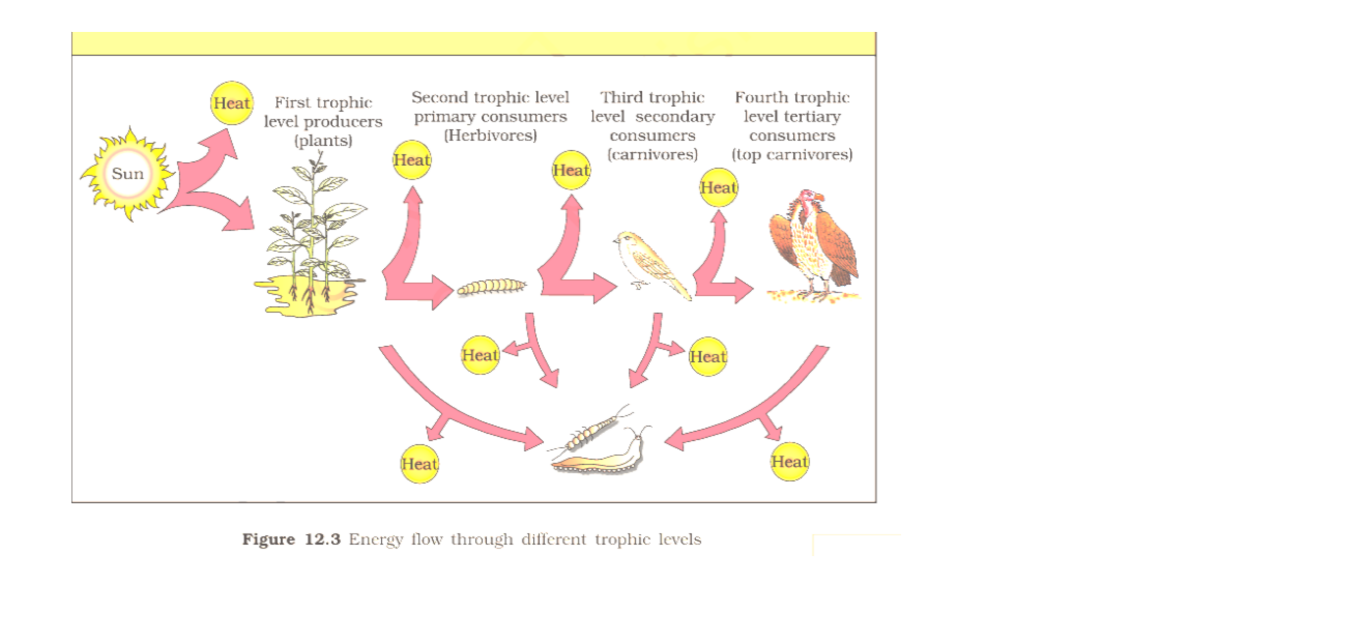
Energy flow — The transfer of energy through organisms in an ecosystem, from producers to consumers, is unidirectional.
Energy input and producers
- Main source: The Sun supplies energy to almost all ecosystems; deep-sea hydrothermal ecosystems are the exception.
- PAR: Less than 50% of incoming solar radiation is photosynthetically active radiation (PAR).
- Capture: Plants and photosynthetic bacteria capture only about 2–10% of PAR; this small fraction supports the living world.
- Producers: Autotrophs use radiant energy to make food from simple inorganic materials.
| Ecosystem | Major producers |
|---|---|
| Terrestrial | Herbaceous and woody plants |
| Aquatic | Phytoplankton, algae and higher plants |
Thermodynamic principles
- First law: Energy is neither created nor destroyed; it changes form and passes through the ecosystem.
- Second law: Energy transfers are not completely efficient; some energy becomes unavailable, increasing disorder.
- Implication: Ecosystems need a continuous energy supply to make the molecules organisms require and to offset energy loss.
Food Chains and Consumers
Feeding relationships
- Food chains and webs: They form as organisms feed on plants or other animals and may, in turn, be eaten by others.
- Consumers: Heterotrophs that depend on producers directly or indirectly for food.
- Energy exit: Energy captured by an organism is eventually transferred to a consumer or enters the detritus pathway when the organism dies.
| Consumer type | Food source | Feeding type |
|---|---|---|
| Primary consumer | Producer | Herbivore |
| Secondary consumer | Primary consumer | Carnivore; also called a primary carnivore |
| Tertiary consumer | Secondary consumer | Higher-level carnivore |
Examples of consumers
- Terrestrial herbivores: Common examples include insects, birds and mammals.
- Aquatic herbivores: Molluscs are common examples.
- Humans: Humans are omnivores when they feed on both plant and animal matter.
Grazing food chain example
- Grass (producer)
- Goat (primary consumer)
- Human (secondary consumer)
Grazing and Detritus Food Chains
| Point | Grazing food chain (GFC) | Detritus food chain (DFC) |
|---|---|---|
| Begins with | Living producers | Dead organic matter (detritus) |
| Main energy pathway | Producer → herbivore → carnivore | Detritus → decomposers |
| Key organisms | Plants and consumers | Mainly fungi and bacteria |
| Relative importance | Major energy-flow route in aquatic ecosystems | Carries a much larger fraction of energy than the GFC in terrestrial ecosystems |
Decomposers and food webs
- Decomposers: Heterotrophs that obtain energy and nutrients by breaking down dead organic matter and wastes.
- Saprotrophs: Decomposers, mainly fungi and bacteria; they secrete digestive enzymes and absorb the resulting simple inorganic materials.
- Food-web links: DFC organisms may be prey for GFC animals; omnivores such as cockroaches and crows can also connect feeding pathways.
Trophic Levels and Energy Transfer
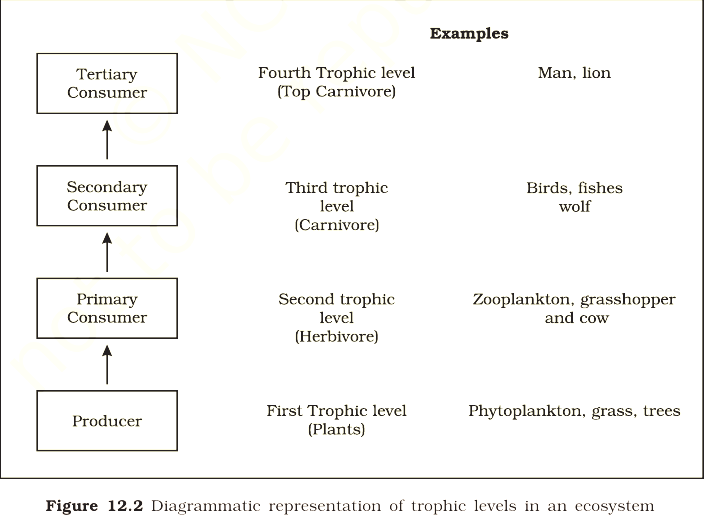
Trophic level — The position an organism occupies in a food chain according to its source of nutrition.
| Trophic level | Organism group |
|---|---|
| First | Producers |
| Second | Herbivores (primary consumers) |
| Third | Carnivores (secondary consumers) |
| Higher levels | Further carnivores, such as tertiary consumers |
Energy decrease and standing crop
- Energy decrease: Available energy declines at successive trophic levels; each level depends on the one below it.
- Death and detritus: Dead organisms become detritus or dead biomass, providing energy to decomposers.
- Standing crop: The mass of living material, or number of organisms, present per unit area at a particular time.
- Biomass measurement: Biomass may be recorded as fresh or dry weight; dry weight is more accurate because water content varies.
10% law — Only about 10% of the energy at one trophic level is transferred to the next higher trophic level.
Consequences of the 10% law
- Limited GFC length: Energy loss at each transfer restricts the number of trophic levels in a grazing food chain.
- Typical sequence: A GFC may include producers, herbivores, primary carnivores and secondary carnivores.
Why is dry-weight biomass measurement more accurate than fresh-weight measurement?
Quick recap
- The Sun is the energy source for nearly all ecosystems; producers capture only a small share of PAR.
- Energy moves one way through an ecosystem, from producers to consumers, with energy lost at each transfer.
- GFC begins with living producers; DFC begins with dead organic matter and is especially important in terrestrial ecosystems.
- Trophic levels describe feeding positions: producers are first, herbivores second and carnivores higher.
- Standing crop is living biomass or organism number per unit area at a given time; dry-weight biomass is more accurate.
- The 10% law means only about one-tenth of energy passes to the next trophic level, limiting GFC length.
Ecological Pyramids
Meaning and Structure
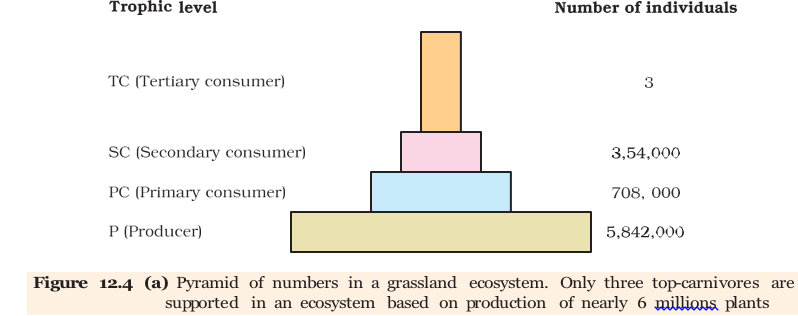
- Ecological pyramid: A graphical representation of the relationship among organisms at successive trophic levels.
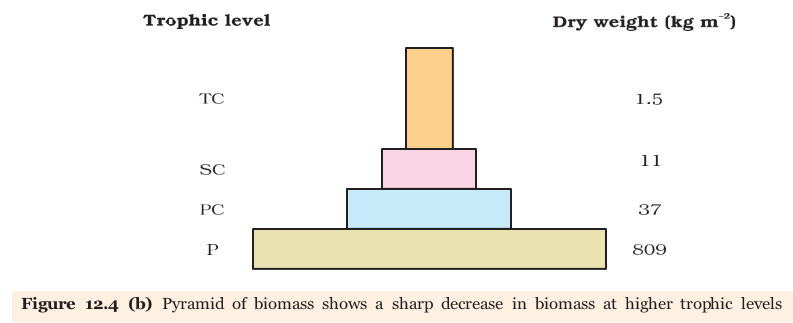
- Structure: The broad base represents the producer level, while the apex represents the top consumer level.
Types of Ecological Pyramids
| Type | What it represents | Typical pattern / example |
|---|---|---|
| Pyramid of numbers | Number of individuals at each trophic level | Usually upright in grassland; may be inverted or spindle-shaped in a tree ecosystem. |
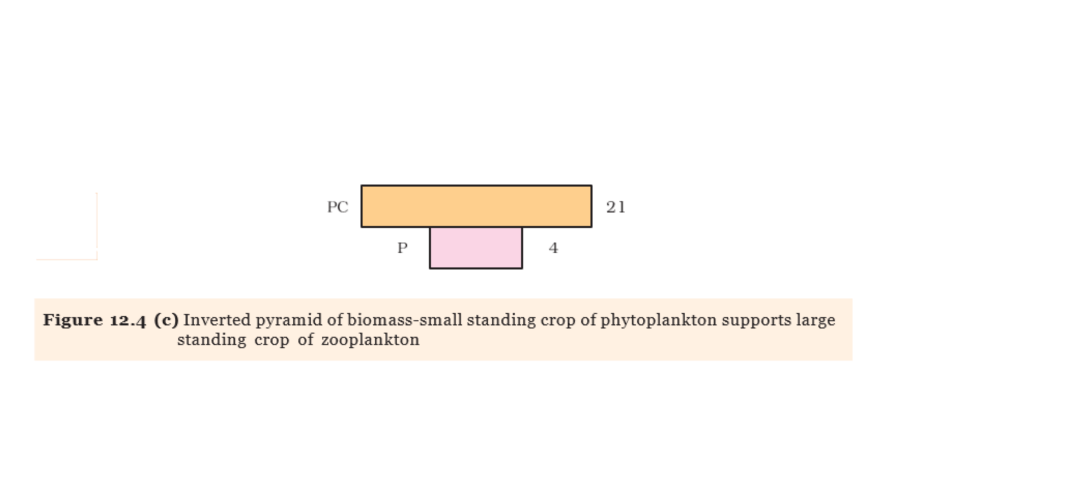
| Pyramid of biomass | Total biomass at each trophic level | Usually upright on land; generally inverted in the sea. |
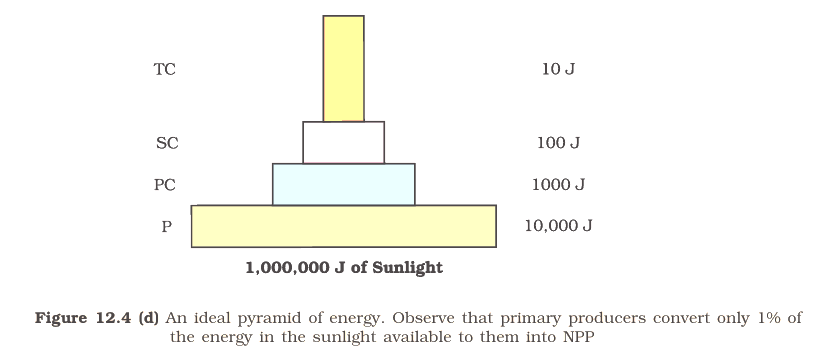
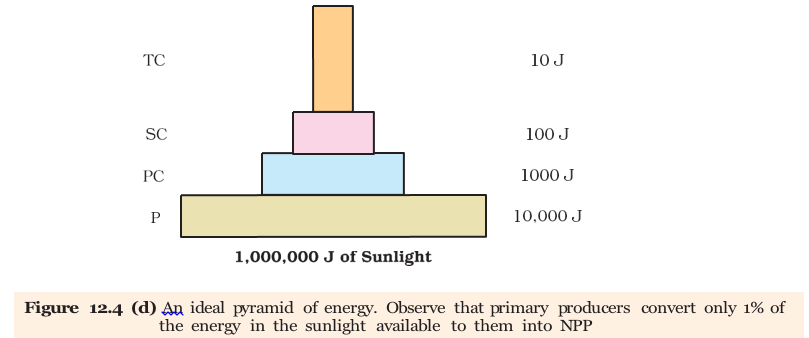
| Pyramid of energy | Energy present at each trophic level in a given time or annually per unit area | Always upright. |
Common Patterns and Exceptions
- Usually upright: Producers generally exceed herbivores, and herbivores generally exceed carnivores in number and biomass.
- Numbers in a tree ecosystem: One large tree can support many insects, which support fewer small birds and still fewer larger birds; the pyramid may be inverted or spindle-shaped.
- Marine biomass: The standing biomass of phytoplankton can be smaller than that of zooplankton and fish, so the biomass pyramid is generally inverted.
- Energy: Energy available at a lower trophic level is always greater than at the next higher level because some energy is lost as heat at every transfer.
Trophic Levels and Organisms
- Trophic level: The functional position an organism occupies in a food chain according to its source of nutrition.
- Levels: Producers occupy the first level, herbivores the second, and carnivores feeding on herbivores the third.
- Variable position: A species may occupy more than one trophic level; a sparrow, for example, is a primary consumer when eating seeds and a secondary consumer when eating insects.
Why the Energy Pyramid Is Always Upright
- Energy loss: Some energy is dissipated as heat at every transfer from one trophic level to the next.
- Upright pyramid: Energy available at higher trophic levels is always less than at lower levels, so an energy pyramid can never be inverted.
Limitations of Ecological Pyramids
Do not assume every ecological pyramid is upright: pyramids of numbers and biomass can be inverted, but the energy pyramid is always upright.
Ecosystem: Structure and Components
- Abiotic components: Non-living factors include air, water, soil, inorganic substances and climatic conditions.
- Biotic components: Producers make organic matter, consumers obtain food from other organisms, and decomposers act on dead organic matter.
- Organisation: Interactions among these components create the ecosystem’s characteristic species composition and vertical structure.
Ecosystem Processes and Productivity
- Productivity: The rate of biomass production per unit area over time; primary productivity is the production of organic matter by plants.
- GPP and NPP: Gross primary productivity is total production during photosynthesis; net primary productivity is GPP minus respiratory losses and is available to consumers.
- Secondary productivity: The rate at which consumers form new organic matter. Ecosystem functioning also involves energy flow and repeated nutrient cycling.
Decomposition
- Decomposition: Decomposers convert detritus—dead plant and animal remains and waste—into simpler inorganic substances.
- Steps: Fragmentation, leaching and catabolism act on detritus; humification forms resistant humus, and mineralisation releases inorganic nutrients.
- Rate: Warm, moist conditions favour decomposition, while low temperature and anaerobiosis inhibit it. Lignin- and chitin-rich detritus decomposes slowly.
Energy Flow and Food Chains
- Energy flow: Energy generally enters ecosystems from the Sun, is captured by producers and passes to consumers in one direction, with some lost as heat at each transfer.
- Food chains: Grazing food chains begin with living producers; detritus food chains begin with dead organic matter and are driven mainly by fungi and bacteria.
- Food webs: Interconnected food chains form a food web. About 10% of energy is transferred to each successive trophic level.
Nutrient Cycling and Ecosystem Services
Why can the biomass pyramid in the sea be inverted?
Why can an energy pyramid never be inverted?
Name the four major ecosystem processes and define NPP.
Quick recap
- Ecological pyramids represent numbers, biomass or energy across trophic levels; producers form the base and top consumers the apex.
- Numbers and biomass pyramids may be inverted; energy pyramids are always upright because energy is lost as heat at each transfer.
- A species may occupy multiple trophic levels, and pyramids omit food webs and saprophytes.
- Ecosystems contain interacting abiotic and biotic components; species composition and stratification are key structural features.
- The four major ecosystem processes are productivity, decomposition, energy flow and nutrient cycling; GPP is total producer output and NPP is what remains after producer use.
- Nutrient cycles may be gaseous or sedimentary, and ecosystem services include air and water purification by forests.
Biology — ALL CHAPTERS
1
Sexual Reproduction In Flowering Plants
2
Human Reproduction
3
Reproductive Health
4
Principles Of Inheritance And Variation
5
Molecular Basis Of Inheritance
6
Evolution
7
Human Health And Disease
8
Microbes In Human Welfare
9
Biotechnology : Principles And Processes
10
Biotechnology And Its Applications
11
Organisms And Populations
12
Ecosystem
13
Biodiversity And Conservation