Class 12 PCB . Biology . Biology . Biotechnology and Its Applications
Chapter 10: Biotechnology And Its Applications
Ch 10
Biology
Class 12 PCB
Biotechnological Applications In Agriculture
Biotechnology: Scope and Applications
- Biotechnology: Uses genetically modified microbes, fungi, plants and animals for large-scale production of useful products.
- Applications: Include therapeutics, diagnostics, agriculture, processed food, bioremediation, waste treatment and energy production.
- Key research areas: Improving catalysts, creating optimal conditions for their action, and purifying the products through downstream processing.
Approaches to Increasing Food Production
Why New Crop Technologies Were Needed
- Green Revolution: Tripled food supply, but this was insufficient for the growing population.
- Yield gains: Came partly from improved crop varieties, but mainly from better management practices and agrochemicals.
- Limitations: Agrochemicals may be too expensive for farmers in developing countries; conventional breeding could not provide sufficiently fast improvements or further yield gains with existing varieties.
Tissue Culture and Micropropagation
Tissue culture — Growing plant cells, tissues or organs from an explant under sterile conditions in a nutrient medium.
Micropropagation — The rapid production of large numbers of plants through tissue culture.
Producing Virus-Free Plants
- Meristem culture: Apical and axillary meristems of an infected plant are generally free of virus.
- Use: Removing a meristem and growing it in vitro can produce a healthy, virus-free plant.
- Examples: Meristems of banana, sugarcane and potato have been cultured.
Somatic Hybridisation
- Protoplasts: Naked plant cells obtained after their cell walls are removed can be isolated from different varieties.
- Somatic hybridisation: Fusion of protoplasts from two varieties combines desirable characters; the resulting hybrids are called somatic hybrids.
- Example: Fusion of tomato and potato protoplasts produced pomato, but it lacked the desired combination of traits for commercial use.
Genetically Modified Crops
- Genetically modified organisms: Plants, bacteria, fungi or animals whose genes have been altered by genetic manipulation.
- Crop benefits: GM crops can tolerate abiotic stresses, reduce pesticide use and post-harvest losses, and improve mineral-use efficiency.
- Enhanced value: Genetic modification can improve nutritional quality, as in vitamin A-enriched golden rice, and produce resources such as starches, fuels and pharmaceuticals.
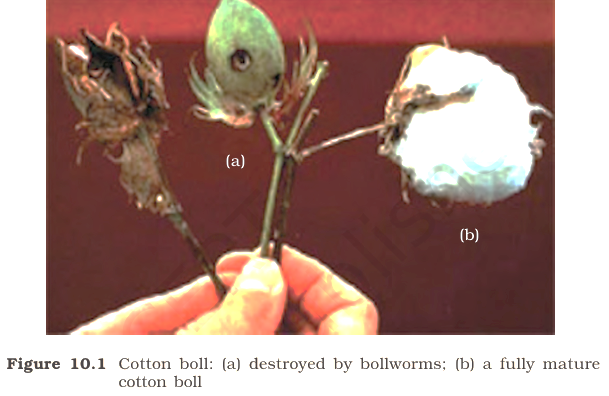
Bt Crops: Insect Resistance
| Bt toxin gene | Target pest |
|---|---|
| cryIAc and cryIIAb | Cotton bollworms |
| cryIAb | Corn borer |
How Bt Toxin Kills an Insect
- Bt forms protein crystals containing inactive protoxin, so the bacterium is not harmed by its own toxin.
- An insect ingests the crystals; the alkaline gut dissolves them and activates the toxin.
- The active toxin binds to midgut epithelial cells and forms pores.
- Cells swell and lyse, eventually killing the insect.
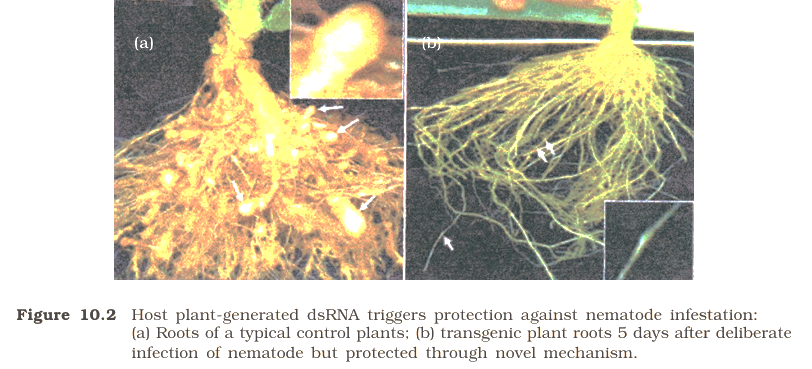
RNA Interference for Pest Resistance
What are totipotency and micropropagation?
Explain how Bt toxin kills susceptible insects.
How does RNAi protect tobacco from Meloidogyne incognita?
Quick recap
- Biotechnology improves a biological catalyst—usually a microbe or pure enzyme—engineers conditions for it, and purifies the product downstream.
- Tissue culture uses totipotency; micropropagation rapidly produces genetically identical somaclones.
- Meristem culture can produce virus-free plants; protoplast fusion can produce somatic hybrids.
- GM crops can improve stress tolerance, pest resistance, mineral use, post-harvest preservation and nutrition.
- Bt protoxin is activated in the alkaline insect gut and damages midgut cells; Bt toxins target specific insect groups.
- RNAi uses double-stranded RNA to silence complementary mRNA and can protect crops from pests.
Biotechnological Applications In Medicine
Recombinant Therapeutics
- Recombinant therapeutics: Recombinant DNA technology enables the mass production of safe and effective therapeutic drugs.
- Advantage: These products are less likely to cause unwanted immune responses than similar products obtained from non-human sources.
- Availability: About 30 recombinant therapeutics have been approved for human use worldwide; 12 are marketed in India.
Genetically Engineered Insulin
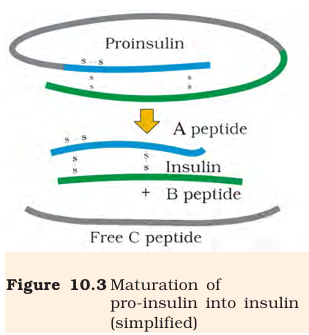
Gene Therapy
ADA Gene Therapy Using Lymphocytes
- Collect the patient’s blood lymphocytes and grow them in culture outside the body.
- Introduce functional ADA cDNA using a retroviral vector.
- Return the genetically engineered lymphocytes to the patient.
- Repeat the infusions periodically because the lymphocytes are not immortal.
Molecular Diagnosis
| Technique | Principle | Example or use |
|---|---|---|
| Recombinant DNA technology | DNA-based methods support early disease diagnosis | Used as a molecular diagnostic approach |
| PCR | Amplifies tiny amounts of nucleic acid | Early pathogen detection; HIV, cancer mutations and genetic disorders |
| DNA/RNA probe | A radioactive probe binds a complementary sequence; detected by autoradiography | A non-complementary mutation gives no signal |
| ELISA | Detects antigen–antibody interaction | Detects pathogen antigens or antibodies against the pathogen |
Transgenic Animals
| Use | Purpose | Example or key detail |
|---|---|---|
| Normal physiology and development | Study gene regulation and how genes affect body functions and development | Study growth factors such as insulin-like growth factor |
| Disease models | Understand genetic contributions to disease and investigate treatments | Models for cancer, cystic fibrosis, rheumatoid arthritis and Alzheimer’s disease |
| Biological products | Produce useful human proteins that may otherwise be expensive to make | Human α-1-antitrypsin for emphysema; research also targets PKU and cystic fibrosis |
| Vaccine safety | Test vaccines before use in humans | Transgenic mice are used for polio vaccine safety testing and could replace monkeys if reliable |
| Chemical safety testing | Study the effects of toxic substances, often more quickly | Animals carry genes that make them more sensitive to toxic substances |
Transgenic Animals as Biological Product Producers
- Rosie (1997): The first transgenic cow produced milk containing human α-lactalbumin at 2.4 grams per litre.
- Significance: The human protein-enriched milk was described as nutritionally more balanced for human babies than natural cow’s milk.
How was recombinant human insulin produced using *E. coli*?
How is ADA deficiency treated using gene therapy, and why may treatment need repeating?
How do PCR and ELISA help in molecular diagnosis?
Quick recap
- Recombinant therapeutics enable large-scale production and are less likely to cause unwanted immune responses than products from non-human sources.
- Mature insulin has A and B chains joined by disulphide bonds; the C peptide is removed during maturation.
- Gene therapy supplies a functional gene; ADA-deficient patients treated with engineered lymphocytes may need repeat infusions.
- Recombinant DNA technology, PCR and ELISA are used in molecular diagnosis; probes can identify complementary DNA sequences.
- Transgenic animals are used to study physiology and disease, make biological products, and test vaccine and chemical safety.
- Rosie, a transgenic cow, produced human α-lactalbumin-enriched milk in 1997.
Biology — ALL CHAPTERS
1
Sexual Reproduction In Flowering Plants
2
Human Reproduction
3
Reproductive Health
4
Principles Of Inheritance And Variation
5
Molecular Basis Of Inheritance
6
Evolution
7
Human Health And Disease
8
Microbes In Human Welfare
9
Biotechnology : Principles And Processes
10
Biotechnology And Its Applications
11
Organisms And Populations
12
Ecosystem
13
Biodiversity And Conservation