Class 12 PCB . Biology . Biology . Microbes in Human Welfare
Chapter 8: Microbes In Human Welfare
Ch 8
Biology
Class 12 PCB
Microbes In Household Products & Microbes In Industrial Products
Microbes: useful as well as harmful
- Diversity: Microbes include bacteria, fungi, protozoa, microscopic plants and animals, viruses, viroids and prions.
- Habitats: They occur in soil, water, air and inside organisms; some also survive extreme heat, cold or acidity.
- Human welfare: Although some microbes cause disease, many are useful in making foods, beverages and other products.
Microbes in Household Products
Lactic acid bacteria (LAB) — Bacteria, including Lactobacillus, that grow in milk and produce lactic acid.
Curd and fermented dough
- Curd formation: LAB multiply in warm milk and produce acids that coagulate and partially digest milk proteins.
- Starter: A small amount of curd added to fresh milk provides millions of LAB that initiate fermentation.
- Nutrition and health: Curd has increased vitamin B₁₂; LAB in the stomach help check disease-causing microbes.
- Idli and dosa: Bacteria ferment the dough; the released makes it rise and appear puffed.
- Bread: Baker’s yeast, Saccharomyces cerevisiae, ferments the dough and helps it rise.
Traditional fermented foods and cheese
- Toddy: A traditional drink made by fermenting sap from palms.
- Other foods: Microbes ferment fish, soybeans and bamboo shoots.
- Swiss cheese: Propionibacterium sharmanii produces abundant , creating the characteristic large holes.
- Roquefort cheese: Ripened using a specific fungus, which gives it its characteristic flavour.
- Cheese varieties: The microbes used contribute to differences in texture, flavour and taste.
Microbes in Industrial Products
Industrial production
- Products: Microbes are used industrially to produce valuable products, including beverages and antibiotics.
- Fermentor: A large vessel in which microbes are grown for production on an industrial scale.
Fermented Beverages
Yeast and alcoholic fermentation
- Yeast: Saccharomyces cerevisiae, also called brewer’s yeast, ferments malted cereals and fruit juices to produce ethanol.
- Alcoholic fermentation: Yeast converts sugars into ethanol and carbon dioxide.
- Raw material and processing: The beverage produced depends on the starting material and whether the fermented broth is distilled.
| Processing | Examples |
|---|---|
| Produced without distillation | Wine, beer |
| Produced by distilling fermented broth | Whisky, brandy, rum |
How do LAB help in making curd, and what are two benefits of LAB?
What causes the holes in Swiss cheese?
Which alcoholic beverages are made with and without distillation?
Quick recap
- LAB ferment milk into curd, improve its nutritional quality and help inhibit harmful microbes in the stomach.
- Bacterial fermentation makes idli and dosa dough rise; baker’s yeast is used for bread.
- Different microbes create distinctive fermented foods and cheeses, including Swiss and Roquefort cheese.
- Microbes are grown at industrial scale in large vessels called fermentors.
- Brewer’s yeast ferments sugars into ethanol and carbon dioxide.
- Wine and beer are made without distillation; whisky, brandy and rum involve distillation.
Antibiotics & Microbes In Sewage Treatment
Antibiotics
- Antibiotics: Chemical substances produced by some microbes that kill or inhibit the growth of disease-causing microbes.
- Importance: They have helped control deadly infections such as plague, whooping cough, diphtheria and leprosy.
Chemicals, Enzymes and Other Bioactive Molecules
- Industrial products: Microbes are used commercially to produce organic acids, alcohols and enzymes.
- Bioactive molecules: Microbial products such as streptokinase, cyclosporin A and statins have important medical uses.
Sewage and Its Treatment
- Sewage: Municipal wastewater containing human excreta, organic matter and microbes is called sewage.
- Treatment: Sewage is treated by naturally occurring heterotrophic microbes before its release, reducing its pollution potential.
Primary Treatment
- Primary treatment: Physical processes remove large and small particles from sewage by filtration and sedimentation.
- Primary sludge: Settled solids form primary sludge, while the liquid supernatant is called the effluent.
- Next step: The effluent from the primary settling tank proceeds to secondary treatment.
Secondary or Biological Treatment
Sludge Digestion and Final Effluent
- Most activated sludge → anaerobic sludge digesters.
- Anaerobic bacteria digest bacteria and fungi in the sludge.
- Digestion releases methane, hydrogen sulphide and carbon dioxide → biogas.
- Biogas is inflammable and can be used as an energy source.
- Treated effluent → natural water bodies such as rivers and streams.
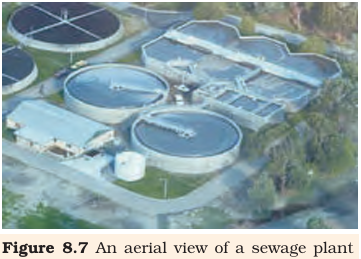
Sewage Pollution and River Protection
- Urbanisation increases sewage production.
- Too few STPs are available to treat all the sewage.
- Untreated sewage may be discharged into rivers.
- River pollution and water-borne diseases increase.
- The Ministry of Environment and Forests initiated the Ganga Action Plan and Yamuna Action Plan to build more STPs and ensure only treated sewage enters these rivers.
What is BOD, and what does a high BOD indicate?
Distinguish primary and secondary sewage treatment.
What happens to activated sludge?
Quick recap
- Antibiotics are microbial substances that kill or inhibit disease-causing microbes; penicillin was the first discovered.
- Microbes produce commercial acids, ethanol, enzymes and bioactive molecules with medical and industrial uses.
- Primary sewage treatment removes particles through filtration and sedimentation.
- Aerobic flocs consume organic matter in secondary treatment, reducing BOD.
- Settled activated sludge is partly recycled and mostly digested anaerobically to produce biogas.
- Untreated sewage pollutes rivers; the Ganga and Yamuna Action Plans promote treatment before discharge.
Microbes In Production Of Biogas & Microbes As Biocontrol Agents
Microbes in Biogas Production
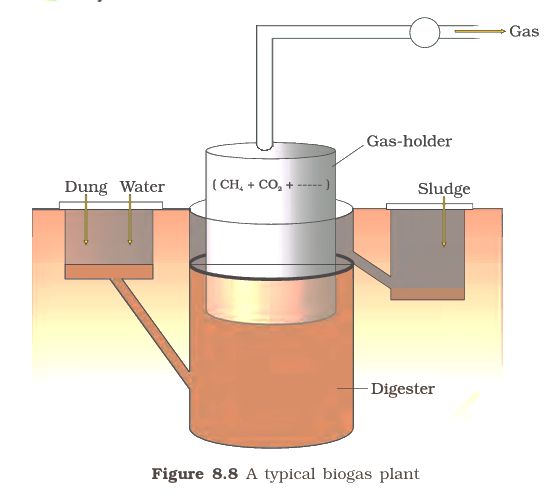
Biogas Plant: Structure and Use
Biogas Production
- Dung and other bio-wastes are fed into the digester as slurry.
- Methanogens break down organic material anaerobically.
- Biogas accumulates under the floating cover and is piped to users.
- Spent slurry leaves the plant and can be used as fertiliser.
Biocontrol of Plant Pests and Diseases
| Agent | Target or use | Key action or feature |
|---|---|---|
| Ladybird beetle | Aphids | A beneficial predator that feeds on aphids. |
| Dragonfly | Mosquitoes | A beneficial predator that helps control mosquitoes. |
| Bacillus thuringiensis (Bt) | Butterfly caterpillars | Larvae ingest Bt; a toxin released in their gut kills them, while other insects are unharmed. |
| Trichoderma | Several plant pathogens | Free-living fungi common in root ecosystems; effective against plant pathogens. |
| Baculoviruses | Insects and other arthropods | Species-specific, narrow-spectrum agents with no negative impact on plants, mammals, birds, fish or non-target insects. |
Microbial Biocontrol Agents
How does a biogas plant produce and supply biogas?
Explain how Bt controls caterpillar pests.
Why are baculoviruses useful in biological control?
Quick recap
- Biogas is mainly methane, produced by anaerobic methanogens such as *Methanobacterium*.
- Cattle dung supplies methanogens and is a useful feedstock for rural biogas plants.
- Biogas plants provide cooking and lighting fuel; spent slurry can be used as fertiliser.
- Biocontrol uses living organisms and natural interactions to reduce reliance on harmful chemicals.
- Ladybirds control aphids, dragonflies control mosquitoes, Bt controls caterpillars, and *Trichoderma* controls plant pathogens.
- Baculoviruses are narrow-spectrum agents that help protect non-target organisms in IPM.
Microbes As Biofertilisers
Biofertilisers and Their Role
Biofertilisers — Organisms that enrich the nutrient quality of soil and help make nutrients available to plants.
Why Use Biofertilisers?
- Chemical fertilisers: Their excessive use contributes to environmental pollution.
- Organic farming: Biofertilisers can replenish soil nutrients and reduce dependence on chemical fertilisers.
- Main microbial sources: Bacteria, fungi and cyanobacteria.
Bacterial Biofertilisers
| Type | Association or habitat | Examples | Contribution |
|---|---|---|---|
| Symbiotic | Root nodules of leguminous plants | Rhizobium | Fixes atmospheric nitrogen into organic forms used by the plant. |
| Free-living | Soil | Azospirillum, Azotobacter | Fixes atmospheric nitrogen and enriches soil nitrogen. |
Fungal Biofertilisers: Mycorrhiza
Mycorrhiza — A symbiotic association between a fungus and the roots of a plant.
Benefits of Mycorrhiza
- Fungal partner: Many species of the genus *Glomus* form mycorrhiza; the fungus absorbs phosphorus from soil and passes it to the plant.
- Plant benefits: Greater resistance to root-borne pathogens, tolerance to salinity and drought, and improved growth and development.
- Fungal benefit: The plant supplies the fungus with carbohydrates and other nutrients.
Cyanobacterial Biofertilisers
- Cyanobacteria: Autotrophic microbes found in aquatic and terrestrial environments; many can fix atmospheric nitrogen.
- Examples: *Anabaena*, *Nostoc* and *Oscillatoria*.
- Paddy fields: Cyanobacteria are important biofertilisers; blue-green algae also add organic matter and improve soil fertility.
Use in Agriculture
- Commercial use: Biofertilisers are available commercially and are used by farmers to replenish soil nutrients.
- Overall value: Their use helps reduce reliance on chemical fertilisers and supports organic farming.
Quick recap
- Biofertilisers are organisms that improve the nutrient quality of soil.
- Rhizobium fixes nitrogen in legume root nodules; Azospirillum and Azotobacter fix nitrogen freely in soil.
- Mycorrhizal fungi, including *Glomus*, transfer soil phosphorus to plants.
- Mycorrhiza can improve plant growth and resistance to root pathogens, salinity and drought; the fungus receives plant nutrients.
- Cyanobacteria such as *Anabaena*, *Nostoc* and *Oscillatoria* enrich soil, especially in paddy fields.
- Biofertilisers replenish soil nutrients and reduce dependence on polluting chemical fertilisers.
Biology — ALL CHAPTERS
1
Sexual Reproduction In Flowering Plants
2
Human Reproduction
3
Reproductive Health
4
Principles Of Inheritance And Variation
5
Molecular Basis Of Inheritance
6
Evolution
7
Human Health And Disease
8
Microbes In Human Welfare
9
Biotechnology : Principles And Processes
10
Biotechnology And Its Applications
11
Organisms And Populations
12
Ecosystem
13
Biodiversity And Conservation