Class 12 PCB . Biology . Biology . Principles of Inheritance and Variation
Chapter 4: Principles Of Inheritance And Variation
Ch 4
Biology
Class 12 PCB
Mendel's Laws Of Inheritance
Genetics, Inheritance and Variation
- Genetics: The branch of biology that studies the inheritance and variation of characters.
- Inheritance and variation: Inheritance passes characters from parents to offspring; variation describes differences between offspring and their parents.
Selective Breeding and Variation
- Selective breeding: Humans have used naturally occurring variation to breed plants and animals with desirable characters.
- Example: Indian Sahiwal cows were developed through artificial selection and domestication from ancestral wild cows.
Mendel’s Pea-Plant Experiments
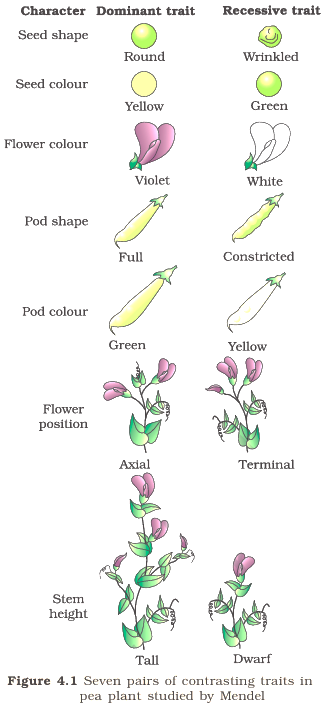
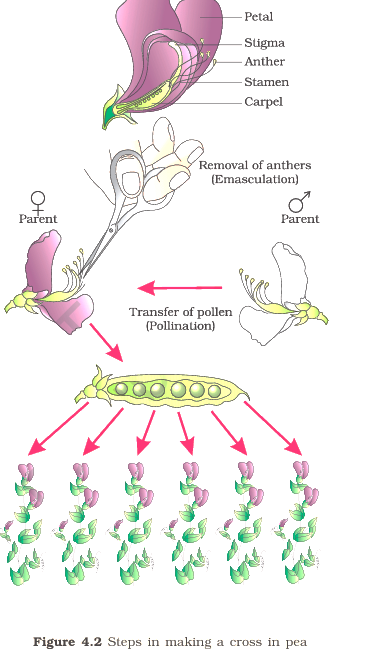
True-breeding line — A plant line that retains stable trait inheritance and expression through several generations of continuous self-pollination.
| Character | Contrasting traits |
|---|---|
| Stem height | Tall / dwarf |
| Flower colour | Violet / white |
| Flower position | Axial / terminal |
| Pod shape | Inflated / constricted |
| Pod colour | Green / yellow |
| Seed shape | Round / wrinkled |
| Seed colour | Yellow / green |
What is a true-breeding line?
Why were Mendel’s experimental conclusions considered reliable?
Quick recap
- Genetics studies the inheritance and variation of characters.
- Inheritance passes characters from parents to offspring; variation describes differences between them.
- Artificial selection uses natural variation to breed organisms with desirable traits.
- Mendel studied pea plants from 1856 to 1863 using true-breeding lines and artificial pollination.
- His 14 varieties formed pairs differing in one character, across seven contrasting characters.
- Large samples, statistical reasoning and checks across generations supported Mendel’s conclusions.
Inheritance Of One Gene
Monohybrid Cross: One Pair of Contrasting Traits
Monohybrid cross — A cross used to study the inheritance of one pair of contrasting traits.
Mendel’s observations
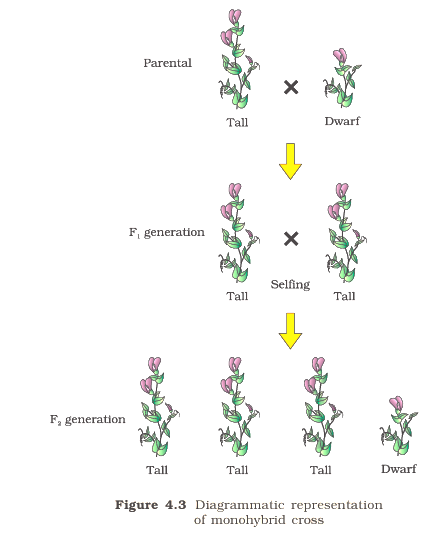
- Parental cross: Mendel crossed tall and dwarf pea plants to follow plant height.
- F₁ generation: All offspring were tall; the dwarf trait was not expressed.
- F₂ generation: Self-pollinating tall F₁ plants produced tall and dwarf offspring in a phenotype ratio.
- Other traits: The same pattern appeared in other contrasting trait pairs: one parental trait showed in F₁, while both appeared in F₂ in a ratio.
- No blending: Offspring showed either parental form, not an intermediate trait.
| Generation | Genotype | Phenotype |
|---|---|---|
| Parents | Tall × dwarf | |
| F₁ | All tall | |
| F₂ | Tall:dwarf = |
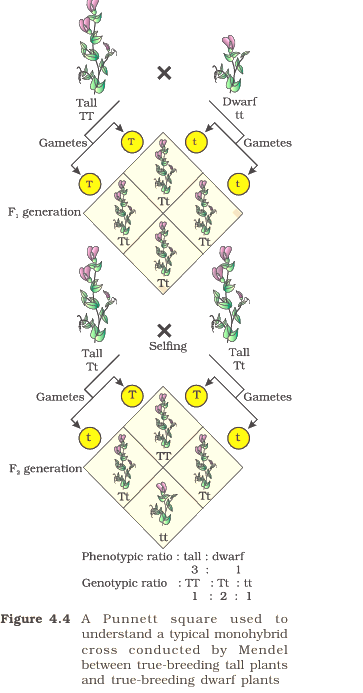
- Genotype
- The allele combination an organism carries, such as , , or .
- Phenotype
- An observable trait, such as tall or dwarf plant height.
- Homozygous
- Having two identical alleles, as in or .
- Heterozygous
- Having two different alleles, as in .
F₂ plants and their genotypes
- Dwarf F₂ plants: They continued to produce dwarf plants in F₃ and F₄; their genotype is homozygous recessive, .
- Tall F₂ plants: Appearance alone cannot show whether a plant is or .
- Ratios: The F₂ genotype ratio is , while the phenotype ratio is .
Test Cross
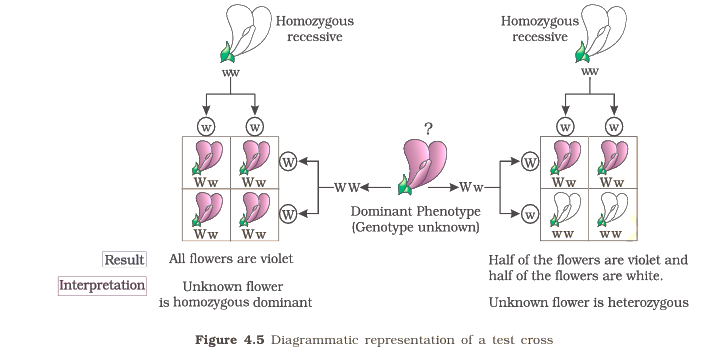
Test cross — A cross between an individual with a dominant phenotype and a homozygous recessive individual, used to determine the unknown genotype.
| Unknown dominant plant | Cross | Offspring result |
|---|---|---|
| Homozygous dominant, | All tall; unknown parent is | |
| Heterozygous, | Tall:dwarf = ; unknown parent is |
Flower-colour example
- Alleles: Violet flower colour, , is dominant over white, .
- Cross: Test the violet-flowered plant of unknown genotype against a white-flowered plant, .
- Interpretation: All violet offspring indicate ; a violet:white ratio of indicates .
Principles of Inheritance
Mendel’s two rules
- First Law: The Law of Dominance.
- Second Law: The Law of Segregation.
- Context: Mendel proposed these general rules to summarise his observations from monohybrid crosses.
State the F₂ genotype and phenotype ratios in Mendel’s monohybrid cross.
How does a test cross distinguish a homozygous dominant plant from a heterozygous plant?
Quick recap
- A monohybrid cross studies one pair of contrasting traits.
- In Mendel’s pea-plant cross, all F₁ plants were tall; F₂ plants showed tall and dwarf traits in a ratio.
- The F₂ genotype ratio is ; its phenotype ratio is .
- Dwarf F₂ plants bred true in F₃ and F₄, showing their genotype was .
- A dominant phenotype alone cannot distinguish from ; a test cross can.
- Mendel named the First Law the Law of Dominance and the Second Law the Law of Segregation.
Law Of Dominance
Law of Dominance
- Factors: Characters are controlled by discrete units, now called genes, which occur in pairs.
- Dominance: In a pair of different factors, the dominant one is expressed, while the recessive one is masked.
- Monohybrid cross: Dominance explains the expression of one parental trait in F₁ and the typical 3:1 phenotypic ratio in F₂.
Law of Segregation
- Segregation: The two alleles of a gene separate during gamete formation, so each gamete receives only one allele.
- No blending: Both alleles remain distinct and can be recovered in later generations, even if one is not expressed in F₁.
- Gametes: A homozygous individual produces one type of gamete; a heterozygous individual produces two types in equal proportions.
Incomplete Dominance
Alleles and Enzyme Function
- Allele function: An allele may produce a normal enzyme, a less efficient enzyme, a non-functional enzyme, or no enzyme.
- Dominant allele: A functioning allele can determine the phenotype when its partner allele produces no functional enzyme.
- Recessive allele: A trait may appear when both alleles fail to produce a functional enzyme; the effect depends on the gene product and the trait examined.
Co-dominance and ABO Blood Groups
- ABO blood groups: In the AB phenotype, alleles IA and IB are both expressed, producing both A and B sugars on red blood cells.
- Dominance over i: IA and IB each express their sugar when paired with i, which produces no sugar.
Multiple Alleles and Trait-Dependent Dominance
- Dominance is not absolute: It depends on the gene product and on which phenotype is being examined.
- One gene, different outcomes: The same allele pair may appear dominant for one trait and incompletely dominant for another.
How does incomplete dominance differ from complete dominance?
Why is the ABO blood group system an example of both co-dominance and multiple alleles?
Quick recap
- Dominance: A dominant allele masks its recessive partner in a heterozygote.
- Segregation: Paired alleles separate during gamete formation; each gamete receives one.
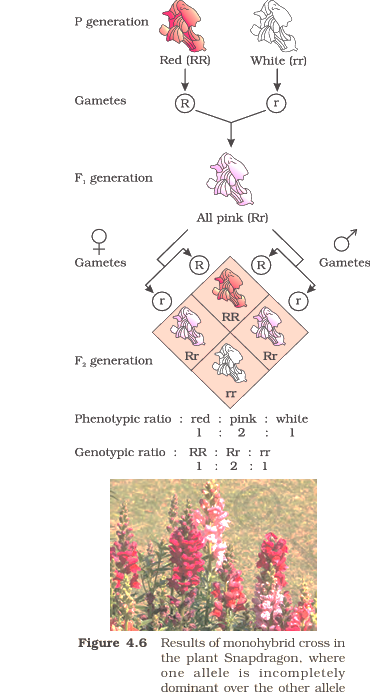
- Incomplete dominance: The heterozygote is intermediate; snapdragon F₂ gives a ratio.
- Co-dominance: Both alleles are expressed together, as with blood group AB.
- Multiple alleles: A population may have more than two alleles for a gene, though each person carries only two.
- Trait matters: Dominance may differ depending on which phenotype is examined.
Inheritance Of Two Genes
Dihybrid Cross
Dihybrid cross — A cross between individuals differing in two pairs of contrasting traits.
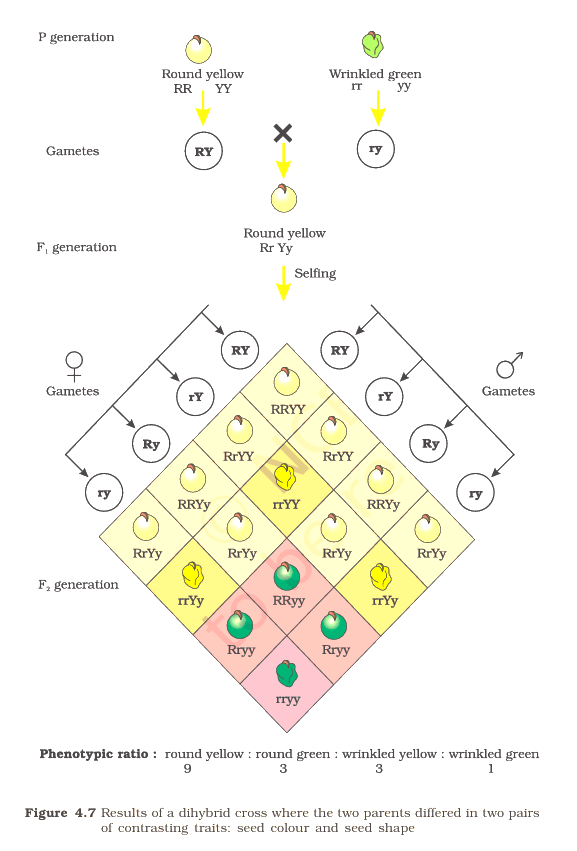
Seed colour and shape
- Alleles: = yellow (dominant), = green (recessive); = round (dominant), = wrinkled (recessive).
- Parental cross: (round, yellow) × (wrinkled, green) produces plants with genotype .
- Dominance: All seeds are round and yellow, showing that round and yellow are dominant over wrinkled and green.
- Single-trait ratios: In , each trait separately shows a dominant-to-recessive ratio of .
Law of Independent Assortment
Law of Independent Assortment — During gamete formation, segregation of one pair of traits is independent of segregation of another pair.
Dihybrid inheritance in and
- Gametes: The plant produces four equally frequent types: , , and ; each makes up one-quarter of its gametes.
- Independent segregation: Inheritance of or does not determine whether a gamete receives or y; each allele pair segregates independently.
- phenotypes: Round yellow : wrinkled yellow : round green : wrinkled green = .
- Ratio derivation: Combining the two separate monohybrid ratios gives the four phenotype groups in a ratio.
| Genotype | Phenotype |
|---|---|
| , , , | Round, yellow |
| , | Round, green |
| , | Wrinkled, yellow |
| Wrinkled, green |
- Genotypic ratio: .
- Phenotypic ratio: counts phenotype groups, not distinct genotypes.
Chromosomal Theory of Inheritance
Chromosomal theory of inheritance — Chromosome behaviour during meiosis provides a physical explanation for how genes are inherited and how Mendel’s laws operate.
Key milestones
- 1865Mendel published his findings on inheritance, but they initially received little recognition.
- 1900Hugo de Vries, Carl Correns and Erich von Tschermak independently rediscovered Mendel’s results.
- By 1902Chromosome movement during meiosis had been worked out; Walter Sutton and Theodore Boveri related chromosome behaviour to Mendel’s laws.
Why Mendel’s work was not recognised at first
- Limited communication: His findings were not widely publicised.
- Unfamiliar ideas: Stable, discrete factors and non-blending alleles did not fit many biologists’ explanations of continuous variation.
- New approach: Using mathematics to explain biological inheritance was unfamiliar to biologists of the time.
- No physical evidence: Mendel could not identify the physical nature or location of his factors.
Chromosomes and meiotic inheritance
- Chromosomes: These nuclear structures were observed to double and divide before cell division; they were named for their appearance as coloured bodies when stained.
- Paired units: Chromosomes and genes occur in pairs; the two alleles of a gene occupy corresponding sites on homologous chromosomes.
- Segregation: Homologous chromosomes separate during meiosis, so only one chromosome of each pair—and one allele of each gene pair—passes to a gamete.
| Behaviour | Chromosomes | Genes |
|---|---|---|
| Pairing | Occur in pairs in diploid cells. | Genes occur in pairs as alleles. |
| Segregation | Members of a pair separate during gamete formation; each gamete receives one. | Alleles of a pair separate during gamete formation; each gamete receives one. |
| Independent assortment | Independent chromosome pairs can segregate independently. | One gene pair can segregate independently of another pair. |
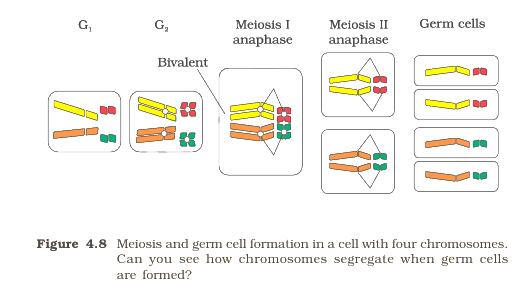
Independent assortment of chromosomes
- Meiosis I: Chromosome pairs can align independently at the metaphase plate.
- Different combinations: Their independent alignment and separation produce different chromosome combinations in germ cells.
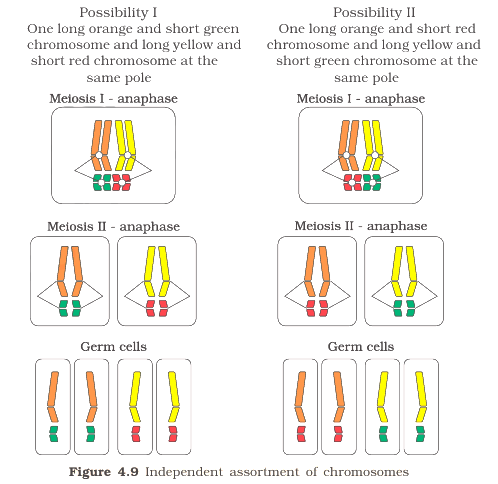
Experimental Verification: Morgan and Drosophila
Morgan’s work
- Thomas Hunt Morgan and colleagues: Their experiments verified the chromosomal theory and helped reveal the basis of variation produced by sexual reproduction.
- Study organism: They used the fruit fly, *Drosophila melanogaster*.
- Why suitable: It grows on simple laboratory medium, completes its life cycle in about two weeks and produces many offspring from one mating.
- Useful traits: The sexes are easily distinguished, and many hereditary variations can be seen with a low-power microscope.
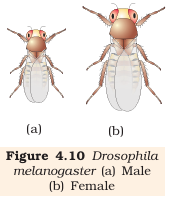
Quick recap
- A dihybrid cross tracks inheritance of two pairs of contrasting traits.
- The hybrid forms four equally frequent gamete types: , , and .
- Independent assortment produces an phenotypic ratio of ; the genotypic ratio is .
- Chromosomes and genes occur in pairs and show corresponding patterns of segregation and independent assortment.
- Sutton and Boveri linked chromosome behaviour to Mendel’s laws; Morgan and colleagues experimentally verified the chromosomal theory.
Linkage And Recombination
Linked Genes and Their Inheritance
Linkage — The physical association of genes located on the same chromosome.
Recombination — The generation of non-parental combinations of genes.
Morgan’s Drosophila Crosses
- Cross studied: Morgan crossed yellow-bodied, white-eyed females with brown-bodied, red-eyed males, then intercrossed their F₁ progeny.
- Location: The genes in these crosses were located on the X chromosome.
- Observed pattern: Parental gene combinations occurred much more often than non-parental combinations, so the F₂ ratio differed greatly from the independent-assortment ratio of .
- Explanation: Genes on the same chromosome tend to be inherited together; recombination produces non-parental combinations.
| Linkage pattern | Recombination | Example |
|---|---|---|
| Tight linkage | Low; parental combinations predominate | White and yellow genes: |
| Loose linkage | Higher; more non-parental combinations occur | White and miniature-wing genes: |
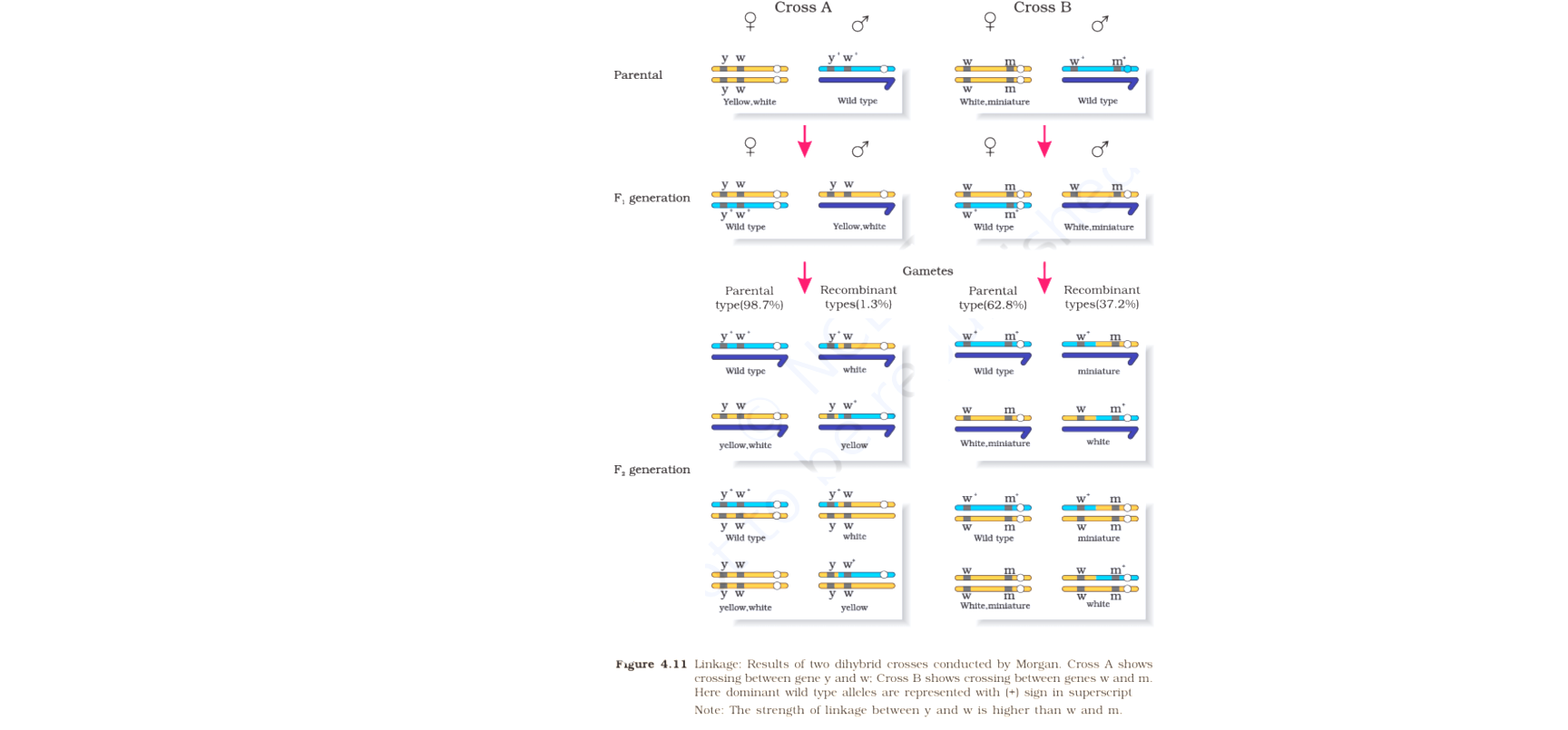
Recombination Frequency and Gene Mapping
- Sturtevant’s method: Alfred Sturtevant used recombination frequency between gene pairs on the same chromosome to estimate the distance between them and map their positions.
- Application: Genetic maps are used as a starting point for whole-genome sequencing; they were used in the Human Genome Sequencing Project.
Polygenic Inheritance
Polygenic trait — A trait controlled by three or more genes, often showing a continuous range of phenotypes.
Features and Example
- Continuous variation: Unlike traits with distinct alternatives, polygenic traits vary across a gradient, as seen in human height.
- Combined effects: Each contributing allele adds to the phenotype; environmental influence is also considered.
- Human skin colour: In the example, dominant alleles , , and contribute to darker skin, while recessive alleles , , and contribute to lighter skin.
| Genotype | Allele pattern | Expected effect |
|---|---|---|
| Six dominant alleles | Darkest skin colour | |
| Six recessive alleles | Lightest skin colour | |
| Three dominant and three recessive alleles | Equal numbers of both allele types | Intermediate skin colour |
Pleiotropy
Pleiotropic gene — A single gene that produces effects on multiple phenotypic traits.
Phenylketonuria
- Underlying basis: Pleiotropy often occurs when one gene affects a metabolic pathway that contributes to several phenotypes.
- Cause: Phenylketonuria results from a mutation in the gene coding for the enzyme phenylalanine hydroxylase.
- Manifestations: The disease is associated with mental retardation and reduced hair and skin pigmentation.
How does recombination frequency help map genes?
What is polygenic inheritance? Give one example.
What is pleiotropy? Give the example described.
Quick recap
- Linkage is the physical association of genes on the same chromosome; recombination produces non-parental combinations.
- Morgan studied X-chromosome genes in Drosophila; parental combinations were more common than non-parental ones.
- Tightly linked genes show less recombination than loosely linked genes.
- Sturtevant used recombination frequency to estimate gene distances; genetic maps supported the Human Genome Sequencing Project.
- Polygenic traits involve three or more genes, additive allele effects, and often continuous variation; environment can also influence them.
- Pleiotropy occurs when one gene affects multiple traits; phenylketonuria is an example.
Sex Determination
Chromosomal Basis of Sex Determination
Sex-Chromosome Patterns
- system: Males have one chromosome and no second sex chromosome; females have . In grasshoppers, males therefore have one fewer chromosome than females.
- system: Males are and females are ; both sexes have the same total chromosome number and the same number of autosomes.
- Male heterogamety: The male makes two kinds of gametes—-bearing and -bearing in the system, or -bearing and sex-chromosome-free in the system.
- Female heterogamety: The female makes two kinds of sex-chromosome-bearing gametes, as in birds: females are and males are .
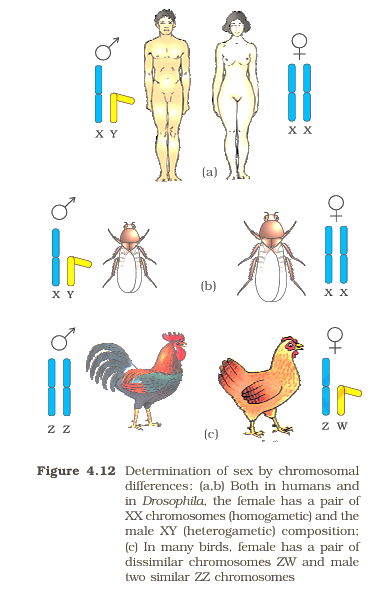
Sex Determination in Humans
Human Sex Determination
- Ovum carries
- Fertilisation by -bearing sperm → zygote → female
- Fertilisation by -bearing sperm → zygote → male
Sex Determination in Honeybees
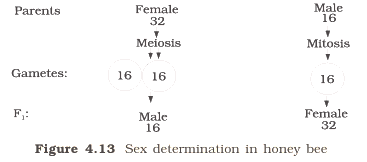
| Point | Chromosomal systems | Honeybee system |
|---|---|---|
| Basis | Different sex chromosomes | Number of chromosome sets |
| Heterogametic sex | Male in and ; female in | Not based on male/female sex-chromosome pairs |
| Male development | Fertilisation involving the male-determining chromosome pattern | Unfertilised egg develops by parthenogenesis |
| Chromosome sets | Usually the same total number in both sexes in and systems | Female diploid; male haploid |
Mutation
| Type | Change | Example or effect |
|---|---|---|
| Chromosomal aberration | Loss, insertion, or duplication of a DNA segment | Chromosome abnormality; commonly observed in cancer cells |
| Point mutation | Change in one base pair | Sickle-cell anaemia |
| Frameshift mutation | Insertion or deletion of base pairs shifts the reading frame | Can alter the encoded sequence |
Do not blame the mother for a child's sex: in humans, the ovum always carries , while the sperm contributes either or .
What is male heterogamety? Give one example.
How does sex determination occur in honeybees?
What is a point mutation, and what is one example?
Quick recap
- Sex chromosomes determine sex; the remaining chromosomes are autosomes.
- and systems show male heterogamety, while birds show female heterogamety with females and males.
- In humans, -bearing sperm produce offspring and -bearing sperm produce offspring, with equal probability.
- Honeybees use haplodiploidy: fertilised eggs form diploid females and unfertilised eggs form haploid males.
- Mutations alter DNA; point mutations affect one base pair, while insertions or deletions can cause frameshifts.
Genetic Disorders
Pedigree Analysis
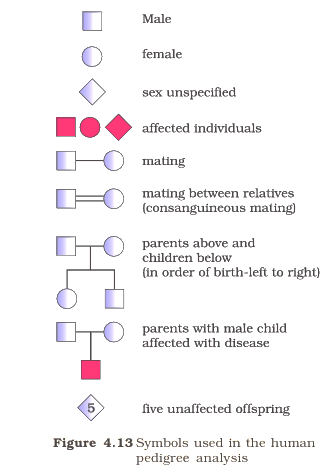
Pedigree analysis — The study of how a trait is inherited through several generations of a family, represented as a family tree.
Why pedigree analysis is used
- Purpose: Human controlled crosses are not possible, so family history is used to trace inheritance.
- Uses: Helps identify how a particular trait, abnormality, or disease passes through generations.
- Basis: Genes on chromosomes contain DNA, the carrier of genetic information, which is transmitted between generations.
- Mutation: A mutation is a change or alteration in genetic material; altered genes or chromosomes can cause inherited disorders.
Mendelian Disorders
Mendelian disorder — A genetic disorder mainly caused by mutation or alteration in a single gene and inherited according to Mendelian patterns.
Inheritance patterns
- Categories of genetic disorders: Mendelian disorders and chromosomal disorders.
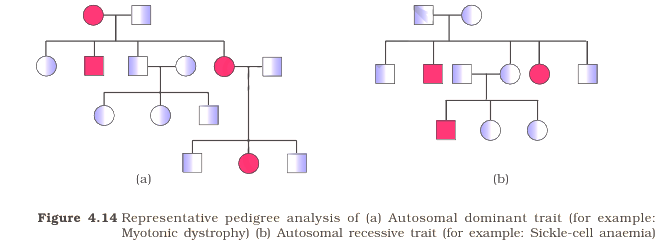
- Mendelian inheritance: These disorders may be dominant or recessive; pedigree patterns help distinguish them.
- Location: A Mendelian trait may be autosomal or linked to a sex chromosome.
- Examples: Haemophilia, cystic fibrosis, sickle-cell anaemia, colour blindness, phenylketonuria, and thalassemia.
Haemophilia
Haemophilia — A sex-linked recessive disorder in which a blood-clotting protein is affected, causing prolonged bleeding.
Inheritance and effects
- Transmission: An unaffected carrier female can pass the altered gene to her sons; some male offspring may be affected.
- Effect: A simple cut can cause continuous bleeding because blood clotting is impaired.
- Affected females: Extremely rare; an affected daughter must inherit the altered gene from both parents, so her father must be affected and her mother at least a carrier.
- Example: Queen Victoria was a carrier, and haemophilia occurred among several of her descendants.
Sickle-Cell Anaemia
Sickle-cell anaemia — An autosomal recessive blood disorder caused by an altered beta-globin chain in haemoglobin.
Inheritance
- Parents: The disease may be transmitted when both parents are heterozygous carriers.
- Carrier transmission: A heterozygous carrier has a probability of passing the mutant allele to each offspring.
| Genotype | Phenotype |
|---|---|
| Unaffected; no mutant allele. | |
| Apparently unaffected carrier; has sickle-cell trait and can transmit . | |
| Affected; homozygous for the sickle-cell allele. |
Cause of the altered red blood cell shape
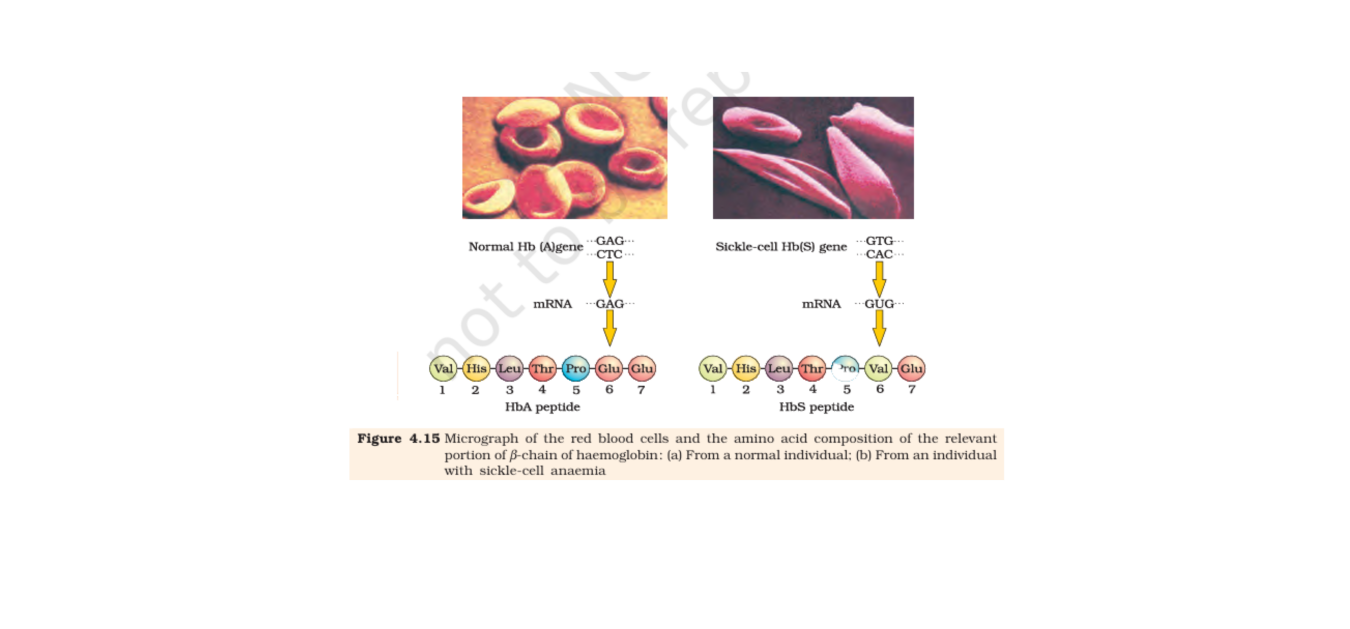
- Single-base substitution in the sixth codon of the beta-globin gene: .
- At the sixth position of the beta-globin chain, glutamic acid is replaced by valine.
- Under low oxygen tension, mutant haemoglobin molecules polymerise.
- Red blood cells change from biconcave discs to elongated, sickle-like cells.
Thalassemia
Thalassemia — An autosomal recessive blood disorder in which reduced production of an alpha- or beta-globin chain causes abnormal haemoglobin and anaemia.
Cause and inheritance
- Inheritance: Usually occurs when both parents are unaffected carriers; the disorder is recessive.
- Defect: Mutation or deletion reduces synthesis of one of the globin chains that form haemoglobin.
- Result: Too little globin chain leads to abnormal haemoglobin and anaemia.
| Type | Affected chain and genes | Genetic basis |
|---|---|---|
| Alpha thalassemia | Alpha-globin production; genes and on chromosome 16 from each parent. | Mutation or deletion affects one or more of the four genes; more affected genes mean less alpha-globin production. |
| Beta thalassemia | Beta-globin production; one gene on chromosome 11 from each parent. | Mutation affects one or both copies of the gene. |
| Point | Thalassemia | Sickle-cell anaemia |
|---|---|---|
| Main defect | Quantitative: too few globin molecules are synthesised. | Qualitative: an altered globin chain functions abnormally. |
| Cause | Mutation or deletion reduces globin-chain synthesis. | A single-base substitution changes glutamic acid to valine in beta-globin. |
How does sickle-cell anaemia arise at the molecular level?
State the main difference between thalassemia and sickle-cell anaemia.
Quick recap
- Pedigree analysis traces inheritance of traits through generations when controlled human crosses are not possible.
- Mutations alter genetic material; Mendelian disorders usually involve a single gene and may be dominant, recessive, autosomal, or sex-linked.
- Haemophilia is sex-linked recessive and is commonly passed from carrier females to male offspring.
- Sickle-cell anaemia is autosomal recessive and may be inherited when both parents are carriers; each heterozygous carrier has a chance of passing on the mutant allele to each offspring.
- Only individuals show the sickle-cell disease phenotype; the beta-globin substitution leads to haemoglobin polymerisation and sickle-shaped red blood cells.
- Thalassemia reduces production of alpha- or beta-globin; alpha and beta types involve different genes and chromosomes.
- Thalassemia is a quantitative globin-production problem, while sickle-cell anaemia is a qualitative globin-function problem.
Chromosomal Disorders
Chromosomal Number Changes
- Aneuploidy: Gain or loss of one or more chromosomes, usually caused by failure of chromosome segregation during cell division.
- Polyploidy: Increase in the number of complete chromosome sets, which can result from failure of cytokinesis; it is often seen in plants.
- Chromosome number: Trisomy is an extra copy of a chromosome, while monosomy is the loss of one chromosome from a pair.
Common Chromosomal Disorders
Key Details
- Down syndrome: First described by Langdon Down in ; it results from an additional copy of chromosome .
- Klinefelter syndrome: The individual has overall masculine development, but may also show feminine development such as gynaecomastia.
- Turner syndrome: The missing X chromosome is associated with rudimentary ovaries and infertility.
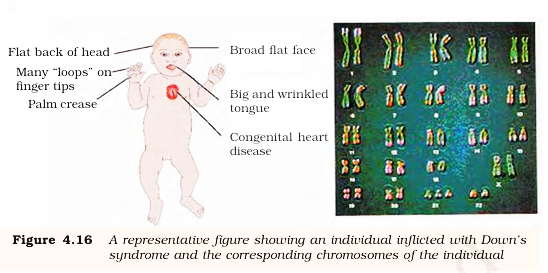
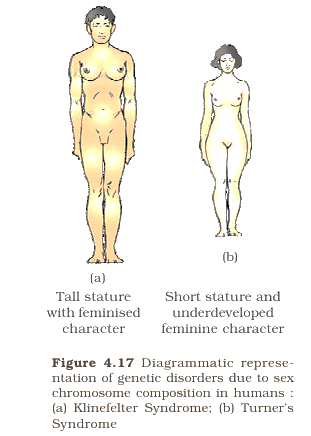
Distinguish aneuploidy from polyploidy.
Give the chromosome change and one key feature of each of the three common chromosomal disorders.
Quick recap
- Chromosomal disorders arise from chromosome absence, excess or abnormal arrangement.
- Aneuploidy changes individual chromosome number; polyploidy changes whole-set number.
- Trisomy is an extra chromosome; monosomy is a missing chromosome from a pair.
- Down syndrome is caused by trisomy of chromosome .
- Klinefelter syndrome has karyotype ; Turner syndrome has .
Biology — ALL CHAPTERS
1
Sexual Reproduction In Flowering Plants
2
Human Reproduction
3
Reproductive Health
4
Principles Of Inheritance And Variation
5
Molecular Basis Of Inheritance
6
Evolution
7
Human Health And Disease
8
Microbes In Human Welfare
9
Biotechnology : Principles And Processes
10
Biotechnology And Its Applications
11
Organisms And Populations
12
Ecosystem
13
Biodiversity And Conservation