Class 12 PCB . Biology . Biology . Biotechnology Principles and Processes
Chapter 9: Biotechnology : Principles And Processes
Ch 9
Biology
Class 12 PCB
Principles Of Biotechnology
Meaning and Scope of Biotechnology
Biotechnology — Using living organisms or their enzymes to make products or carry out processes useful to humans.
Scope
- Traditional examples: Microbe-mediated production of curd, bread and wine can be considered biotechnology.
- Modern restricted use: Usually refers to processes using genetically modified organisms to produce useful outcomes on a larger scale.
- Other applications: In vitro fertilisation, gene synthesis and use, DNA vaccines, and correction of defective genes are also biotechnology.
- EFB definition: Biotechnology integrates natural science with organisms, cells, parts of cells, and molecular analogues to provide products and services.
Core Techniques of Modern Biotechnology
| Technique | Meaning and purpose |
|---|---|
| Genetic engineering | Altering DNA or RNA, introducing it into a host, and changing the host's phenotype. |
| Bioprocess engineering | Maintaining sterile, contamination-free conditions so desired microbes or eukaryotic cells grow in large quantities to make products such as antibiotics, vaccines and enzymes. |
Why Genetic Engineering Is Useful
| Point | Asexual reproduction | Sexual reproduction |
|---|---|---|
| Genetic outcome | Preserves existing genetic information. | Creates variation and new combinations of genetic material. |
| Significance | Maintains genetic consistency. | Some variations may benefit individuals and populations. |
Limitations of Traditional Breeding
- Hybridisation: Traditional plant and animal breeding can transfer desired genes together with undesirable genes.
- Genetic engineering: Recombinant DNA, gene cloning and gene transfer can isolate and introduce only one or a chosen set of desirable genes.
Replication and Cloning of Alien DNA
Origin of replication — A specific DNA sequence that initiates replication of a chromosome or DNA molecule.
How Alien DNA Is Maintained
- Without integration or replication control: Transferred alien DNA is unlikely to multiply in the recipient's progeny cells.
- After integration: If alien DNA becomes part of a chromosome, it can replicate with that chromosome and be inherited.
- For cloning: Link alien DNA to a DNA molecule with an origin of replication so it can multiply in the host.
- Cloning: Making multiple identical copies of a template DNA.
Construction of Recombinant DNA
Recombinant DNA — A DNA molecule formed in vitro by joining DNA from different sources; it can replicate autonomously when it has an origin of replication.
First Recombinant DNA
- 1972Stanley Cohen and Herbert Boyer linked an antibiotic-resistance gene to a native plasmid from Salmonella typhimurium, creating the first recombinant DNA molecule.
| Component | Role |
|---|---|
| Restriction enzymes | Molecular scissors that cut DNA at specific locations. |
| DNA ligase | Joins the ends of cut DNA molecules. |
| Plasmid | Autonomously replicating, circular, extra-chromosomal DNA; can act as a vector. |
| Vector | Carries attached alien DNA into a host organism. |
Example: Cloning an Antibiotic-Resistance Gene
- Cut the resistance gene from a plasmid using restriction enzymes.
- Join the gene to plasmid DNA using DNA ligase to form recombinant DNA.
- Transfer the recombinant plasmid into Escherichia coli.
- The recombinant DNA replicates using the host's DNA polymerase, producing many copies of the gene.
Example Details
- Host: Escherichia coli is closely related to Salmonella.
- Vector action: A plasmid can deliver alien DNA to a host, just as an insect vector can carry a parasite to an organism.
- Cloning result: Multiplication of the antibiotic-resistance gene in E. coli is called cloning of that gene.
Three Basic Steps in Genetic Modification
Genetic Modification
- Identify DNA containing the desirable gene or genes.
- Introduce the identified DNA into the host.
- Maintain the introduced DNA in the host and ensure its transfer to progeny.
Why must alien DNA be linked to an origin of replication?
What are the roles of restriction enzymes and DNA ligase in making recombinant DNA?
Name the three basic steps in genetically modifying an organism.
Quick recap
- Biotechnology uses organisms, cells or their components to create useful products and services.
- Genetic engineering changes genetic material; bioprocess engineering enables sterile, large-scale production.
- Genetic engineering can introduce selected desirable genes without the unwanted genes often transferred by traditional hybridisation.
- Alien DNA needs an origin of replication, or integration into a replicating chromosome, to multiply and be inherited.
- Restriction enzymes cut DNA, DNA ligase joins it, and plasmids can carry recombinant DNA into host cells.
- Cohen and Boyer made the first recombinant DNA in 1972; genetic modification involves identification, introduction and maintenance of desired DNA.
Tools Of Recombinant DNA Technology
Key Tools of Recombinant DNA Technology
- Core tools: Recombinant DNA technology uses enzymes, vectors and host organisms to construct and propagate recombinant DNA.
- Purpose: These tools enable a desired DNA fragment to be joined to a vector and introduced into a host cell.
Restriction Enzymes
Restriction endonuclease — A nuclease that recognises a specific DNA sequence and cuts DNA at particular sites within the molecule.
Discovery and Recognition
- 1963: Two enzymes involved in restricting bacteriophage growth in *Escherichia coli* were isolated: one added methyl groups to DNA, while the other cut DNA.
- 1968: Hind II, the first restriction endonuclease shown to depend on a specific DNA sequence, was isolated and characterised.
- Recognition sequence: Hind II recognises a specific sequence of six base pairs; each restriction enzyme recognises its own DNA sequence.
- Range: More than 900 restriction enzymes have been isolated from over 230 bacterial strains.
Naming Restriction Enzymes
- First letter: From the genus of the prokaryote; the next two letters come from its species.
- Strain letter: Taken from the name of the bacterial strain.
- Roman numeral: Shows the order in which enzymes were isolated from that strain.
- Example — EcoRI: Isolated from *Escherichia coli* strain RY 13; R comes from the strain name, and I indicates the first enzyme isolated from that strain.
| Type | Action |
|---|---|
| Exonuclease | Removes nucleotides from the ends of DNA. |
| Endonuclease | Cuts DNA at specific positions within the molecule. |
How Restriction Endonucleases Cut DNA
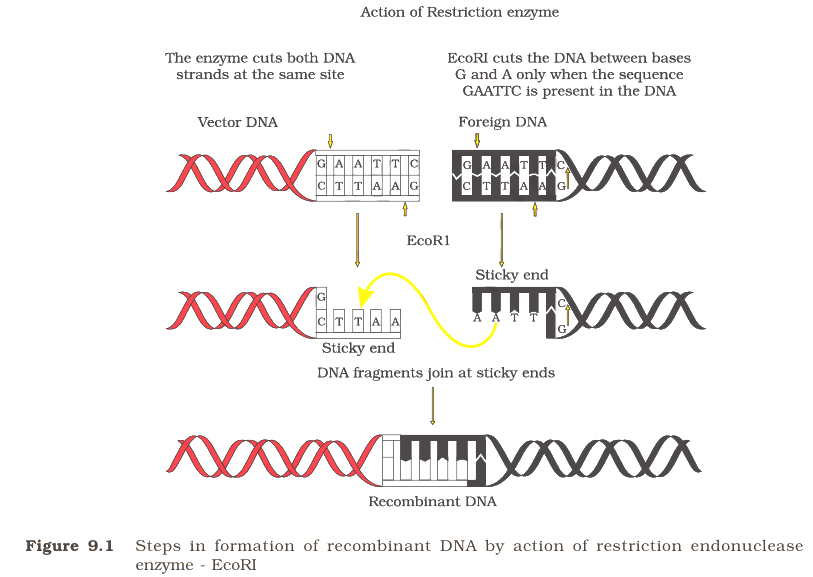
- Recognition: The enzyme inspects DNA until it finds its specific recognition sequence, then binds to it.
- Cutting: It cuts both strands at specific points in their sugar-phosphate backbones.
- Palindromic sites: Restriction endonucleases recognise palindromic DNA sequences.
- Example: The same sequence is read in the direction on both strands: and .
Sticky ends — Short, single-stranded DNA overhangs produced when a restriction enzyme makes staggered cuts in the two DNA strands.
Sticky Ends and Recombinant DNA
- Cut positions: The enzyme cuts slightly away from the centre of the palindrome, between the same two bases on opposite strands.
- Complementary pairing: Sticky ends form hydrogen bonds with matching complementary ends.
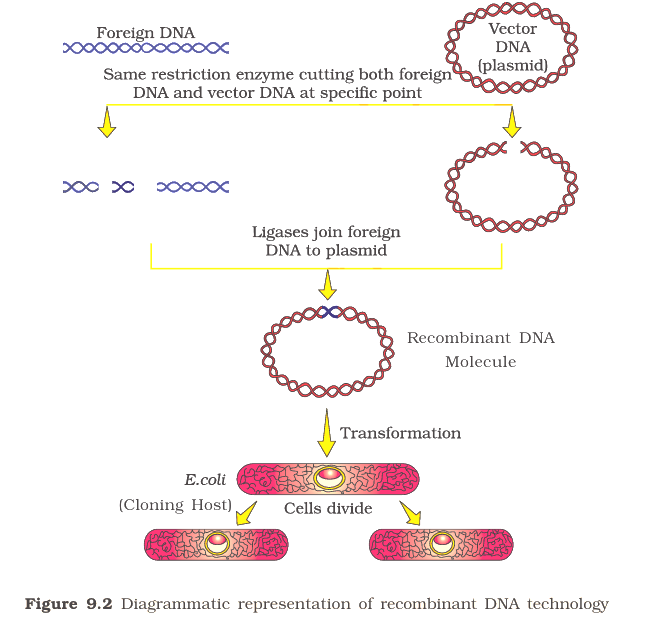
- Joining DNA: DNA cut with the same restriction enzyme has compatible sticky ends; DNA ligase joins the fragments end-to-end.
- Recombinant DNA: A DNA molecule formed by joining DNA from different sources or genomes.
Agarose Gel Electrophoresis
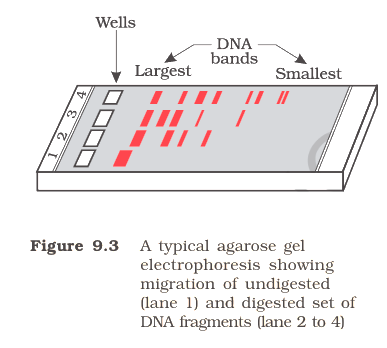
- Principle: Agarose gel electrophoresis separates DNA fragments according to their size.
How do restriction enzymes help form recombinant DNA?
Distinguish between exonucleases and endonucleases.
Quick recap
- Restriction enzymes are nucleases that recognise specific DNA sequences; endonucleases cut within DNA.
- Hind II was the first restriction endonuclease characterised for sequence-specific action.
- Restriction endonucleases recognise palindromic DNA sequences and can create sticky ends through staggered cuts.
- Sticky ends from DNA cut by the same enzyme can pair; DNA ligase joins the fragments.
- Restriction enzyme names encode the source genus, species, strain and isolation order.
- Agarose gel electrophoresis separates DNA fragments by size.
Cloning Vectors
Cloning Vectors: Role and Copy Number
- Role: Plasmids and bacteriophages can carry foreign DNA into bacterial cells and replicate independently of chromosomal DNA.
- Copy number: Linked DNA is multiplied along with the vector; copy numbers vary among vectors and can be high.
- Use: Engineered vectors make it easier to link foreign DNA and identify recombinant cells.
Essential Features of a Cloning Vector
Selectable marker — A gene that helps identify and select transformed cells while eliminating cells that did not take up the vector.
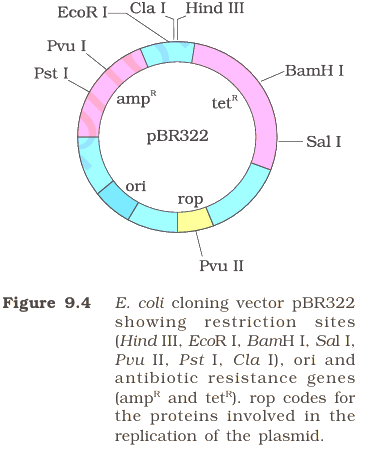
Cloning site — A cloning site is a restriction-enzyme recognition site where foreign DNA can be inserted into a vector.
Identifying Recombinants
| Plasmid in bacterium | β-galactosidase gene | Colony with chromogenic substrate |
|---|---|---|
| No foreign-DNA insert | Functional | Blue |
| Foreign-DNA insert | Inactivated by insertion | Colourless; recombinant |
Cloning Vectors for Plants and Animals
- Plant example: *Agrobacterium tumefaciens* naturally transfers T-DNA into plant cells and can cause tumour formation.
- Ti plasmid: The tumour-inducing plasmid has been disarmed—made non-pathogenic—while retaining its ability to deliver DNA into plant cells.
- Animal example: Retroviruses can transfer genetic material into animal cells; disarmed retroviral vectors can deliver desirable genes.
- Outcome: A suitable vector transfers the ligated gene or DNA fragment into a host, where it can multiply.
Competent Hosts and DNA Introduction
| Method | How DNA enters the host |
|---|---|
| Micro-injection | Recombinant DNA is directly injected into the nucleus of an animal cell. |
| Biolistics (gene gun) | Plant cells are bombarded with high-velocity gold or tungsten particles coated with DNA. |
| Disarmed pathogen vectors | A vector infects the host cell and transfers recombinant DNA into it. |
How does insertion into the tetracycline-resistance gene of pBR322 help identify recombinants?
How are recombinant and non-recombinant colonies distinguished using β-galactosidase?
Name three methods for introducing recombinant DNA into host cells besides bacterial heat shock.
Quick recap
- A vector carries foreign DNA and enables it to replicate in a host.
- The ori starts replication and influences the copy number of linked DNA.
- Selectable markers help identify transformed cells; cloning sites allow DNA insertion.
- Insertional inactivation distinguishes recombinants, including by antibiotic resistance or blue-white screening.
- Disarmed Ti plasmids and retroviral vectors can deliver genes into plant and animal cells.
- Bacterial DNA uptake can be promoted by calcium treatment and heat shock; other methods include micro-injection and biolistics.
Processes Of Recombinant DNA Technology
Biotechnology — Biotechnology uses live organisms, cells or enzymes for the large-scale production and marketing of products and processes.
Recombinant DNA technology (genetic engineering) — It alters DNA and combines DNA from different sources to construct recombinant DNA, enabling a foreign gene to be carried into a host and expressed.
Overall Sequence
Main steps
- Sequence: Isolate DNA → cut source DNA and vector → obtain the desired DNA fragment → ligate it into the vector → transfer recombinant DNA into a host → express the gene → produce and purify the product.
Isolation of Genetic Material
DNA isolation — DNA isolation releases and purifies DNA from cells so it can be cut by restriction enzymes.
Purification
- Cell opening: Enzymes break cell walls or membranes to release DNA with RNA, proteins, polysaccharides and lipids.
- Enzyme examples: Lysozyme breaks open bacterial cells; cellulase acts on plant cells; chitinase acts on fungal cells.
- Removal of contaminants: Ribonuclease removes RNA; protease removes proteins. Other molecules are removed with suitable treatments.
- Precipitation: Chilled ethanol causes purified DNA to precipitate as fine threads.
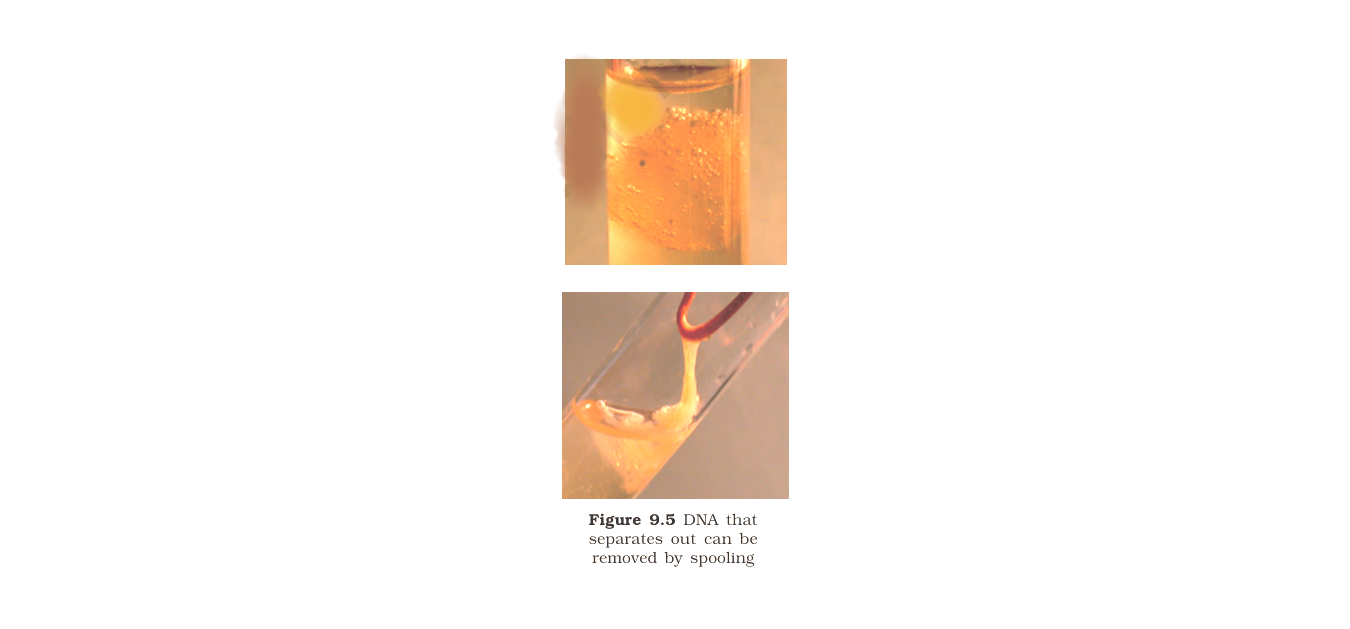
Cutting DNA and Joining Fragments
Restriction digestion and ligation
- Restriction digestion: Purified source DNA and vector DNA are incubated separately with a specific restriction enzyme under its optimal conditions.
- Vectors: Plasmid or viral vectors are used to carry foreign DNA into host organisms.
- Checking digestion: Agarose gel electrophoresis is used to monitor the progress of restriction digestion.
- DNA movement: DNA is negatively charged, so it moves through the gel toward the positive electrode (anode).
- Recombinant DNA formation: Mix the desired source-DNA fragment with the cut vector and add DNA ligase; ligase joins the DNA fragments to form recombinant DNA.
Amplification of the Gene of Interest by PCR
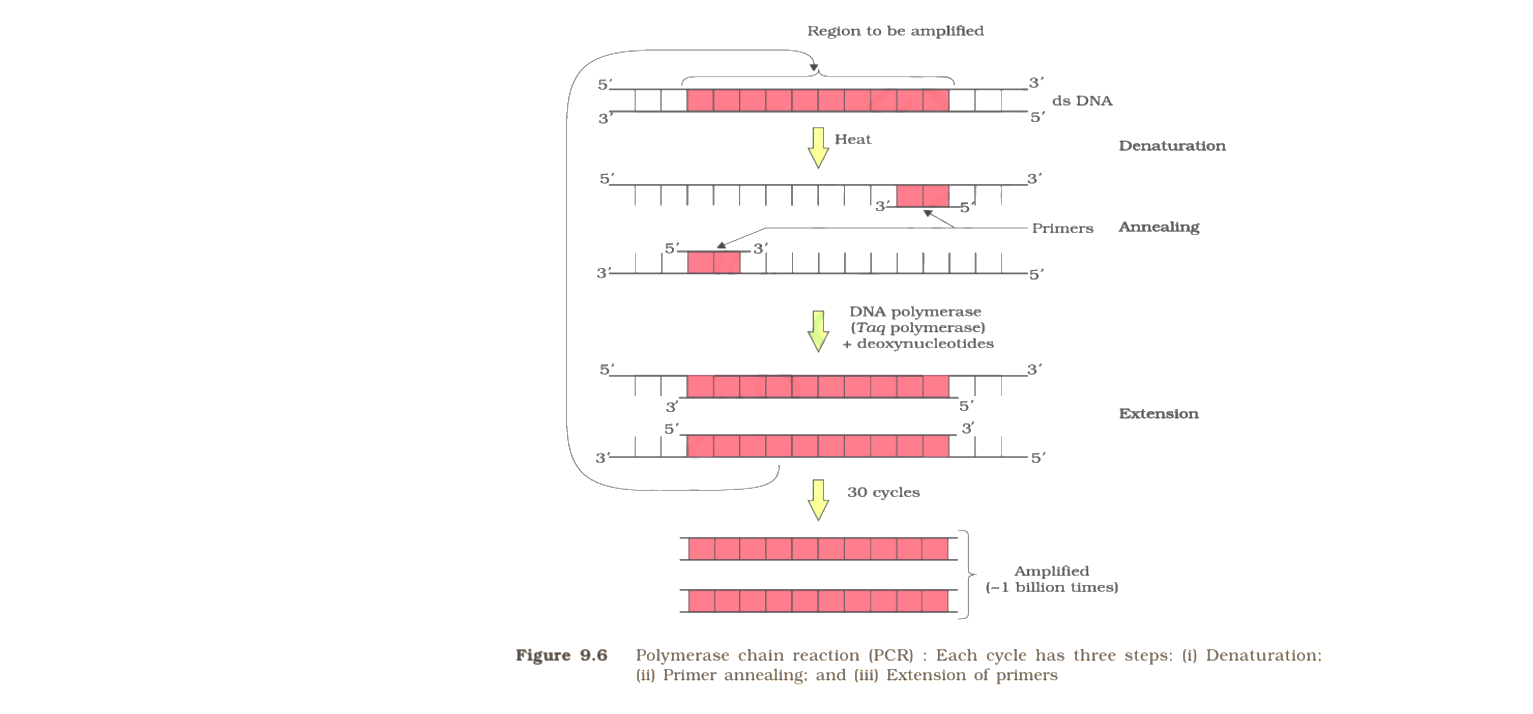
Polymerase Chain Reaction (PCR) — PCR is an in vitro method that uses primers and DNA polymerase to make many copies of a selected DNA segment.
PCR essentials
- Primers: Two short, chemically synthesised oligonucleotides complementary to regions flanking the target DNA provide starting points for copying.
- DNA polymerase: Extends the primers using supplied nucleotides and the DNA template.
- Thermostable enzyme: Taq DNA polymerase, isolated from *Thermus aquaticus*, remains active through the high temperatures used to denature double-stranded DNA.
- Amplification: Repeated cycles can amplify the target to approximately one billion copies.
Insertion of Recombinant DNA into Host Cells
Transformation — Transformation is the uptake of foreign DNA by recipient cells that have been made competent to receive it.
Selecting transformed cells
- Antibiotic example: Recombinant DNA carrying an ampicillin-resistance gene can transform *E. coli* into ampicillin-resistant cells.
- Selection: On agar containing ampicillin, transformed cells grow while non-transformed recipient cells die.
- Selectable marker: The ampicillin-resistance gene identifies cells that have taken up the recombinant DNA.
Obtaining the Foreign Gene Product
Gene expression and production
- Expression: Once recombinant DNA is inside a host, the foreign DNA can multiply; under suitable conditions, its gene is expressed to produce the desired protein.
- Recombinant protein: A protein encoded by a gene expressed in a heterologous host is called a recombinant protein.
- Small-scale culture: Laboratory cultures can be used to extract the target protein, which is then purified by suitable separation techniques.
- Scale-up: Large-scale production is needed because small-volume cultures do not yield appreciable quantities of product.
Continuous culture — A culture system in which spent medium is continuously drained and fresh medium added to keep cells in the log (exponential) phase.
Continuous culture and bioreactors
- Continuous culture benefit: Maintaining cells in their physiologically active log phase increases biomass and can increase desired-protein yield.
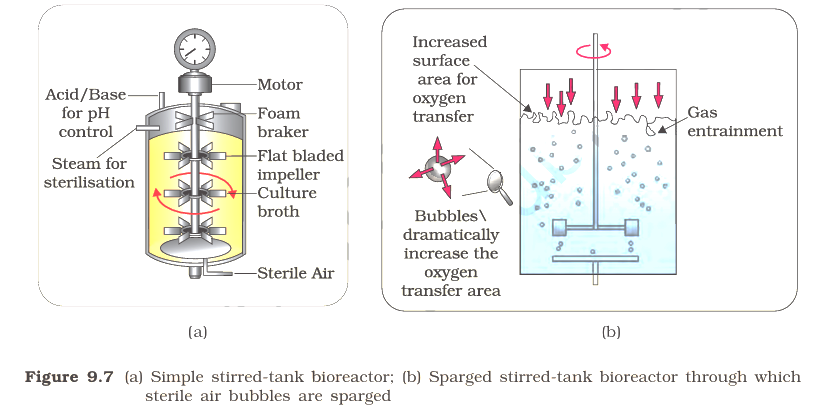
- Bioreactor: A vessel in which cells biologically convert raw materials into specific products, including enzymes and other desired products.
- Scale: Bioreactors can process large culture volumes, commonly around 100–1000 litres.
- Controlled conditions: Bioreactors maintain optimal temperature, pH, substrate, salts, vitamins and oxygen for product formation.
- Stirred-tank design: The commonly used stirred-tank reactor is usually cylindrical or curved at the base; its agitator promotes even mixing and oxygen availability. Air may also be bubbled through the culture.
- Other systems: Bioreactors include oxygen delivery, foam control, temperature and pH control, and sampling ports.
Downstream Processing
Downstream processing — Downstream processing is the series of steps used to separate and purify a product after biosynthesis.
Finishing the product
- Formulation: The purified product is prepared with suitable preservatives before marketing.
- Testing: Formulations undergo thorough clinical trials, as with drugs, and strict quality-control testing.
- Variation: Downstream-processing and quality-control requirements differ from product to product.
How is DNA purified for recombinant DNA work?
What is the role of a selectable marker?
What are the main purposes of a bioreactor and downstream processing?
Quick recap
- Biotechnology uses organisms, cells or enzymes for large-scale production and marketing; recombinant DNA technology is genetic engineering that constructs recombinant DNA.
- Cell-opening enzymes include lysozyme for bacteria, cellulase for plants and chitinase for fungi; chilled ethanol precipitates purified DNA.
- Restriction enzymes cut source and vector DNA; agarose electrophoresis checks digestion, and DNA migrates toward the anode.
- Plasmid or viral vectors carry foreign DNA; DNA ligase joins the desired fragment to a cut vector, while PCR can make about one billion copies using primers and thermostable Taq polymerase.
- Competent host cells take up recombinant DNA; selectable markers such as ampicillin resistance identify transformants.
- Bioreactors enable large-scale production under controlled conditions; downstream processing includes purification, formulation, clinical trials and quality control.
Biology — ALL CHAPTERS
1
Sexual Reproduction In Flowering Plants
2
Human Reproduction
3
Reproductive Health
4
Principles Of Inheritance And Variation
5
Molecular Basis Of Inheritance
6
Evolution
7
Human Health And Disease
8
Microbes In Human Welfare
9
Biotechnology : Principles And Processes
10
Biotechnology And Its Applications
11
Organisms And Populations
12
Ecosystem
13
Biodiversity And Conservation