Class 12 PCB . Biology . Biology . Sexual Reproduction in Flowering Plants
Chapter 1: Sexual Reproduction In Flowering Plants
Ch 1
Biology
Class 12 PCB
Flower – A Fascinating Organ Of Angiosperms
Flower as a Reproductive Organ
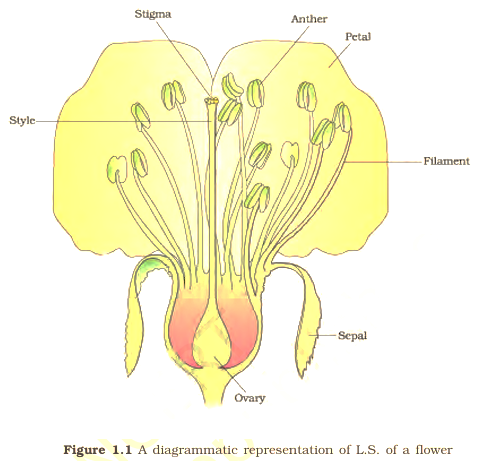
Pre-fertilisation: Structures and Events
Early floral development
- Hormonal and structural changes begin before the flower is visible.
- A floral primordium differentiates and develops.
- Inflorescences form, bearing floral buds and then flowers.
- The androecium and gynoecium develop as the male and female reproductive structures.
Stamen and Anther Structure
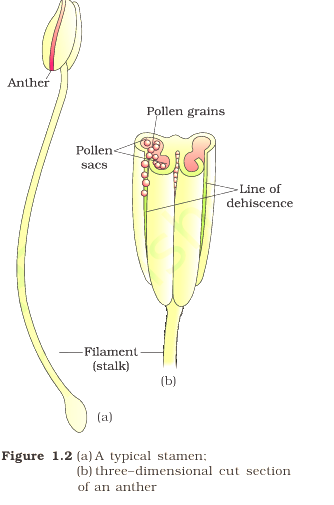
Stamen — The male reproductive organ of a flower, consisting of a filament and an anther.
Parts of a stamen
- Filament: Long, slender stalk; its proximal end attaches to the thalamus or a petal.
- Anther: Usually a terminal, bilobed structure; stamen number and length vary among species.
Anther organisation
- Typical anther: Bilobed and dithecous, with a longitudinal groove often separating the theca.
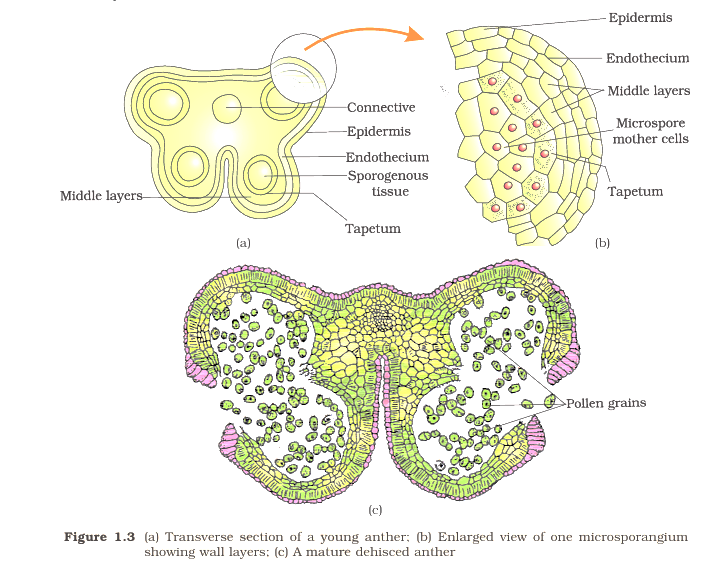
- Microsporangia: A tetragonal cross-section has four microsporangia, positioned at the corners—two in each lobe.
- Pollen sacs: Microsporangia develop into pollen sacs that extend along the anther and contain pollen grains.
Microsporangium and Microsporogenesis
| Layer | Position and function |
|---|---|
| Epidermis | Outermost protective layer. |
| Endothecium | Protects the microsporangium and helps anther dehiscence. |
| Middle layers | Protective layers; help in anther dehiscence. |
| Tapetum | Innermost layer; nourishes developing pollen grains. Cells have dense cytoplasm and are often multinucleate. |
Sporogenous tissue
- Location: In a young anther, compact sporogenous tissue occupies the centre of each microsporangium.
- Pollen mother cells: Sporogenous cells can develop into pollen (microspore) mother cells, each capable of forming a tetrad.
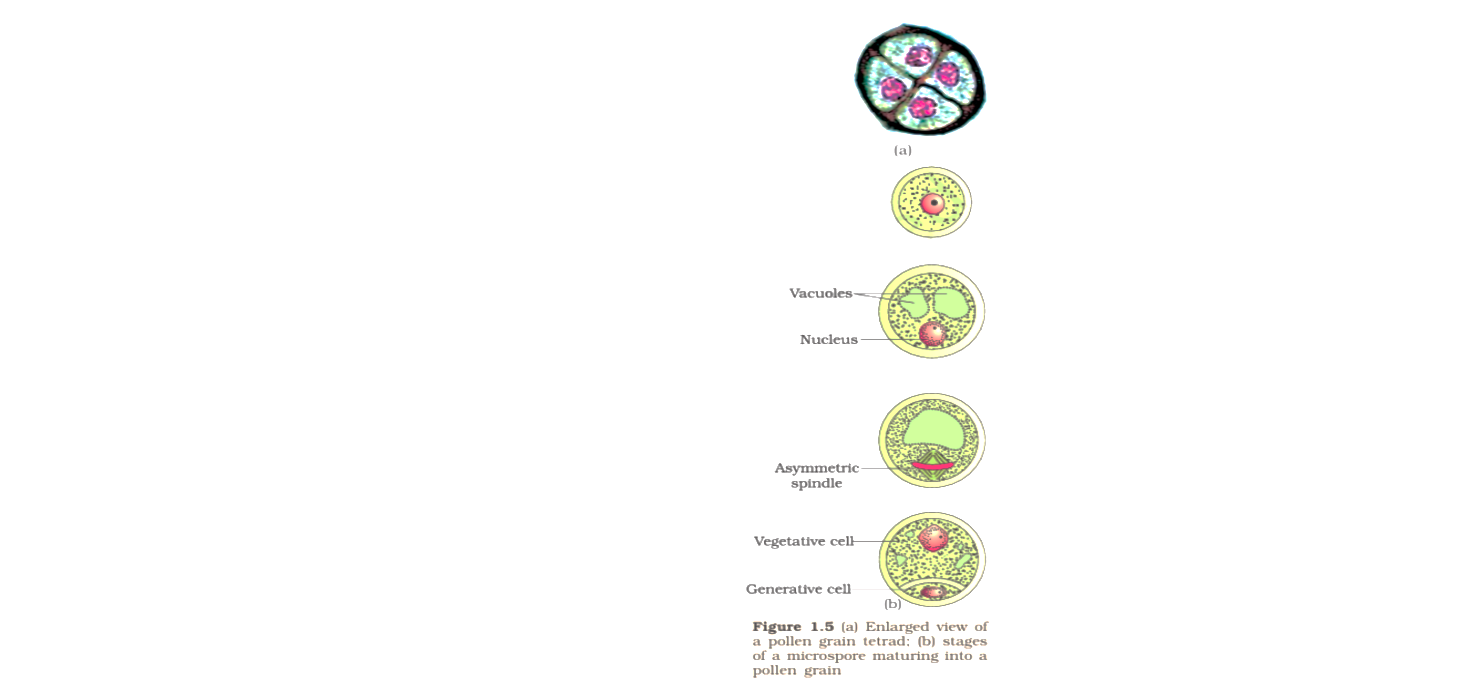
Microsporogenesis — Formation of microspores from a pollen mother cell through meiosis.
Formation and release of pollen
- Diploid pollen mother cell undergoes meiosis.
- Four haploid microspores form a microspore tetrad.
- As the anther matures and dehydrates, the microspores separate and develop into pollen grains.
- Anther dehiscence releases thousands of pollen grains from each microsporangium.
Pollen Grain: Structure and Development
Pollen grain — The male gametophyte of a flowering plant, formed from a microspore.
Pollen wall
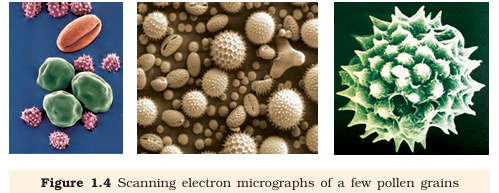
- Size and shape: Pollen grains are generally spherical and about – in diameter.
- Exine: Hard outer wall made of sporopollenin, an exceptionally resistant organic material; it withstands high temperatures, strong acids and alkalis.
- Resistance: No enzyme that degrades sporopollenin is known; this resistance allows pollen grains to persist as fossils.
- Germ pores: Apertures in the exine where sporopollenin is absent; the pollen tube emerges through a germ pore.
- Intine: Thin, continuous inner wall made of cellulose and pectin.
- Inside: The pollen cytoplasm is enclosed by a plasma membrane.
| Cell | Features |
|---|---|
| Vegetative cell | Larger; abundant food reserve and a large, irregularly shaped nucleus. |
| Generative cell | Smaller; spindle-shaped, with dense cytoplasm and a nucleus; divides mitotically to form two male gametes. |
| Stage | Proportion and condition |
|---|---|
| Two-celled | Over of angiosperms shed pollen with a vegetative cell and a generative cell. |
| Three-celled | In the remaining species, the generative cell divides before pollen is shed, producing two male gametes. |
Pollen: Effects, Viability and Storage
Pollen effects and uses
- Allergies: Pollen from some species can cause allergies and respiratory disorders such as asthma and bronchitis.
- Parthenium: Also called carrot grass, it entered India as a contaminant with imported wheat and became widespread; its pollen causes allergies.
- Nutrients: Pollen is nutrient-rich and is sold in supplements such as tablets and syrups; claims that it improves athletic or racehorse performance have been made.
Viability and pollen banks
- Fertilisation requirement: Pollen must reach a stigma while still viable.
- Variable lifespan: Viability depends partly on temperature and humidity.
- Short viability: In rice and wheat, pollen may lose viability within about minutes of release.
- Long viability: Pollen of some Rosaceae, Leguminosae and Solanaceae can remain viable for months.
- Long-term storage: Pollen can be stored for years in liquid nitrogen at .
- Pollen banks: Stored pollen is used in crop-breeding programmes, similar to seed banks.
What is microsporogenesis, and what is the ploidy of the microspore tetrad?
Describe the layers of a typical microsporangium wall.
Quick recap
- Flowers contain the androecium (stamens) and gynoecium, the male and female reproductive structures.
- A typical anther has two lobes and four microsporangia; each microsporangium has four wall layers.
- Meiosis of a pollen mother cell forms a haploid microspore tetrad; microspores develop into pollen grains.
- Pollen has a sporopollenin-rich exine, germ pores and a cellulose-pectin intine.
- Mature pollen is usually shed at the two-celled stage; some species shed three-celled pollen.
- Pollen viability varies widely, and long-term storage in liquid nitrogen enables pollen banking.
The Pistil, Megasporangium (Ovule) And Embryo Sac
The Gynoecium and Pistil
Structure and types
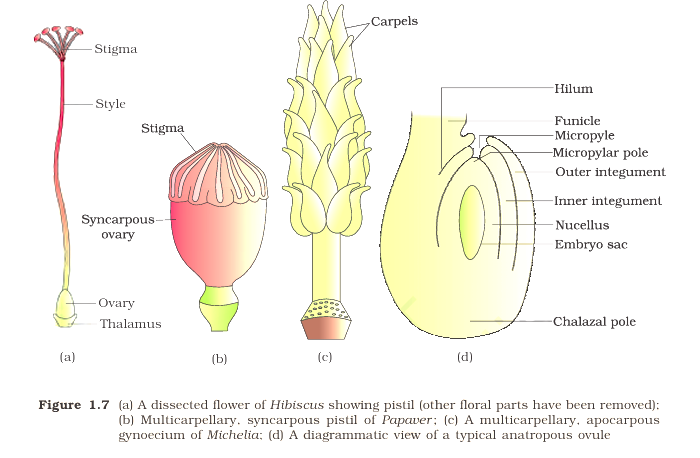
- Carpels: A gynoecium may have one pistil (monocarpellary) or several pistils (multicarpellary).
- Several pistils: They may be fused (syncarpous) or free (apocarpous).
- Pistil parts: The stigma receives pollen; the slender style lies below it; the ovary is the swollen basal part.
- Ovary: Its cavity is the locule. The placenta lies inside the locule, and ovules arise from it.
- Ovule number: An ovary may contain one ovule (wheat, paddy, mango) or many (papaya, watermelon, orchids).
The Megasporangium (Ovule)
Ovule — A small structure attached to the placenta that contains the female gametophyte, or embryo sac.
Ovule structure
- Funicle: The stalk attaching the ovule to the placenta.
- Hilum: The junction where the ovule body joins the funicle.
- Integuments: One or two protective layers surrounding the nucellus, except at the micropyle.
- Micropyle: The small opening at the tip of the integuments.
- Chalaza: The basal part of the ovule, opposite the micropyle.
- Nucellus: Tissue enclosed by the integuments; its cells contain abundant reserve food.
- Embryo sac: Located within the nucellus; an ovule generally contains one embryo sac formed from a megaspore.
Megasporogenesis and Embryo-Sac Development
Megasporogenesis — The formation of megaspores from the megaspore mother cell (MMC).
Formation of the embryo sac
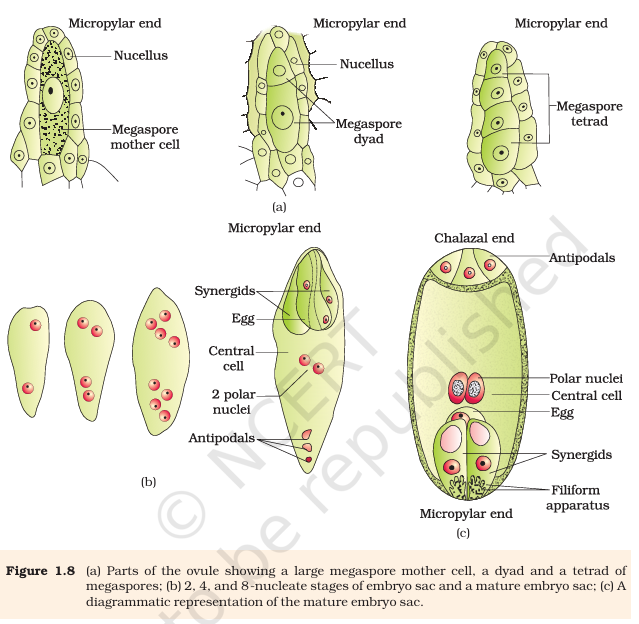
- MMC: A single large cell, with dense cytoplasm and a prominent nucleus, usually differentiates in the micropylar region of the nucellus.
- Meiosis: The MMC undergoes meiosis, producing four megaspores.
- Functional megaspore: Its nucleus divides mitotically to form two nuclei that move to opposite poles.
- Nuclear divisions: Two further mitotic divisions produce the 4-nucleate and then 8-nucleate stages; these divisions are free nuclear, with no immediate cell-wall formation.
- Cell formation: After the 8-nucleate stage, cell walls form and organise the mature embryo sac.
| Region | Cells or nuclei | Role / detail |
|---|---|---|
| Micropylar end | Two synergids and one egg cell | Together they form the egg apparatus. |
| Central cell | Two polar nuclei | The large central cell contains both nuclei. |
| Chalazal end | Three antipodal cells | Located at the end opposite the micropyle. |
Key features of the embryo sac
- Filiform apparatus: Special cellular thickenings at the micropylar tip of the synergids; they help guide the pollen tube into a synergid.
- Mature state: The typical angiosperm embryo sac has eight nuclei but seven cells: six nuclei are in walled cells, while the two polar nuclei share the central cell.
Pollination
Pollination — The transfer of pollen grains from anther to the stigma of a pistil.
- Why it is needed: Male and female gametes are non-motile; pollination helps bring them together for fertilisation. Male gametes are produced in pollen grains, while female gametes are in the embryo sac.
- Transfer: Pollen grains shed from the anther must reach a stigma; flowering plants use external agents to achieve this.
Kinds of Pollination
| Type | Transfer | Pollination / genetic relation |
|---|---|---|
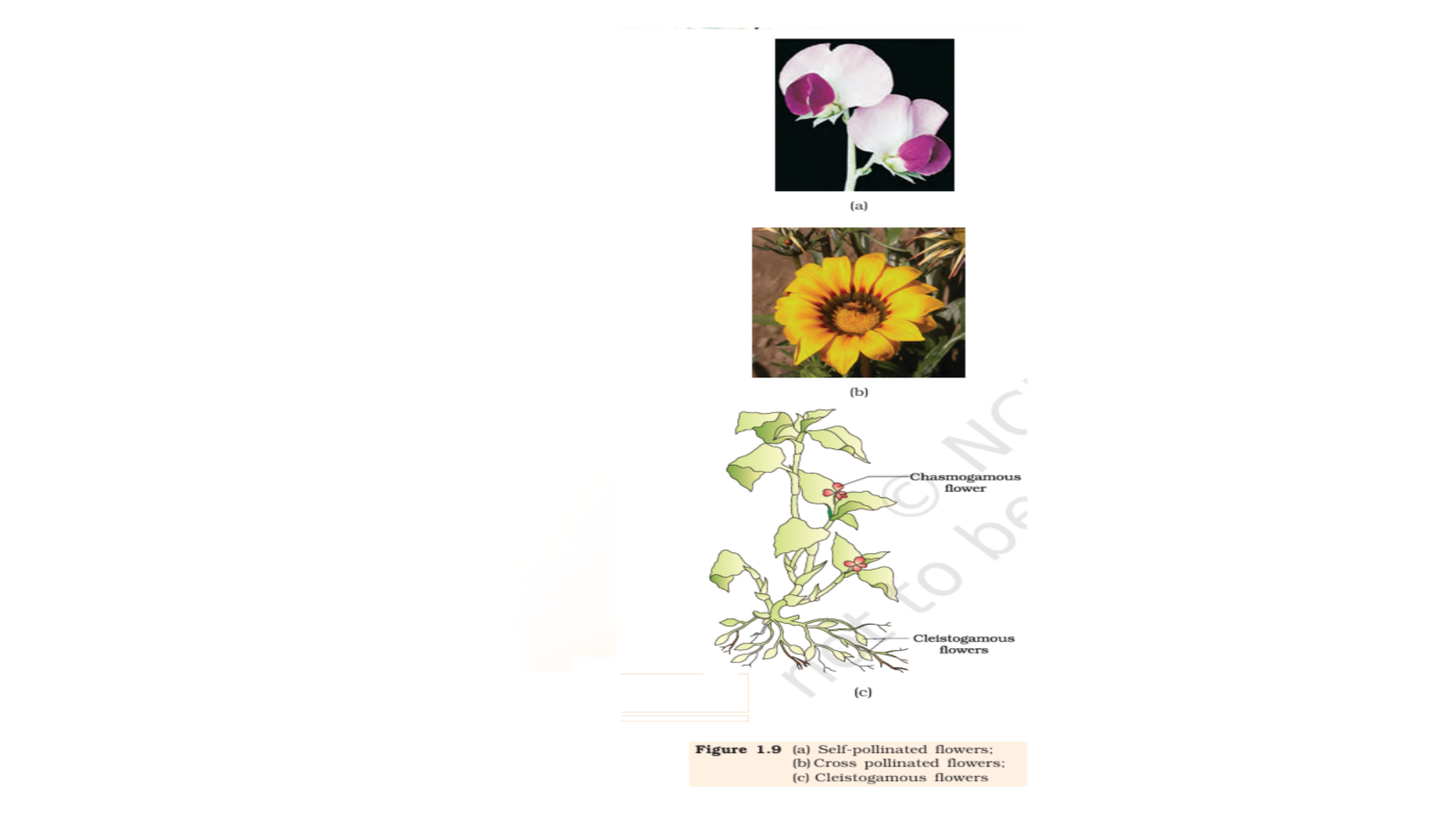
| Autogamy | Anther to stigma of the same flower | Self-pollination within one flower. |
| Geitonogamy | Anther to stigma of another flower on the same plant | Functionally cross-pollination because it uses an agent; genetically like autogamy because pollen comes from the same plant. |
| Xenogamy | Anther to stigma of a flower on a different plant | The only type that brings genetically different pollen to the stigma. |
| Feature | Chasmogamous | Cleistogamous |
|---|---|---|
| Opening | Open; anthers and stigma are exposed. | Do not open. |
| Pollination | Autogamy requires synchronised pollen release and stigma receptivity, plus close anthers and stigma. | Anthers and stigma lie close; pollen reaches the stigma when anthers dehisce in the flower bud. |
| Outcome | Complete autogamy is relatively rare in a normal open flower. | Invariably autogamous; assured seed-set is possible without pollinators. |
| Examples | Viola, Oxalis and Commelina produce this flower type. | Viola, Oxalis and Commelina produce this flower type. |
Remember the pollen routes
Auto = same flower; geitono = another flower on the same plant; xeno = a different plant.
Why is geitonogamy functionally cross-pollination but genetically similar to autogamy?
Why is a mature angiosperm embryo sac described as 8-nucleate but 7-celled?
Quick recap
- The gynoecium contains one or more pistils, each with a stigma, style and ovary.
- Ovules develop from the placenta and contain a nucellus with an embryo sac.
- MMC meiosis forms four megaspores; mitotic divisions of the functional megaspore form the embryo sac.
- The mature embryo sac is 8-nucleate and 7-celled, with an egg apparatus, central cell and antipodals.
- Pollination transfers pollen from anther to stigma; male and female gametes are non-motile.
- Autogamy occurs within one flower; geitonogamy between flowers on the same plant; xenogamy between different plants.
- Cleistogamous flowers remain closed and ensure autogamy and seed-set even without pollinators.
Agents Of Pollination
Pollination Agents
Main agents and pollen loss
- Abiotic agents: Wind and water carry pollen; animals are biotic agents.
- Occurrence: Most flowering plants use biotic agents, while only a small proportion use abiotic agents.
- Pollen wastage: In wind and water pollination, pollen reaching a stigma is a chance event, so plants produce abundant pollen relative to the number of ovules.
| Agent | Occurrence and examples | Typical features |
|---|---|---|
| Wind | Most common abiotic agent; common in grasses and corn | Light, non-sticky pollen; exposed stamens; large, often-feathery stigmas |
| Water | Rare in flowering plants; found in about 30 genera, mostly monocotyledons | Pollen in many species is protected from wetting by a mucilaginous covering |
| Animals | Used by the majority of flowering plants | Flowers attract visitors with features and rewards; pollen is generally sticky |
Wind Pollination
Wind pollination — The transfer of pollen to a stigma by air currents.
Adaptations and examples
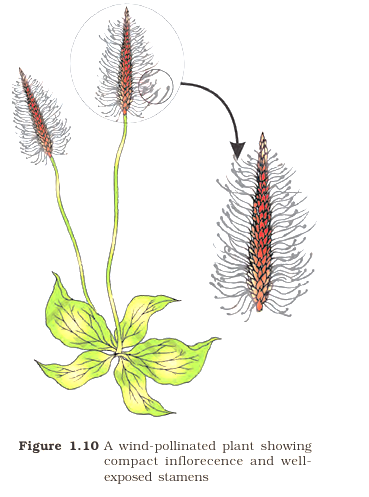
- Pollen: Grains are light and non-sticky, allowing wind currents to carry them.
- Stamens and stigma: Stamens are well exposed for pollen release; large, often-feathery stigmas trap airborne pollen.
- Flower arrangement: Flowers often have one ovule per ovary, with numerous flowers packed into an inflorescence.
- Examples: Wind pollination is common in grasses. In corn, tassels are the stigma and style, which wave in the wind to trap pollen.
Water Pollination
Water pollination — The transfer of pollen to a stigma by water currents.
Occurrence, examples and mechanisms
- Occurrence: Water pollination is rare in flowering plants, occurring in about 30 genera, mostly monocotyledons.
- Examples: Vallisneria and Hydrilla grow in fresh water; Zostera is a marine seagrass.
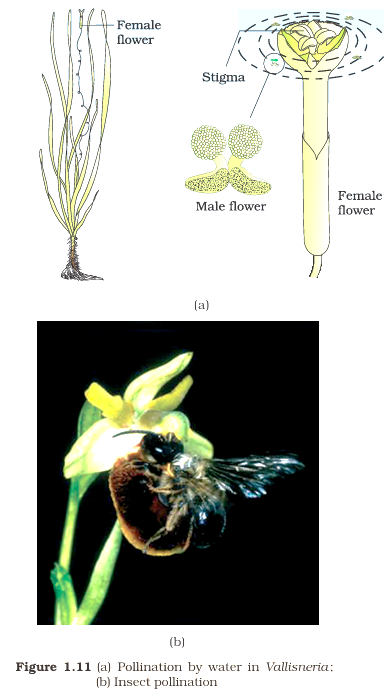
- Vallisneria: The female flower reaches the surface on a long stalk. Male flowers or pollen are released at the surface and carried passively by currents.
- Seagrasses: Female flowers remain submerged and pollen is released underwater. Pollen may be long and ribbon-like and is carried passively to stigmas.
- Pollen protection: Many water-pollinated species have a mucilaginous covering that protects pollen from wetting.
Important distinctions
- Aquatic plants: Water hyacinth and water lily have flowers that emerge above water and are pollinated by insects or wind, not by water.
- Flower appearance: Wind- and water-pollinated flowers are generally not colourful and do not produce nectar because they do not need to attract animal pollinators.
- Lower plant groups: Water commonly transports male gametes in algae, bryophytes and pteridophytes; dependence on water for gamete transport and fertilisation can limit the distribution of some bryophytes and pteridophytes.
Animal Pollination
Animal pollination — Pollination in which an animal carries pollen from an anther to a stigma.
Pollinators, floral features and pollen transfer
- Pollinators: Insects are common; other reported pollinators include primates such as lemurs, tree-dwelling rodents, and reptiles such as geckos and garden lizards.
- Specific adaptations: Flowers of some animal-pollinated plants are adapted to a particular animal species.
- Attractive flowers: Many insect-pollinated flowers are large, colourful, fragrant and rich in nectar. Small flowers may cluster in an inflorescence to become conspicuous.
- Scents: Colour and fragrance attract animals; flowers pollinated by flies and beetles may produce foul odours.
- Rewards: Nectar and pollen are usual rewards. Some flowers also provide safe places for animals to lay eggs.
- Pollen transfer: While obtaining a reward, an animal may contact the anthers and stigma. Sticky pollen coats its body and can then reach a stigma.
Special pollination relationships
- Amorphophallus: Its flower, about 6 feet tall, provides a safe egg-laying place for some animals.
- Yucca and its moth: The moth lays eggs in the ovary locule and pollinates the flower. The larvae emerge as seeds begin developing.
- Mutual dependence: The Yucca plant and its moth cannot complete their life cycles without each other.
Pollen/nectar robber — A floral visitor that consumes pollen or nectar without bringing about pollination.
Do not assume every flower visitor is a pollinator: it must contact the anthers and stigma to transfer pollen.
Why are wind- and water-pollinated flowers generally not colourful or nectar-producing?
What distinguishes an animal pollinator from a pollen/nectar robber?
Quick recap
- Wind and water are abiotic agents; animals are biotic and pollinate most flowering plants.
- Wind-pollinated flowers have light, non-sticky pollen, exposed stamens and large, often-feathery stigmas.
- Water pollination is rare; Vallisneria, Hydrilla and Zostera are examples.
- Some aquatic flowers, such as water hyacinth and water lily, emerge above water and are pollinated by insects or wind.
- Animal-pollinated flowers attract visitors with floral features and rewards; effective pollinators contact anthers and stigma.
- Yucca and its moth are mutually dependent; pollen/nectar robbers do not bring about pollination.
Outbreeding Devices & Double FertiliIsation
Outbreeding Devices
Why plants discourage self-pollination
- Hermaphrodite flowers have both male and female reproductive parts, so pollen may reach the stigma of the same flower.
- Continued self-pollination can cause inbreeding depression; plants therefore have devices that reduce self-pollination and promote cross-pollination.
| Device | How it works | Effect / example |
|---|---|---|
| Different timing | Pollen release and stigma receptivity occur at different times. | Prevents autogamy. |
| Different positions | Anther and stigma are placed so pollen cannot reach the stigma of the same flower. | Prevents autogamy. |
| Self-incompatibility | A genetic mechanism inhibits self-pollen germination or pollen-tube growth in the pistil. | Prevents fertilisation by pollen from the same flower or another flower on the same plant. |
| Monoecy | Separate male and female flowers occur on the same plant. | Castor and maize; prevents autogamy, but not geitonogamy. |
| Dioecy | Male and female flowers occur on different plants; each plant is either male or female. | Papaya; prevents both autogamy and geitonogamy. |
- Autogamy
- Transfer of pollen to the stigma of the same flower.
- Geitonogamy
- Transfer of pollen between different flowers on the same plant.
- Inbreeding depression
- Reduced fitness associated with continued inbreeding or self-pollination.
Pollen–Pistil Interaction
Pollen–pistil interaction — The events from pollen deposition on the stigma until the pollen tube enters the ovule, involving pollen recognition and acceptance or rejection.
Recognition and pollen-tube growth
- Pollen type: Pollination may place compatible pollen of the same species, incompatible self-pollen, or pollen from another species on the stigma.
- Recognition: Chemical components of pollen and pistil interact in a continuous dialogue that determines compatibility.
- Compatible pollen: The pistil accepts it and supports post-pollination events leading to fertilisation.
- Incompatible pollen: The pistil rejects it by preventing pollen germination on the stigma or pollen-tube growth through the style.
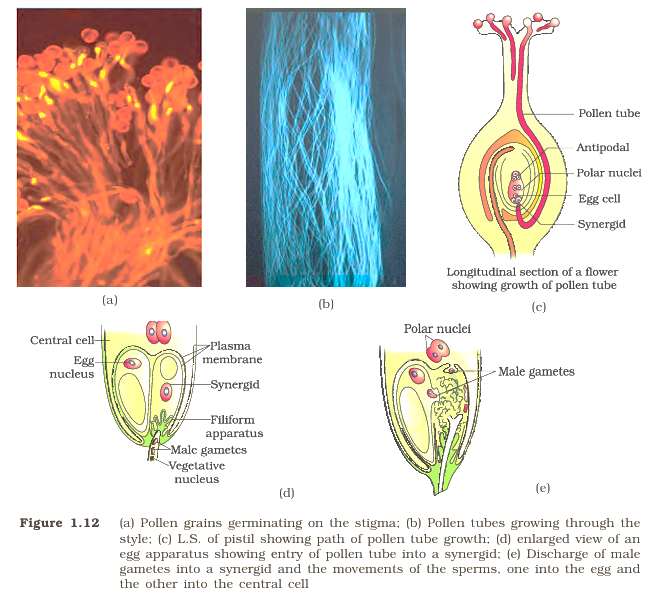
- Tube growth: A compatible pollen grain germinates through a germ pore; its contents enter the tube, which grows through the stigma and style towards the ovary.
- Entry into ovule: The pollen tube enters through the micropyle and then one synergid; the filiform apparatus at the synergid’s micropylar end guides its entry.
| Point | Two-celled pollen | Three-celled pollen |
|---|---|---|
| Cells at shedding | A vegetative cell and a generative cell | A vegetative cell and two male gametes |
| Male-gamete formation / transport | The generative cell divides to form two male gametes while the pollen tube is growing in the stigma. | The pollen tube carries the two male gametes from the beginning. |
Importance
- Plant breeding: Understanding pollen–pistil interactions can help breeders manipulate even incompatible pollinations to produce desired hybrids.
Artificial Hybridisation
Artificial hybridisation — Controlled crossing using selected pollen while protecting the stigma from unwanted pollen.
Purpose and importance
- Purpose: Breeders cross different species, and sometimes different genera, to combine desirable characteristics and develop commercially superior varieties.
- Crop improvement: Artificial hybridisation is a major approach in crop-improvement programmes.
Emasculation and bagging
- For a bisexual female-parent flower, remove the anthers from the unopened flower bud before they dehisce; this is emasculation.
- Cover the emasculated flower with a suitable bag, usually butter paper, to prevent unwanted pollen from reaching the stigma; this is bagging.
- When the stigma becomes receptive, dust it with mature pollen collected from the selected male parent.
- Rebag the pollinated flower and allow the fruit to develop.
- For a unisexual female flower, emasculation is unnecessary; bag the bud before it opens, pollinate when the stigma is receptive, then rebag it.
Double Fertilisation
Two fusion events in the embryo sac
- Gamete release: After entering a synergid, the pollen tube releases two male gametes into its cytoplasm.
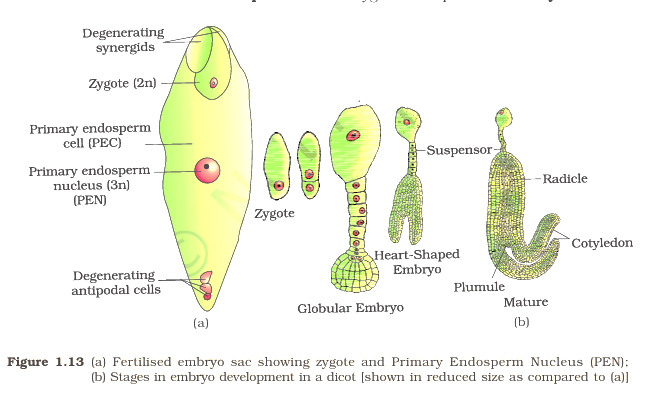
- Syngamy: One male gamete fuses with the egg-cell nucleus, forming the diploid zygote.
- Triple fusion: The other male gamete fuses with the two polar nuclei in the central cell, forming the triploid primary endosperm nucleus (PEN).
- Double fertilisation: Syngamy and triple fusion occur in the same embryo sac; this phenomenon is unique to flowering plants.
- Development: After triple fusion, the central cell becomes the primary endosperm cell (PEC) and develops into the endosperm; the zygote develops into the embryo.
What is double fertilisation?
How does dioecy differ from monoecy in preventing self-pollination?
Quick recap
- Outbreeding devices reduce self-pollination and the risk of inbreeding depression.
- Timing differences, floral positioning, and self-incompatibility prevent autogamy.
- Monoecy prevents autogamy; dioecy prevents both autogamy and geitonogamy.
- Pollen–pistil recognition accepts compatible pollen and rejects incompatible pollen.
- Artificial hybridisation combines desirable traits and is important in crop improvement.
- Emasculation and bagging protect controlled crosses from unwanted pollen.
- Double fertilisation comprises syngamy (zygote) and triple fusion (PEN).
Post- Fertilisation : Structures And Events
Post-fertilisation events — Events after double fertilisation, including endosperm and embryo development, ovule maturation into seed(s), and ovary maturation into a fruit.
Endosperm Development
- Origin: The primary endosperm cell divides repeatedly to form triploid endosperm tissue.
- Role: Endosperm stores reserve food and nourishes the developing embryo; it usually develops before the embryo, ensuring nutrition is available.
- Free-nuclear stage: In the common pattern, the primary endosperm nucleus divides repeatedly before cell walls form; the resulting free nuclei make free-nuclear endosperm.
- Cellular stage: Cell walls later form around the tissue, making it cellular. The number of free nuclei formed before this varies.
- Coconut: Tender coconut water is free-nuclear endosperm, while the surrounding white kernel is cellular endosperm.
| Fate | Description | Examples |
|---|---|---|
| Consumed | Endosperm is used up during embryo development before the seed matures. | Pea, groundnut, beans |
| Persistent | Some endosperm remains in the mature seed and may be used during germination. | Castor, coconut, wheat, maize, barley |
Embryo Development and Structure
Embryogeny
- Location: The embryo develops at the micropylar end of the embryo sac, where the zygote is situated.
- Timing: In most plants, the zygote starts dividing after some endosperm forms, providing assured nutrition to the embryo.
- Shared pattern: Early embryo development is similar in monocotyledons and dicotyledons.
- Sequence: Zygote → proembryo → globular stage → heart-shaped stage → mature embryo.
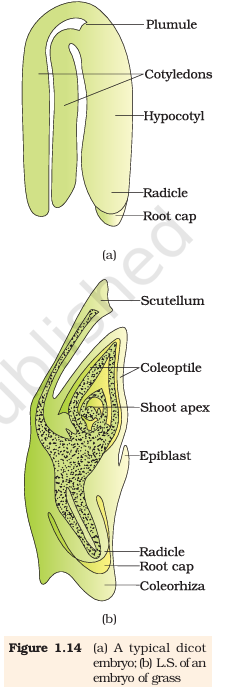
| Point | Dicot embryo | Monocot embryo (grass) |
|---|---|---|
| Cotyledons | Two cotyledons | One cotyledon, called the scutellum; it lies laterally on the embryonal axis |
| Upper embryonal axis | Epicotyl terminates in the plumule, or shoot tip | Epicotyl has a shoot apex and leaf primordia enclosed by the coleoptile |
| Lower embryonal axis | Hypocotyl terminates in the radicle, or root tip, which is covered by a root cap | Radicle and root cap are enclosed by the coleorrhiza |
Embryonal Axis: Key Parts
- Epicotyl: Part of the embryonal axis above the cotyledons; in a dicot it terminates in the plumule.
- Hypocotyl: Part below the cotyledons; it terminates in the radicle, or root tip.
- Scutellum: The single, lateral cotyledon of a grass embryo.
- Coleoptile: Hollow foliar sheath enclosing the shoot apex and leaf primordia in grass embryos.
- Coleorrhiza: Sheath enclosing the radicle and root cap in grass embryos.
Seed Formation and Structure
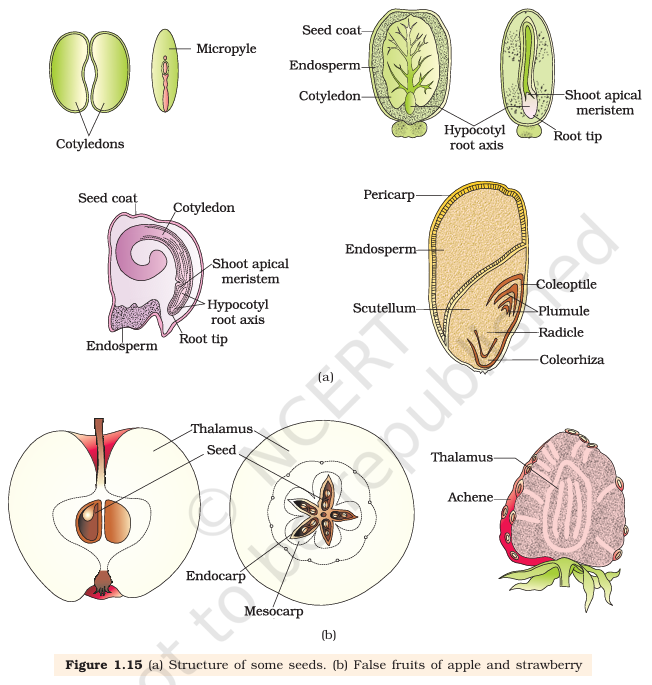
Seed — The mature fertilised ovule; a typical seed contains seed coat(s), cotyledon(s) and an embryo axis.
| Type | Endosperm at maturity | Examples |
|---|---|---|
| Non-albuminous (ex-albuminous) | No residual endosperm; it was consumed during embryo development. | Pea, groundnut |
| Albuminous | Some endosperm remains in the mature seed. | Wheat, maize, barley, castor |
Seed Coats, Perisperm and Germination
- Cotyledons: Often thick and swollen because they store food, as in legumes.
- Seed coat: The ovule integuments harden into tough protective coats. The micropyle remains as a small pore that allows oxygen and water to enter during germination.
- Perisperm: Persistent remnant of the nucellus in some seeds, including black pepper and beet.
- Maturation: Seed water content falls to about 10–15% of its mass, and embryo metabolism slows.
- Dormancy and germination: The embryo may become inactive (dormant); germination can occur when moisture, oxygen and suitable temperature are available.
Fruit Formation and Types
Simultaneous Maturation
- Ovules mature into seeds while the ovary develops into a fruit.
- The ovary wall develops into the fruit wall, called the pericarp.
| Type | Origin or feature | Examples |
|---|---|---|
| Fleshy fruit | Fruit with fleshy tissue | Guava, orange, mango |
| Dry fruit | Fruit with a dry pericarp | Groundnut, mustard |
| True fruit | Develops from the ovary alone | Most fruits |
| False fruit | Thalamus also contributes to fruit formation | Apple, strawberry, cashew |
| Parthenocarpic fruit | Develops without fertilisation; growth hormones can induce seedless fruits | Banana |
Seed Dispersal and Many-seeded Fruits
- Dispersal: Many fruits have mechanisms that help disperse their seeds.
- Many-seeded fruits: Orchid fruits and fruits of parasitic plants such as Orobanche and Striga contain thousands of tiny seeds.
Why does endosperm usually develop before the embryo?
Distinguish albuminous and non-albuminous seeds, giving examples.
What are false fruits and parthenocarpic fruits?
Quick recap
- Post-fertilisation events include endosperm and embryo development and maturation of ovules into seeds and the ovary into a fruit.
- Endosperm nourishes the embryo; free nuclei form before cell walls in the common pattern.
- Dicot embryos have two cotyledons; grass embryos have one cotyledon called the scutellum.
- Albuminous seeds retain endosperm, while non-albuminous seeds use it up during embryo development.
- The ovule becomes a seed, the ovary becomes a fruit, and the ovary wall forms the pericarp.
- False fruits include apple, strawberry and cashew; parthenocarpic fruits such as banana develop without fertilisation.
Apomixis And Polyembryony
Apomixis
Parthenocarpy — Fruit development without fertilisation; unlike apomixis, it does not describe seed formation.
Do not confuse apomixis with parthenocarpy: apomixis produces seeds without fertilisation, while parthenocarpy produces fruit without fertilisation.
Polyembryony
Apomictic Embryos and Their Genetic Nature
- Unreduced egg embryos: Develop without meiosis or fertilisation, so they retain the maternal genetic constitution.
- Nucellar embryos: Arise from maternal somatic tissue and are genetically like the mother plant.
- Clone-like nature: These embryos are generally considered maternal clones because they form without fertilisation.
Importance of Apomixis in Hybrid Crops
Why Apomixis Is Useful for Hybrid Seed Production
- Hybrid seed produces high-performing plants
- Ordinary hybrid progeny segregate and lose some hybrid characters
- Apomixis prevents segregation in the progeny
- Farmers can reuse the seeds while retaining hybrid characters
What is apomixis, and how does it differ from parthenocarpy?
Define polyembryony and give an example.
Why is apomixis useful in hybrid crops?
Quick recap
- Apomixis is seed formation without fertilisation and is a form of asexual reproduction.
- Apomictic embryos can develop from an unreduced diploid egg or from nucellar cells.
- Nucellar embryony can produce multiple embryos in a seed, a condition called polyembryony.
- Apomictic embryos are generally genetically like the maternal plant.
- Apomixis could let farmers reuse hybrid seeds without losing hybrid characters through segregation.
- Parthenocarpy means fruit development without fertilisation, not seed formation.
Biology — ALL CHAPTERS
1
Sexual Reproduction In Flowering Plants
2
Human Reproduction
3
Reproductive Health
4
Principles Of Inheritance And Variation
5
Molecular Basis Of Inheritance
6
Evolution
7
Human Health And Disease
8
Microbes In Human Welfare
9
Biotechnology : Principles And Processes
10
Biotechnology And Its Applications
11
Organisms And Populations
12
Ecosystem
13
Biodiversity And Conservation