QUESTION PAPER
2024 BOARD EXAM
CBSE Class 12 PCM Physics Board Paper 2024 — Set 2
2024
Physics
Class 12 PCM
CBSE EXAMINATION PAPER-2024
PHYSICS
(Solved)
General Instructions :
Read the following instructions carefully and follow them :
- This question paper contains 38 questions. All questions are compulsory.
- This question paper is divided into 5 sections.
- Section A – questions number 1 to 2 are case based questions
- Section B – questions number 3 to 18 are multiple choice questions
- Section C – questions number 19 to 24 are very short answer
- Section D – questions number 25 to 32 are short answer
- Section E – questions number 33 to 38 are long answer
- There is no overall choice given in the question paper. However, an internal choice has been provided in few questions.
- Use of calculator is NOT allowed.
Section A
When the terminals of a cell are connected to a conductor of resistance R, an electric current flows through the circuit. The electrolyte of the cell also offers some resistance in the path of the current, like the conductor. This resistance offered by the electrolyte is called internal resistance of the cell (r). It depends upon the nature of the electrolyte, the area of the electrodes immersed in the electrolyte and the temperature. Due to internal resistance, a part of the energy supplied by the cell is wasted in the form of heat.
When no current is drawn from the cell, the potential difference between the two electrodes is known as emf of the cell (ε). With a current drawn from the cell, the potential difference between the two electrodes is termed as terminal potential difference (V).
(1) (i) Choose the incorrect statement : (A) The potential difference (V) between the two terminals of a cell in a closed circuit is always less than its emf (E) during discharge of the cell. (B) The internal resistance of a cell decreases with the decrease in temperature of the electrolyte. (C) When current is drawn from the cell then V = ε-Ir. (D) The graph between potential difference between the two terminals of the cell (V) and the current (I) through it is a straight line with a negative slop.
(2) Two cells of emfs 2.0 V and 6.0 V and internal resistances 0.1 ohm and 0.4 ohm respectively, are connected in parallel. The equivalent emf of the combination will be: (A) 2·0 V (B) 2·8 V (C) 6·0 V (D) 8·0 V
(3) Dipped in the solution, the electrode exchanges charges with the electrolyte. The positive electrode develops a potential V₊ (V₊ > 0), and the negative electrode develops a potential -(V_) (V_≥ 0), relative to the electrolyte adjacent to it. When no current is drawn from the cell then : (A) ε= V₊ + V > 0 (B) ε= V₊ -V > 0 (C) ε= V₊ + V < 0 (D) ε= V₊ + V =0
(4) a) Five identical cells, each of emf 2 V and internal resistance 0·1Ω are connected in parallel. This combination in turn is connected to an external resistor of 9·98 Ω. The current flowing through the resistor is : (A) 0·05 A (B) 0·1 A (C) 0·15 A (D) 0·2 A
(5) Potential difference across a cell in the open circuit is 6 V. It becomes 4 V when a current of 2 A is drawn from it. The internal resistance of the cell is : (A) 1·0 Ω (B) 1·5 Ω (C) 2·0 Ω (D) 2·5 Ω
(1) A ray of light of wavelength 600 nm is incident in water (n=4/3) on the water-air interface at an angle less than the critical angle. The wavelength associated with the refracted ray is: (A) 400 nm (B) 450 nm (C) 600 nm (D) 800 nm
(2) For a ray incident at the critical angle, the angle of reflection is : (A) 0° (B) < 90° (C) > 90° (D) 90°
(3) The interface AB between the two media A and B is shown in the figure. In the denser medium A, the incident ray PQ makes an angle of 30° with the horizontal. The refracted ray is parallel to the interface. The refractive index of medium B with respect to medium A is: (A) √3/2 (B) √5/2 (C) 4/√3 (D) 2/√3
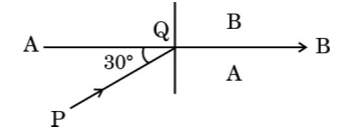 [1 Mark]
(4) The figure shows the path of a light ray through a triangular prism. In this phenomenon, the angle θ is given by : (A) sin⁻¹ √n²-1 (B) sin⁻¹ (n²- 1) (C) sin⁻¹ (1/√n²-1) (D) sin⁻¹ (1/n²-1)
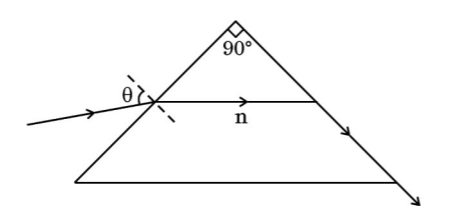 [1 Mark]
(5) Two media A and B are separated by a plane boundary. The speed of light in medium A and B is 2 10⁸ ms ⁻¹ and 2·5 10⁸ ms⁻¹ respectively. The critical angle for a ray of light going from medium A to medium B is : (A) sin⁻¹1/2 (B) sin⁻¹ 4/5 (C) sin⁻¹ 3/5 (D) sin⁻¹ 2/5
Section B
Two charged particles P and Q, having the same charge but different masses m_P and m_Q, start from rest and travel equal distances in a uniform electric field 𝐄⃗ in time t_P and t_Q respectively. Neglecting the effect of gravity, the ratio t_P/t_Q is:
Electrons drift with speed v_d in a conductor with potential difference V across its ends. If V is reduced to V/2, their drift speed will become:
A wire of length 4·4 m is bent around in the shape of a circular loop and carries a current of 1.0 A. The magnetic moment of the loop will be:
A circular coil of radius 10 cm is placed in a magnetic field 𝐵⃗=(1⋅0𝑖̂+0⋅5𝑗̂) mT such that the outward unit vector normal to the surface of the coil is (0⋅6𝑖̂+0⋅8𝑗̂). The magnetic flux linked with the coil is:
Which of the following quantity/quantities remains same in primary and secondary coils of an ideal transformer?
Current, Voltage, Power, Magnetic flux
A resistor and an ideal inductor are connected in series to a 100√2 V, 50 Hz ac source. When a voltmeter is connected across the resistor or the inductor, it shows the same reading. The reading of the voltmeter is:
Energy levels A, B and C of an atom correspond to increasing values of energy i.e. E_A < E_B < E_C. Let λ₁, λ₂ and λ₃ be the wavelengths of radiation corresponding to the transitions C to B, B to A and C to A, respectively. The correct relation between λ₁, λ₂, and λ₃ is:
An alpha particle approaches a gold nucleus in the Geiger-Marsden experiment with kinetic energy K. It momentarily stops at a distance d from the nucleus and reverses its direction. Then d is proportional to:
Assertion (A): Photoelectric current increases with an increase in intensity of incident radiation, for a given frequency of incident radiation and the accelerating potential.
Reason (R): Increase in the intensity of incident radiation results in an increase in the number of photoelectrons emitted per second and hence an increase in the photocurrent.
Assertion (A): Lenz's law is a consequence of the law of conservation of energy.
Reason (R): There is no power loss in an ideal inductor.
Assertion (A): An electron and a proton enter with the same momentum 𝐩⃗ in a magnetic field 𝐁⃗ such that 𝐩⃗ ⊥ 𝐁⃗. Then both describe a circular path of the same radius.
Reason (R): The radius of the circular path described by the charged particle (charge q, mass m) moving in the magnetic field 𝐁⃗ is given by r = (mv)/(qB).
Assertion (A): The magnifying power of a compound microscope is negative.
Reason (R): The final image formed is erect with respect to the object.
Section C
Define resistivity of a conductor. How does the resistivity of a conductor depend upon the following:
(a) Number density of free electrons in the conductor (n)
(b) Their relaxation time (𝜏)
Two waves, each of amplitude 'a' and frequency 'ω' emanating from two coherent sources of light superpose at a point. If the phase difference between the two waves is Φ, obtain an expression for the resultant intensity at that point.
The carbon isotope ₆¹²C has a nuclear mass of 12.000000 u. Calculate the binding energy of its nucleus.
Given mp = 1.007825 u; mₙ = 1.008665 u.
What is the effect on the interference pattern in Young's double-slit experiment when (i) the source slit is moved closer to the plane of the slits, and (ii) the separation between the two slits is increased ? Justify your answers.
Section D
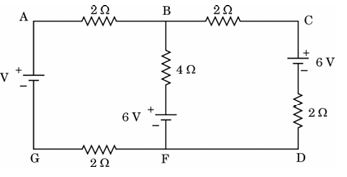
(a) On what factors does the speed of an electromagnetic wave in a medium depend ?
(b) How is an electromagnetic wave produced ?
(c) Sketch a schematic diagram depicting the electric and magnetic
fields for an electromagnetic wave propagating along z-axis.
A 100-turn coil of radius 1.6 cm and resistance 5.0 Ω is co-axial with a solenoid of 250 turns/cm and radius 1.8 cm. The solenoid current drops from 1.5 A to zero in 25 ms. Calculate the current induced in the coil in this duration. (Take π²= 10)
Two long, straight, parallel conductors carry steady currents in opposite directions. Explain the nature of the force of interaction between them. Obtain an expression for the magnitude of the force between the two conductors. Hence define one ampere.
Using Bohr's postulates, derive the expression for the radius of the nᵗʰorbit of an electron in a hydrogen atom. Also find the numerical value of Bohr's radius a₀.
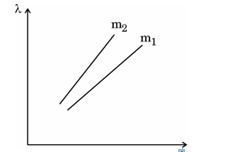
The de Broglie wavelength λ as a function of 1/√K, for two particles of masses m₁ and m₂ are shown in the figure. Here, K is the energy of the moving particles.
(a) What does the slope of a line represent ?
(b) Which of the two particles is heavier ?
(c) Is this graph also valid for a photon ?
Justify your answer in each case.
Obtain an expression for the torque 𝐫⃗ acting on a current carrying loop in a uniform magnetic field 𝐁⃗. Draw the necessary diagram.
Section E
(i) State Gauss's Law in electrostatics. Apply this to obtain the electric field 𝐄⃗ at a point near a uniformly charged infinite plane sheet.
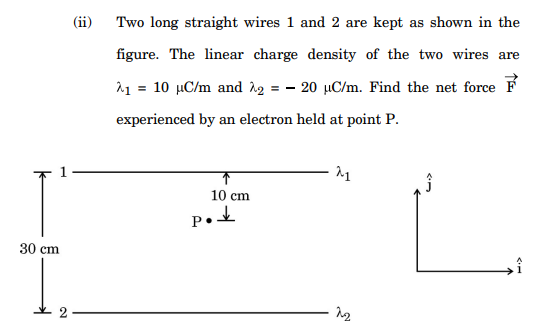
(ii) Two long straight wires 1 and 2 are kept as shown in the figure. The linear charge density of the two wires are λ₁ = 10 μC/m and λ₂ = 20 μC/m. Find the net force 𝐅⃗ experienced by an electron held at point P.
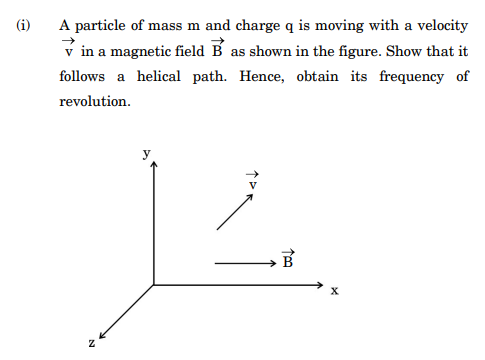
(i) A particle of mass m and charge q is moving with a velocity 𝐯⃗ in a magnetic field 𝐁⃗ as shown in the figure. Show that it follows a helical path. Hence, obtain its frequency of revolution.
(ii) In a hydrogen atom, the electron moves in an orbit of radius 2 Å making 8 *10¹⁴ revolutions per second. Find the magnetic moment associated with the orbital motion of the electron.
(i) Give any two differences between the interference pattern obtained in Young's double-slit experiment and a diffraction pattern due to a single slit.
(ii) Draw an intensity distribution graph in case of a double-slit interference pattern.
(iii) In Young's double-slit experiment using monochromatic light of wavelength λ , the intensity of light at a point on the screen, where path difference is λ , is K units. Find the intensity of light at a point on the screen where the path difference is λ/6.
(i) Obtain an expression for the electric potential due to a small dipole of dipole moment 𝐩⃗, at a point 𝐫⃗ from its centre, for much larger distances compared to the size of the dipole.
(ii) Three point charges q, 2q and nq are placed at the vertices of an equilateral triangle. If the potential energy of the system is zero, find the value of n.
(i) Draw a labelled ray diagram of a compound microscope showing image formation at least distance of distinct vision. Derive an expression for its magnifying power.
(ii) A telescope consists of two lenses of focal length 100 cm and 5 cm. Find the magnifying power when the final image is formed at infinity.
i) What is current sensitivity of a galvanometer ? Show how the current sensitivity of a galvanometer may be increased. "Increasing the current sensitivity of a galvanometer may not necessarily increase its voltage sensitivity" Explain.
(ii) A moving coil galvanometer has a resistance 15 Ω and takes 20 mA to produce full scale deflection. How can this galvanometer be converted into a voltmeter of range 0 to 100 V?
Paper Details
CBSE Board Exam 2024
Class
Class 12 PCM
Subject
Physics
Year
2024
Set
Set 2
Other Years — Physics