QUESTION PAPER
2024 BOARD EXAM
CBSE Class 12 PCM Physics Board Paper 2024 — Set 3
2024
Physics
Class 12 PCM
CBSE EXAMINATION PAPER-2024
PHYSICS
(Solved)
General Instructions :
Read the following instructions carefully and follow them :
- This question paper contains 38 questions. All questions are compulsory.
- This question paper is divided into 5 sections.
- Section A – questions number 1 to 2 are case based questions
- Section B – questions number 3 to 18 are multiple choice questions
- Section C – questions number 19 to 24 are very short answer
- Section D – questions number 25 to 32 are short answer
- Section E – questions number 33 to 38 are long answer
- There is no overall choice given in the question paper. However, an internal choice has been provided in few questions.
- Use of calculator is NOT allowed.
Section A
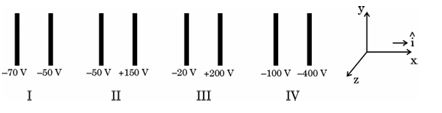
(1) For which pair of the plates is the electric field 𝐄⃗ along 𝑖̂? a) I b) II c) III d) IV
(2) Let V₀ be the potential at the left plate of any set, taken to be at x = 0 m. Then potential V at any point (0 ≤ x ≤ 2 cm) between the plates of that set can be expressed as: (A) V = V₀ + αx (B) V = V₀ + αx² (C) V = V₀ + αx¹ᐟ² (D) V = V₀ + αx³ᐟ² where α is a constant, positive or negative.
(3) a) Let E₁, E₂, E₃ and E₄ be the magnitudes of the electric field between the pairs of plates, I, II, III and IV respectively. Then: (A) E₁ > E₂ > E₃ > E₄ (B) E₃ > E₄ > E₁ > E₂ (C) E₄ > E₃ > E₂ > E₁ (D) E₂ > E₃ > E₄ > E₁
(4) An electron is released midway between the plates of pair IV. It will: (A) move along 𝑖̂ at constant speed (B) move along -𝑖̂ at constant speed (C) accelerate along 𝑖̂ (D) accelerate along-𝑖̂
(5) An electron is projected from the right plate of set I directly towards its left plate. It just comes to rest at the plate. The speed with which it was projected is about : (Take (e/m) =1.76 10¹¹ C/kg) (A) 1.3 *10⁵ m/s (B) 2.6 *10⁶ m/s (C) 6.5* 10⁵ m/s (D) 5.2 *10⁷ m/s
Diffraction and interference are closely related phenomena that occur together. Diffraction is the phenomenon of bending of light around the edges of the obstacle, while interference is the combination of waves that results in a new wave pattern. In order to get interference, there must be at least two waves that are diffracting. So while diffraction can occur without interference, interference cannot occur without diffraction.
Two slits of width 2 μm each in an opaque material are separated by a distance of 6 μm. Monochromatic light of wavelength 450 nm is incident normally on the slits. One finds a combined interference and diffraction pattern on the screen.
(1) The number of peaks of the interference fringes formed within the central peak of the envelope of the diffraction pattern will be : (A) 2 (B) 3 (C) 4 (D) 6
(2) If instead of 450 nm light, another light of wavelength 680 nm is used, the number of peaks of the interference formed in the central peak of the envelope of the diffraction pattern will be: (A) 2 (B) 4 (C) 6 (D) 9
(3) The number of bright fringes formed due to interference on 1 m of screen placed at 4/3m away from the slits is : (A) 2 (B) 3 (C) 6 (D) 10
(4) The number of peaks of the interference formed if the slit width is doubled while keeping the distance between the slits same will be : (A) 1 (B) 2 (C) 3 (D) 4
(5) Consider the diffraction of light by a single slit described in this case study. The first minimum falls at an angle θ equal to : (A) sin⁻¹ (0.12) (B) sin⁻¹ (0.225) (C) sin⁻¹ (0.32) (D) sin⁻¹ (0.45)
Section B
Consider a group of charges q₁, q₂, q₃,.. such that Σq ≠ 0. Then equipotentials at a large distance, due to this group are approximately :
A proton is taken from point P₁ to point P₂, both located in an electric field. The potentials at points P₁ and P₂ are -5 V and +5 V respectively. Assuming that kinetic energies of the proton at points P₁ and P₂ are zero, the work done on the proton is:
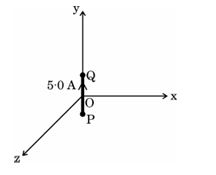
A 2.0 cm segment of wire, carrying 5.0. A current in positive y-direction lies along y-axis, as shown in the figure. The magnetic field at a point (3 m, 4 m, 0) due to this segment (part of a circuit) is :
A circular loop of wire, carrying a current 'I' is lying in xy plane with its centre coinciding with the origin. It is subjected to a uniform magnetic field pointing along +z-axis. The loop will:
A current carrying circular loop of magnetic moment 𝐌⃗ is suspended in a vertical plane in an external magnetic field 𝐁⃗such that its plane is normal to 𝐁⃗. The work done in rotating this loop by 45 degrees about an axis perpendicular to 𝐁⃗ is closest to :
The current in a coil of 15 mH increases uniformly from zero to 4 A in 0.004 s. The emf induced in the coil will be:
Consider a solenoid of length l and area of cross-section A with fixed number of turns. The self-inductance of the solenoid will increase if:
A proton and an alpha particle having equal velocities approach a target nucleus. They come momentarily to rest and then reverse their directions. The ratio of the distance of closest approach of the proton to that of the alpha particle will be:
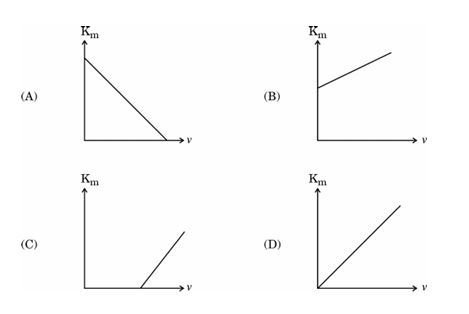
Which one of the following is the correct graph between the maximum kinetic energy (Kₘ) of the emitted photoelectrons and the frequency of incident radiation (ν) for a given photosensitive surface?
Si is doped with a pentavalent element. The energy required to set the additional electron free is about:
Assertion (A): In a semiconductor, the electrons in the conduction band have lesser energy than those in the valence band.
Reason (R): Donor energy level is just above the valence band in a semiconductor.
Assertion (A): Photoelectric effect demonstrates the particle nature of light.
Reason (R): Photoelectric current is proportional to frequency of incident radiation.
Assertion (A): A proton and an electron enter a uniform magnetic field 𝐁⃗ with the same momentum 𝐩⃗ such that 𝐩⃗ is perpendicular to 𝐁⃗. They describe circular paths of the same radius.
Reason (R): In a magnetic field, orbital radius r is equal to p/qB.
Assertion (A): A convex lens, when immersed in a liquid, disappears.
Reason (R): The refractive indices of the material of the lens and the liquid are equal.
Section C
What is meant by relaxation time of free electrons in a conductor? Show that the resistance of a conductor can be expressed by R =ml/ne² τA, where symbols have their usual meanings.
The magnifying power of an astronomical telescope is 24. In normal adjustment, distance between its two lenses is 150 cm. Find the focal length of the objective lens.
Explain the following :
a) For a simple microscope, the angular size of the object equals the angular size of the image. Yet it offers magnification.
b) Both plane and convex mirrors produce virtual images of objects. Can they produce real images under some circumstances ?
The minimum intensity of white light that our eyes can perceive is about 0.1 nW/m⁻². Calculate the number of photons of this light entering our pupil (area 0.4 cm²) per second.
( take average wavelength of white light =500nm and Planck's constant = 6.6 * 10⁻³⁴ Js)
Suppose a pure Si crystal has 5 × 10²⁸ atoms/m-³. It is doped by 1 ppm concentration of boron. Calculate the concentration of holes and electrons, given that nᵢ = 1.5 × 10¹⁶ m⁻³. Is the doped crystal n-type or p-type?
Draw the circuit diagram of a Wheatstone bridge. Obtain the condition when no current flows through the galvanometer in it.
Section D
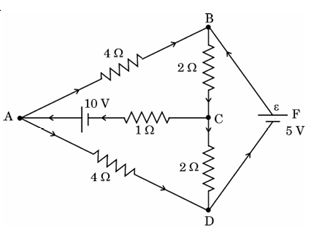
A sinusoidal voltage is applied to an electric circuit containing a circuit element 'X' in which the current leads the voltage by π/2
(a) Identify the circuit element 'X' in the circuit.
(b) Write the formula for its reactance.
(c) Show graphically the variation of this reactance with frequency of ac voltage.
(d) Explain the behaviour of this element when it is used in (i) an ac circuit, and (ii) a dc circuit.
The electric field in an electromagnetic wave in vacuum is given by:
𝐄⃗= (6.3 N/C) [cos (1.5 rad/m) y + (4.5 × 10⁸ rad/s) t] î.
(a) Find the wavelength and frequency of the wave.
(b) What is the amplitude of the magnetic field of the wave ?
(c) Write an expression for the magnetic field of this wave.
State Bohr's first and second postulates. Use them to derive an expression for the radius of the nᵗʰ orbit in a hydrogen atom.
a) Define atomic mass unit (u).
b) Calculate the energy required to separate a deuteron into its constituent parts (a proton and a neutron). Given:
m(D) = 2.014102 u,
m_H = 1.007825 u,
mₙ = 1.008665 u.
Draw the circuit diagrams for obtaining the V-I characteristics of a p-n junction diode. Explain briefly the salient features of the V-I characteristics in (i) forward biasing, and (ii) reverse biasing.
On the basis of energy band diagrams, distinguish between (i) an insulator, (ii) a semiconductor, and (iii) a conductor.
Section E
(i) Obtain the expression for the capacitance of a parallel plate capacitor with a dielectric medium between its plates.
(ii) A charge of 6 μC is given to a hollow metallic sphere of radius 0.2 m. Find the potential at (i) the surface and (ii) the centre of the sphere.
(i) (1) What is meant by current sensitivity of a galvanometer ? Mention the factors on which it depends.
(2) A galvanometer of resistance G is converted into a voltmeter of range (0-V) by using a resistance R. Find the resistance, in terms of R and G, required to convert it into a voltmeter of range (0-V/2)
(ii) The magnetic flux through a coil of resistance 5 Ω increases with time as : φ= (2.0 t³ + 5.0 t² + 6.0 t) mWb
Find the magnitude of induced current through the coil at t = 2 s.
(i) Trace the path of a ray of light showing refraction through a triangular prism and hence obtain an expression for angle of deviation (δ) in terms of A, i and e, where symbols have their usual meanings. Draw a graph showing the variation of angle of deviation with the angle of incidence.
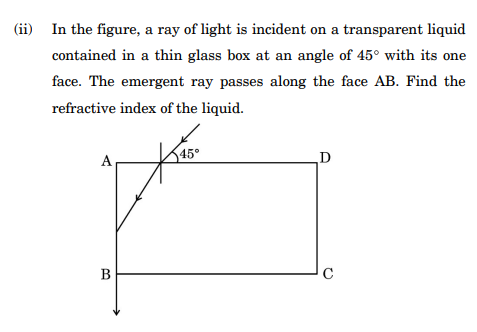
(ii) In the figure, a ray of light is incident on a transparent liquid contained in a thin glass box at an angle of 45° with its one face. The emergent ray passes along the face AB. Find the refractive index of the liquid.
(i) A charge + Q is placed on a thin conducting spherical shell of radius R. Use Gauss's theorem to derive an expression for the electric field at a point lying (i) inside and (ii) outside the shell.
(ii) Show that the electric field for same charge density (σ) is twice in case of a conducting plate or surface than in a nonconducting sheet.
(i) A rectangular coil of N turns and area of cross-section A is rotated at a steady angular speed ω in a uniform magnetic field. Obtain an expression for the emf induced in the coil at any instant of time.
(ii) Two coplanar and concentric circular loops L₁ and L₂ are placed coaxially with their centres coinciding. The radii of L₁ and L₂ are 1 cm and 100 cm respectively. Calculate the mutual inductance of the loops. (Take π² = 10)
(i) The displacement of two light waves, each of amplitude 'a' and frequency ω, emanating from two coherent sources of light, are given by y₁ = a cos ωt and y₂ = a cos ( ωt +φ ). φ is the phase difference between the two waves. These light waves superpose at a point. Obtain the expression for the resultant intensity at that point.
(ii) In Young's double slit experiment, find the ratio of intensities at two points on a screen when waves emanating from two slits reaching these points have path differences (i) λ/6 (ii) λ/12 .
Paper Details
CBSE Board Exam 2024
Class
Class 12 PCM
Subject
Physics
Year
2024
Set
Set 3
Other Years — Physics